
Welcome to the virtual case of Colombian notaphily. This collection documents the country’s paper money — from the emergency issues of independence through free banking to the consolidation of the Banco de la República — as records of monetary sovereignty, not as merchandise.
Paper money in Colombia was born from the urgency of independence, not from a central bank. Hernández (8th ed., 2023) lists first a 2-reales of 1812 printed at Mompós — the only example he records — then the 1-real of 1813; Banrepcultural’s encyclopedia identifies that Gutiérrez de Piñeres 1-real, signed by hand on ordinary paper. Cundinamarca followed the next year with treasury vales. Gran Colombia’s drafts, engraved by Peter Maverick in New York, were never issued. A public used to gold and silver distrusted those papers. After the 1815 reconquest many were destroyed; survivors are extremely rare.
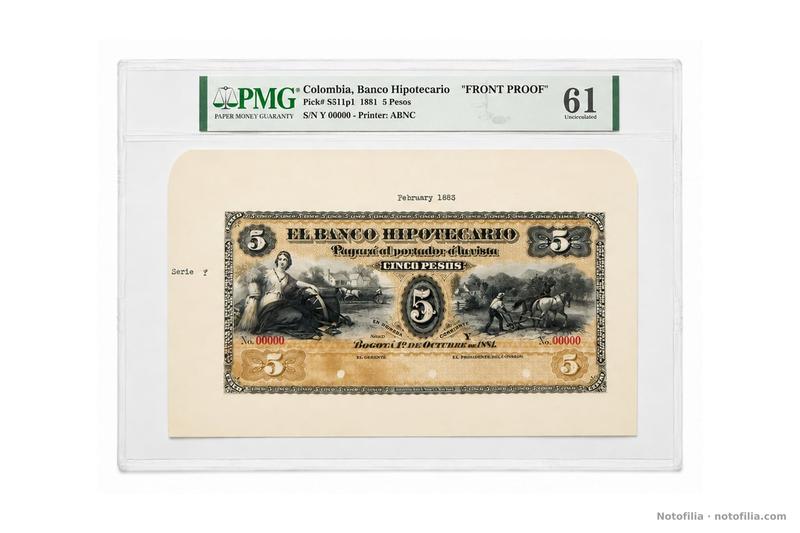
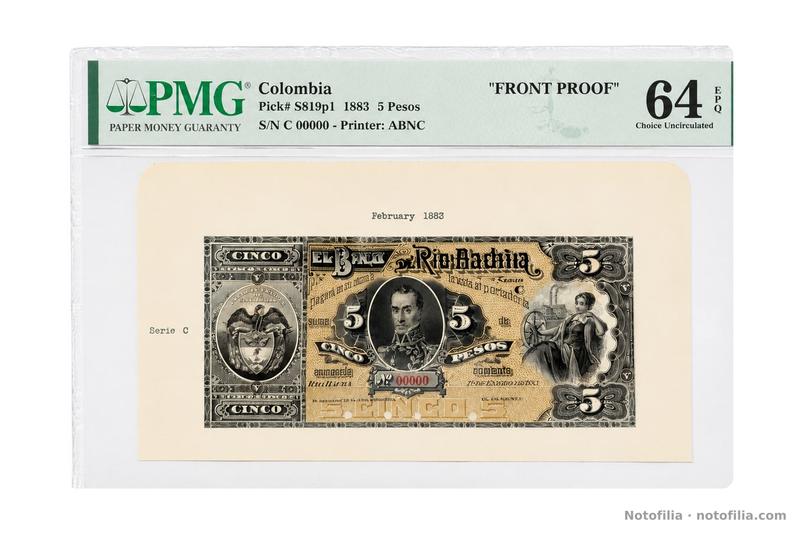
The modern note arrived in the 1870s with free banking. Law 35 of 1865 opened convertible issue. The Banco de Bogotá was constituted on 15 November 1870 and was the first private issuer the market broadly accepted. Moving specie across the highlands was costly and dangerous; more than three dozen regional banks — Antioquia, Colombia, Bolívar, Medellín, Pamplona, the Norte, the Cauca, the Hipotecario, Riohacha — covered local credit with their own paper, fractionals included, engraved in New York and London. Those issues, with proofs and specimens, are the historical core of this case. Free banking opens with the ABNC proofs of the Banco Hipotecario of Bogotá (1881) and the Riohacha 5 pesos (1883).
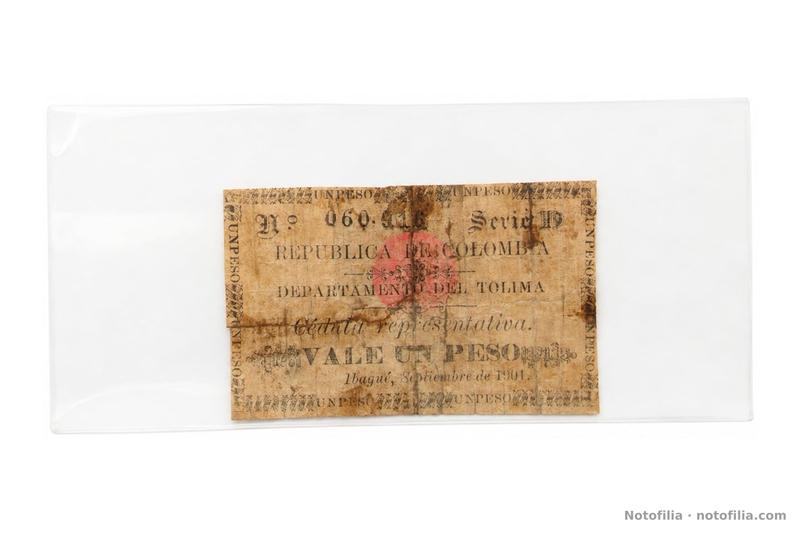
In 1880–1881, under Rafael Núñez’s Regeneración, the Banco Nacional was born (Law 39 of 1880): to handle state funds, issue notes, and lend to the treasury. At first it coexisted with private issues. In 1886 the government ended convertibility: Decree 104 and Law 87 made the paper peso the forced-tender monetary unit. Law 57 of 1887 suspended private banks’ right to issue while the Nacional held the exclusive privilege. A lax, untransparent issuing policy depreciated the bill; for those excesses, Law 70 of 1894 ordered the institute liquidated. Astrid Romero places the final closure on 1 January 1896. The Thousand Days’ War (1899–1902) set off another surge of unbacked paper — from the government and from regional commanders — and a devastating inflation. The Casa de Moneda Museum records Gobierno Provisional notes from Ocaña (1900) and Nacional overstamps on private paper. In 1909 the Conversion Board rated 100 paper pesos to 1 gold peso. Even in the early 1910s old Nacional bills were still in circulation. This case documents a one-peso cédula representativa of the Departamento del Tolima, Ibagué, September 1901, serial N.º 060.416, Series D (Hernández Cód. 1242).
To stabilize the postwar economy, Rafael Reyes created the Banco Central de Colombia in 1905. It was a short-lived issuer: in 1909, after Reyes fell, its privilege of issue was withdrawn. It is not the bank of 1923. In 1922 the Conversion Board was authorized to overstamp treasury bonds (Law 5, Decree 165, deed 206) before the institute opened. Law 25 of 1923, the fruit of the Kemmerer Mission — the “money doctor” hired by Pedro Nel Ospina — created the Banco de la República with mixed capital, 10 million gold pesos, and the monopoly of legal-tender issue. A run on the Banco López brought the opening forward to 23 July 1923: Medellín gold certificates came by rail, flying boat, and train and were overstamped over a weekend as provisional notes. The first regular issues were engraved by the American Bank Note Company; the paper was called peso oro to signal convertibility. Gold convertibility ended in 1931. After the war with Peru (1932) pesos plata circulated. Thomas De La Rue printed at mid-century. On 23 October 1959 the Imprenta de Billetes opened in Bogotá, with the blue 1-peso (Pick 404). The 1963 Monetary Board and Law 31 of 1992 reordered the bank’s authority; in 1973 the state nationalized nearly all the capital. This case documents the 1953 Treasury ½ peso oro (Pick 345b), serial C5256707, the 1945 1 peso oro (Pick 380d), the 1954 1 peso oro (Pick 380g), the 1959 1 peso oro (Pick 398), serial 60870843, the 1973 1 peso oro (Pick 404e), the 1974 1 peso oro (Pick 404e), the 1943 10 pesos oro (Pick 389b), the 1944 2 pesos oro (Pick 390b), the 1955 2 pesos oro (Pick 390d), the 1977 2 pesos oro (Pick 413b), the 1960 5 pesos oro specimen (Pick 405s), by De La Rue, the 1980 5 pesos oro (Pick 406f / TBB B949p), serial 94658896, the 1979 5 pesos oro replacement (Pick 406f; Hernández 156), serial 00141180, the 1976 10 pesos oro replacement (Pick 407f / TBB B950kr), the 1979 10 pesos oro (Pick 407g), serial 98040194, the 1983 20 pesos oro (Pick 409d), serial 056462955, the 1974 50 pesos oro (Pick 414a / TBB B953b), serial 2467354822, the 1984 50 pesos oro (Pick 425a), serial 0001806322, the 1980 100 pesos oro specimen (Pick 418s), SPECIMEN Nº 027, the 1979 1,000 pesos oro (Pick 421a / TBB B963a), the 1983 2,000 pesos oro specimen (Pick 430as), printed by Thomas De La Rue, the 1993 5,000 pesos oro (Pick 436A / TBB B974c), serial 82210365, the 1994 Emberá 10,000 pesos (Pick 437A / TBB B980az), one record with star serials 00113227 and 00249902, and the 2008 2,000 pesos (Pick 457) with binary radar serial 10000001.
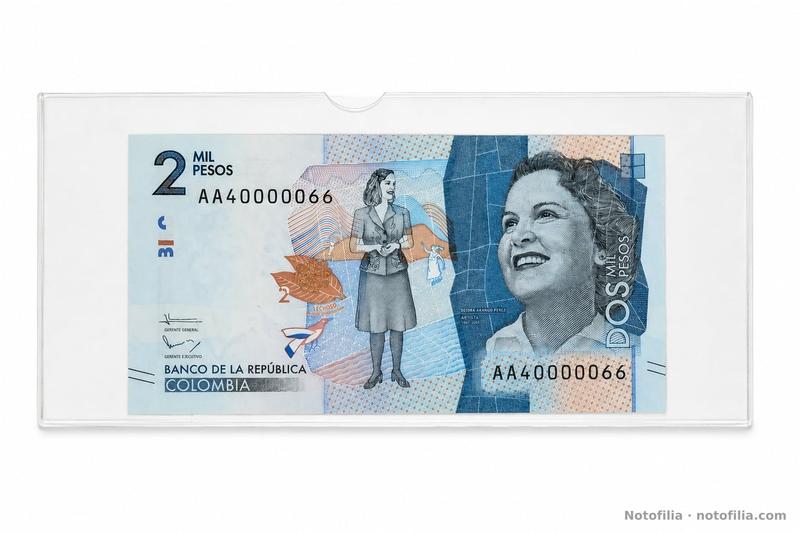
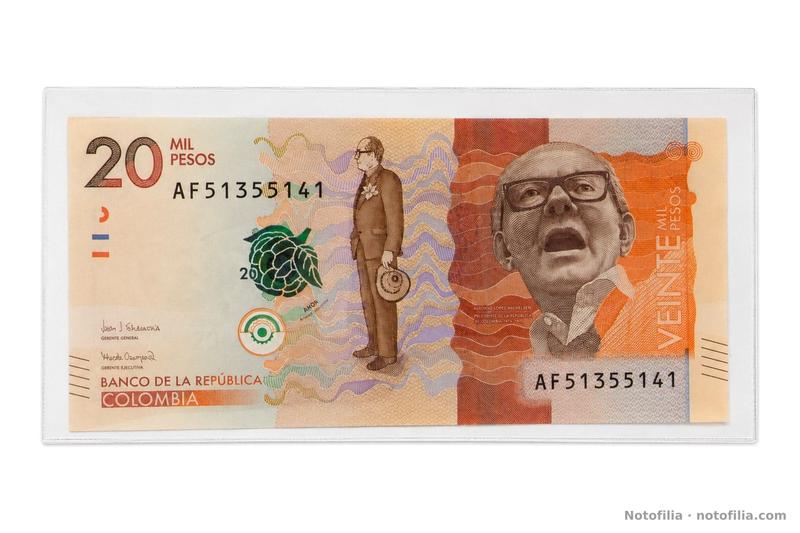
From 1993 the notes dropped the legend “pesos oro.” On 16–17 October 1994 the “robo del siglo” at Valledupar took some 24.072 billion pesos in 2,000, 5,000, and 10,000 notes; the bank published the serial ranges — the “billetes vallenatos” — and, in 1995–1996, replaced those three denominations. In 2016 it put a new family into circulation — 2,000 to 100,000 — with stronger security, statutory homages to López Michelsen and García Márquez, biodiversity, and indigenous cultures. This case documents the 2015 2,000 pesos (Pick 458a / TBB B993a), fancy serial AA40000066, and the 2017 20,000 pesos (Pick 461 / TBB B996c), serial AF51355141.
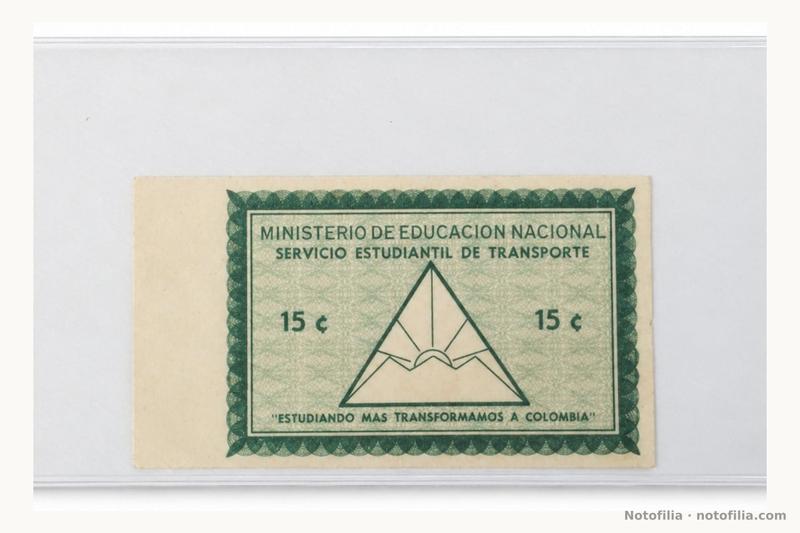
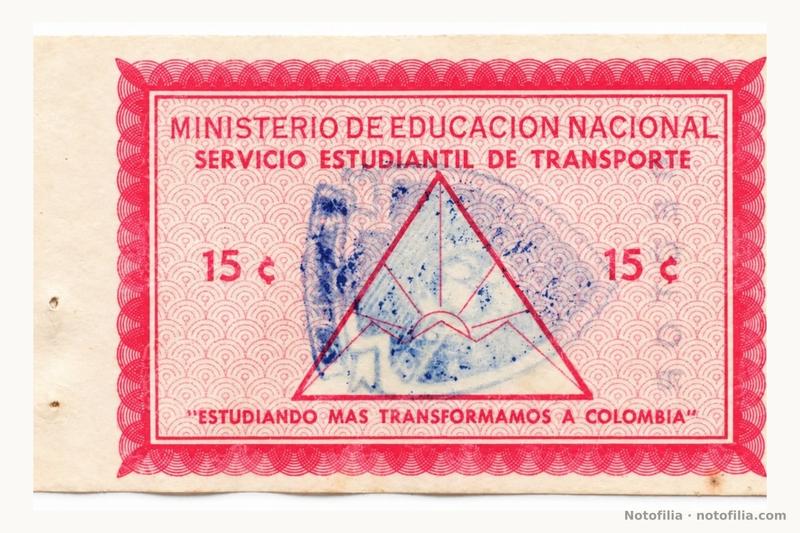
Outside bank paper, this case documents two 15-centavos student-transport tickets of the Ministry of National Education, Student Transportation Service, in green ink and in red ink, with no serial and no printed date. They are not Banco de la República notes.
Coinage from the same periods is documented in the numismatics case. Colombia-Numismatics
1811–1819
Independence
The first emergency papers: Mompós (1812), Cartagena (1813), Cundinamarca, and Gran Colombia’s unissued drafts.
Before a bank of issue existed, patriot provinces paid for war with paper. Hernández (8th ed., 2023) places the first Colombian notes at Mompós: 2 reales of 1812 — the only example he records — equal to a peseta, on ordinary paper; then the 1-real of 1813. Banrepcultural’s encyclopedia records that 1-real signed by hand by Germán Gutiérrez de Piñeres, president of the patriot junta in Cartagena. A hundred reales of that paper traded for sixteen in the market; Hernández allows a possible 1814 issue. Cundinamarca followed in 1814 with General Treasury vales. A public used to gold and silver distrusted those titles; after the 1815 reconquest many were destroyed. After Boyacá (1819), Gran Colombia ordered Peter Maverick, in New York, to engrave drafts of 6, 12, 18, and 30 pesos in sheets of six, redeemable in salt at Zipaquirá, Nemocón, or Tausa. They were never issued: they remain unsigned. Bolívar backed them; Santander opposed them. No lasting national bank was founded before the union dissolved in 1830.
1870–1887
Free banking
Law 35 of 1865, the Banco de Bogotá (1870), and dozens of regional issuers convertible into metal.
Until the mid-nineteenth century, trade still ran on gold, silver, and foreign coin. Mosquera had even ordered treasury notes in the hope of a central bank; the public discounted them and they did not take. Law 35 of 1865 opened private convertible issue. The Banco de Bogotá was constituted on 15 November 1870 — merchants and politicians, a deed at the Second Notary — and was the first private issuer the market broadly accepted: its statutes tied the note to metal in the till. Moving specie across broken country was costly and dangerous; regional banks covered local credit — trade, agriculture, infrastructure — with their own paper, fractionals included. Between 1870 and 1886 more than three dozen were founded. Banks of Antioquia, Colombia, Bolívar, Medellín, Pamplona, the Norte, the Cauca, the Hipotecario of Bogotá, and Riohacha on the Guajira followed. Banrepcultural’s encyclopedia notes that the leading banks ordered printing in England or the United States. Proofs, specimens, and regional issues from that decade belong in this collection.
1880–1903
Banco Nacional
La Regeneración, the 1886 fiat standard, Law 70 of 1894, and the paper of the Thousand Days’ War.
A Banco Nacional was proposed in March 1880; Law 39 of 1880 and its establishment in 1881 made it part of Rafael Núñez and Miguel Antonio Caro’s Regeneración: to handle state funds, issue notes, and lend to the treasury. At first it coexisted with private issues. In 1886 the government ended convertibility of those bills into metal: Decree 104 defined the paper peso as the monetary unit and unit of account, and Law 87 made it forced legal tender — a fiat standard. Law 57 of 1887 regulated banking nationwide and suspended private banks’ right to issue while the Nacional held the exclusive privilege. A lax, untransparent issuing policy depreciated the bill; clandestine issues finished the collapse of confidence. For those excesses, Law 70 of 1894 ordered the institute liquidated and the paper amortized; Astrid Romero places the final closure on 1 January 1896, after about fifteen years. The Thousand Days’ War (1899–1902) set off another surge of unbacked paper — from the government and from regional commanders — and one of the country’s worst inflations. The Casa de Moneda Museum’s permanent-exhibition booklet records Gobierno Provisional notes printed at Ocaña in 1900. The Issue Board even overstamped private-bank paper with the Nacional’s seal. In 1909 the Conversion Board set 100 paper pesos to 1 gold peso. Even in the early 1910s old Banco Nacional bills still made up a large share of the money supply, despite agencies created to convert and retire them. This case documents a one-peso cédula representativa of the Departamento del Tolima, Ibagué, September 1901, serial N.º 060.416, Series D (Hernández Cód. 1242).
1905–1909
Banco Central de Colombia
Reyes, postwar stabilization, and a short-lived bank of issue.
To stabilize the economy after the war, Rafael Reyes’s government created the Banco Central de Colombia in 1905 — Decree 47 of 6 March; the Assembly approved it days later — with issue, giro, and deposit functions in the line of the Nacional. It was short-lived: after Reyes fell, Carlos E. Restrepo’s government revoked its exclusive right of issue in 1909 and organized the Conversion Board. Hernández and Meisel place the end of its role as issuer there; as a private bank it survived until the Banco de Bogotá absorbed it in 1928. It is not the Banco de la República of 1923.
1909–1923
Conversion Board
Retire Regeneración paper and introduce the American 1915 edition.
After Reyes’s Banco Central, Carlos E. Restrepo’s government created the Conversion Board in 1909 to retire the depreciated paper mass and, as far as possible, replace it with gold and backed notes. Hernández (8th ed., 2023) places that task beside state revenues; the First World War interrupted the plan and the government seized the Board’s metal. What did circulate was the exchange of the English 1904 edition — Waterlow & Sons, the so-called Próceres — for the American Bank Note Company edition. The issue dated 20 July 1915 stands out: 1 peso, 2 pesos (Antonio Nariño), 5 pesos (José María Córdova), and 10 pesos (Francisco de Paula Santander). Hernández also records 50- and 100-peso notes of August 1910. Some of those types remained accepted — sometimes overstamped — in the early years of the Banco de la República. In 1922 the same Board — Law 5, Decree 165, and deed 206 at Bogotá’s Third Notary — was authorized to issue and retire two treasury bonds overstamped on the back, before the 1923 institute opened. This case does not yet publish an example of that issue; the chapter is historical framing.
from 1923
Banco de la República
Law 25 of 1923, the Kemmerer Mission, the gold peso, 1923 provisionals, 1932 silver pesos, ABNC, De La Rue, and the Imprenta de Billetes.
After years of financial crises, Pedro Nel Ospina’s government asked an expert committee to study and reform the country’s economic conditions. In 1922 the Conversion Board — Law 5, Decree 165, and deed 206 at Bogotá’s Third Notary — was authorized to issue and retire two treasury bonds overstamped on the back, before the Banco de la República was created. In March 1923 it hired Edwin W. Kemmerer, the American economist widely known as a “money doctor.” Law 25 of 1923, on his recommendations, created the Banco de la República as a mixed-capital company — government and commercial banks — with 10 million gold pesos and the exclusive right to issue legal tender. It was to open in January 1924; a run on the Banco López brought the doors forward to 23 July 1923. President Ospina had gold certificates engraved by the American Bank Note Company flown from the Medellín mint — rail to Puerto Berrío, flying boat to Girardot, train to Bogotá — and, over a weekend, they were overstamped on the back “BANCO DE LA REPÚBLICA — BILLETE PROVISIONAL.” The museum booklet also records a 2½-peso provisional. The regular pesos-oro series — the paper was so named to signal its backing and its convertibility — followed from New York; the 1-peso of that family was printed through 1977. In 1931 the bank took control of the metal and convertibility ended. After the war with Peru (1932) issues in pesos plata appeared beside heavy 50-centavo coinage. In the Second World War 1-peso notes were cut and overstamped as ½ peso; in 1948 the Treasury issued its own ½ peso. Mid-century Thomas De La Rue printed alongside ABNC. On 23 October 1959 the Imprenta de Billetes opened in Bogotá; its first job was the blue 1-peso (Pick 404). The 5-peso of 1961–1981 carries the walls of Cartagena. In 1951, after recommendations by Richard Grove and Gerald Alter, the legislature gave monetary and credit authority to the Board; in 1963 that policy passed to the Monetary Board and the bank became the executor. In 1973 the state bought nearly all private shares (Law 7). The 1991 Constitution and Law 31 of 1992 restored the Board’s autonomy from the executive, with a mandate to preserve purchasing power. This case documents the 1953 Treasury ½ peso oro (Pick 345b), serial C5256707, the 1945 1 peso oro (Pick 380d), the 1954 1 peso oro (Pick 380g), the 1959 1 peso oro (Pick 398), serial 60870843, the 1973 1 peso oro (Pick 404e), the 1974 1 peso oro (Pick 404e), the 1943 10 pesos oro (Pick 389b), the 1944 2 pesos oro (Pick 390b), the 1955 2 pesos oro (Pick 390d), the 1977 2 pesos oro (Pick 413b), the 1960 5 pesos oro specimen (Pick 405s), by De La Rue, the 1980 5 pesos oro (Pick 406f / TBB B949p), serial 94658896, the 1979 5 pesos oro replacement (Pick 406f; Hernández 156), serial 00141180, the 1976 10 pesos oro replacement (Pick 407f / TBB B950kr), the 1979 10 pesos oro (Pick 407g), serial 98040194, the 1983 20 pesos oro (Pick 409d), serial 056462955, the 1974 50 pesos oro (Pick 414a / TBB B953b), serial 2467354822, the 1984 50 pesos oro (Pick 425a), serial 0001806322, the 1980 100 pesos oro specimen (Pick 418s), SPECIMEN Nº 027, the 1979 1,000 pesos oro (Pick 421a / TBB B963a), the 1983 2,000 pesos oro specimen (Pick 430as), by De La Rue, the 1993 5,000 pesos oro (Pick 436A / TBB B974c), serial 82210365, the 1994 Emberá 10,000 pesos (Pick 437A / TBB B980az), one record with star serials 00113227 and 00249902, and the 2008 2,000 pesos (Pick 457) with binary radar serial 10000001.
-
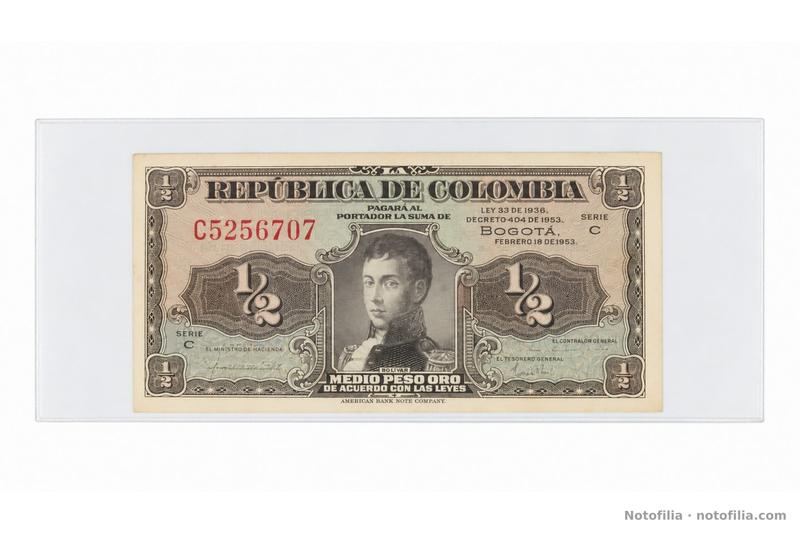
Half peso oro · Republic of Colombia · 1953
Pick P# 345b · Serial C 5256707
Open the note page → -
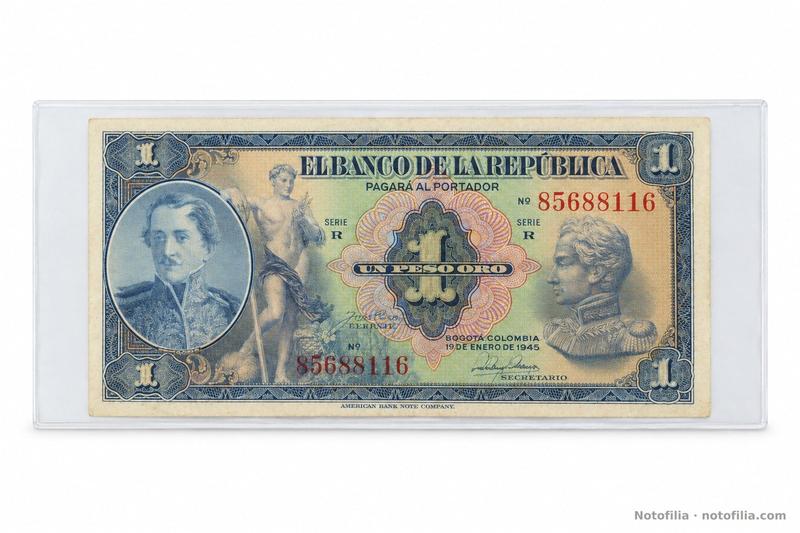
1 peso oro · Banco de la República · 1945
Pick P# 380d · TBB B922f · Serial R 85688116
Open the note page → -
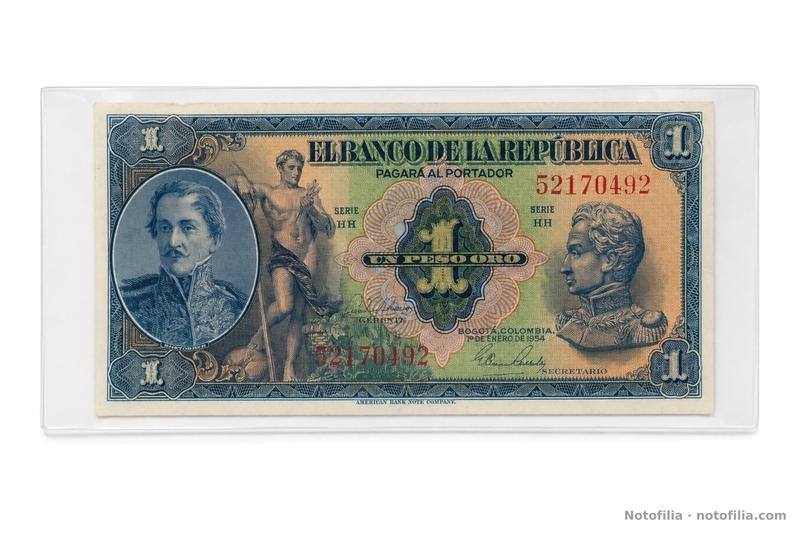
1 peso oro · Banco de la República · 1954
Pick P# 380g · TBB B922k · Serial HH 52170492
Open the note page → -
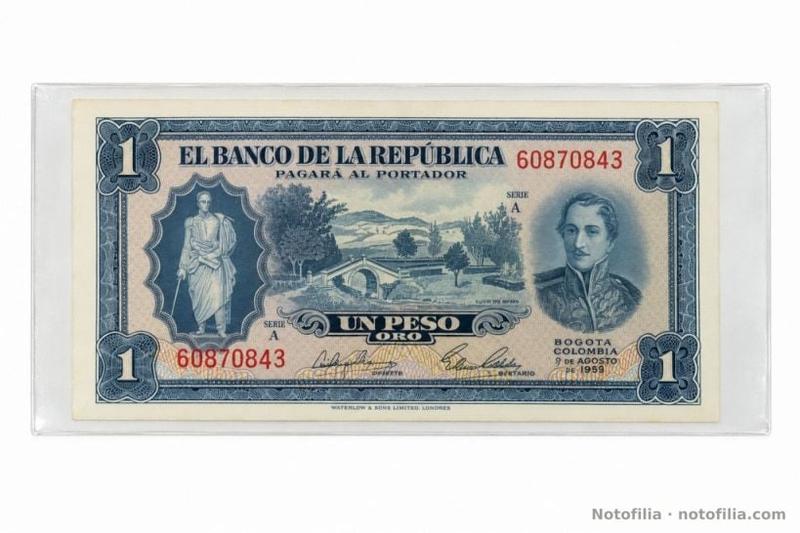
1 peso oro · Banco de la República · 1959
Pick P# 398 · TBB B938 · Serial A 60870843
Open the note page → -
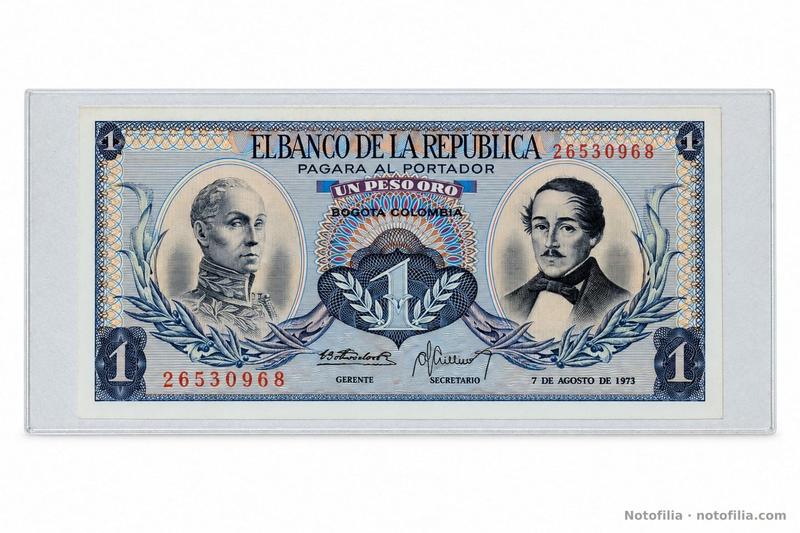
1 peso oro · Banco de la República · 1973
Pick P# 404e · Serial 26530968
Open the note page → -
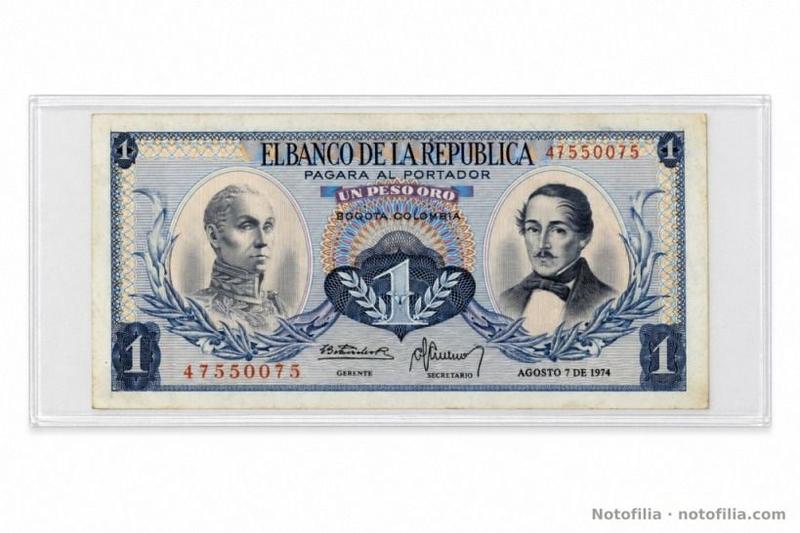
1 peso oro · Banco de la República · 1974
Pick P# 404e · Serial 47550075
Open the note page → -
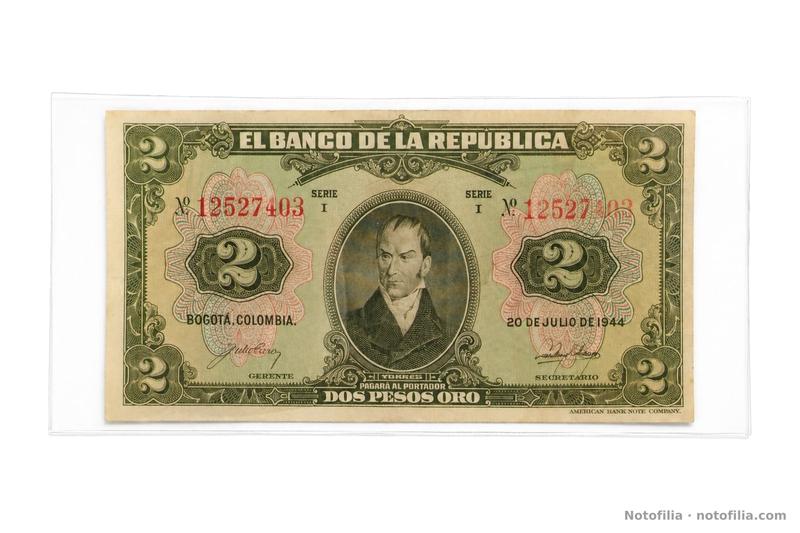
2 pesos oro · Banco de la República · 1944
Pick P# 390b · TBB B923c · Serial I 12527403
Open the note page → -
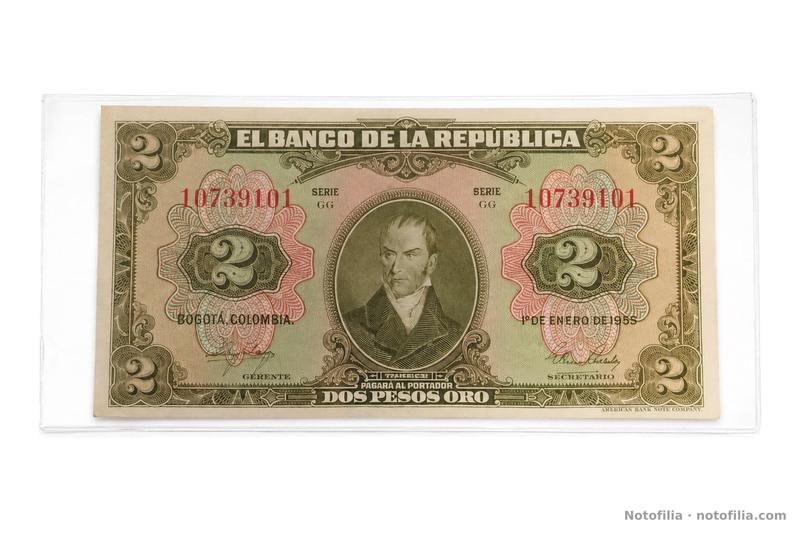
2 pesos oro · Banco de la República · 1955
Pick P# 390d · TBB B923g · Serial GG 10739101
Open the note page → -
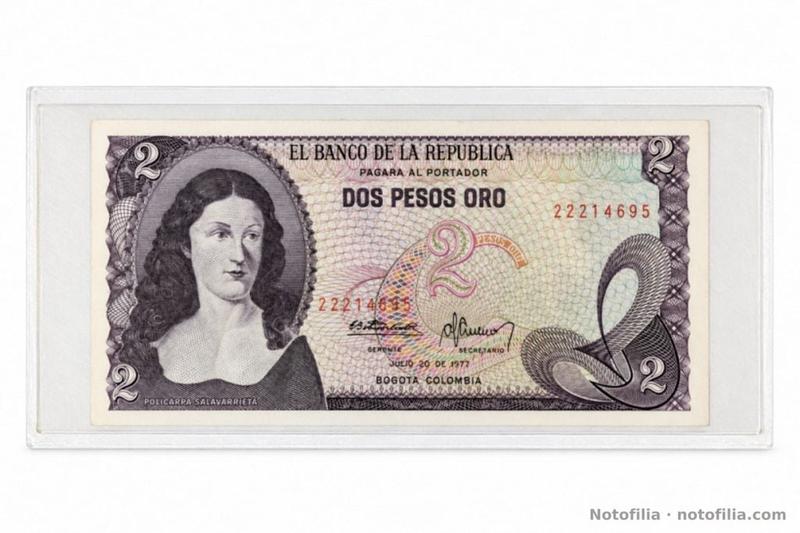
2 pesos oro · Banco de la República · 1977
Pick P# 413b · Serial 22214695
Open the note page → -
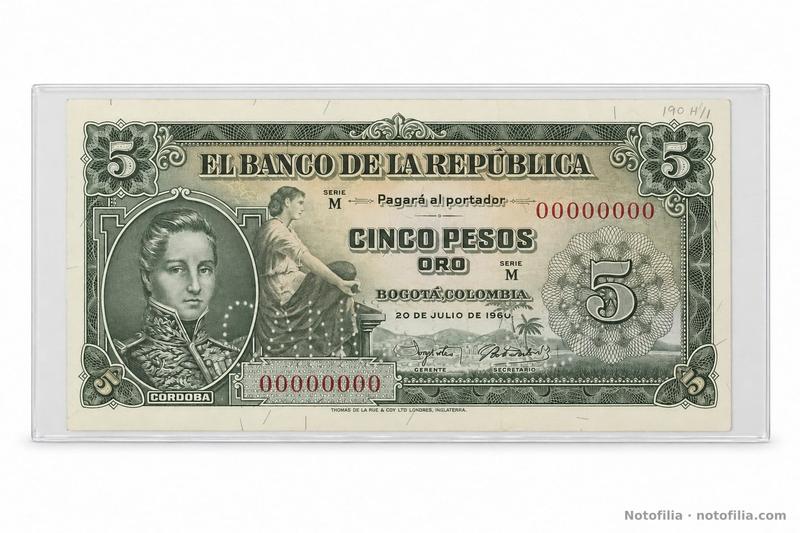
5 pesos oro · specimen · 1960
Pick P# 405s · Serial 00000000
Open the note page → -
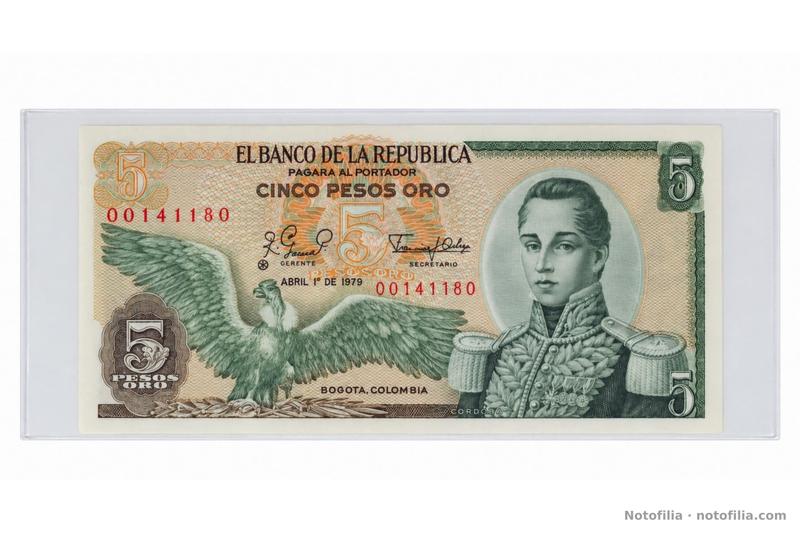
5 pesos oro · replacement · 1979
Pick P# 406f · Hernández 156 · Serial 00141180
Open the note page → -
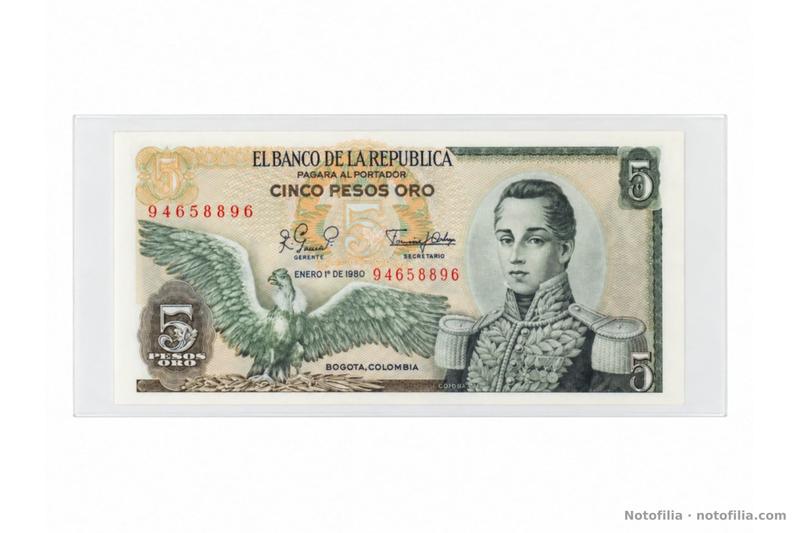
5 pesos oro · 1980
Pick P# 406f · TBB B949p · Serial 94658896
Open the note page → -
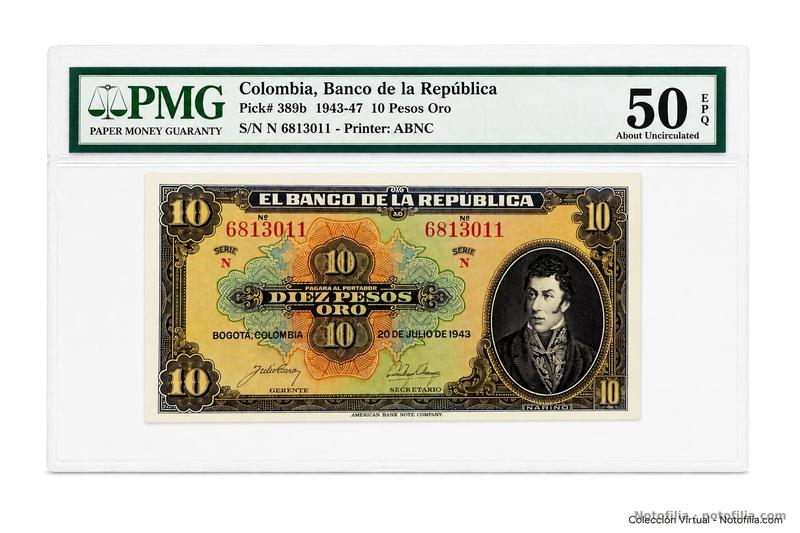
10 pesos oro · Banco de la República · 1943
Pick P# 389b · Serial N 6813011
Open the note page → -
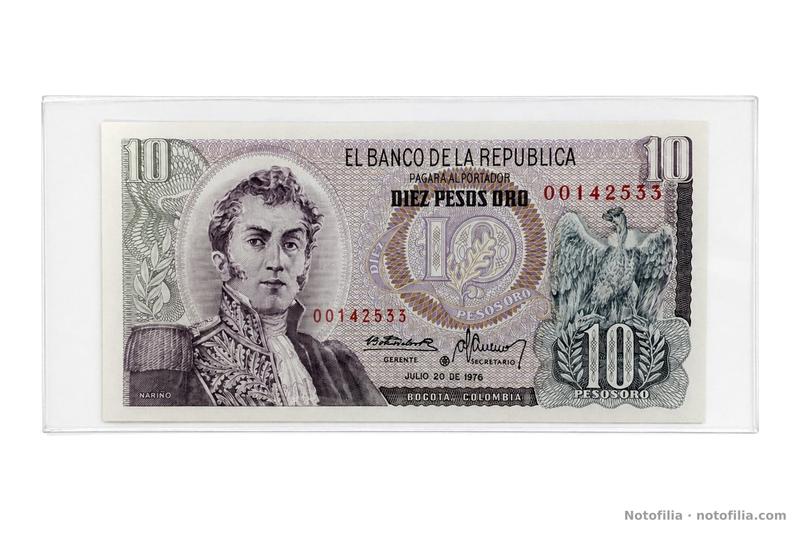
10 pesos oro · replacement · 1976
Pick P# 407f · TBB B950kr · Serial 00142533
Open the note page → -
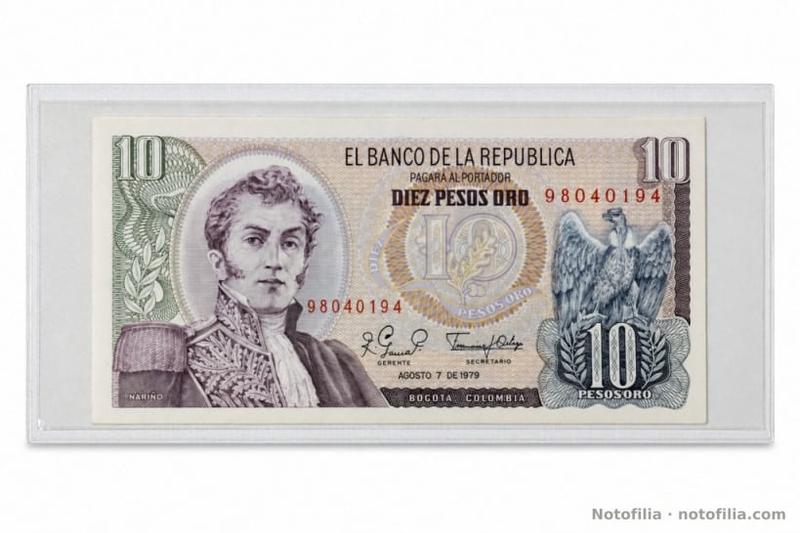
10 pesos oro · Banco de la República · 1979
Pick P# 407g · TBB B950m · Serial 98040194
Open the note page → -
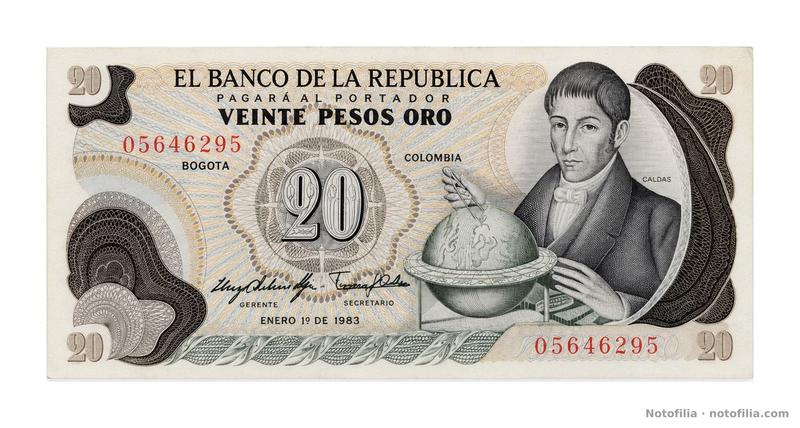
20 pesos oro · Banco de la República · 1983
Pick P# 409d · TBB B951l · Serial 056462955
Open the note page → -
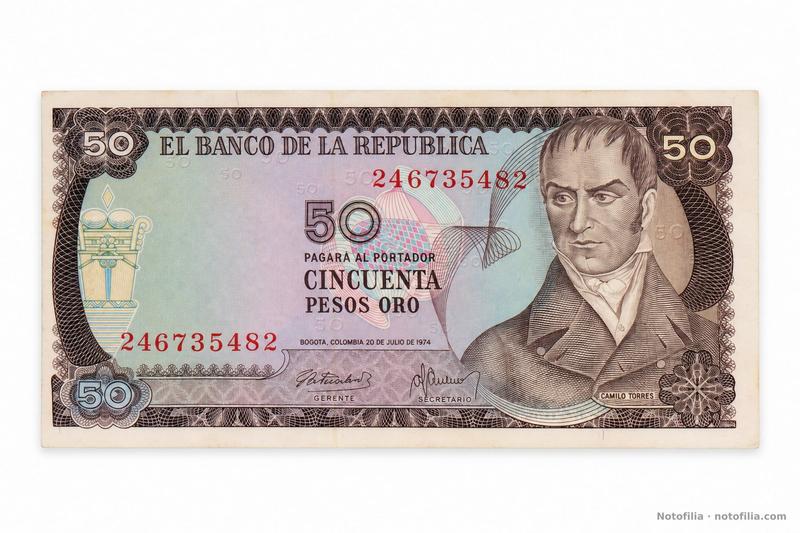
50 pesos oro · 1974
Pick P# 414a · TBB B953b · Serial 2467354822
Open the note page → -
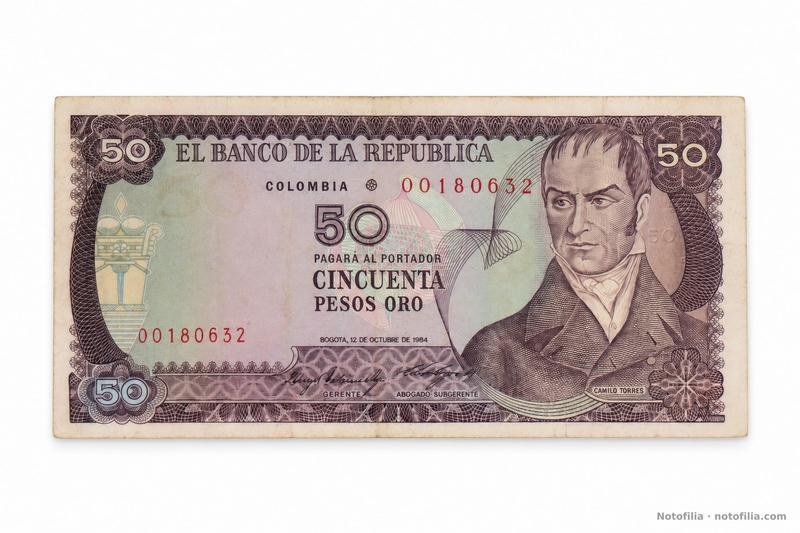
50 pesos oro · 1984
Pick P# 425a · Serial 0001806322
Open the note page → -
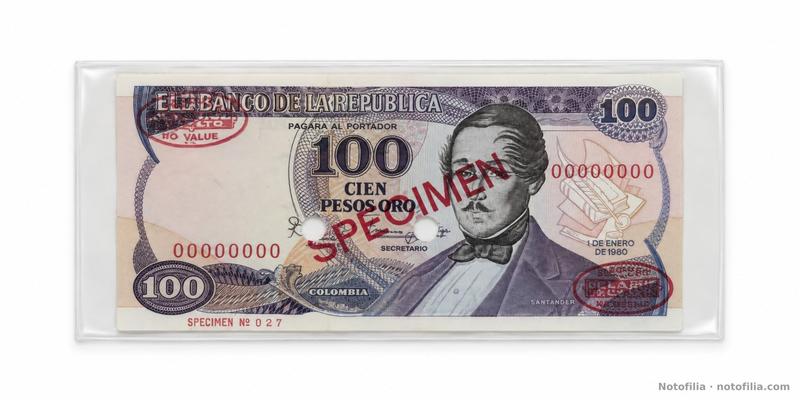
100 pesos oro · specimen · 1980
Pick P# 418s · Serial 00000000 · SPECIMEN Nº 027
Open the note page → -
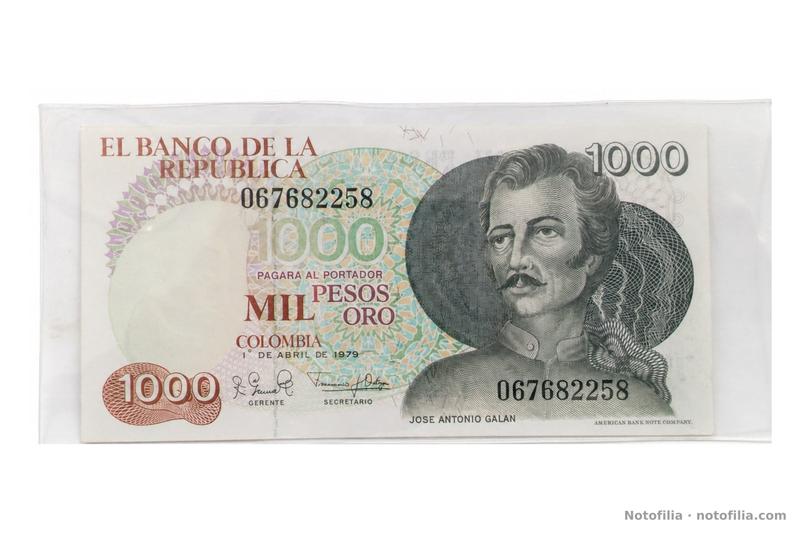
1,000 pesos oro · Banco de la República · 1979
Pick P# 421a · TBB B963a · Serial 067682258
Open the note page → -
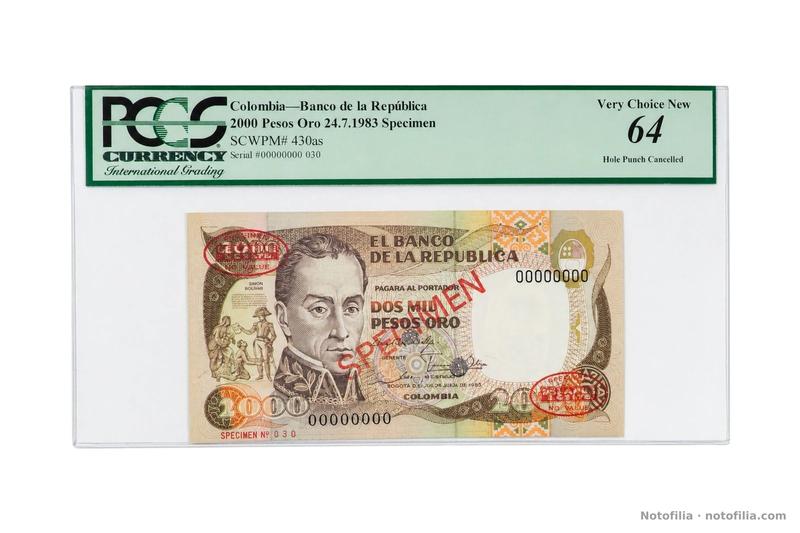
2,000 pesos oro · 1983
Pick P# 430as · Serial 00000000 · SPECIMEN Nº 030
Open the note page → -
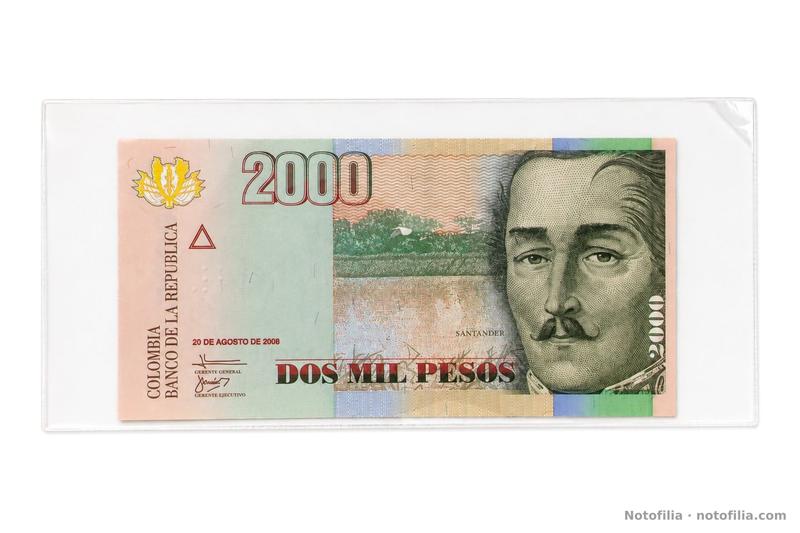
2,000 pesos · 2008
Pick P# 457 · Serial 10000001
Open the note page → -
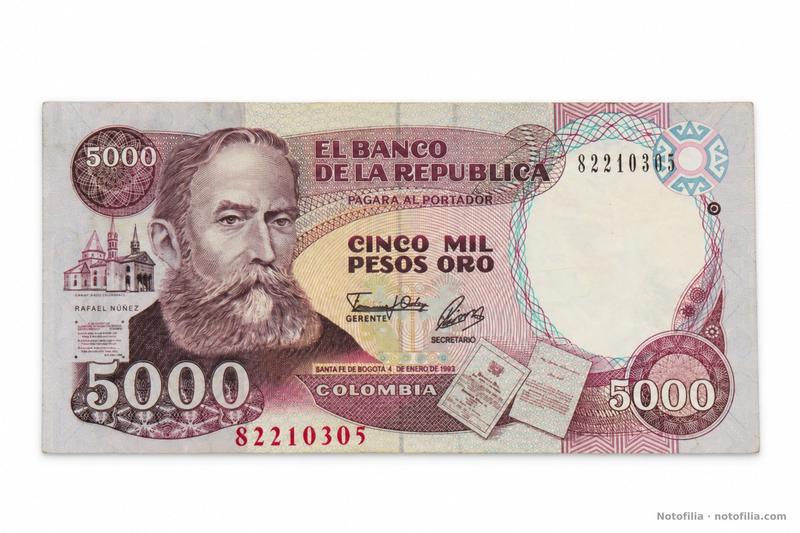
5,000 pesos oro · 1993
Pick P# 436A · TBB B974c · Serial 82210365
Open the note page → -
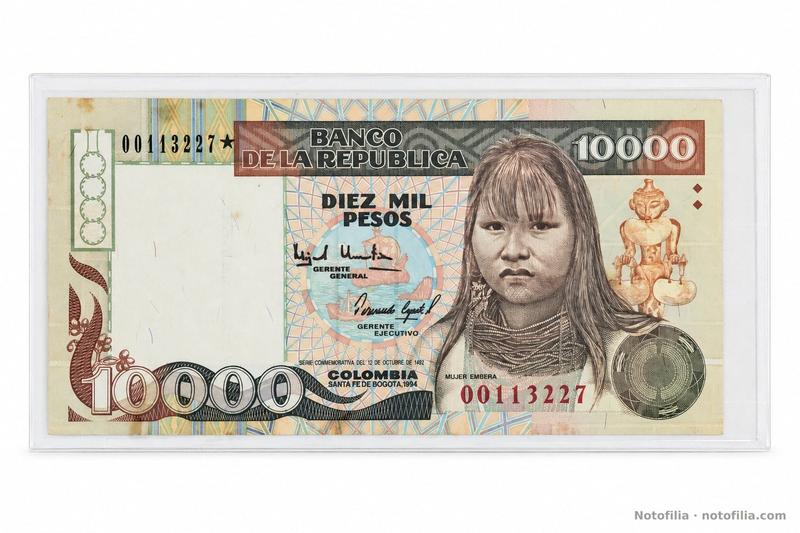
10,000 pesos · star replacement · 1994
Pick P# 437A · TBB B980az · Serial 00113227 / 00249902
Open the note page →
from 1993
Modern families
The end of the gold peso, the Valledupar heist, and the 2016 family.
From 1993 Banco de la República notes dropped the legend “pesos oro”: the currency’s name returned to simply the peso. On 16–17 October 1994 — the “robo del siglo,” the robbery of the century — thieves entered the vault of the Valledupar branch and took some 24.072 billion pesos, in 2,000-, 5,000-, and 10,000-peso notes, much of it still unissued. The bank published the serial ranges — popularly called “billetes vallenatos” — opened an exchange for good-faith holders, and quickly demonetized those three families. Between 1995 and 1996 it replaced them with a new family; the uncirculated 1993 and 1994 dates of those denominations were cut short by that swap. In 2016 it put another family into circulation — 2,000 to 100,000 — with stronger security and the check slogan “Look, touch, tilt, turn, and verify.” That family moves beyond independence heroes: the 20,000 honors Alfonso López Michelsen under Law 1599 of 2012 and the 50,000 honors Gabriel García Márquez under article 5 of Law 1741 of 2014; the program also honors biodiversity and indigenous cultures, with figures such as Virginia Gutiérrez and Débora Arango. Records of that family note optically variable inks, a motion thread that reveals the initials BRC, and ultraviolet reactions — including Victoria amazonica and the burgao snail — when the example shows them. This case documents the 2015 2,000 pesos (Pick 458a / TBB B993a), fancy serial AA40000066, and the 2017 20,000 pesos (Pick 461 / TBB B996c), serial AF51355141.
20th century
Tickets and vouchers
Fare-control paper, not a banknote: tickets, vouchers, and coupons that collectors still call “bills.”
This case is not a Banco de la República banknote, nor a free-banking banknote. It documents printed tickets and vouchers for transport — student, urban, or company — used as proof of fare, not as legal tender. They have no Pick or BG# numbers. The published record gathers two 15-centavos tickets of the Ministry of National Education, Student Transportation Service, with no serial and no printed date: green ink and the red-ink variety, the latter with a school stamp of the Externado Nacional Camilo Torres. No national decree is cited unless it appears on the paper or in the gazette.
Errors
Maculatures and printing errors from the Banco de la República and earlier issues, sorted by year and denomination. Note pages are published as pieces are documented.
-
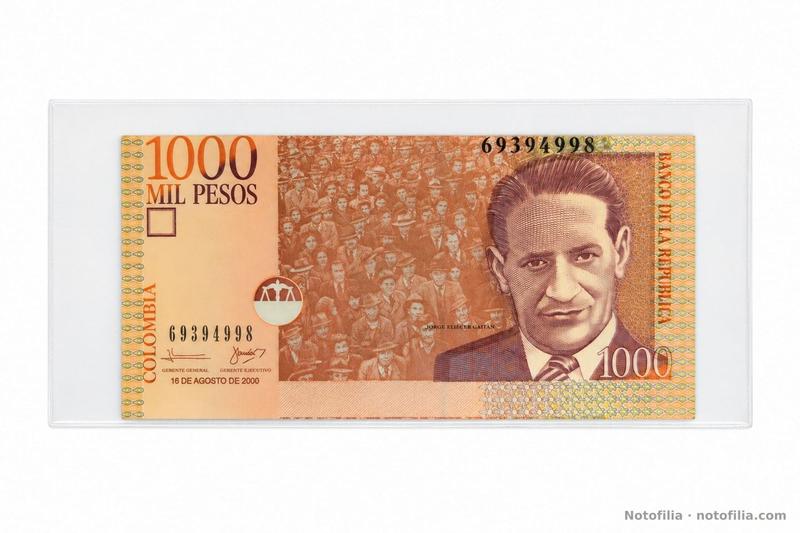
1,000 pesos · cutting error · 2000
Pick P# 450 / TBB B985 · Serial 693949988
Open the note page → -
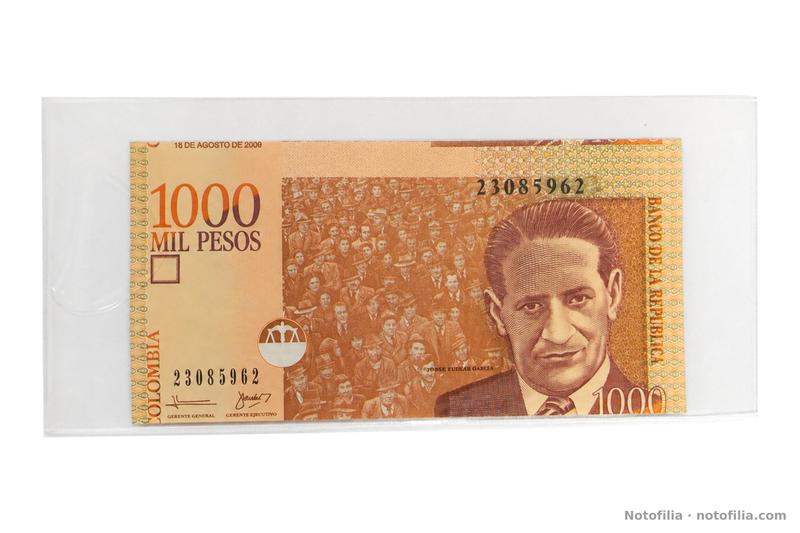
1,000 pesos · cutting error · 2008
Pick P# 456 / TBB B986 · Serial 23085962
Open the note page → -
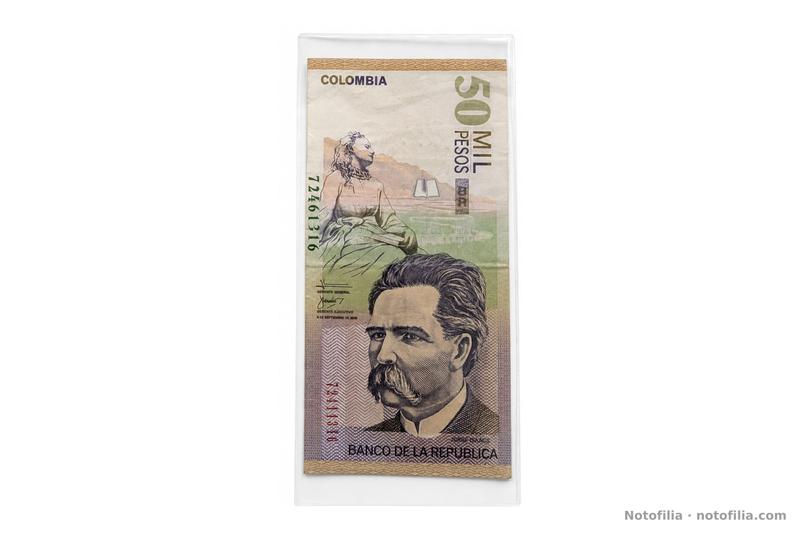
50,000 pesos · numbering error · 2008
Pick P# 455l / TBB B992l · Serial 72461316 / 72411316
Open the note page → -
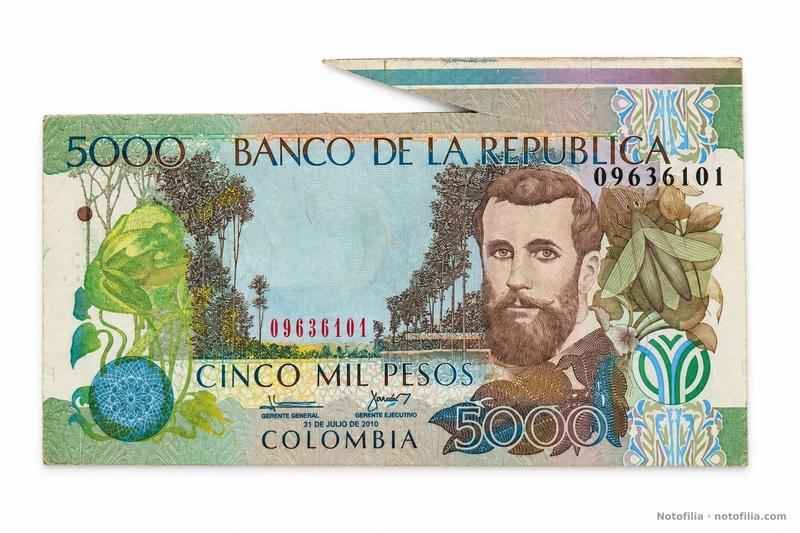
5,000 pesos · butterfly-cut error · 2010
Pick P# 452l / TBB B989m · Serial 09636101
Open the note page → -
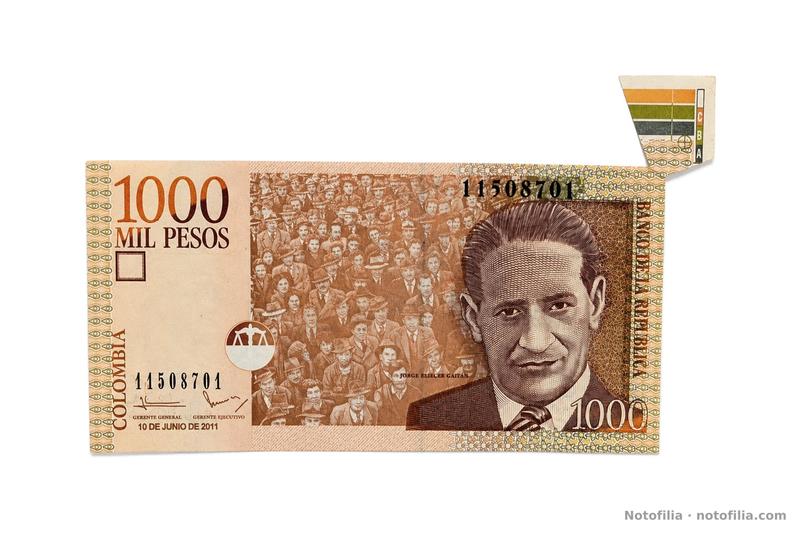
1,000 pesos · butterfly-cut error · 2011
Pick P# 456n / TBB B986n · Serial 11508701
Open the note page → -
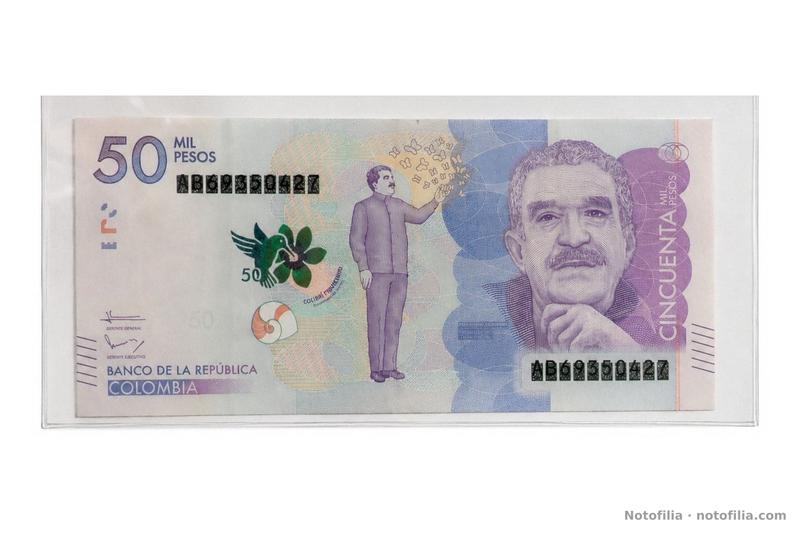
50,000 pesos · numbering error · 2015
Pick P# 462a / TBB B997a · Serial AB69350427
Open the note page →
Subsidy Ticket / Control Ticket
That transport paper is not a printing error. It is documented in the tickets-and-vouchers case. See tickets and vouchers
Cataloguing, printing, and conservation
Identifying a Colombian note goes beyond the portrait. This case crosses imprint, replacement, grade, and local catalogues; the Pick number is not enough.
Imprints
The Imprenta de Billetes has used three legends on the lower edge. Pick often lists them as if they were separate houses; this collection documents them as the same Banco de la República works, under the municipal name that belonged to each period.
- Imprenta de Billetes - Bogotá (IBB). Used from the plant’s opening on 23 October 1959.
- Imprenta de Billetes - Santa Fe de Bogotá (IBSFB). Adopted when the 1991 Constitution restored the capital’s name to Santa Fe de Bogotá.
- Banco de la República. The later shortened form after Legislative Act 01 of 2000, which restored the official name Bogotá D.C.
The editorial note on those three legends is in Three imprints and the Colombian banknote printer .
Historical printers
| Printer | Initials | Period highlighted | Representative paper |
|---|---|---|---|
| American Bank Note Co. | ABNC | 1880s–1950s | Free banking, Banco Nacional, Conversion Board, and early BanRep |
| Waterlow & Sons | W&S | 1900–1920; also 1959 | 1904 Próceres; in this case, the 1959 1 peso oro |
| Thomas De La Rue | TDLR | 1960s–1980s | 1983 2,000 pesos oro specimen and the 1960 5 pesos oro |
| Imprenta de Billetes (Bogotá) | IBB / IBSFB | 1959–present | Blue 1-peso (1959), the 2016 family, and modern issues |
Replacement notes
Sheets that fail quality control are destroyed. To keep the accounts and the numerical sequence, the Bank inserts replacements.
On series from the 1970s to the 1990s, González White and Hernández identify those notes by an asterisk (*) beside the serial or near the manager’s title on the face. Later families use a star (★); this case documents that mark on the 1994 Emberá 10,000-peso notes. Other issues reserve a prefix — Z is the example most often cited in the glossary.
Hernández catalogues asterisk varieties as their own Cód. numbers. No printage or price is invented here: a replacement is named on the record when the example carries the mark.
The definition of replacement and star notes is in the glossary: replacement / star note .
Certification and grade
A note’s historical interest depends, in large part, on how it was kept. Records in this collection cite the Sheldon scale (1 to 70) and the grading house when the example is slabbed — PMG, for instance.
A grade such as PMG 64 Choice Uncirculated EPQ (Exceptional Paper Quality) describes paper without circulation folds, with original embossing, and without chemical washing or physical alteration. It is not an appraisal: it is a shared language of condition. Nothing documented here is for sale.
A guide to grading houses is in the best coin and banknote grading companies .
Reference standards
The Standard Catalog of World Paper Money (Pick / TBB) is a useful world baseline, but its granularity often falls short for Colombian issues. This collection crosses those identifiers with the local catalogues, without republishing price columns or plates.
- Pedro Pablo Hernández (8th ed., 2023). Coins and Banknotes of Colombia: issues before 1923, provincial paper, and the separation of asterisk replacement varieties (Cód.).
- Bernardo González White (7th ed., 2019). Catálogo de Billetes Banco de la República: central-bank types from 1923, signatures, and print ranges (BG#).
A comparison of those catalogues with this case is in Notofilia versus Colombian banknote catalogues .
Every note shown belongs to a private collection, for preservation and study. None of the pieces documented on this site is for sale.
Frequently asked questions
Which Colombian banknotes does Notofilia document?
The case covers independence issues, free banking, the Banco Nacional, the Conversion Board, the Banco de la República, transport tickets, and printing errors, with note pages published as pieces are photographed. It is not a complete catalog of every Colombian Pick number.
Does Notofilia sell Banco de la República banknotes?
No. Every piece belongs to a private collection and none is for sale. The site cites Pick, TBB, González White (BG#), and Hernández (Cód.) when those references exist on the record.
How is this catalog different from Pick or the BanRep museum?
Pick lists types; the Banco de la República Numismatic Collection is an institutional museum. Notofilia documents specific examples from a private collection, with photos, a serial when it can be read, and sources, without republishing prices.
Sources
-
Banrepcultural Encyclopedia — Paper money in Colombia
(opens in a new tab)
Free banking, Regeneración, Banco Nacional, the 1905 Banco Central, the Kemmerer Mission, and the 1931 end of convertibility.
-
Banrepcultural Encyclopedia — Financing independence
(opens in a new tab)
Records the 1813 Cartagena 1-real signed by Gutiérrez de Piñeres. Hernández (8th ed., 2023) lists a 2-reales of 1812 printed at Mompós first.
-
Banco de la República — History of the Bank
(opens in a new tab)
Law 25 of 1923, mixed capital, monopoly of issue, and the early opening on 23 July; the museum booklet details the weekend overstamp of Medellín certificates.
-
Banco de la República — 1973 reform
(opens in a new tab)
Law 7 and Decree 2617: the state acquired nearly all private shares.
-
Banco de la República — 60 years of the Imprenta de Billetes
(opens in a new tab)
23 October 1959; first job: the blue 1-peso printed in Bogotá. The 5-peso of 1961–1981 carries the walls of Cartagena.
-
Banco de la República — Background, evolution, and structure (Meisel et al.)
(opens in a new tab)
The 1886 fiat standard, Law 70 of 1894, Reyes’s Banco Central, the Kemmerer Mission, and the 1923 opening.
-
Adolfo Meisel Roca — Background to the Banco de la República, 1904–1922
(opens in a new tab)
Postwar stabilization, projects for a bank of issue, and the setting in which Reyes created the Banco Central.
-
Historical evolution of the Banco de la República (SciELO; citing Hernández, 2001)
(opens in a new tab)
The 1905 Banco Central as a bank of issue; in 1909 its privilege was suspended and it became a private bank.
-
HiSTOReLo — Núñez, Caro, and the Banco Nacional (1886–1903)
(opens in a new tab)
Decree 104 and Law 87 of 1886 (fiat monetary unit); Law 70 of 1894 and closure in 1896.
-
Pedro Pablo Hernández — Coins and Banknotes of Colombia, 8th ed. 2023 (Numista L100183)
(opens in a new tab)
8th-ed. Cód. numbers (ISBN 978-958-49-7741-0): independence paper at Mompós, Gran Colombia drafts, the 1909–1923 Conversion Board (the 1915 ABNC edition and 1922 bonds), free banking, and Banco de la República notes through 2023 (Un Peso Oro Cód. 45–81). Prices and plates are not published here. Numista’s older H# (91, 95, 96, 199/201) are not replaced by 2023 Cód. numbers.
-
Astrid Romero — La Regeneración and the Banco Nacional (1991)
(opens in a new tab)
Established in 1881; forced tender from 1886; final liquidation in 1896.
-
Banco de Bogotá — Our Bank
(opens in a new tab)
Founded 15 November 1870; the country’s first commercial bank.
-
Portafolio — The Banco de Bogotá was born with the right to issue notes
(opens in a new tab)
15 November 1870; statutes: bearer notes in proportion to metal in the till.
-
Banrepcultural Encyclopedia — Money issue
(opens in a new tab)
Forced tender, the Thousand Days’ War, the 1909 Conversion Board, the exchange of the 1904 edition for the American 1915 notes, and Banco Nacional paper still circulating in the 1910s.
-
El Espectador — Twenty-five years after the “robo del siglo” (2019)
(opens in a new tab)
Valledupar, 16–17 October 1994; some 24.072 billion pesos; exchange and redesign of the 2,000, 5,000, and 10,000 in 1995–1996.
-
Banco de la República — Press release: new banknote family (25 September 2015)
(opens in a new tab)
The 2016 family (2,000 to 100,000): biodiversity, culture, and the homage to Gabriel García Márquez.
-
Banrepcultural — The new Colombian banknote family
(opens in a new tab)
Theme of each denomination: landscapes, indigenous cultures, and figures of culture, science, and politics.
-
Banrepcultural — Casa de Moneda Museum
(opens in a new tab)
1996 permanent exhibition: 1923 provisionals, 1932 pesos plata, wartime cut ½-peso notes, and the Imprenta’s first note.
- Bank Note Museum — Colombia (states, Republic, and Banco de la República) (opens in a new tab)
-
Bank Note Museum — Colombia, Banco de la República
(opens in a new tab)
Pick index: 1923 provisionals, pesos oro, and the 1959 series (P-404).