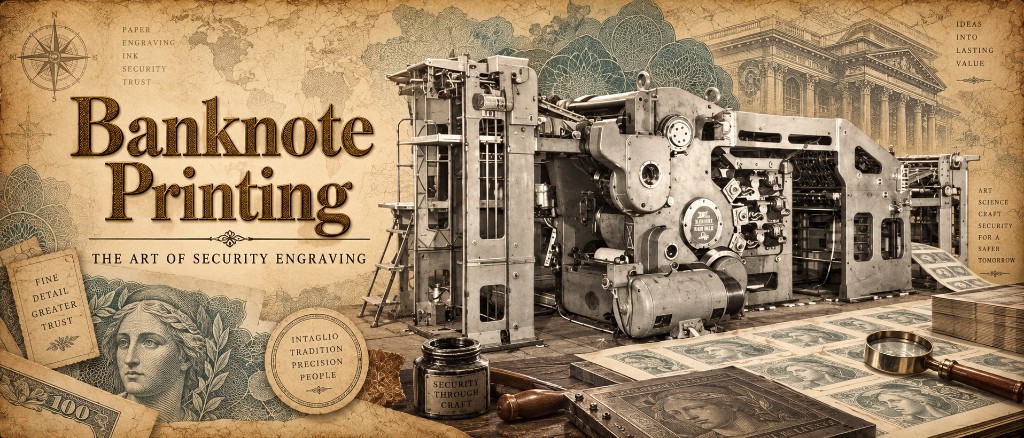
From Gualtiero Giori’s chablons to Koenig & Bauer Banknote Solutions: how trial notes record presses, symposiums, and the paper collectors call test notes.
Types in this case
One example is in the case: the Lincoln Memorial uniface. The other types stay blank until a piece is photographed.

Test notes produced under Gualtiero Giori and the firms that followed him are not trade-fair souvenirs. In security printing — and in notaphily — shops call them, according to the job, trial notes, press proofs, demonstration specimens, or samples. They were made to push high-precision presses to their limits. From the mid-twentieth century to the present they record the shift from single-colour flatbed intaglio to simultaneous multi-colour offset and to multi-colour intaglio in one pass.
They were printed at factory acceptance, on customer trials, and at international symposiums. Those sheets tested anti-copy chemistry, optoelectronic inspection, and micrometre registration. For the printing historian and the paper-money collector they are the bridge between press engineering and the object in a sleeve. This page does not add a new holding: the only Giori piece in the virtual case remains the uniface Lincoln Memorial.
Origins: Gualtiero Giori and multi-colour intaglio
Several colours in a single pass
Until the mid-twentieth century intaglio — viscous ink leaving engraved recesses under extreme pressure — gave the tactile relief and crispness that photography copies poorly. The constraint was physical: one colour per pass. A note with several intaglio hues needed consecutive presses, or hand inking of different zones on one plate. Each cycle distorted damp paper: stretch, shrink on drying, worse register each time.
Gualtiero Giori, an Italian engineer from a Milanese security-printing family, changed the method. In 1947, at thirty-four, he adapted ideas and patents linked to the French inventor Serge Beaune and built a multi-colour intaglio press that actually ran.
The key was indirect, segmented inking. Instead of flooding the whole plate cylinder with one film, the machine uses cut relief rollers — chablons in the security trade. Each chablon carries raised areas only for one colour’s coordinates. It lays that ink on a collector cylinder faced with an elastic blanket. Turning in time, the chablons assemble a fully registered design on the blanket. The collector then presses against the master plate cylinder and drives the multi-colour film into the recesses in a single revolution. Paper meets tons of impression: a sharp multi-colour intaglio print without the register errors of several feeds.
In 1949 the first commercial six-colour Giori press was delivered to Casa de Moneda de la República Argentina in Buenos Aires. Industrial viability was no longer a claim.
From Organisation Giori to Koenig & Bauer Banknote Solutions
Giori saw that sovereign issuers needed an engineering partner, not only an inventor. In October 1952 he founded Organisation Giori, with headquarters at Rue de la Paix 4, Lausanne. He took the winged horse Pegasus as the emblem: a vignette, watermark, and blind-embossed mark that returns for decades on test currency.
That same year he allied with Koenig & Bauer AG of Würzburg, the world’s oldest press maker: K&B built the machines; Giori directed design, patents, sales, and integration. In 1965, for the British Commonwealth and the private security market, the joint venture De La Rue Giori S.A. was formed with Thomas De La Rue. Over the century those lines reached, among others, the United States Bureau of Engraving and Printing (BEP), the Bank of Japan, Goznak in the Soviet Union, and the Bank of England.
In June 2001 Koenig & Bauer bought Organisation Giori and De La Rue’s stake. KBA-Giori S.A. followed, then KBA-NotaSys, and from 2020 Koenig & Bauer Banknote Solutions. That succession explains imprints, watermarks, and catalogue prefixes across generations of test notes.
| Years | Entity | Mandate | Milestone |
|---|---|---|---|
| 1947–1952 | Gualtiero Giori workshops | Single-pass multi-colour intaglio | 1949: press to Casa de Moneda (Argentina) |
| 1952–1965 | Organisation Giori (Lausanne) | Worldwide deployment; K&B alliance | 1956: Simultan prototype; 1959: Pegasus offset |
| 1965–2001 | De La Rue Giori S.A. | Supply to sovereign and private works | Shakespeare (1962, still in the Organisation Giori period); Pushkin (1978); Varinota |
| 2001–2010s | KBA-Giori S.A. | K&B integration; digital prepress and laser CTiP | Le Mont 2000 (Da Vinci); Banknote Horizons (Verne) |
| 2010s–2020 | KBA-NotaSys | Modular lines, inspection, micro-optics | Cash Cycle (2010); Generation (2016–2018) |
| 2020–present | Koenig & Bauer Banknote Solutions | Substrate-agnostic security; InPrint | Laika (2021); Diversity (2024) |
Functional architecture: why a test note was printed
Calibration and register
A modern sheet-fed press can run at about 10,000 sheets an hour under hundreds of kilonewtons of impression. Tolerances between processes are fractions of a millimetre: background micro-guilloches without moiré, front-to-back see-through register, and high-relief intaglio edges aligned with the offset beneath.
In Würzburg, a newly assembled machine was trialled with plate cylinders, gear trains, and blankets: cylinder deflection under load, ink distribution on lateral and circumferential axes, and the balance of wiping rollers that clean margins without stripping fine engraving. It was then dismantled, shipped, and, at the client’s plant, tuned again with test plates or the bank’s own plates, according to temperature, humidity, paper caliper, and local ink chemistry.
The resulting sheets — progressive passes, unfinished layouts, alignment designs — usually went as industrial waste. Some technicians kept them as engineering benchmarks. Over time those sheets reached the collector market as test notes.
Substrates and demonstration lines
The same notes also served paper mills and chemists: long-life cotton blended with synthetics, high-tensile cylinder-mould watermarks, hybrids such as Landqart’s Durasafe, or biaxially oriented polypropylene of the Guardian type. Drying, roughness, opacity, and adhesion under heavy intaglio wiping were the questions.
From the 1980s the same paper became a commercial argument. At Drupa and at Banknote Horizons symposiums — Milan, Sevelin, Le Mont-sur-Lausanne — a full line ran in front of governors and technical directors:
- Super Simultan: multi-colour security underprints, both sides at once and in register.
- NotaScreen: heavy opaque films of optically variable ink (OVI) or iridescent coatings.
- OptiNota-H: hot stamping of diffractive devices (DOVIDs), holograms, or registered patches.
- Super Orlof Intaglio: portrait, microlettering, and relief, several colours in one pass.
- Super Numerota or NotaNumber: letterpress numbering, NotaMark laser, and fluorescent inkjet JetCode.
- NotaCheck: optical inspection that ejects a defective sheet, and CutPak to cut, band, and shrink-wrap without a hand.
The Leonardo da Vinci (2000) and Jules Verne (2004) specimens were pulled live on those lines: physical proof from end to end.
Innovations first proved on Giori test paper
Chablons, collector, and wiping
In single-colour intaglio an ink duct coats an engraved roller and surplus ink is wiped with a paper band or cloth. In several colours that mixed pigments. Giori solved it with indirect inking, described for example in U.S. patent 5,062,359: discrete ducts feed chablons whose relief matches only each colour’s areas; the collector assembles the design; the plate receives ink only where there is a groove. Deep portraits can reach about 250–320 microns. A counter-rotating wiping cylinder in solvent or alkaline emulsion cleans the unengraved surface and leaves ink in the recess. On the finished note, contrasting inks meet along one contour without halo or bleed.
Three authentication lines
Because there is no legal tender and no denomination convention, Giori’s studios — with engravers such as Renato Manfredi — used these notes to trial features that later moved onto circulating paper.
First line (the public): deep intaglio portraits, readable by touch and of help to people with low vision; rotary-screen OVI and foil stripes; see-through marks that close only in transmitted light, thanks to Simultan.
Second line (the till and bank automation): multi-wavelength fluorescents, including SUSI Flip (an ordinary design in ambient light, a coloured composition under 365 nm); windowed threads with demetalized microlettering; infrared metameric pairs that look the same to the eye and drop out or reflect under an IR camera.
Third line (the issuing bank’s laboratory and high-speed processing): intaglio microlettering and Computer-to-Intaglio Plate (CTiP) laser ablation, positive and negative along portrait linework. Recent series add acoustic verification — Sound of Intaglio® — a relief meant to emit a measurable friction signal on sorting sensors or a telephone microphone.
Chronological typology
North American sovereign trials: Washington and Jefferson
After the Second World War the BEP faced demand that its 12-subject flatbed presses, with damp paper and long drying between face and back, could no longer meet. In 1957 it installed in Washington its first rotary multi-colour sheet-fed Giori. That opened the way to 18-subject sheets and, later, 32.
In the 1960s and 1970s two families remained that collectors now treat separately.
The first is the Washington Center group, tied to what numismatists call the Edgar L. Pigman hoard. In the 1970s the American Bank Note Company, a BEP contractor, subcontracted American Can Company to assemble high-speed presses using the Giori process. Fabrication and testing sat at Geneva, New York, under engineer Edgar L. Pigman (1932–2008). The BEP supplied composite plates with genuine vignettes from types then in use, laid out as non-negotiable: Lincoln from the $5 at left, Washington from the $1 at centre, Grant from the $50 at right. Most Pigman impressions are uniface, 32-subject sheets on unwatermarked paper, in deep green, black, or purple-brown. There are also unifaces with the Lincoln Memorial and the Great Seal. The presses ran in Geneva and were delivered to Washington; administrative disputes — including the resignation of Director James A. Conlon and later litigation — kept them out of regular production. Pigman retained a group of sheets. Decades later they reached the market. The E-Sylum summarises that history in the American Can / Giori note; this collection does not claim that its Memorial example comes from that hoard.
The second family is the Jefferson notes. After the 1957 order, the BEP in 1963 ordered four more machines through Miehle Co. of Chicago, Organisation Giori’s representative. It sent genuine Thomas Jefferson master plates (the $2) to Koenig & Bauer in Würzburg. The sheet is composite: the central third Jefferson; the outer two-thirds three Canadian test designs from British American Bank Note Company (BABN) plates. Almost all are two-sided, with the reverse inverted relative to the face (a tumble turn). There are four ink ranges (grey/black, weak green, mud brown, purple-brown) and up to nine chromatic combinations; trial serials in red or black, in several placements. Early pulls are on plain paper; later ones — about 1964–1968, and perhaps through 1970 trials on the BEP’s web-fed Huck Multicolor — use Louisenthal paper with the localized watermark “Papierfabriklouisent.” Gene Hessler details plates, correspondence, and varieties in his essay on these Jeffersons; he records fewer than 100 known examples for some varieties.
| Parameter | Washington Center (Pigman hoard) | Jefferson Center (BEP / BABN trials) |
|---|---|---|
| Plant | American Can, Geneva, NY | Koenig & Bauer (Würzburg) and BEP plants |
| Machine | ABNC-Giori 32-subject sheet intaglio | Sheet-fed Giori and Huck Multicolor web |
| Vignettes | Lincoln ($5), Washington ($1), Grant ($50) | Jefferson ($2) flanked by BABN Canadian motifs |
| Sides | Almost always uniface | Two-sided; reverse systematically inverted |
| Paper | Plain, unwatermarked security paper | Plain and Louisenthal watermarked paper |
| Serial | Unnumbered (blank serial reserves) | Red or black; seven typographic formats |
| Published population | Several hundred cut singles; few intact sheets | Hessler: <100 for specific varieties |
European demonstration series
Outside North America, De La Rue Giori and KBA-Giori designed original specimens — not collages of circulating plates — around figures from European intellectual history.
The first complete note meant to prove simultaneous offset was the 1959 Pegasus, at Organisation Giori’s Instruction Centre in Milan: five offset colours (three on the face, two on the back) and guilloche underprints on both sides, in optical register.
In 1962 came Shakespeare, built on the Chandos portrait and theatrical motifs, with three-colour intaglio from a single plate; colour trials continued into the 1970s. Late in that decade, for Goznak, the large-format Pushkin joined an intaglio portrait, St Petersburg architecture, and scenes from The Queen of Spades: eight wet offset colours on Super Simultan and three intaglio inks, to show that the extra sheet size did not stretch the paper.
The Varinota series (“1 Varinota”, variable note), with Beethoven, was the most widely seen demonstration from the 1970s through the 1990s: the composer writing on the face; at the piano before an audience on the back. It was a long-running test bed: Pegasus and DLRG initials in blind embossing; segmented threads; magnetic inks; localized watermarks; fluorescent guilloches; gold interference bands; red numbering.
Gutenberg had two editions, 1986 and 1994. The first showed Orlof offset and intaglio in one continuous machine. “Version 2” in 1994 brought diffractive foil via OptiNota-H and NotaScreen OVI to the market.
At the Le Mont 2000 symposium, Leonardo da Vinci ran through a ten-machine line (Super Simultan 212, OptiNota-H, NotaScreen, Super Orlof Intaglio, NotaCheck II at 10,000 sheets/hour). For many collectors the lineage closes with the 2004 Jules Verne, designed by Renato Manfredi for Banknote Horizons: more than ninety features, CTiP, foil airships, dual-colour OVI patches, latent imagery, and NotaMark laser-perforated serials. A 2007 iteration trialled OPTI-Windows: clear laminated windows in hybrid paper.
Afterwards: Cash Cycle and Flower Power (2010), the Super Simultan IV 2D-Iris module; Generation (Childhood, Seniority, Family, 2016–2018), all three security lines at once; Laika Exploration (2021), five polymer denominations with SUSI Flip and SPARK Flow; Diversity (2024), the InPrint concept: optical and tactile features generated in-plant on durable cotton.
| Year | Title | Platform | What was demonstrated |
|---|---|---|---|
| 1959 | Pegasus | First Simultan prototype | 5-colour offset; face-to-back register |
| 1962 | Shakespeare | Multi-colour production intaglio | Three colours, one plate; line shading |
| 1978 | Alexander Pushkin | Super-format Simultan + intaglio | 8 wet offset inks + 3 intaglio |
| 1986 | Gutenberg (v. 1) | Combined Orlof offset and intaglio | Mechanical integration of both processes |
| 1990 | Amerbach | High-relief intaglio calibration | Depth trials to about 320 μm |
| 1994 | Gutenberg (v. 2) | OptiNota-H and NotaScreen | DOVID/holographic foil and screen OVI |
| 2000 | Leonardo da Vinci | Le Mont 2000 line (Super Simultan 212) | Modular line; NotaCheck II inspection |
| 2003 | Lord Byron | CTiP station | Laser-ablated master intaglio plates |
| 2004 | Jules Verne | Super Simultan IV, CTiP, OptiNota-H | >90 features; multi-depth intaglio; NotaMark |
| 2007 | Jules Verne (vertical) | OPTI-Windows | Substrate apertures and clear windows |
| 2010 | Cash Cycle / Flower Power | Super Simultan IV, 2D-Iris module | Automated sorting; 2D rainbowing |
| 2016–18 | Generation | Super Simultan IV and Super Orlof Intaglio III | Three-tier security architecture |
| 2021 | Laika Exploration | Koenig & Bauer Banknote Solutions line | Five notes; SUSI Flip, SPARK Flow, polymer |
| 2024 | Diversity | InPrint platform | 100% in-plant security creation on cotton |
Classification, legal status, and the market
Catalogues and production states
These pieces do not fit the Standard Catalog of World Paper Money: they did not circulate. The framework most used is Roland Rollins’s Catalog of Printers Promotional Sheets & Test Notes. Prefixes:
- GIOR-: Organisation Giori, De La Rue Giori, and early KBA-Giori (Beethoven Varinota GIOR-111, Shakespeare GIOR-141, intermediate sheets such as GIOR-331).
- KBA-: after full integration into Koenig & Bauer and KBA-NotaSys.
- K&B-: Koenig & Bauer Banknote Solutions, from the 2021 Laika series.
Rollins distinguishes progressive proofs (intaglio or offset alone, without later layers), finished demonstration specimens (foil, screen, serials), and mechanical varieties (inverted reverse, misalignment, smears, plain paper versus watermark). For United States-linked material, Gene Hessler’s archive complements Rollins with plate transfers and BEP correspondence.
Legal status (United States)
This is not legal advice. Title 18 of the United States Code, § 474, addresses unauthorized possession of impressions taken from dies or plates made under the authority of the United States. Because the Washington and Jefferson sheets used genuine BEP master dies (Washington, Lincoln, Grant, Jefferson), collectors and dealers for years feared Secret Service seizure. The Pigman hoard stayed out of sight for more than thirty years.
The E-Sylum records that, once policy on non-negotiable security-printer trials was reviewed — no denomination, no legal-tender obligation, vignettes in a collage that cannot pass as money — the BEP clarified that possession of those historical impressions did not violate federal law. That opened certification at PMG and at PCGS Currency / PCGS Banknote. Anyone holding such a piece should check current official sources; Notofilia offers no paper for sale.
Market dynamics
There are two publics: specialists in United States currency (BEP) and world-paper collectors interested in printing technology. The ranges below are secondary-market observations (dealer lists, eBay, and auction notes cited in the bibliography), not hammers verified one by one by Notofilia and not prices of this house. They are not an offer.
On the United States side, Washington Center cut notes in Gem Uncirculated (65–67 EPQ) are typically cited between $150 and $350; horizontal pairs or three-subject strips (Lincoln–Washington–Grant) between $500 and $700; intact 32-subject sheets are scarce — Kagin’s 308th sale in 1976 and hoard verification in 2012 — and, when they trade, four-figure sums are discussed; several sit in institutions (Ontario County Historical Society) or advanced private holdings. Jefferson notes, with a wider range of colour and numbering varieties, are scarcer in total population: Hessler records fewer than 100 for specific varieties. Two-sided notes on unwatermarked paper are cited around $130–$220; Louisenthal “Papierfabriklouisent” or numbering errors (duplicate serials), around $275–$450.
On the European side, ordinary uniface Gutenberg, Shakespeare, and Beethoven Varinota notes are often listed between $10 and $30 uncirculated. Standard Da Vinci (2000) and Verne (2004/2005) notes, $40–$120; consecutive sets, progressive proofs missing a layer (no foil, blank window), or presentation binders, $200–$350. Generation or five-note Laika sets trade higher because they were distributed to central-bank delegates, not to the general public.
Synthesis
Giori test currency documents how banknote production moved from a craft to an industrial science of tolerances. The 1947 multi-colour intaglio solved the paper handling that had limited register. For seven decades, ink formulae, drying, and mechanics were refined on these faces. Koenig & Bauer Banknote Solutions still uses the same trial method to join physical printing with diffractive optics, micro-optics, and acoustic checks on a telephone.
For the notaphilist the object is not a circulating Pick. It is the tangible record of a press, a symposium, or an institutional dispute. In this collection that record is a single example: the green Lincoln Memorial uniface, with no serial, in a sleeve. The rest of the typology is described here so that record — and any that may be photographed later — can be read without mixing proof, specimen, and legal tender.
Sources
Starting points: history and specimens at Koenig & Bauer Banknote Solutions (opens in a new tab); American Can and the Giori notes (opens in a new tab) (The E-Sylum); Gene Hessler’s essay on the Jeffersons; patent US 5,062,359 (opens in a new tab); Roland Rollins’s Catalog of Printers Promotional Sheets & Test Notes; Andrew Nash’s note on the Jules Verne. eBay and dealer listings illustrate market ranges; they are not a census.
Cited links
- Koenig & Bauer Banknote Solutions — company history (opens in a new tab)
- Koenig & Bauer Banknote Solutions — specimens (opens in a new tab)
- The E-Sylum — American Can Company and the Giori notes (opens in a new tab)
- Gene Hessler — an alternate look at the Giori Jefferson notes (PDF) (opens in a new tab)
- U.S. patent 5,062,359 — intaglio machine for currency papers (opens in a new tab)
- Andrew Nash — the KBA-Giori Jules Verne (opens in a new tab)
- Numista — Catalog of Printers Promotional Sheets & Test Notes (Rollins) (opens in a new tab)
- The E-Sylum — 18th edition of the Rollins catalogue (opens in a new tab)
Open the Giori Lincoln Memorial record Back to the notaphily case