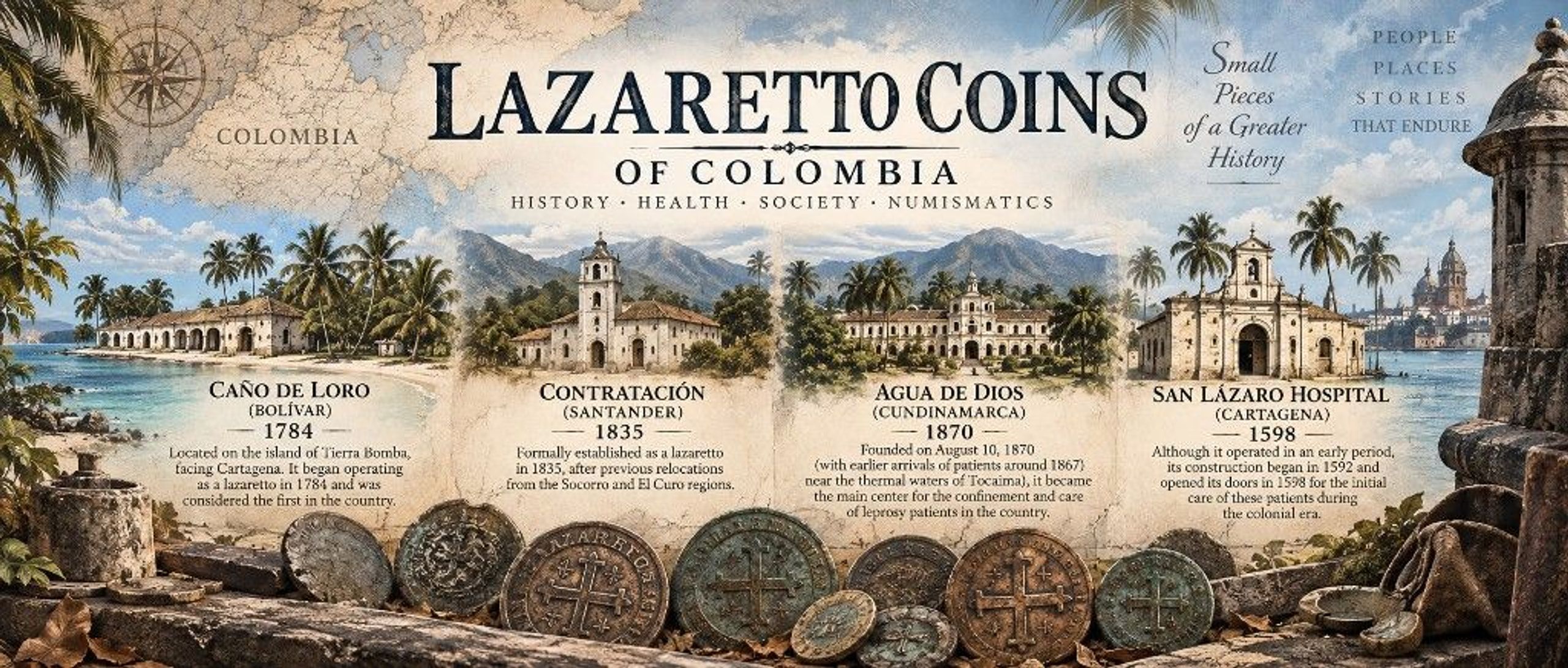
An essay on the lazarettos of Caño del Loro, Contratación, and Agua de Dios, and on the coin the State struck so that it would not leave the sanitary cordon.
·
In the collection
Two published pieces: the 1921 cupronickel 2 centavos and a 50 centavos dated 1931, with the lazaretto cross. That date is not in KM, Hernández, or Restrepo. The other denominations still have no record.


Introduction: leprosy and the architecture of moral panic
Hansen’s disease, known under the stigma of leprosy, is one of the most complex epidemiological and cultural phenomena in history. The origins of this chronic infection, caused by the bacillus Mycobacterium leprae and the variant Mycobacterium lepromatosis, are traced by genomics and archaeology to East Africa and India, with evidence in bone remains more than four thousand years old.1 The bacillus spread along routes of trade, migration, military campaigns, and pilgrimage across Eurasia.2 The social burden of the disease was also shaped by Western theology. The Latin Bible, the Vulgate, used the word “leprosy” for the Hebrew zara'at and fixed a rule of ritual impurity: the affected were to live apart and submit to inspection by religious authorities.2
That mixture of pathology and divine punishment crossed the Atlantic at the end of the fifteenth century. Europeans and the transatlantic trade in enslaved Africans brought the disease to the Americas and the Caribbean.2 In the territory of present-day Colombia, leprosy entered through the port of Cartagena de Indias and opened a public-health crisis that the State would later meet with a machinery of biopolitical control without precedent in the region.4
The State’s response was not limited to the clinic. It became a punitive system of absolute segregation. Its cornerstone was the lazarettos, or leprosaria: isolated, guarded settlements where patients lost civil rights and were confined for life.3 At the peak of that hygienist structure an extraordinary episode in economic history appeared. Driven by the fear that inanimate objects could carry contagion, the government of Colombia struck a coin for exclusive circulation inside the leprosaria.7 The “coscojas,” pieces bearing the cross of Saint Lazarus, ceased to be only a medium of exchange. They became the material frontier between the world of the healthy and the confined world of the sick.9
A reading of Caño del Loro, Contratación, and Agua de Dios — of their monetary ecosystem, the segregationist legislation, the Church’s intervention, and the later process of heritage designation — shows the tension among scientific ignorance, moral panic, and the resilience of the confined communities.
The center of this essay is the coin the Colombian State struck for those three lazarettos between 1901 and 1928. It is not a catalogue of money from every leprosy colony. The social history stands. The numismatic section separates what a summarized decree says, what a catalogue says, and what this collection can measure on a disc.
| Date | What this page fixes |
|---|---|
| 1598 | The Royal Hospital of San Lázaro begins to operate in Cartagena. |
| 1796–1798 | Move to Tierrabomba, the place called Caño del Loro. |
| 1861 | Caño del Loro is made an official lazaretto; in Santander, Eustorgio Salgar authorizes Contratación. |
| 1870–1873 | Law C of 1870 and, on 15 January 1873, the village of Agua de Dios. |
| 1890 | Law 104: compulsory isolation of patients recognized as contagious. |
| 1901 and 1907 | The first exclusive coin, then the paper-money pesos. Law 14 of 1907 tightens the cordon. |
| 1918–1921 and 1928 | Decrees summarized for the third series, and the last catalogued denomination, the 50 centavos. |
| 1940s | Sulfones. The clinic no longer supports confinement; the statute lags. |
| 1961 and 2011 | Law 148 restores rights. Law 1435 declares heritage. |
Demographic and geographic shape of the national lazarettos
Institutional isolation in Colombia was not uniform. Over the centuries it took shape in three enclaves, each with its own geography and politics. The passage from colonial charity hospitals to republican lazarettos records how State policy toward the disease hardened.
Caño del Loro: island confinement in the Caribbean
Catalogues and this site spell the place three ways: Caño del Loro, Caño de Loro, and Caño del Oro. This essay uses Caño del Loro. The other two are source variants, not a second place.
The first institutional effort to contain leprosy in the colonial territory took form in Cartagena de Indias. Faced with the concentration of the sick in the outskirts, the cabildo ordered in 1592 the construction of the Royal Hospital of San Lázaro, which began to operate around 1598 on the edge of Getsemaní.1 The building was caught in the military life of the Caribbean. Its nearness to the Castillo de San Felipe de Barajas made it a tactical liability: during the siege of British Vice-Admiral Edward Vernon in 1741 the structure was badly damaged, and the risk became plain that an invading force might use the wards as trenches or magazines against the fortress.12
Military pressure and hygienist urgency forced a move to an island. Between 1796 and 1798 the hospital was relocated to the island of Tierrabomba, at the place called Caño del Loro.1 In 1861, with the Granadine Confederation, the enclave was made official as the lazaretto of the Sovereign State of Bolívar.4 The Caribbean Sea secured the isolation and subjected patients to a hostile tropical setting. Medical records document ophthalmia and malarial fevers among the interned.1
Caño del Loro was also the scene of early scientific trials. The physician Roberto Azuero was sent by the Ministry of Government in 1896 to test the serum of Juan de Dios Carrasquilla; later trials, documented in photographs, used chaulmoogra oil.1 By January 1939 the lazaretto held 466 patients under strict pass rules.1 The end was tragic. In 1950 the national government decreed the closure and, in an act of extreme prophylaxis meant to erase the physical stigma, the Colombian Air Force bombed the ruins. Fragmentary memories remained among native elders and the descendants of the interned.4
Contratación: “Little Germany” and the Andean exodus
In the northeast, isolation had an erratic beginning. The sick of the provinces of Socorro, Pamplona, and Tunja were relegated to a place called El Regadillo.15 Under social pressure, in 1822 the provincial government ordered a transfer to an inhospitable settlement in the jurisdiction of the Suárez River, known as El Curo.15 The conditions of survival forced the sick into an exodus through the Andean mountains in search of a kinder setting.
Their path crossed the routes of cinchona traders and extractors. In a valley where those merchants camped and closed their deals — hence “Valle de los Contratos,” or “La Contrata” — the sick found refuge.15 The Assembly of the Sovereign State of Santander made the movement official. In 1861 Governor Eustorgio Salgar authorized the new lazaretto, organized in law in 1869 with a hospital to shelter the “poor elephantiacs.”15
With Conservative hegemony, and its interest in countering liberal secularism through religious communities, the Salesians and the Daughters of Mary Help of Christians arrived at Contratación around 1887.15 That intervention changed the look of the settlement: urban order, discipline, and sanatoria that earned it the name “Little Germany.”16 The apparent order did not stop the colony from working as an open-air prison. The best-documented drama is the separation of newborns, sent to the preventoria of Guadalupe (girls) and to the asylum of San Evasio or Guacamayo (boys and the sick).6
Agua de Dios: the city of pain
Tocaima, in the centre of the country, drew medical pilgrims because of the fame of its hot springs. Over time a community of people with leprosy settled there, came to own property, and joined the local economy.3 Fear of contagion produced a violent reaction. The healthy inhabitants expelled the sick and pushed them across the Bogotá River onto barren land.3
Faced with the crisis, the Sovereign State of Cundinamarca intervened through the secretary of finance, José María Baraya, and the politician Manuel Murillo Toro, who in 1856 had acquired, under deed number 66, the lands of the Agua de Dios hacienda from Pablo Afanador.18 The State Convention, by Law C of 10 November 1870, assigned those lands to the lazaretto and named the settlement Aldea de Agua de Dios on 15 January 1873.18
The geographic separation was fixed in 1875 with Colombia’s first suspension bridge over the Bogotá River. The work, needed to cross the current without unstable rope ferries, was popularly called the Bridge of Sighs.3 The name holds the structure’s function: it was the frontier where the sick took leave of healthy relatives and of civic status, and began a perpetual confinement.16 Agua de Dios grew into the most populous lazaretto in the nation, supported by the infrastructure of the Salesians (arrived in 1891) and the Sisters of the Presentation (in 1892).18
The biopolitics of isolation: law, hygiene, and civil death
Confinement ceased to be parish charity and became State policy, resting on legal coercion and hygiene. In 1874 the Norwegian physician Gerhard Henrik Armauer Hansen isolated Mycobacterium leprae, proved the infectious nature of the disease, and brought down the theory of the humours.2 With no pharmacological cure in the nineteenth century, and backed by the First International Leprosy Congress (Berlin, 1897), governments embraced isolation as the only prophylactic model they considered viable.8
The sanitary cordon: Law 104 of 1890 and Law 14 of 1907
The Colombian State carried out the segregationist mandate with Law 104 of 1890, which declared the total, absolute, and compulsory isolation of all persons with leprosy recognized as contagious in the national territory.26 The law in effect criminalized the disease by naming patients as those directly responsible for spreading the endemic.27
The disciplinary regime reached its height under President Rafael Reyes, with Law 14 of 1907, which ordered a strict sanitary cordon around the three lazarettos.18 The colonies of Agua de Dios and Contratación were besieged with barbed-wire fences and checkpoints of the so-called “healthy police.”22 The statutes forbade drinking or eating in the company of the healthy, using public fountains, or leaving the perimeter without a highly restrictive safe-conduct.4
Entry into the lazaretto symbolized the loss of civic identity. At the checkpoints, guards destroyed citizenship cards and stripped civil and political rights at once.3 That “civil death” blocked the vote, inheritance, wills, and marriage in the ordinary jurisdiction.3 In exchange, the State issued an internal card that reduced the person to the category of inmate, an instrument of population control and of the distribution of the subsidy or ration.3
The García Medina census and the human hunt
The repressive structure fed on the hygienist statistics of the time. The leprosy census led by Dr. Pablo García Medina in 1906 projected alarming figures for the spread of the bacillus, justified to public opinion a harder confinement, and placed Colombia, in the eyes of the international community, among the principal “leprosy powers” of the world.32
To meet the confinement targets, the State created the “secretaries of the anti-leprosy campaign.”3 Those officials worked on economic incentives, as bounty hunters charged with locating, capturing, and handing patients to the police.3 Diagnostic ignorance and social terror turned the captures into arbitrary hunts. People with benign skin conditions, a cleft lip, or an appearance judged unpleasant were diagnosed empirically and banished to the lazarettos.3 The system encouraged anonymous denunciations: personal disputes and revenge ended in the confinement of healthy people.34 In the cities, by contrast, the “art of petroleo” spread: beggars, most of them healthy, displayed photographs of the sick in order to capture public charity.3
Biological rupture: disinfection and the broken family
The hygienist obsession entered the architecture and the social life of confinement. To ease the fear of contagion by objects, the Disinfection House was built at the edge of the lazarettos.22 Any healthy person leaving, and all goods and mail, had to be fumigated and treated with formaldehyde. The concentration of vapours, an agent with bactericidal, fungicidal, and sporicidal activity, was presented as a guarantee that the material flow had been sterilized, despite the toxicological and carcinogenic risks of inhalation for those who operated the compound.35
The most devastating aspect was the destruction of the family. On the mistaken premise that immediate postnatal contact guaranteed infection, the authorities seized infants after birth and moved them to preventoria and asylums.34
The territory was split to receive those populations. At Contratación, healthy girls went to the Guadalupe preventorium and infants to San Evasio or Guacamayo.6 At Agua de Dios the boarding schools of Santa Ana and Crisanto Luque operated, as did the Hogares Infantiles San José, a work founded by the Archdiocese in 1910 to receive and educate children separated from their families.22 The policy left an intergenerational trauma: there are accounts of mothers who never again saw their children beyond the perimeter fence.6
Economic asepsis: the numismatics of the lazarettos
The most elaborate level of segregation lay in monetary policy. Medicine of the period held to the theory of fomites and presumed that Hansen’s bacillus remained viable on inanimate surfaces. National currency, metal or paper, handled by patients with active ulcers, was classed as a vector of high danger.7 Hansen’s disease is now understood as a chronic bacterial infection, not as a moral failing. Casual contact with a coin is not the route current clinical accounts describe, and multidrug treatment makes a patient noninfectious in a relatively short time. “Leprosy” is the word of the statutes and of the pieces; “Hansen’s disease” is the one contemporary medical language prefers.2 The people who decreed the coin in 1901 did not have that knowledge. Fomite theory explains the exclusive coin. It does not vindicate it.
In response, President José Manuel Marroquín decreed coinage in 1901 for the lazarettos of Agua de Dios, Caño del Loro, and Contratación.7 Numismatic literature often calls Colombia the first State to strike its own lazaretto coin, and sometimes the first in an absolute sense.72 8 That priority is a catalogue description, open to earlier vouchers, tokens, and local issues that have not yet been gathered. It is not closed here.
“Forced tender,” “exclusive,” “non-transferable,” and “without value outside the cordon” are not the same legal figure. Secondary summaries of Decree 300 of 12 March 1901 and of Decree 1452 of 30 November 1907 speak of circulation limited to the lazarettos and, in 1907, of confiscation if a piece left.71 74 This page does not transcribe the official gazette. It does not decide whether every shop had to accept the piece, whether a patient could exchange it at par for national money, or whether the ban on taking it out was statutory, administrative, or practical. Until that text, the coscoja stands as institutional money with restricted circulation, not as ordinary legal tender.
The purpose described in the secondary sources was several things at once. It kept the colonies’ capital from returning to the economic centres of the healthy country.8 It standardized payment of the maintenance rations or subsidies.11 And it worked as a tacit imprisonment: without purchasing power outside the cordon, anyone who slipped the physical watch was forced back, or into destitution.8 Who received the piece, how it was booked, and which workshop counterfeited it are not in the decrees summarized here.
The interned called that currency “coscojas,” a local word for trinkets or things of negligible worth, and with it they named the contempt and the marginality of their artificial economy.9 The same nickname names another series, the Santander coscojas of 1902, cartridge brass struck in Bucaramanga. They are not the cordon’s coin. The most stigmatizing feature of the lazaretto design, on most issues, was the cross of Saint Lazarus — or the octagonal Templar cross — the historic symbol of leprosy, cut into the metal so the piece could be recognized without doubt.10
The working catalogues are two books by Andrés Yépez Pérez (Yepes on Numista records): the Banco de la República’s Guía de estudio núm. 61 (2007), written for the Casa de Moneda exhibition, and Lepra y coleccionismo en Colombia (Medellín, 2011; Numista L228571).69 70 75 The type table crosses that apparatus with Krause-Mishler, Restrepo (4th ed., 2012), and Hernández (8th ed., 2023), only on the rows this revision opened. Mintages are catalogue figures. Banco de la República coin tables begin in 1987 and do not cover these pieces.
| Issue and year | Administration | Denominations | Composition and mints | Design and numismatic weight |
|---|---|---|---|---|
| First issue (1901) | President José Manuel Marroquín | 2½, 5, 10, 20, and 50 centavos | The Contratación account says bronze, with alloys of varying colour. Numista calls the 2½ centavos bronze and the 10 centavos brass. The mint those sources name is Bogotá.71 | Catalogue obverse: the denomination. Reverse: “LAZARETO” in the cross of Saint Lazarus. Decree 300 of 12 March 1901 is cited from summaries, not from the official gazette: one gives a face value of about 20,000 pesos and includes the 2½ centavos; another lists 5, 10, 20, and 50 and omits the 2½.71 74 Numista (N#24865, Andrés 93) gives 20,422 pieces, 1.3 g, and 14 mm for the 2½ centavos, and notes that few specimens are known. That is a catalogue comment, not a census made here. |
| Second issue (1907) | President Rafael Reyes | 1, 5, and 10 pesos P/M. The 2 pesos does not enter: it is neither in the decree summary nor in the KM L6–L8 concordance. | Cupronickel, Bogotá, according to the local account: metal from national coins of 1881, 1886, and 1888 that were melted. This revision assigns neither Heaton, nor Medellín, nor Philadelphia.71 | Numista describes the lazaretto 1 peso (KM# L6, N#24882) with LAZARETO inside a circle and “1 PESO P.M.” inside a wreath. It is not the national paper-money peso of Liberty (KM# A279, N#26600), which does carry that head and, on some dates, Heaton’s H. The “Mariana” and Birmingham of an earlier version of this table came from that confusion. The summary of Decree 1452 gives an equivalent of 30,000 gold pesos and forbids circulation outside the lazaretto.76 |
| Third issue (1921) | President Marco Fidel Suárez | 1, 2, 5, 10, and 50 centavos | Cupronickel in the decree summary and in the Numista rows opened here (2, 10, and 50 centavos). It is not .900 silver: that fineness belongs to the national 50 centavos, KM# 193.1. The mint named is Bogotá. Medellín and Philadelphia are not supported in these sources.71 | The local account splits the order: Decree 2209 of 1918 for the 1, 2, and 5 centavos, and Decree 68 of January 1919 for the 10 and 50, with a face of 100,000 pesos. It restores the cross. On the collection’s 1921 2 centavos, the obverse bears the cross with LAZARETO, the legend REPUBLICA DE COLOMBIA — without an accent, as engraved — and the date; the reverse, the value inside a wreath. Under the reverse bow sit the initials RH of the engraver Roberto Hinestrosa, a feature of the type; on this specimen they cannot be read with certainty. A popular summary calls the whole 1921 series copper.72 This page follows the cupronickel of the summarized decree and of Numista, and records the disagreement. |
| Fourth issue (1928) | President Miguel Abadía Méndez | 50 centavos (a single denomination) | Bronze on Numista (KM# L14): 9.8 g, 30 mm, reeded edge, initials RH. The local account also says bronze. A popular summary says nickel.72 No decree number appears in the sources opened here. | CoinWeek says this 50 centavos omits the cross. Numista transcribes, for KM# L14, “REPÚBLICA DE COLOMBIA LAZARETO” with the date, and “50 CENTAVOS RH” on the other side. This collection has no measured 1928, so it does not decide the iconography. It is the last date the working catalogues give this design. It is not a fifth series.7 |
Type table
KM L1–L14 is the official series that the Numista concordance, drawn from the Standard Catalog and from Restrepo, places on four dates. Hernández (Cód.) enters only where this revision opened the Numista row. The record column says whether Notofilia publishes that disc. The 50 centavos of 1931 is not a row in this table.
| Type | KM | Restrepo | Hernández | Numista | Record |
|---|---|---|---|---|---|
| 1901 · 2½ centavos | L1 | 360 | 303 | N#24865 (opens in a new tab) | No |
| 1901 · 5 centavos | L2 | 364 | — | — | No |
| 1901 · 10 centavos | L3 | 374 | — | N#24880 (opens in a new tab) | No |
| 1901 · 20 centavos | L4 | 386 | — | — | No |
| 1901 · 50 centavos | L5 | 410 | — | — | No |
| 1907 · 1 peso P/M | L6 | 346 | 308 | N#24882 (opens in a new tab) | No |
| 1907 · 5 pesos P/M | L7 | 367 | — | — | No |
| 1907 · 10 pesos P/M | L8 | 376 | — | — | No |
| 1921 · 1 centavo | L9 | 348 | — | — | No |
| 1921 · 2 centavos | L10 | 355.1 | 313 | N#6830 (opens in a new tab) | Yes |
| 1921 · 5 centavos | L11 | 369 | — | — | No |
| 1921 · 10 centavos | L12 | 378 | 315 | N#7544 (opens in a new tab) | No |
| 1921 · 50 centavos | L13 | 417 | 316 | N#7542 (opens in a new tab) | No |
| 1928 · 50 centavos | L14 | 418 | 317 | N#21644 (opens in a new tab) | No |
The same forum post notes a 1901 50 centavos in copper, KM# L5a, and says two are known. That is a variety notice, not a fifth denomination, and this page has not seen it. On the rows opened here, the 1921 2 centavos is listed at 3 g and 18.89 mm, plain edge; Numista gives 300,000 pieces and CoinVarieties 350,000. The 1921 10 centavos is listed at 5.1 g, 22.89 mm, and 200,000 pieces. The 1921 50 centavos, cupronickel, 9.8 g, 30 mm, plain edge, 120,000. The 1928 piece, bronze, the same weight and module, reeded edge, 50,000. The 1907 1 peso is listed at 792,000, with a weight that varies from 2.45 to 2.65 g. The 1901 10 centavos, at 10,000 for the B mark, with a variable weight. None of those figures is a Casa de Moneda report.73
Notes and the 1907 paper-money peso
Guide 61 says, in its own library record, that the State struck coins and paper money to circulate only inside the sick community.69 This revision did not open the PDF. It assigns a lazaretto note no Pick number, printer, vignette, or signature.
The Contratación account summarizes Decree 1452 this way: the coins of 1, 5, and 10 pesos P/M were to exchange the national notes patients held; the decree forbade taking them out and ordered confiscation; and it ordered the national notes that came from those institutions to be burned and replaced with new notes.71 It does not describe those new notes. They may have been replacement national notes, not a lazaretto series of their own. Until the decree or the guide, both readings stay open. What is catalogued in metal is the P/M coin in the table, distinct from the national Liberty peso.
Pieces outside the KM series
Unofficial fractional pieces are sometimes mentioned for Contratación, tied to the hospital administration when small change ran out. This revision did not confirm, on an opened record, a half-disc of 25 centavos, a date of 1929–1930, or the metal. That entry is not created. If the type is in Yépez or on Colnect, the link and the description are still missing.
The 50 centavos dated 1931
The collection holds a 50 centavos dated 1931, with the cross and the value inside a wreath. It is a research problem, not a fifth official issue. The working catalogues date this design to 1921 (KM# L13, cupronickel, plain edge, Cód. 316) and to 1928 (KM# L14, bronze, reeded edge, Cód. 317). They do not list 1931. The record leaves the attribution pending: it assigns neither L13 nor L14, nor a mintage.
The date 1931 does exist on another coin: the national silver 50 centavos, KM# 193.1, with the bust of Bolívar. It is not this disc. Without weight, specific gravity, or an edge photograph, the metal cannot be assigned, and so neither can the series. The explanations left open are an altered date, a recut die, or an undocumented strike. None is asserted. The published photographs do not authenticate the metal.
Other colonies, in brief
Colombia stands apart, in the sources used here, for the state issue, for the span from 1901 to 1928, and for the cross with the word LAZARETO. The table does not catalogue the rest of the world. It only sets beside Colombia what those sources already say, and it marks the disagreement.
| Place | What the cited sources say | The feature that matters here |
|---|---|---|
| Colombia | Four coin series, 1901–1928, and a mention of paper money in guide 61, with no note record. | The cross of Saint Lazarus and the legend LAZARETO on most of the metal. Circulation described as internal. |
| Culion, Philippines | CoinWeek: from half a centavo to 1 peso, aluminium and nickel, from 1913, under United States administration. | Another authority and another metal. This page does not open those types. |
| Palo Seco, Canal Zone | CoinWeek: pieces from 1 to 5 cents with a square hole, 1919. Another synthesis widens the denominations and speaks of a hole, without fixing the shape.8 | The hole as a mark for the touch. The detail of the hole stays in disagreement between sources. |
| Venezuela, Brazil, Japan | Cabo Blanco, Maracaibo, and other names appear in the survey literature. A separate study treats Venezuelan coins and notes.77 | Colombia is not the only case. It is the one this page can cite type by type. |
Numista, on the rows for these types, says the hospitals closed in the late 1950s and that patients could exchange the pieces for ordinary currency at a bank.47 It gives no decree, deadline, rate, or fate of the metal (melting, reserve, or museum). An earlier version of this paragraph placed the exchange at the Banco de la República without that precision. That claim is withdrawn. The procedure stays undocumented.
Resistance and culture inside confinement
Where emotional, educational, and infrastructural support was absent, the Catholic Church and the interned themselves occupied a substantial part of life in the lazaretto.
The Salesian work: Father Rabagliati and Luis Variara
The congregations of Saint John Bosco were early organizers of the institutions at Agua de Dios and Contratación. In 1890 Father Evasio Rabagliati, a disciple of Don Bosco who had founded the first hospital of Argentine Patagonia (Viedma), was commissioned to Colombia as superior of the Salesian mission.19 Under his rectorship, schools, dispensaries, and a moral structure were set up in the midst of abandonment.29
The work that most changed the dignity of the patients was that of Father Luis Variara. Arriving at Agua de Dios in 1894, he saw the double marginality of young women and of the healthy daughters of the sick, rejected by traditional congregations because of the stigma of their origin. In 1905 he founded the Institute of the Daughters of the Sacred Hearts of Jesus and Mary.52 It was the first community in Catholicism made up of, and administered by, patients with leprosy and their descendants. Forced to leave Agua de Dios by conflicts of hierarchy, he died in Cúcuta in 1923. John Paul II declared him blessed in 2002.53
Genius confined: Luis Antonio Calvo
The turning of suffering into art has its figure in the maestro Luis Antonio Calvo. Born in Gámbita, Santander, in 1882, he left poverty as a messenger and a kitchen hand and reached the Army Band in Bogotá as a virtuoso musician.54 At the height of his standing as a national composer he was diagnosed with Hansen’s disease in 1916.54
After a farewell concert at the Teatro Colón, he entered the lazaretto of Agua de Dios in May 1916.54 With a piano provided by benefactors and Salesian priests, he made the confinement the most prolific stage of his career.23 Works such as Intermezzo No. 1, Lejano azul, Eclipse de belleza, and Anhelos were performed in Paris and London and recorded by the BBC.54 He lived at Agua de Dios until his death from uremia in April 1945, with his wife Ana Rodríguez.55
Scientific dissent and the passage to freedom
While the State reinforced isolation, the medical community split. The most notable voice was Juan de Dios Carrasquilla, who from 1890 questioned the scientific and moral validity of forced confinement and called it a measure “cruel, inhuman, and injurious to the dignity of man.”25 In 1896 he developed and applied a serotherapy, the “Carrasquilla serum,” as an alternative to confinement.59 The efficacy of the serum was debated and overtaken by later advances; Carrasquilla’s philosophical position planted a rights-based approach in the clinical handling of leprosy.
The pharmacological turning point came in the 1940s with the sulfones, the first effective agents against Hansen’s bacillus.1 They stopped the degenerative progress and the transmissibility in treated patients, and removed the scientific justification for prolonging the carceral regime and for the fear of fomites and coins.11
Legal disarmament was slower than the epidemiological evidence. Only in 1961, after pressure from the interned, Congress enacted Law 148 of 1961.25
The law worked as an edict of emancipation. Article 2 proclaimed that, from its promulgation, persons with leprosy would have all the civil and political rights and the social guarantees of the Constitution.38 Its effects:
- It repealed the segregationist directives accumulated since the beginning of the century, including Law 14 of 1907.61
- It ordered the destruction of the sanitary cordon and the resumption of free movement.25
- It restored the suffrage, marriage, the making of wills, and the holding of property.6
- It kept the pecuniary benefits, forbade any reduction or suspension of the subsidies, and charged lifelong pensions to the National Treasury.38
- It empowered the departmental power to reorganize the compounds. By Ordinance 78 of 29 November 1963, of the Assembly of Cundinamarca, Agua de Dios passed from a police asylum to a municipality with a mayor and a council.60
Heritage, historical memory, and museums
With the opening of the lazarettos and pharmacological cure, the State and historians faced the problem of preserving the memory of an era that many wished to bury, as happened with the demolition of Caño del Loro in 1950.4
To protect the architectural and documentary fabric, Congress issued Law 1435 of 6 January 2011.22 It declared immovable property of the Sanatorium of Agua de Dios and the Sanatorium of Contratación to be Historic and Cultural Heritage of the Nation, and recognized those spaces as part of Colombian cultural identity.22
Under the Special Management and Protection Plan, Cultural Interest status was given to buildings whose conservation became urgent in the face of decay.66
| Property | Function in the system of segregation | Documented condition and use |
|---|---|---|
| Bridge of Sighs | The only formal access over the Bogotá River, the limit of the sanitary cordon.20 | Preserved as a public good and a monument of memory.22 |
| Disinfection House | Fumigation and chemical control with formaldehyde for people, objects, and mail.22 | In critical condition, threatened with collapse for lack of maintenance.22 |
| Carrasquilla Building | Outpatient medical clinic; scientific centre of the lazaretto, built around 1918.67 | Seat of the E.S.E. administration and of the Medical Museum of Leprosy.22 |
| Herrera Restrepo Hospital | Clinic for primary care and surgical procedures.68 | Active. First-level services and epidemiological control.22 |
| Hostels Boyacá, San Vicente, and Ospina Pérez | Wards segregated by sex for disabled patients without family networks.22 | Active. Long-term homes for elderly cured patients with motor limitations.22 |
| Luis A. Calvo House Museum | The musician’s residence and studio.22 | A museum of instruments, scores, and the biographical archive.22 |
| Santa Ana and Crisanto Luque boarding schools | Preventoria for the confinement and education of children separated from their parents.22 | Inactive, with decay or no documented established use.22 |
The most coherent effort of collective memory was the Medical Museum of Leprosy, opened in 2009 in the Carrasquilla Building.67 Under the curation of the pediatrician Hugo Armando Sotomayor Tribín and the management of María Teresa Rincón, the museum gathered the historical, scientific, and sociological archive of the Sanatorium of Agua de Dios.67
In rooms devoted to human rights and to the medical sciences it displays more than 900 linear metres of archive.67 The cases show surgical equipment, restricted-circulation passes, and the coscojas. The inventory is not offered as a curiosity: it works as a device of destigmatization and of moral reparation toward the victims of one of the most relentless practices of Colombian hygienism.67
Conclusion
The history of the lazarettos in Colombia shows that the State’s response to Hansen’s disease, in its most radical phase, joined moral panic, early scientific shortcomings, and an ideology of exclusion. The complexes of Caño del Loro, Contratación, and Agua de Dios turned a public-health problem into a policy of stripping rights, with the sanitary cordon and perpetual confinement as mechanisms of civil punishment.
The exclusive coin — the coscojas — of the three colonies shows how far the administration intervened in the economy and the dignity of persons under hygienism and the theory of fomites. By engraving the symbol of the disease in the metal, the State made the stigma material and paralysed the commercial life of the affected population.
Confinement coexisted with a documented resilience. Father Luis Variara founded congregations made up of the interned women themselves. Luis Antonio Calvo composed, inside the colony, a body of work that left the cordon. Law 148 of 1961 and the mandate to preserve the structures under Law 1435 of 2011 close an ethical cycle: no medical prophylaxis is justified if it is carried out at the expense of human dignity.
Works cited
- The lazaretto of Caño de Loro, Cartagena Bay (opens in a new tab)
- History of the disease — Sasakawa Leprosy Initiative (opens in a new tab)
- Agua de Dios, the town that lived off leprosy — Universidad Jorge Tadeo Lozano (opens in a new tab)
- Other lazarettos — El Lazareto (opens in a new tab)
- History through numismatics: lazarettos (opens in a new tab)
- Leprosy: a history that leaves a wound in Santander — Universidad Industrial de Santander (opens in a new tab)
- Offbeat Numismatics: The Leper Colony Coins of Colombia — CoinWeek (opens in a new tab)
- Leper colony money — Wikipedia (opens in a new tab)
- Coscoja, or coin — Lazaretto of Contratación (opens in a new tab)
- When leprosaria used their own coin — La Brújula Verde (opens in a new tab)
- Leper Colony Coins 1901–1951 — Dema Coins (opens in a new tab)
- The bombing of the Caño de Loro lazaretto, Cartagena de Indias — SciELO (opens in a new tab)
- Contratación, its history — Alcaldía de Contratación (opens in a new tab)
- The Colombian town where no one could leave — YouTube (opens in a new tab)
- Lazarettos, coins of the leprosaria — Imperio Numismático (opens in a new tab)
- The lazaretto of Agua de Dios — Patricia Devia Angarita (opens in a new tab)
- Monument: the Bridge of Sighs — Primicia Diario (opens in a new tab)
- Heritage by statute. History or memory of leprosy — Redalyc (opens in a new tab)
- The musical legacy of Luis A. Calvo and Hansen’s disease — National Academy of Medicine (opens in a new tab)
- Reflections on the fight against leprosy — National Academy of Medicine (opens in a new tab)
- Agua de Dios — Wikipedia (opens in a new tab)
- The coscoja, a strategy to stop the spread of leprosy — El Diario de Salud (opens in a new tab)
- Leprosy, lazaretto, and lepers — Dialnet (PDF, a download starts) (opens in a new tab)
- Lazarettos — Notofilia case
- How Colombia became the world’s leading leprosy power — SciELO (opens in a new tab)
- The last forgotten: leprosy in Agua de Dios — Bienestar Colsanitas (opens in a new tab)
- Manual for cleaning and disinfection of hospital areas (PDF, a download starts) (opens in a new tab)
- Law 148 of 1961 — Función Pública (opens in a new tab)
- 2 centavos, leprosarium coinage — Numista (opens in a new tab)
- Paschal centenary of Father Luis Variara — El Catolicismo (opens in a new tab)
- Luis Variara — Wikipedia (opens in a new tab)
- Luis Antonio Calvo — Banrepcultural Encyclopedia (opens in a new tab)
- Luis Antonio Calvo — EcuRed (opens in a new tab)
- Juan de Dios Carrasquilla Lema — history of medicine (opens in a new tab)
- History and tourism in Agua de Dios (opens in a new tab)
- Law 148 of 1961 — Sanatorio de Contratación (PDF, a download starts) (opens in a new tab)
- Agua de Dios, urbanism and architecture (PDF, a download starts) (opens in a new tab)
- Medical Museum of Leprosy at Agua de Dios (opens in a new tab)
- The lazareto of Agua de Dios — Patricia Devia Angarita (opens in a new tab)
- Andrés Yépez Pérez, Guía de estudio núm. 61. La moneda de los lazaretos. Banco de la República, Unidad de Artes y otras colecciones, 2007. Biblioteca Digital de Bogotá (opens in a new tab)
- Andrés Yepes Pérez, Lepra y coleccionismo en Colombia, 1st ed., Medellín, 2011. Numista L228571. ISBN 978-958-44-8572-4. The record gives 158 pages; an announcement of the edition says 154. This page does not choose a figure (opens in a new tab)
- Contratación lazareto: coins. A local summary of decrees 300 of 1901, 1452 of 1907, 2209 of 1918, and 68 of 1919. Not the official gazette (opens in a new tab)
- Adolfo Ruiz Calleja, “Monedas para lazaretos a principios del siglo XX,” Blog Numismático, 30 October 2016. Calls Colombia the first issuing country and describes metals that do not match Numista (opens in a new tab)
- Numista forum, “Leper colony coinage.” Concordance of KM L1–L14 with Restrepo’s type numbers. A collector’s post, not a catalogue plate (opens in a new tab)
- El Diario, note on the exhibition. Decree 300, a face of twenty thousand pesos, and 1901 denominations without the 2½ centavos (opens in a new tab)
- Banrepcultural, exhibition “La moneda de los lazaretos.” Series of 1901, 1907, 1921, and 1928 (opens in a new tab)
- Numista N#24882, lazaretto 1 peso papel moneda, 1907, KM# L6. Set against the national peso N#26600, KM# A279 (opens in a new tab)
- Adolfo Ruiz Calleja, comment on the numismatics of the lazarettos in Venezuela, Blog Numismático, 18 July 2020. It points to a study of coins and notes; this page does not catalogue it (opens in a new tab)
Open the 1921 2 centavos record Open the 1931 50 centavos record Open the lazarettos case Back to numismatics