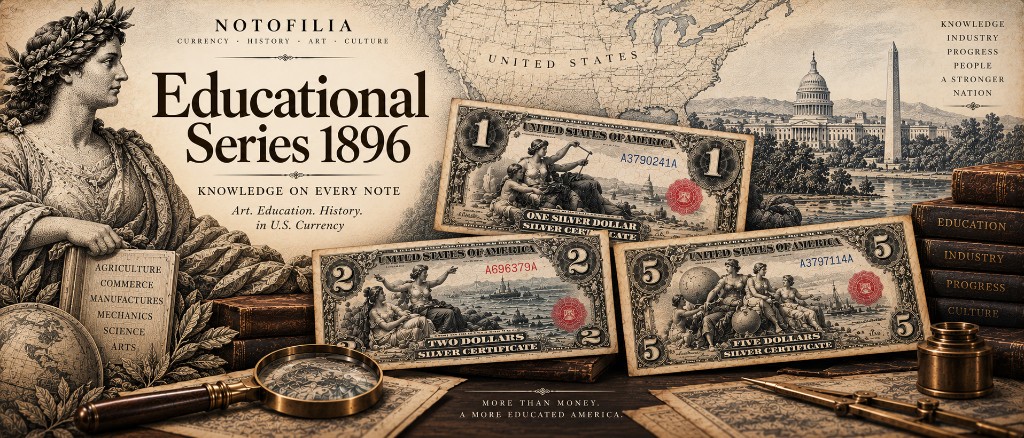
Three large-size silver certificates — $1, $2, and $5 — commissioned from muralists and withdrawn within a few years. The $1, Fr. 224, serial B3207078, the $2, Fr. 247, serial 1712091, and the $5, Fr. 270, serial 31528195, already have note pages.
·
-

$1 · Silver Certificate · Series 1896
Pick P#335(1) · Fr. 224 · Serial B3207078
Open the note page → -

$2 · Silver Certificate · Series 1896
Pick P#336(1) · Fr. 247 · Serial 1712091
Open the note page → -

$5 · Silver Certificate · Series 1896
Pick P#337(3) · Fr. 270 · Serial 31528195
Open the note page →
In 1896 the Bureau of Engraving and Printing issued three silver certificates that set aside the centered portrait and geometric lathe guilloche for mural allegories. The series takes its name from the title of the $1, History Instructing Youth. Only the $1, $2, and $5 were released. Within a few years the Treasury replaced them with the Series of 1899. The $1, Fr. 224, serial B3207078, Tillman–Morgan signatures, already has a note page. The $2, Fr. 247, serial 1712091, plate C, Tillman–Morgan signatures, also has a note page. The $5, Fr. 270, serial 31528195, plate C, Lyons–Roberts signatures, also has a note page.
Silver, bimetallism, and the certificate
A silver certificate stood for silver held in Treasury vaults. After the Civil War the United States tied the dollar to gold. The Coinage Act of 1873 left the standard silver dollar off the list of authorized coins; agrarians and Western miners called it the “Crime of ’73.” Deflation made farm debts harder to pay while the Comstock Lode and other strikes flooded the silver market. The political demand was free and unlimited coinage at the legal ratio of 16 to 1.
The Bland-Allison Act of February 1878 passed over Rutherford B. Hayes’s veto and required the Treasury to buy between two and four million dollars of silver bullion each month and coin it. The silver dollar was too heavy for daily trade. The paper that represented it began at $10 and above. On 4 August 1886 the act was amended to allow $1, $2, and $5 certificates.
The Sherman Silver Purchase Act of 1890 required the purchase of 4.5 million ounces a month. That inflow of silver weakened the gold reserve and fed the Panic of 1893. Grover Cleveland won repeal late that year. In 1896, the year of William Jennings Bryan’s “Cross of Gold” speech, the Treasury commissioned these designs to give a contested paper the look of a work of art.
Claude M. Johnson and the pocket mural
The visual language came from the American Renaissance and from the 1893 World’s Columbian Exposition in Chicago, the “White City”: Beaux-Arts symmetry, neoclassical façades, and allegorical murals. The fair drew more than 27 million visits in six months.
Claude M. Johnson, Chief of the BEP, commissioned the faces in 1893 from three Paris-trained muralists — Will H. Low, Edwin H. Blashfield, and Walter Shirlaw — rather than from the bureau’s usual bank-note designers. The sources put the fee at $800 per approved design and give an inflation-adjusted equivalent above $20,000 today. Johnson ordered that the face carry no geometric lathework. No federal note issued since 1861 had lacked that device on the obverse. Chief Engraver Thomas F. Morris opposed the order on counterfeiting grounds and was overruled.
The original plan ran through $1, $2, $5, $10, $20, $50, $100, $500, and $1,000. Only the three low denominations circulated. The sources say five of the original canvases still hang at the BEP.
$1: History Instructing Youth
The face is by Will H. Low, engraved by Charles Schlecht. Schlecht began in August 1892 and finished on 1 January 1895; the design was accepted on 10 July 1894 and printing started on 18 April 1896. History, in a laurel wreath, reclines on a marble block and points with her right hand toward the Potomac, the Washington Monument, and the Capitol dome. A boy stands beside her. At right the Constitution is displayed; a flag lies across History’s lap. The border carries the surnames of 23 Americans — among them Washington, Franklin, Jefferson, Hamilton, Lincoln, Fulton, Morse, and Grant — each in a wreath. An open book sits in each lower corner.
The back, by Thomas F. Morris, restores the lathework missing from the face. Martha Washington, at left, is Charles Burt’s 1878 engraving; George Washington, at right, is Alfred Sealey’s of 1867. L. F. Ellis, James Kennedy, D. S. Ronaldson, G. U. Rose, Jr., and E. M. Hall also worked on the back. A large “1” fills the center. Part of the public objected: no one should come between George and Martha.
On 2 August 1896 The New York Times said the preamble printed on the note spelled “tranquility” with one L. Notes were hoarded at a premium of 10 to 25 cents, on the assumption of a recalled error. The BEP answered that the single-L spelling was the accepted orthography in 1787 and that the note was not an error. The premium disappeared.
$2: Science, steam, and electricity
Johnson had first asked Low for a $2 titled War and Defence. He demanded changes — a softer chin on the male figure, the flag removed — and in January 1895 rejected the design as “not satisfactory.” The commission went to Edwin H. Blashfield, later the painter of the Library of Congress dome and of the Manufactures and Liberal Arts Building at the Chicago fair.
The title is Science presenting steam and electricity to Commerce and Manufacture. Five figures form a pyramid: Science stands and presents two youths — one holding a galvanic coil, Electricity; one holding a throttle, Steam — to Commerce, seated with a money bag, and Manufacture, seated among machinery and goods. Blashfield wrote Johnson that the composition was meant for a $50 and that compressing it onto a single-digit note ruined it. Johnson kept the $2. G. F. C. Smillie engraved the central vignette, Charles Schlecht the border, and Thomas F. Morris the ground and inner frame.
The back, designed by Morris and engraved by Lorenzo J. Hatch, places Robert Fulton and Samuel F. B. Morse in roundels.
$5: Electricity as the Dominant Force in the World
Walter Shirlaw — muralist, painter, former American Bank Note Company engraver, and a founder of the Society of American Artists — designed the vignette. Winged Electricity holds a glowing bulb. At her left, Jupiter rides a chariot with a thunderbolt; beside him Fame blows a trumpet over a map of the United States. At right a bald eagle stands, and behind it Peace holds a dove. The Capitol dome is in the distance. G. F. C. Smillie engraved the face. Morris persuaded Johnson to fill with plants a set of shields that had been blank.
An 1893 ivoryette of Annie Wintermuth carries a reverse inscription signed by Fred Smillie: “Miss Annie Wintermuth of New York City; Original for central figure and face in engraving of Shirlaw’s $5.00 ‘picture note’ silver certificate of 1894-5.” The E-Sylum and Intelligent Collector publish that find.
The back, by Morris and Hatch and engraved chiefly by Smillie, shows Ulysses S. Grant at left and Philip H. Sheridan at right. Collectors have rumored that the female head at top center was modeled on the wife of Thomas F. Morris. This page does not treat that as fact.
Denominations that were not issued
Designs were planned for $10, $20, $50, $100, $500, and $1,000. The $10, using artwork by Charles S. Reinhart, turned on Agriculture; Blashfield’s first layout was intended for the $50. Face die proofs and essays survive in BEP archives and sometimes appear at auction. Heritage has offered, for example, an Fr. 268 face proof. The reaction to the three issued values ended the series before the higher denominations were produced.
Objection, ink, and the teller’s window
Art critics praised the series. Banks and part of the public did not. On the $5, Electricity is shown with a bare breast, ordinary in a Beaux-Arts mural and unfamiliar on a note in daily use. Conservative groups — high-society women in Boston are the group usually named — asked that the “indelicate” figures be recalled and clothed. Several Massachusetts banks are reported to have refused the $5. That is the origin of the legend that the phrase “banned in Boston” began with this note. The BEP prepared a draped version for an 1897 printing; the series was canceled before it was made.
Use mattered more. The face intaglio called for a heavy charge of black ink. Notes left the press dark, and in circulation the ink smeared until the paper looked suspicious. Tellers missed the numeral in the upper corners: the mural filled the face and counting a stack was slow. The missing lathework on the face, as Morris had warned, left open grounds easier to copy by photography or lithography.
Lyman J. Gage and the Series of 1899
After William McKinley took office, Lyman J. Gage — a Chicago banker, of the First National Bank, and a gold-standard advocate — became Secretary of the Treasury in 1897. Gage did not want mural painters on the currency. He asked for a return to the “old style”: clear counters, visible blank paper, and lathework. The BEP stopped the Educational Series, dropped the higher denominations, and released the Series of 1899 silver certificates.
| Value | 1896 | 1899 |
|---|---|---|
| $1 | History Instructing Youth, edge to edge | “Black Eagle”: a centered eagle, broad white space, and large numerals |
| $2 | Pyramid of Science, Steam, Commerce, and Manufacture | “Mini-Porthole”: Washington between Mechanics and Agriculture, with lathework |
| $5 | Electricity, bare-chested | “Chief”: Running Antelope, with dominant “5” and “V” |
Smillie, who had just engraved Electricity, engraved Running Antelope, the only Native American used as the central motif on United States federal paper. Accounts say the three-feather headdress in the source photograph was too tall for the format and that Smillie replaced it with a Pawnee war bonnet. The mural note did not return.
Friedberg and the signatures
Large-size federal paper is arranged by Friedberg number: denomination, series year, seal, and the signature pair of the Register of the Treasury and the Treasurer of the United States.
| Value | Fr. | Signatures | Seal |
|---|---|---|---|
| $1 | 224 | James F. Tillman / Daniel N. Morgan | Small red, with rays |
| $1 | 225 | Blanche K. Bruce / Ellis H. Roberts | Small red, with rays |
| $2 | 247 | James F. Tillman / Daniel N. Morgan | Small red |
| $2 | 248 | Blanche K. Bruce / Ellis H. Roberts | Small red |
| $5 | 268 | James F. Tillman / Daniel N. Morgan | Small red |
| $5 | 269 | Blanche K. Bruce / Ellis H. Roberts | Small red |
| $5 | 270 | Judson W. Lyons / Ellis H. Roberts | Small red |
Blanche K. Bruce, Register from 1897 to 1898 (Fr. 225, 248, and 269), had been enslaved, was the first African American to serve a full term in the Senate, and was the first whose signature appeared on United States paper money.
| Value | Pick | Friedberg | Numista | 100 Greatest |
|---|---|---|---|---|
| $1 | P#335 | Fr. 224 (Tillman–Morgan), Fr. 225 (Bruce–Roberts) | N#207329 (opens in a new tab) | #7 |
| $2 | P#336 | Fr. 247 (Tillman–Morgan), Fr. 248 (Bruce–Roberts) | N#307145 (opens in a new tab) | #11 |
| $5 | P#337 | Fr. 268 (Tillman–Morgan), Fr. 269 (Bruce–Roberts), Fr. 270 (Lyons–Roberts) | N#332092 (opens in a new tab) | #5 |
Format and look of the type
All three values are large-size silver certificates, before the 1929 size reduction. Numista lists the $1 at 187 × 79 mm and the $2 at 189 × 79 mm. The Numista page for the $5 gives no size. The Smithsonian gives about 18.8 × 8.1 cm, the type measure already used on the $1 record. That is not a caliper reading of the sleeved notes in this case.
Face in black intaglio, mural edge to edge, small red Treasury seal (with rays on the $1). Blue serials. Green back with guilloche lathework. There is no large counter in the upper corners of the face — one reason tellers disliked counting them.
How the series is collected
Two usual goals:
- Type set: one note of each denomination ($1, $2, $5). The set most often assembled outside specialist large-size cabinets.
- Friedberg set: all seven signature combinations — Fr. 224 and 225 ($1), Fr. 247 and 248 ($2), Fr. 268, 269, and 270 ($5).
Relative availability today, grade for grade: the $1 is the entry point; the $2 is clearly scarcer; the $5 is the dearest and the most contested. On the $1, Fr. 224 is more common than Fr. 225. On the $5 the three signature pairs are not interchangeable. Bowers and Sundman, 100 Greatest American Currency Notes, rank the $5 at #5 and the $1 at #7. Rank #11 for the $2 is the place assigned in summaries of that book and in the PMG type set that follows it. This page did not open the volume for that rank.
Published printings versus observed serials
This page does not invent a BEP total where no closed production book was consulted.
On the $1, numbering is continuous from Fr. 224 into Fr. 225: it does not restart when the signers change. The first issued sheet carries serials 1–4 and the second sheet 5–8, so the series begins at 1. This page does not set the serial at which Tillman–Morgan gives way to Bruce–Roberts, or the last number printed for Fr. 224. No BEP production ledger consulted here closes that figure, and a round break at 30,000,000 does not fit: Fr. 224 notes survive above 30 million.
| Fr. | Signatures | Documented serials | Relative availability today |
|---|---|---|---|
| 224 | Tillman–Morgan | From 1 and at least into the 33-million range. Examples: 29,871,139 and 33,265,935. | The more common variety |
| 225 | Bruce–Roberts | Examples in the 38- to 54-million-plus range: 38,334,959, 45,911,746, 49,933,739, and 54,448,111. | Scarcer |
If the counter never reset, the two signature pairs together cover on the order of 55–56 million counts. That is a reading of observed serials, not a BEP audit.
The $1 in this collection is Fr. 224, Tillman–Morgan, serial B3207078: counter 3,207,078. It falls very early in Fr. 224 production, within the first several million. It already has a note page. The serial is neither low nor fancy: it is ordinary, only early against a count that runs into the tens of millions.
On the $2, catalog and dealer sources quote different printings by signature. PCGS has published (opens in a new tab), for Fr. 248 (Bruce–Roberts), an estimated printing of about 11,252,000 and survival on the order of 1,000 notes. That figure is not audited here.
On the $5, no round millage is copied here. It is the least available value in the current market.
Printed, surviving, and slabbed are three different numbers.
Certified population
PMG population has been cited at about 4,400 Fr. 224 and 1,670 Fr. 225. That counts what is in holders today, not what left the press.
This page does not set its own census for the $2 and $5. Check PMG Population and PCGS Banknote when pricing a note: both denominations have far less certified supply than the $1, and Gem notes with EPQ/PPQ are auction lots.
Stars, plates, and condition
Replacements. On Treasury large-size paper of this period a replacement star, when present, sits in front of the serial, not after it. Star examples of the Educational $1 exist (encapsulated Fr. 225 stars have been offered). They do not carry a separate Friedberg number. None is in this case.
Plate. Large-size sheets for this series are four subjects. Plate letter (A–D) is a minor variety, not a distinct Fr. number. The $2 in this collection is plate C. On the $5, letter C is the letter the 2013 lot records; it is not securely readable on the photographs in the note record.
Typical condition. Face intaglio took a heavy black inking; in circulation the ink smeared and the paper darkened. The mural runs to the edge, so wide margins are scarce. Teller pinholes, later washing (EPQ/PPQ lost), and old repairs are routine. That is why a Very Good or Very Fine $1 is common and a Gem $5 is not.
Proofs, essays, and the draped $5
Besides the three issued values, archive material appears at auction from time to time:
- Face proofs and essays for unissued denominations ($10, Reinhart / Agriculture; Blashfield’s first layout intended for the $50).
- Face proofs of issued types (Heritage has offered an Fr. 268 face proof).
- First uncut sheets, serials 1–4 of all three denominations. Claude M. Johnson kept them in a folio titled UNITED STATES PROOF BANK NOTES ISSUED 1896, with a three-page typewritten letter. Those sheets later entered the cabinet of Harry W. Bass, Jr., graded AU-55 by PMG. Bowers, presenting them at auction, called them the most important lot ever offered in the history of collecting American paper money. The Monarch Collection holds another sheet of four $1 notes, also PMG 55; CoinWeek describes it as the only known sheet with the Bruce–Roberts signatures, against other $1 sheets that carry Tillman–Morgan.
- A draped $5 prepared for 1897; the series was canceled before that printing.
None of those objects is in this case.
Grades, cited figures, and sheets held elsewhere
PMG and PCGS Banknote grade on the 1–70 scale. EPQ and PPQ mark original, unwashed paper. Smeared ink and daily use leave few high-grade notes. The figures below are those published by the dealer and auction links cited at the end. They are not hammers checked by Notofilia.
For the $1, a Very Good 8 has been listed in the $300 to $450 band; a Very Fine 25 to 30, between $900 and $2,000; a Gem Uncirculated 66 EPQ, above $15,000 to $20,000 at a cited auction. For the $2, a circulated note has been placed from about $3,000; a video cites $40,800 for a PMG 67 EPQ. For the $5, even low grades are described in those sources as several thousand dollars; The E-Sylum records $72,000 in 2024 for an Fr. 268 in PCGS 68 PPQ, tied for finest known in that account.
The uncut sheets, the proofs, and the draped $5 are described above. They are not in this case. The cut $1, Fr. 224, serial B3207078, already has a note page. The cut $2, Fr. 247, serial 1712091, also has a note page. The cut $5, Fr. 270, serial 31528195, also has a note page.
Sources
- Wikipedia — Educational Series (opens in a new tab)
- Wikipedia — Silver certificate (United States) (opens in a new tab)
- Wikipedia — History Instructing Youth (opens in a new tab)
- Wikipedia — World’s Columbian Exposition (opens in a new tab)
- Smarthistory — The White City and the fairgrounds (opens in a new tab)
- PMG — The Making of History: Educational Series (part 1) (opens in a new tab)
- PMG — The Making of History: Educational Series (part 2) (opens in a new tab)
- PMG — 1896 uncut sheets (Bass) (opens in a new tab)
- The E-Sylum — 1896 Educational Series: a flawed experiment (opens in a new tab)
- The E-Sylum — the artist behind the Educational Series (opens in a new tab)
- PCGS — the Series of 1896 $2 silver certificate (opens in a new tab)
- World Money Art — US “Educational” Notes of 1896 (opens in a new tab)
- Great American Coin Company — a brief history of silver certificates (opens in a new tab)
- Miller Center — Grover Cleveland, domestic affairs (opens in a new tab)
- CoinWeek — the 1899 $2 and the 1886 precedent (opens in a new tab)
- CoinWeek — the Harry W. Bass Jr. collection of Educational Notes (opens in a new tab)
- CoinWeek — PMG and the Monarch $1 sheet (opens in a new tab)
- CoinWeek — 1896 Educational set at GreatCollections (opens in a new tab)
- Sahara Coins — guide to the 1896 Educational Notes (opens in a new tab)
- Collectibles Currency — the 1896 $5 Educational note (opens in a new tab)
- Bellevue Rare Coins — why the design did not last (opens in a new tab)
- Playing in the World Game — Beauty in Paper (opens in a new tab)
- World Banknotes & Coins — the 1896 $5 (opens in a new tab)
- Intelligent Collector — the model for the $5 (opens in a new tab)
- Heritage — Fr. 268 face proof (archive lot, not a piece in this collection) (opens in a new tab)
- Wikipedia — Presidency of William McKinley (opens in a new tab)
- r/papermoney — account of the 1899 $5 “Chief” (opens in a new tab)
- GreatCollections — Fr. 269 Bruce / Roberts archive (opens in a new tab)
- CV Coins — Fr. 225 listed PMG Very Good 8 (dealer price, not a hammer) (opens in a new tab)
- Find Bullion Prices — ranges cited for silver certificates (opens in a new tab)
- Video cited for a PMG 67 EPQ $2 (not verified here) (opens in a new tab)