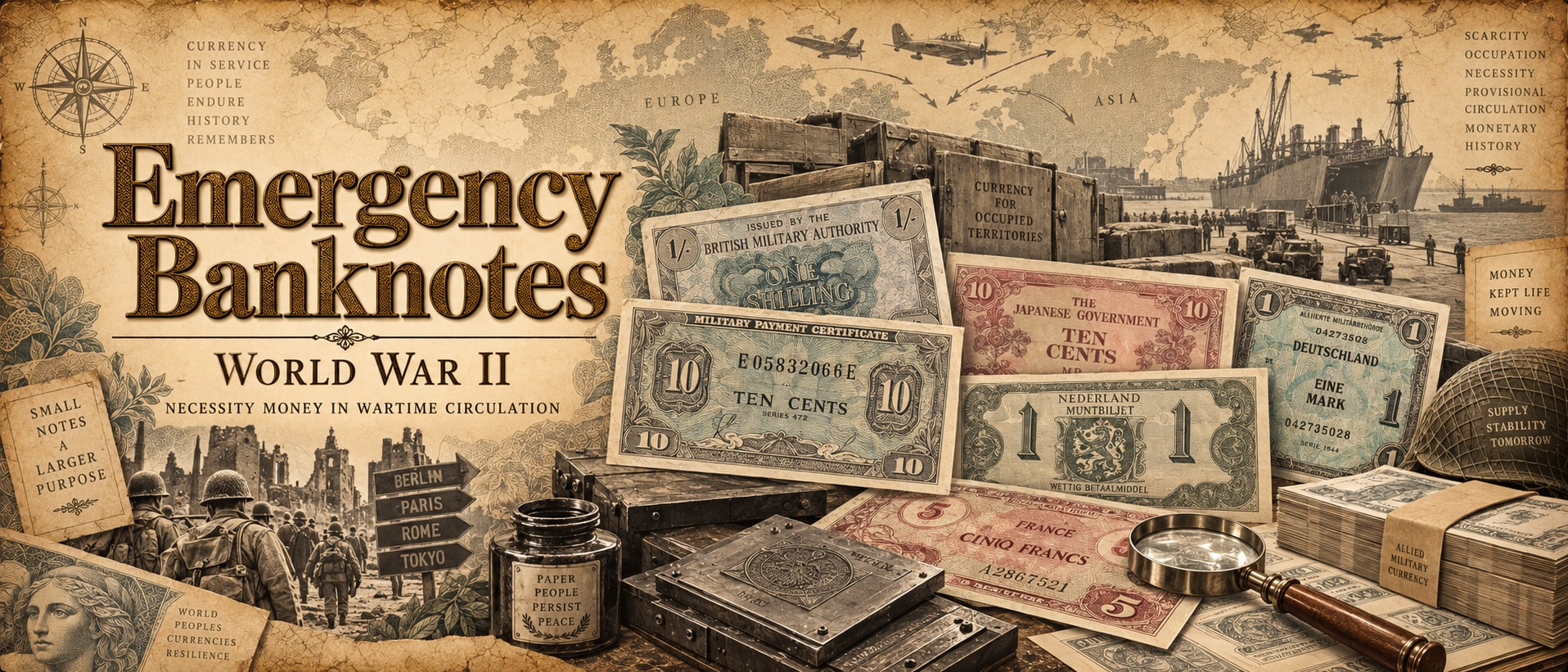
Hawaii, North Africa, Allied military currency, Operation Bernhard, and postwar British forces vouchers: paper money as a weapon from 1939 to 1948.
Text by Yezid Acosta · Updated 10 October 2026
The frame
- Period
- 1939–1948, with the BAFSV echo running to 1982.
- In this case
- Series 1935A HAWAII $1 (Hawaii P#36 · Fr. 2300), serial S40499058C, and Series 1934A HAWAII $20 (Fr. 2305), serial L86654132A, numbered in 1944; the Series 1934A HAWAII $5 (P#38 · Fr. 2302), serial L68013147A, L–A block; the Series 1934A HAWAII $10 (P#40 · Fr. 2303), serial L45104670B, L–B block; the Series 1935A yellow-seal $1 (Fr. 2306), serial B52497547C, B–C block, and serial C78095129C, C–C block; and the Series 1935A S-experimental $1 (P#416AS · Fr. 1610), serial S74796042C, S–C block, and the Series 1935A R-experimental $1 (P#416AR · Fr. 1609), serial S71208111C, S–C block.
- Issues
- HAWAII overprints, yellow-seal silver certificates, R/S experimentals, Allied Military Currency (lire, francs, marks, schillings, and yen), Theresienstadt Ghetto-Kronen and other ghetto and camp paper, Operation Bernhard, Japanese invasion money and military yen, Reichskreditkassenscheine, Channel Islands issues, Soviet 1944 notes, 1943 Dutch muntbiljetten, and BAFSV.
Federal paper from the war years, military payment certificates, and the Philippine Victory Series have their own cases.
Hawaii Series
-

$1 · HAWAII · Series 1935A
Pick Hawaii P#36 · Fr. 2300 · Serial S40499058C
Open the note page → -

$5 · HAWAII · Series 1934 A
Pick P#38 · Fr. 2302 · Serial L68013147A
Open the note page → -

$10 · HAWAII · Series 1934 A
Pick P#40 · Fr. 2303 · Serial L45104670B
Open the note page → -

$20 · HAWAII · Series 1934 A
Pick Fr. 2305 · Serial L86654132A
Open the note page →
North Africa Series


R and S experimentals


The Second World War recast armies and factories — and it also turned monetary policy into a full-spectrum weapon. Fiduciary paper stopped being only a means of payment and a store of value. Control of the money stock, the exchange rate, and liquidity in occupied territory could wreck an economy as thoroughly as a bombing campaign. Induced inflation, occupation currencies used for plunder, and industrial-scale counterfeiting were deployed to freeze markets, sap civilian morale, and fund covert work.
When troops cross a border they bring enormous purchasing power with them. Paying them in dollars or sterling inside a ruined economy feeds the black market, drives local prices, and risks letting that hard currency fall into enemy hands. Allies and Axis answered with several kinds of emergency money: geographically ring-fenced issues that could be repudiated, occupation military currency, canteen vouchers for troop control, and paper designed to extract resources or to wage psychological fraud.
This case follows that network: the Hawaii and North Africa notes and the United States R/S experimentals; Allied Military Currency in lire, francs, marks, schillings, and yen; British, Soviet, and Dutch occupation paper that falls in the same 1939–1948 arc; money used as an illusion at Theresienstadt and in other ghettos and camps; Operation Bernhard; Japanese invasion money — with military yen kept separate — and the Reichskreditkassenscheine; and, as the war closed, British Armed Forces Special Vouchers. It is not a price list. The frame is historical; further down, a map of types, relative rarity, and fakes turns that frame into a collecting guide. Notofilia’s virtual case already holds United States paper from the war years, the Philippine Victory Series, the Series 1935A HAWAII $1, serial S40499058C, the Series 1934A HAWAII $5, serial L68013147A, the Series 1934A HAWAII $10, serial L45104670B, the Series 1934A HAWAII $20, serial L86654132A, and the Series 1935A yellow-seal $1, serial B52497547C, and the same type, serial C78095129C.
United States defensive and experimental issues
After Pearl Harbor the Treasury and the War Department saw a clear logistical risk: if Japan or Germany captured large stocks of ordinary dollars, they could spend them in neutral countries for raw materials, espionage, or to prop up their own currencies. The answer was compartmented series with a visual switch for instant repudiation.
The Pacific vulnerability: HAWAII overprints
7 December 1941 left the Territory of Hawaii open to invasion. On 10 January 1942 the military governor, Lieutenant General Delos C. Emmons, ordered regular United States currency withdrawn. Individuals could keep no more than $200; businesses, $500, with exceptions for documented payrolls. Holding or exporting large sums of unmarked dollars became a serious offence.
The Hawaiian series was issued on 25 June 1942. In March the Treasury had brought $20 million of the new notes to the islands for the exchange. The plates were those of silver certificates and of Federal Reserve notes of the San Francisco bank, but the Treasury seal and serials changed from blue and green to an unmistakable brown. “HAWAII” was overprinted vertically on both face margins and, on the back, in hollow letters that fill almost the entire field.
The contingency was blunt: if Japan took the islands, Washington would declare every note with that overprint and that seal worthless. From 15 August 1942, unmarked notes were banned in the Territory.
Withdrawing some $200 million in regular currency raised another problem: shipping it back to the mainland through waters hunted by Japanese submarines was an unjustifiable risk. The notes were burned in Hawaii. The work began at the Nuʻuanu crematorium, with screens to catch fragments; when that was not enough, the furnaces of the Aiea sugar mill finished it.
| Denomination | Series | Regular printage | Stars | Relative rarity | In this case |
|---|---|---|---|---|---|
| $1 silver certificate. George Washington | 1935A (Fr. 2300) | 35,052,000 | 204,000 | common; the star is scarce against the regular | S40499058C |
| $5 Federal Reserve Note. Abraham Lincoln | 1934 and 1934A (Fr. 2301–2302) | 9,416,000 (both series combined) | no figure in that table | shortest regular printage; the Fr. 2301m mule is kept apart | L68013147A |
| $10 Federal Reserve Note. Alexander Hamilton | 1934A (Fr. 2303) | 10,424,000 | no figure in that table | less often seen than the $1 | L45104670B |
| $20 Federal Reserve Note. Andrew Jackson | 1934 and 1934A (Fr. 2304–2305) | 11,246,000 (both series combined) | 54,500 | less often seen than the $1; the star is scarce | L86654132A |
Compulsory use lasted until 21 October 1944, when an invasion of the archipelago was no longer plausible. Official withdrawal began in April 1946. Many notes survived because service members and residents kept them as souvenirs.
In modern notaphily they are a war type, not a trinket. The 1935A $1 (Fr. 2300) is the common note; the $5 has the shortest regular printage. The keys are paper quality — especially an EPQ designation — the sharpness of the overprint (it was a separate pass, often light or crooked), and star replacements. Stars exist in every denomination. The type records publish 204,000 for the $1 and 54,500 for the $20; the $5 and $10 have no star figure in that same table, and in hand they remain far scarcer than the $1 star. The series’ Federal Reserve Notes are San Francisco district L / 12: the $5 in this case is the L–A block, the $10 is L–B, and the $20 is L–A. The $1 is a silver certificate; the S prefix on S40499058C is not a district letter.
A mule pairs a 1934 face plate (small plate number) with a 1934A back (large plate number), or the reverse. On the $5 that cross is Fr. 2301m. A blue or green seal with “HAWAII” added later is not this series: the period overprint belongs with brown seal and serials, on both face margins and in outline letters on the back. This case records the Series 1935A HAWAII $1, serial S40499058C (Hawaii P#36; numbered in 1944; PMG 58 EPQ — Choice About Uncirculated), the Series 1934A HAWAII $5, serial L68013147A (P#38; Fr. 2302; L–A block; unslabbed), the Series 1934A HAWAII $10, serial L45104670B (P#40; Fr. 2303; L–B block; circulated), and the Series 1934A HAWAII $20, serial L86654132A (Fr. 2305; numbered in 1944; circulated). It does not publish auction or dealer prices. For grading houses see the ranking of certifiers; for serial patterns, special serial numbers.
Operation Torch: the North Africa yellow seal
The same logic was applied to the European–African theatre. Before Operation Torch (November 1942), paying troops in ordinary dollars risked a Rommel haul flooding Axis coffers with standard United States currency.
The Treasury chose a quieter mark than Hawaii’s: $1, $5, and $10 silver certificates with a bright yellow Treasury seal and blue serials, and no giant word on the back. If the Wehrmacht captured a depot, the yellow seal could be demonetized at once.
| Denomination | Series | Friedberg | Documented printage |
|---|---|---|---|
| $1 | 1935A | Fr. 2306 | 26,916,000 |
| $5 | 1934A | Fr. 2307 | 16,710,000 |
| $10 | 1934 | Fr. 2308 | included with 1934A; the 1934 type, with mules, is the scarce one |
| $10 | 1934A | Fr. 2309 | 21,860,000 with Fr. 2308 |
Those notes served in North Africa, in Operation Husky (Sicily, July 1943), and in the first weeks in Italy, until occupation lire replaced them. Star replacements exist for all four numbers; Fr. 2308 stars are especially scarce. A mule of that 1934 $10 is the same plate cross — a 1934 face with a 1934A back, or the reverse — and is part of why the type is the scarce one. The yellow seal fades: a washed yellow does not become a blue seal, and a tinted blue does not become a yellow one. The Treasury briefly considered using the yellow seal in the Pacific as well; the Hawaiian dollar stayed, because the central Pacific islands cleared through Hawaii and because the word “HAWAII” was a faster deterrent under martial law. This case records the $1 Fr. 2306, serial B52497547C, B–C block, in the second yellow-seal run of that block (B51624001C–B52624000C), and the same type, serial C78095129C, C–C block, in the second yellow-seal run of that block (C78000001C–C79904000C). Circulated, unslabbed.
The “R” and “S” experimental notes
The war also squeezed the materials in the paper itself — linen and cotton. In June 1944 the Bureau of Engraving and Printing printed exactly 2,368,000 Series 1935A $1 silver certificates, Julian–Morgenthau signatures, for a paper-durability test. The figures in the table are the regular, non-star run, and they close: 1,184,000 R notes on regular currency paper and 1,184,000 S notes on special experimental paper. A large red R or S was overprinted on the face, at lower right, beside the blue Treasury seal. R means regular paper. In 1944 the letter was not a rarity mark. S means special paper. Friedberg numbers them Fr. 1609 (R) and Fr. 1610 (S).
| Mark | Paper | Friedberg | Regular printage | Serial | Star |
|---|---|---|---|---|---|
| R | Regular | Fr. 1609 | 1,184,000 | S70884001C–S72068000C | 12,000 (*91176001A–*91188000A) |
| S | Special | Fr. 1610 | 1,184,000 | S73884001C–S75068000C | 12,000 (*91188001A–*91200000A) |
Ordinary blue-seal notes of the same S–C block were printed between the two experimental runs, S72068001C–S73884000C. On 20 June 1944 the experimental notes entered circulation through the Chicago Federal Reserve Bank. The test was inconclusive. The account usually repeated is that the public kept many as curios, so wear could not be tracked cleanly; the sources confirm that no result was reached. The stars sit outside the 2,368,000 and are much scarcer than the regular experimentals. Together the experiment is under 1% of all Series 1935A $1 silver certificates. Collectors often keep them as an R/S pair. No price is quoted here. This case records the $1 Fr. 1610, serial S74796042C, S–C block, in the run S73884001C–S75068000C. Circulated, unslabbed. This case also records the $1 Fr. 1609, serial S71208111C, S–C block, in the run S70884001C–S72068000C. Circulated, unslabbed.
Other emergency markings in the same arc
Two collector facts belong to the same thesis — a mark that lets a shipment be repudiated — and they are neither Hawaii nor the yellow seal.
Most Series 1929 Federal Reserve Bank Notes did not leave the vaults in the 1933 banking crisis, which is when they were printed. Friedberg records that they were released in 1942–1944, with a brown seal, in that series’ denominations ($5 to $100), to meet wartime demand for notes. They carry neither HAWAII nor a yellow seal: another brown-seal issue, earlier in design and late in use.
Neutral Ireland marked its 1940–1944 Legal Tender Notes with a war code (Special Identification Marking): a colored capital letter inside a circle, printed in the design rather than as a seal that could be peeled off. The Minister for Finance sanctioned the mark on 22 February 1941. It identified a shipment if bombing scattered it between England, where the notes were printed, and Ireland. The code stops on notes dated from 1945. The letters by denomination are in the Currency Commission and Central Bank of Ireland record; this page does not list them.
Allied Military Currency: liberation and inflation
Color-coded dollars protected the Treasury, but they did not solve what happened when troops entered a collapsed economy. A soldier with hard dollars priced food and clothing beyond the reach of local civilians, encouraged hoarding, and made the “liberators” unpopular. In a combat zone there was also no cooperating central bank.
War, Navy, State, and Treasury, with the British government, designed Allied Military Currency: temporary fiat of the Allied Military Government of Occupied Territories (AMGOT). Most of it was printed by the Bureau of Engraving and Printing and by Forbes Lithograph Manufacturing Company in Boston, in the native units: lire, francs, marks, schillings, and yen. It was issued to troops at a fixed dollar rate and declared legal tender by military edict.
The AM-lira and Italian inflation
The first large-scale use came with Husky (Sicily, July 1943) and the invasion of the mainland. AMGOT put hundreds of millions of AM-lire into circulation. The first 1943 printing was so hurried that it carried neither “Lira” nor the country name — those words were added three days after the landing, so Axis intelligence would not read the objective on the paper. Denominations ran from 1 to 1,000 lire; the fractional notes (1 to 10) were square and the high values rectangular, dollar-size. The back carried Roosevelt’s Four Freedoms in English. Series 1943A, Forbes only, dropped the 1- and 2-lira notes: inflation had already made them useless.
The shock to Italy was severe. The war had destroyed between 14 and 17 percent of fixed capital and wrecked transport. AMGOT set 100 AM-lire to the dollar — a political rate, not a market one — until 1946, when it moved to 225. That overvalued the dollar, cheapened the lira, and put imports out of reach. Because the AM-lira was interchangeable with the pre-existing lira, the new liquidity without matching goods collapsed the currency: it is cited as falling to a thirtieth of its pre-war value. The black market and local counterfeits — despite the lithographic inks — made the damage worse.
Stabilization took years. Luigi Einaudi and Donato Menichella at the Bank of Italy recovered monetary sovereignty with a four-point plan: dearer credit, a 15 percent cap on direct state financing of spending, Italy’s return to Bretton Woods, and a rebuilt bank supervisor. With the Marshall Plan, that cooled inflationary expectations and prepared the postwar economic miracle.
The AM-franc and Gaullist sovereignty
If Italy shows the danger of fiduciary inflation, France shows that paper is also a claim to legitimacy. Under the code name “Operation Tom Cat,” Washington printed francs for the Normandy troops. Charles de Gaulle, heading the Provisional Government, read it as an insult: unilateral note issue treated France as conquered ground, not a sovereign ally. He denounced the AM-francs as “billet drapeau” and, more contemptuously, as “monnaie de singe” — play money. The GPRF warned that paper without the French Treasury behind it would speed inflation.
There were two printings, distinct in collections today:
- Supplemental currency (first issue, 1944). Printed before the landing: a blue border, “SÉRIE DE 1944” and “ÉMIS EN FRANCE” on the face; on the back, the tricolor and “LIBERTÉ ÉGALITÉ FRATERNITÉ.” The GPRF held that a foreign power had no right to print the symbols of the state. Denominations ran from 2 to 5,000 francs.
- Provisional currency (second issue, 1944–1945). “ÉMIS EN FRANCE” was dropped. On the back, the flag gave way to the word “FRANCE,” without state heraldry.
Local banks and tax offices had to take them so trade could function behind the front. In June 1945, with the European war over, France moved quickly to replace them and demonetized the high denominations (50 to 5,000). The 2-, 5-, and 10-franc notes, of little macroeconomic weight, stayed as small change and were not fully retired until the euro.
The AM-mark, Operation Wild Dog, and the Soviet plates
No AMC issue had longer geopolitical consequences than the Allied military mark. Operation Wild Dog was meant to give one fiduciary currency to the four occupation zones — American, British, French, and Soviet — and to keep Germany a single economic unit.
Forbes designed and printed the notes in a dollar style: a security web, a floral ground, and an ornamental “M” on the back. The denominations were ½, 1, 5, 10, 20, 50, 100, and 1,000 marks. Serials coded the zone: “1” for the American, “0” for the British, “00” for the French, and a hyphen “-” for the Soviet. The secret printer’s mark was a tiny “F,” hidden in the scrollwork under the denomination at lower right on the face.
The breach began at the Treasury. Harry Dexter White, an architect of Bretton Woods, ignored British and American intelligence warnings and handed the Soviet Union the plates, the glass negatives, and the paper and ink specifications. Declassified records and much later historiography place him as a Soviet agent of influence; the point is not settled, and this page does not treat it as a verdict. With the plates, Giesecke & Devrient in Leipzig printed almost identical AM-marks without the “F.” Moscow used them to pay the Red Army months and years of arrears in Central Europe.
That uncapped issue set off inflation and a vast military arbitrage. Soviet soldiers, holding sacks of marks that were worthless in Moscow, bought watches, cigarettes, and luxuries from Americans. Washington kept the official exchange at 10 marks to the dollar to support its own troops’ remittances. GIs cashed the Soviet marks from the black market at Army pay offices for dollars. The Treasury ended up, in effect, subsidizing the Red Army: the War Department’s redemption deficit is put at $250 million and drew congressional inquiries. Refusing conversion would have meant admitting Germany’s economic partition; the United States did not do that until the 1948 Deutsche Mark.
The AM-schilling in Austria
Austria received its own Allied Military Currency in schillings, not marks. The AM-schilling became legal tender in 1945 alongside the pre-Anschluss Austrian schilling, at ten schillings to the dollar. Documented denominations run from 50 groschen to 1,000 schillings (50 groschen and 1, 2, 5, 10, 20, 25, 50, 100, and 1,000). It circulated until the national schilling of 1945–1947. That is the paper the introduction and the FAQ mean when they mention schillings: it is not a subtype of the AM-mark.
A-yen and B-yen
In the Pacific, AMC was issued in yen. A-yen served in the Pacific islands and, in 1945, in occupied metropolitan Japan. B-yen — a distinct color and a distinct intended use — stayed in the Ryukyu Islands, especially Okinawa, for years after the surrender: the U.S. military government kept it as occupation money until 1958, when the Japanese yen returned as the means of payment. Neither A-yen nor B-yen is Japanese military yen from the imperial occupation, which is treated below.
An AMC type map
The account above is the economic effect. This table is what a collector separates: 1943 against 1943A, the “F” against its absence, and A-yen against B-yen. Relative rarity, not a price.
| Family | Denominations | Printing and mark | What is kept apart |
|---|---|---|---|
| 1943 AM-lira | 1 to 1,000 lire | BEP and Forbes; the first sheets, without the word “Lira” | 1–10 square; high values rectangular. Common in the low values |
| 1943A AM-lira | no 1 or 2 lire | Forbes only | inflation had already emptied the 1 and the 2. Less often seen than 1943 |
| Supplemental AM-franc | 2 to 5,000 francs | “SÉRIE DE 1944,” “ÉMIS EN FRANCE,” and the tricolor | the state symbol de Gaulle rejected |
| Provisional AM-franc | the same | “FRANCE,” without “ÉMIS EN FRANCE” | the second iteration, 1944–1945 |
| AM-mark | ½, 1, 5, 10, 20, 50, 100, and 1,000 | Forbes with “F”; Leipzig without “F” | zone code: 1 American, 0 British, 00 French, − Soviet |
| AM-schilling | 50 groschen to 1,000 schillings | legal tender in 1945, at ten schillings to the dollar | not a subtype of the mark |
| A-yen | Allied occupation yen | Pacific islands and metropolitan Japan, 1945 | not gunpyō |
| B-yen | Allied occupation yen | the Ryukyus, chiefly Okinawa, until 1958 | theatre and date distinct from A-yen |
Theresienstadt: money as an illusion
While the powers fought a macroeconomic war, the SS used the form of money to mask the Holocaust in the Theresienstadt (Terezín) ghetto and camp, in occupied Czechoslovakia. This is not Allied military currency: it is an SS issue. The Ghetto-Kronen were printed at the National Bank of Prague in seven denominations — 1, 2, 5, 10, 20, 50, and 100 crowns — and dated 1 January 1943 (1. Jänner 1943); the U.S. Holocaust Memorial Museum notes that they were not distributed until May 1943. They bought nothing. Theresienstadt was shown to the Red Cross as a “model camp”: a paper wage was meant to suggest a self-supporting community and a legitimate wage for forced labor.
The face shows Moses with the tablets of the Law. The design was by the Czech Jewish poet and artist Peter Kien, a prisoner in the camp. Reinhard Heydrich rejected the first project and demanded a more caricatured Moses, with the hand covering the commandment “You shall not kill.” The back carries Jakob Edelstein’s signature as “the Elder of the Jews in Theresienstadt.” Kien later died at Auschwitz; Edelstein was also deported and murdered. Those notes are the conflict’s most macabre use of a currency press: money that purchased nothing, drawn to hide systematic murder.
Related camp paper
Theresienstadt was not the only ghetto or camp paper. In Łódź (Litzmannstadt) Chaim Rumkowski’s administration issued 1940 Quittungen, from 50 pfennig to 50 marks, for a separate closed circuit. Other ghetto issues exist. Wehrmacht stalags and oflags used Lagergeld — prisoner-of-war canteen vouchers — and other camps used internal scrip. Someone who finishes the seven crowns usually looks for that paper next.
This case does not record them one by one: it is not a Holocaust catalog. The type map is Lance K. Campbell, Prisoner-of-War and Concentration Camp Money of the 20th Century. Souvenir reprints of Theresienstadt are common. A 1943 Prague printing is separated from a modern copy by the paper, by the sharpness, and by a reproduction legend the original does not carry.
Operation Bernhard: state counterfeiting
Nazi monetary policy reached its greatest technical scale in Operation Bernhard, the largest state-backed counterfeiting scheme on record. The original plan — Arthur Nebe, approved by Heydrich in September 1939 as Operation Andreas — was to forge Bank of England notes and drop them from the Luftwaffe over British cities. Goebbels saw in that “grotesque plan” a chance to break sterling’s credibility.
Alfred Naujocks and the mathematician Albert Langer ran the first phase. Naujocks reached a point at which Bank of England experts in Switzerland passed 90 percent of the notes as genuine. Internal fights removed him and the plan stalled.
In 1942 SS Major Bernhard Krüger reopened it. Himmler dropped the air drop — air superiority over Britain was gone — and turned the shop toward funding intelligence, buying gold and hard currency in neutrals, and acquiring strategic materials. Krüger recruited more than 140 Jewish prisoners — engravers, lithographers, papermakers, bankers — and isolated them in blocks 18 and 19 at Sachsenhausen. Failure or sabotage meant execution; in return they received clean clothes, proper beds, and radios, unthinkable privileges in the rest of the camp.
Taking the pound apart
The Bank of England “White Note,” almost unchanged since 1855, was thought nearly impossible to forge. The prisoners broke it into seven problems:
- The paper. It was not wood pulp or ordinary cotton, but used linen rags, soiled and then washed. At Spechthausen they matched the chemistry of English water, the watermark, and the irregular “deckle” edge.
- The secret marks. More than 150 deliberate “errors,” different on each denomination (£5, £10, £20, and £50). One example: in the Britannia vignette, the bulge of a leaf near five o’clock stops short on genuine notes; they copied that, and the other 149 flaws.
- Numbering and ageing. Langer got far on the dates and on the chief cashier’s signatures, but the numbering cipher was never fully reproduced: the shop reused genuine serials. Then they rubbed, folded, and soiled the sheets, and even added bank stamps and pencil, so that a note that was too clean would not draw suspicion.
Impact and Lake Toplitz
By January 1943 Sachsenhausen was printing about 400,000 notes a month. At least 8.9 million pieces worth £134.6 million are documented — around 10 percent of the British Empire’s circulating paper at the time. Some estimates run as high as £300 million; this page keeps the documented figure and flags the other as a hypothesis.
Friedrich Schwend laundered the paper. It paid Elyesa Bazna (“Cicero”) £300,000 for secrets from the British embassy in Ankara, and £100,000 for Otto Skorzeny’s raid that took Mussolini off the Gran Sasso.
The Bank of England dates the first detection to 1943, not 1942. A clerk, entering a deposit from a British bank in Morocco (Tangier) into the leather ledgers, saw that the serial was already marked “paid”: the forgers had reused genuine numbering. That fits Krüger’s shop, reopened in 1942, and production running in January 1943. The Bank progressively withdrew denominations above £5 and, after the war, redesigned the paper with a metal thread and new colors. For the everyday gesture of spotting a fake in hand, see how to identify counterfeit banknotes; Bernhard is the extreme, state-run case, not a back-room shop.
At the end of the war the SS dismantled the presses and threw waterproof crates — pounds, plates, and records — into Lake Toplitz in Austria. Divers in 1959 confirmed the cache. By 1944 Himmler had ordered Salomon Smolianoff to copy the United States $100; the Reich collapsed before that shop matured.
How to tell a Bernhard note from a white note
Someone buying a “white fiver” needs tests in the hand, not only the figure of 8.9 million. The comparisons Pam West publishes, and Bryan Burke’s count of differences as PMG summarizes it, agree on these points. A prefix that appears on those lists is a warning, not a verdict: the same dates and the same prefixes exist on genuine notes.
- On a genuine note, Britannia wears a round white earring. On the forgery the head is engraved more coarsely.
- The hair and the robe folds come out heavier and less fine on the forgery.
- Beside the medallion, the line of ornament to Britannia’s right — the “hook” a collector looks for — runs into the design on a genuine note. On the forgery that hook does not close the same way.
- On the £10, the black circles around TEN are full circles on a genuine note. On the forgery they are malformed, and the corner circles are often only halves. Especially the bottom circle between the T and the E, and the lower-right indent of the N.
- The forgery’s watermark is often sharper than the genuine one. In the word ENGLAND in that watermark, the line that meets the triangle under the first N starts from the left on a genuine note and from the center on the forgery.
The numbering cipher was never fully broken, which is why the shop copied real serials: the same fact that exposed the Tangier deposit. A Bernhard note is often sold as a genuine white fiver. A prefix list is not enough without the earring, the hook, the circles, and the watermark.
Axis extraction: occupation and guerrilla money
Japanese invasion money and the puppet banks in China
From 1942 the Japanese Empire, through the Wartime Finance Bank and the Southern Development Bank (Nanpo Kaihatsu Kinko), imposed so-called Japanese Invasion Money. It forcibly replaced the Malayan dollar, the Burmese rupee, and the Netherlands Indies gulden, and it took the metal. It had no gold or silver behind it; it was printed to pay the occupation. In Malaya the collapse of value earned it the name “banana money.”
Collectors sort that paper by the block letter that marks the territory: M Malaya, B Burma, S Netherlands Indies, P the Philippines, and O Oceania. Those letters are not Japanese military yen (gunpyō), a separate family issued for imperial troops and for Chinese and Pacific areas under Army or Navy command. Schwan and Boling’s World War II Remembered is the type reference for both series. Arlie Slabaugh, Japanese Invasion Money, is the short monograph of the invasion series. Pick numbers the types; this page does not copy a price column.
There are two numbering styles. On many small notes of the first issue there are block letters only, with no long serial. On later notes and on the high values there is a serial plus a block letter. The first issue is 1942. The high denominations of 1944–1945 are the inflation paper. In the Philippines, among the 1944 100 pesos, the 1944 500, and the 1945 1,000, the 100 is treated as the least common of the three. It is not a museum rarity: all three are seen, and the 1,000 is the one that flooded the end of the occupation.
| Letter | Territory | What separates the type |
|---|---|---|
| M | Malaya | the 1942 issue against the inflation denominations; there it was called “banana money” |
| B | Burma | the same block letter, another territory |
| S | Netherlands Indies | not the 1943 Dutch liberation gulden |
| P | Philippines | 1942 (centavos and low pesos), 1943 (1, 5, and 10 pesos), 1944–1945 (100, 500, and 1,000). The 1944 100 is less common than the 500 and the 1,000 |
| O | Oceania | the letter least easily confused with military yen |
| Paper | Who issued it | For whom | Mark |
|---|---|---|---|
| Invasion money (JIM) | the Japanese government, through the Wartime Finance Bank and the Southern Development Bank | the occupied civilian population | letters M, B, S, P, O |
| Military yen (gunpyō) | the imperial Army or Navy | its own troops | a separate family; it does not carry those block letters |
| A-yen and B-yen | the U.S. military government | the Allied occupation | A in Japan in 1945; B in Okinawa until 1958 |
The United States counterfeited invasion pesos for the guerrillas and to disorder the occupation currency. The literature records a 1943 request from MacArthur to the OSS: five million 10-peso notes, three million 5-peso, one and a half million 1-peso, and five hundred thousand 50-centavo. That is a documented request, not a census of what reached the islands. Those counterfeits are not the propaganda overprint.
The Allied overprint, on captured occupation notes dropped from the air, reads THE CO-PROSPERITY SPHERE: WHAT IS IT WORTH? A fresh red stamp on a common JIM note imitates that souvenir: the period piece is judged by the ink and the paper, not by the sentence alone. Specimens carry 見本 (mihon), often in red. On the Philippine 100 pesos, Pick separates the issued note (112a) from the specimen (112s).
In China the mechanism went further. The Federal Reserve Bank of China (north) and the Central Reserve Bank (Wang Jingwei’s government in Nanjing) printed yuan at a pace that destroyed purchasing power day by day. By the end of the war the Central Reserve Bank was issuing 5,000- and 10,000-yuan notes: the middle class was stripped, and exports moved to Tokyo at null prices.
Philippine guerrilla and emergency paper
In the Philippines the guerrillas refused invasion money. With MacArthur’s tacit approval, provincial and municipal boards mimeographed emergency vouchers. The field is one of the widest in wartime paper: dozens of issuers, not a footnote to Iloilo. Among those a collector looks up are Bohol, Cebu, Cagayan, Leyte, Mindanao, Aklan, Palawan, Culion, and Iloilo, often on rustic presses such as Dialosa. Possessing them defied the Kempeitai and could mean death. This list is a map, not a census.
The catalogs keep pre-surrender issues apart from post-surrender issues. The first came out while Commonwealth authority still ordered the province, with tighter control of plate and signature. The second was issued by resistance boards after the USAFFE structure had fallen. Neil Shafer, Philippine Emergency and Guerrilla Currency of World War II, numbers those boards; Pick gives them as S-numbers. The two figures sit side by side. This page does not invent a Shafer number or an S-number for each province.
Republic Act No. 369, of 10 June 1949, redeemed paper registered and deposited under Republic Act No. 22. Pre-surrender issues were funded for redemption at par, with the wait the act itself provides if funds ran short above one thousand pesos. Post-surrender issues — guerrilla paper proper — followed a scale: the first ₱500 at one hundred percent, the band up to ₱1,000 at fifty percent, up to ₱10,000 at thirty percent, and the excess at fifteen percent. Not every note that appears at auction was on that register.
Modern reprints, fantasies of boards that never issued, and auction copies are common. Wartime paper is bond or mimeograph stock, sometimes typed or rubber-stamped, not Bureau of Engraving and Printing intaglio. A “VF” on that stock is not a Federal Reserve VF: weak ink, foxing, and crude paper are often original, not damage that should be pressed out.
The liberation counterpart is Victory Series No. 66, Philippine Treasury certificates printed in the United States and overprinted VICTORY. It replaces both invasion money and the guerrilla voucher. It is not a third name for the same object: it is the paper with which the Commonwealth paid again. The Philippines case documents it; this page does not open a new holding for it.
Reichskreditkassenscheine
In western Europe the Wehrmacht financed itself through the Reich Credit Offices and their Reichskreditkassenscheine. In France or Denmark that special mark was imposed at manipulated rates. Occupied central banks handed over real goods and foreign exchange for synthetic credit: the Reich pushed the army’s logistics cost onto the subject countries.
The denominations are 50 Reichspfennig and 1, 2, 5, 20, and 50 Reichsmark. They appeared first in occupied Poland, in 1939, and then in Denmark, Norway, Belgium, France, Luxembourg, the Netherlands, the Balkans, occupied Soviet territory, and Italy. A 1943 United States military report states that they were not negotiable in the Reich: the home mark was not to leave. Pick numbers them as the Reichskreditkassen series; this page does not lock a number it has not checked against the catalog in force. In collecting, the 1 and 5 mark are the ones most often seen; the 20 and the 50, less so.
The Channel Islands
Jersey and Guernsey, occupied from June 1940, did not receive AM-francs: they issued their own occupation paper. Jersey put 6 pence, 1 shilling, 2 shillings, 10 shillings, and £1 into circulation in 1941–1942, signed by the States treasurer. Guernsey, facing a shortage of small change, obtained German permission in 1941 to issue 6 pence, 1 shilling and 3 pence, 2 shillings and 6 pence, and 5 shillings; the 1 shilling and 3 pence proved awkward and much of it was re-stamped as 1 shilling. Guernsey’s 10 shillings and £1 arrived in 1943. Pick numbers both series. This page does not copy printages or prices.
Alderney has no comparable States series. The population was evacuated in June 1940; the island was left as a fortified place, with labor camps and, later, SS camps. A note offered as “Alderney occupation” needs a published issuer. The German paper that did circulate in the islands is the Reichskreditkassenschein, not a BAFSV and not an AM-franc.
The Soviet notes of 1944
When the Red Army moved into Central Europe it printed occupation paper for Hungary (pengő), Romania (leu), and Czechoslovakia (koruna). Those 1944 series paid troops and the Soviet military administration at rates fixed in Moscow. They are not AM-marks: they are Red Army issues, parallel to western AMC and earlier than the postwar national currencies. Denomination lists are in Pick and in Schwan–Boling. Those rates are not the western AMGOT schedules — 100 lire to the dollar, 10 marks to the dollar. This page does not copy a Soviet rate it has not checked in the source.
The Dutch notes of 1943
The Dutch government in exile commissioned in the United States, in 1943, a liberation series — muntbiljetten and high values — to replace occupation paper when the provinces were freed. They were printed in America, by the American Bank Note Company, and carried with Allied forces. They are not AM-francs or Indies gulden: they are paper of the Kingdom of the Netherlands, ready before the landing on the continent.
The muntbiljet exists because the coin was gone: silver and nickel had disappeared, and liberation would not find small change in the tills. The 1 and 2½ gulden replace that coin. The high values — 10, 25, 50, and 100 gulden — replace occupation paper. The series carries a watermark; the device is in Pick, and this page does not invent it.
BAFSV: the postwar black market
Surrender did not end the monetary chaos. In occupied Germany the Reichsmark bought nothing; the cigarette became an informal reserve. Soldiers of the British Army of the Rhine were paid in sterling and bought subsidized coffee, chocolate, and tobacco at NAAFI canteens, then sold them on the German black market. The British Treasury lost the subsidy.
The Army Council closed the circuit: British Armed Forces Special Vouchers. From 1 August 1946 BAOR troops stopped receiving regular sterling and were paid, in part, in BAFSV. The back warned that the notes were valid only in the NAAFI and that passing them to civilians was an offence.
| Series and year | Denominations | Printer | Reason | In collecting |
|---|---|---|---|---|
| 1st (August 1946) | 3d, 6d, 1/-, 2/6, 5/-, 10/-, £1 | Thomas De La Rue | Occupation of Germany | the one most often seen |
| 2nd (January 1948) | 3d to £5 | Thomas De La Rue | Cancellation of the black market | less common than the 1st |
| 3rd (printed 1948; issued 1956) | 3d to £1 | J. Waddington | Suez / Cold War | seen; it waited eight years to be issued |
| 4th (1962) | 1/-, £1, £5 | Bradbury Wilkinson | Strategic reserve; never issued | scarce |
| 5th (designed c. 1962) | reserve; never printed | Bradbury Wilkinson (order) | Strategic reserve; no examples | does not exist |
| 6th (1972) | 5p, 10p, 50p | Bradbury Wilkinson | British decimalization | more often seen than the 4th |
The 1st series was 52.4 million vouchers, about £10 million. Guilloché engraving did not stop local gangs and corrupt quartermasters from absorbing them. In secret the 2nd series was printed — with the legend “2nd SERIES” and the pound repeated ten times on face and back. On 6 January 1948 the books were frozen, the new vouchers issued, and the 1st series demonetized overnight. Anyone who had hoarded the old paper was left with scrap. Together with the Deutsche Mark, that broke the canteen black market.
The program lasted for decades: Suez (3rd), the 1960s reserve (4th printed and 5th only designed), and 1972 decimalization (6th), until withdrawal after the Falklands War in 1982. It is the bridge to the military payment certificates. Series 461, issued in September 1946, is the American cousin of that closed perimeter: the same year the BAOR stopped being paid in sterling. The Korea case explains the step from 461 to 481; the Vietnam case continues through 692. With them the United States closed, from 1946, the same gap that yellow-seal dollars and AMC had opened.
How this paper is collected
Notofilia does not publish prices. The rarity in the tables above — common, scarce, less often seen — is a bearing inside each series, not a quotation. What follows is the map a buyer uses, which the historical account does not replace.
Fakes and reproductions
This field is heavily reproduced. A fantasy HAWAII is a blue-seal or green-seal note with the word added. Theresienstadt has souvenir reprints. Philippine guerrilla paper has fantasies of boards that never issued, and modern copies. JIM has recent copies and new overprints of the Co-Prosperity Sphere sentence. A Bernhard note is offered as a Bank of England white note. The tests sit in the Hawaii, Theresienstadt, Bernhard, guerrilla, and invasion-money sections; they are not repeated here as a price list.
Varieties that separate the type
A star, a mule, a light or a bold HAWAII overprint, a plate number, a signature combination, a block letter, and the serial style — block only, or serial plus block — change the record. They do not change the historical argument. Fr. 2301m, the mule on Fr. 2308, and the two letters R and S, with 12,000 stars each, are the cases already measured in the tables.
Paper and grade
Guerrilla paper, on bond or mimeograph stock, is graded against that stock, not against Bureau intaglio. The yellow seal fades; rust from a clip is ordinary on a wartime note that lived in a billfold; a pressed note can be offered as XF when the paper is already dead. EPQ judges that the paper is original and exceptional: it is not a grade by itself. The HAWAII $1 in this case, PMG 58 EPQ, is a grade plus that judgment of the paper.
A type set
Thirteen pieces build a guide without turning the case into a catalog. Where this collection already has a record, the link is on the line.
- HAWAII $1, Fr. 2300 — S40499058C. The $10 and $20 of the same series are already recorded; they are not required for the minimum set.
- Yellow-seal $1, Fr. 2306 — B52497547C and C78095129C.
- An S experimental, Fr. 1610 — S74796042C. The R, Fr. 1609 — S71208111C.
- One AM-lira, 1943 or 1943A.
- One AM-mark with the “F.”
- One AM-mark without the “F.”
- One invasion note with block P, from the 1942 issue, not only the inflation 1,000 pesos.
- One guerrilla voucher from a board documented in Shafer.
- One note of Victory Series No. 66, the liberation counterpart.
- One Theresienstadt crown, any of the seven.
- One Reichskreditkassenschein.
- One Jersey occupation note.
- One 1st-series BAFSV.
The next step, outside the set, is a Łódź Quittung or a military yen. They are not required to close the 1939–1948 map.
Catalogs
Friedberg, Paper Money of the United States, for Hawaii, the yellow seal, the R and S experimentals, and the Series 1929 Federal Reserve Bank Notes. Pick, in the Standard Catalog of World Paper Money, for AMC, invasion money, the Reichskreditkassen, the Channel Islands, the muntbiljetten, and the guerrilla S-numbers. Shafer for the Philippine boards. Schwan and Boling, World War II Remembered, for the map of the war. Slabaugh for invasion money. Campbell for camp paper. Pam West publishes the Bernhard prefixes; Bryan Burke counts the differences from the white note. The Irish war code is in the record Irish Paper Money summarizes. Wikipedia and the museum files carry the narrative; these books are what a collector opens next.
Conclusion
The emergency notes of 1939–1948 show that the economy was not an annex of the artillery: it belonged to the arsenal. Hawaii and North Africa are the success of compartmented logistics: a seal or a word was enough to isolate the dollar without stopping wartime trade. AMC shows the other face: the AM-lira wrecked Italian prices; the AM-franc collided with Gaullist sovereignty; the AM-mark, with the plates in Leipzig, brought forward the economic border of the Cold War. The AM-schilling and A- and B-yen complete that map; the Channel Islands, the Soviet paper of 1944, and the Dutch muntbiljetten of 1943 remind us that the arc is not only Washington and Berlin.
The Axis used paper to extract, not to stabilize: Japanese invasion money and the RKKS loaded the war deficit onto occupied banks. At Theresienstadt the money did not buy: it sold an illusion. Bernhard — nearly £135 million forged by 140 prisoners — forced the Bank of England to redesign its circulating paper. The BAFSV remind us that, once the shooting stopped, an overnight demonetization could restore a perimeter as well as a decree.
Yellow-seal certificates, Iloilo vouchers, or pounds lifted from Toplitz are the printed record that, in that war, fiduciary faith was a front as well. The type map, the fakes, and the set of thirteen pieces sit above; they do not dilute that argument, and they do not quote the market.
Federal paper from the war years is documented in the United States case. United States
The perimeter that, from 1946, closed the gap opened by yellow-seal dollars and AMC lives in the Korean War MPC case. MPC - Korean War (1951 - 1954)
The same perimeter, later in the Indochina theatre, continues in the Vietnam MPC case. MPC - Vietnam War (1955-1975)
Philippine liberation paper, distinct from the guerrilla vouchers, is in the Victory Series. Philippines · Victory Series
The narrative rests on type records, museum files, and the bibliography cited here. Auction, dealer, and Heritage prices are not republished.
Sources
- Wikipedia — Hawaii overprint note (opens in a new tab)
- CoinSite — World War II Emergency Money (opens in a new tab)
- Pearl Harbor — history of the HAWAII overprint (opens in a new tab)
- CoinWeek — Hawaii Overprint Currency Note (opens in a new tab)
- Bureau of Engraving and Printing — historical fact sheet (opens in a new tab)
- Paper Money Buyers — Hawaii and North Africa (opens in a new tab)
- Wikipedia — Allied Military Currency (opens in a new tab)
- Wikipedia — AM-Lira (opens in a new tab)
- Wikipedia — AM-Franc (opens in a new tab)
- Wikipedia — AM-Mark (opens in a new tab)
- U.S. Holocaust Memorial Museum — AMC 100 francs (opens in a new tab)
- U.S. Holocaust Memorial Museum — AMC 50 marks (opens in a new tab)
- Numista — Allied Military Authority 1 mark (opens in a new tab)
- Numista — AMC 100 francs (opens in a new tab)
- Arizona Memory Project — AMC ½ mark (opens in a new tab)
- Bank of Italy — postwar monetary stabilization (opens in a new tab)
- Journal of European Economic History — capital destruction in Italy (opens in a new tab)
- NBER — halting inflation in Italy and France (opens in a new tab)
- AMEDD — civil affairs, chapter 9 (opens in a new tab)
- Strictly GI — Allied invasion currency (opens in a new tab)
- Warfare History Network — Harry Dexter White (opens in a new tab)
- Wikipedia — Operation Bernhard (opens in a new tab)
- PMG — Operation Bernhard (opens in a new tab)
- Bank of England — Operation Bernhard (opens in a new tab)
- International Spy Museum — Bernhard plate (opens in a new tab)
- PMG — propaganda notes in occupied China (opens in a new tab)
- Bank Note Museum — Chinese puppet banks (opens in a new tab)
- Calkins — Philippine guerrilla issues (opens in a new tab)
- Reichskreditkassen (credit-office context) (opens in a new tab)
- Lone Sentry — German currencies in occupied countries (opens in a new tab)
- Banknote World — BAFSV (opens in a new tab)
- National Army Museum — 1948 BAFSV (opens in a new tab)
- Imperial War Museums — 3-pence voucher (opens in a new tab)
- Littleton — wartime money (opens in a new tab)
- Schwan and Boling — World War II Remembered (WorldCat) (opens in a new tab)
- Lawrence Malkin — Krueger’s Men (opens in a new tab)
- Adolf Burger — Sachsenhausen memoir (The Devil’s Workshop) (opens in a new tab)
- U.S. Holocaust Memorial Museum — Theresienstadt 1 krone (opens in a new tab)
- Kenyon / Bulmash — Currency Notes from Theresienstadt (opens in a new tab)
- Wikipedia — Japanese invasion money (opens in a new tab)
- Wikipedia — Japanese military yen (opens in a new tab)
- Wikipedia — B yen (Okinawa) (opens in a new tab)
- Numista — BAFSV 5 shillings, 1st series (opens in a new tab)
- Royal Army Pay Corps — BAFSV history (opens in a new tab)
- Wikipedia — Banknotes of the British Armed Forces (opens in a new tab)
- CoinWeek — 1944 R and S experimentals (opens in a new tab)
- PMG — small-size silver certificates and R and S experimentals (opens in a new tab)
- USPaperMoney.info — Series 1935–1935D $1 serials (opens in a new tab)
- Friedberg / Berman — Emergency Notes (HAWAII and yellow-seal printages) (opens in a new tab)
- APMEX — North Africa yellow-seal notes (opens in a new tab)
- Wikipedia — Occupation of the Channel Islands (opens in a new tab)
- Wikipedia — Allied occupation of Austria (AM-schilling) (opens in a new tab)
- Wikipedia — Hungarian pengő (1944 Soviet issue) (opens in a new tab)
- Wikipedia — Dutch guilder (liberation muntbiljetten) (opens in a new tab)
- Wikipedia — Łódź Ghetto (Quittungen) (opens in a new tab)
- Republic Act No. 369 — redemption of emergency and guerrilla currency (opens in a new tab)
- Wikipedia — Philippine emergency circulating notes (opens in a new tab)
- Wikipedia — Japanese government-issued Philippine peso (opens in a new tab)
- Pam West — Operation Bernhard prefixes and tests (opens in a new tab)
- Pam West — Guernsey occupation issues (opens in a new tab)
- Irish Paper Money — war code, 1940–1944 (opens in a new tab)
- Bureau of Engraving and Printing — military payment certificates (Series 461) (opens in a new tab)
Frequently asked questions
What were the HAWAII overprint notes?
Silver certificates and Federal Reserve Notes with brown seals and serials and the word HAWAII, issued from June 1942. If Japan took the islands, Washington could declare them worthless at once. The 1935A $1 (Hawaii P#36; Fr. 2300) is the common type; 1935A is the series, not the numbering year. This collection records serial S40499058C and the 1934A $20 (Fr. 2305), serial L86654132A, both numbered in 1944, the 1934A $5 (Fr. 2302), serial L68013147A, L–A block, and the 1934A $10 (Fr. 2303), serial L45104670B, L–B block.
What was Allied Military Currency (AMC)?
Temporary AMGOT fiat, printed mainly by the BEP and Forbes, in lire, francs, marks, schillings, and yen. Troops were paid at a fixed dollar rate. In Italy it fed inflation; in France it collided with de Gaulle; in Germany Soviet plates without the “F” mark brought economic partition forward.
What was Operation Bernhard?
The largest state-backed counterfeiting scheme on record: the SS at Sachsenhausen forged Bank of England notes. At least 8.9 million pieces worth £134.6 million are documented. The Bank of England detected the paper in 1943 — a reused serial that arrived via Morocco — and withdrew the high denominations; after the war it redesigned the circulating notes.
What is a HAWAII overprint note worth?
Notofilia does not publish prices. The value of a HAWAII note depends on the Friedberg type, the denomination, the paper — including an EPQ designation — the sharpness of the overprint, and whether it is a star replacement. The 1935A $1 (Hawaii P#36; Fr. 2300) is the type most often seen; the $5, $10, and $20 notes, and the star notes, are scarcer. This case records serial S40499058C, the $5 Fr. 2302, serial L68013147A, the $10 Fr. 2303, serial L45104670B, and the $20 Fr. 2305, serial L86654132A; the market is not quoted.
What were the yellow-seal silver certificates?
Silver certificates of $1, $5, and $10 (Fr. 2306–2309) with a yellow Treasury seal, used in North Africa and in the first weeks in Italy. If the Axis captured a depot, Washington could demonetize that seal alone. The 1934 $10 (Fr. 2308) is the scarcest type. This case records the $1 Fr. 2306, serial B52497547C, B–C block, and serial C78095129C, C–C block, both circulated and unslabbed.
What were the R and S experimentals?
Two runs of 1,184,000 Series 1935A $1 silver certificates, Julian–Morgenthau signatures, released on 20 June 1944 through the Federal Reserve Bank of Chicago. The red R (Fr. 1609) marks regular paper; the red S (Fr. 1610), the special paper. This case records Fr. 1609, serial S71208111C, S–C block, in the run S70884001C–S72068000C, and Fr. 1610, serial S74796042C, S–C block, in the run S73884001C–S75068000C. Circulated, unslabbed. The market is not quoted.
What were the Theresienstadt Ghetto-Kronen?
Seven denominations (1 to 100 crowns) dated 1 January 1943, printed in Prague, with Moses and the tablets on the face and Jakob Edelstein’s signature. They bought nothing: they were meant to present Theresienstadt as a model camp. Peter Kien designed the type; Heydrich rejected the first drawing. This is not Allied military currency.
What is Japanese invasion money?
Fiduciary paper the Japanese Empire imposed in Malaya (letter M), Burma (B), the Netherlands Indies (S), the Philippines (P), and Oceania (O). It is not military yen (gunpyō) and not AMC A-yen or B-yen. In the Philippines the guerrillas issued their own vouchers, distinct from the Victory Series.
What were BAFSV for?
British Armed Forces vouchers, valid only in NAAFI canteens, meant to cut the postwar black market. The 1st series (1946) includes 3d, 6d, 1/-, 2/6, 5/-, 10/-, and £1. The 5th series was designed and never printed. The program lasted, with gaps, until 1982. Military payment certificate Series 461, of September 1946, is the American cousin of that perimeter.
How do you recognize an Operation Bernhard note?
A published prefix is a warning, not a verdict. On a genuine note Britannia wears a round white earring, the medallion hook runs into the design, the circles around TEN on the £10 are complete, and the watermark is usually less sharp. The numbering cipher was never fully reproduced: the shop reused genuine serials. Notofilia does not publish prices.
What is Philippine guerrilla paper?
Vouchers of provincial and municipal boards, pre-surrender or post-surrender, which Shafer and Pick S-numbers catalogue apart from invasion money. Republic Act No. 369 redeemed registered paper: at par for pre-surrender issues, and on a scale (100%, 50%, 30%, 15%) for post-surrender issues. Victory Series No. 66 is the liberation counterpart, not the same object. Fantasies and reprints are common.