United States · United States Mint
Gold dollar coin, 1856
Gold dollar · United States Mint · 1856
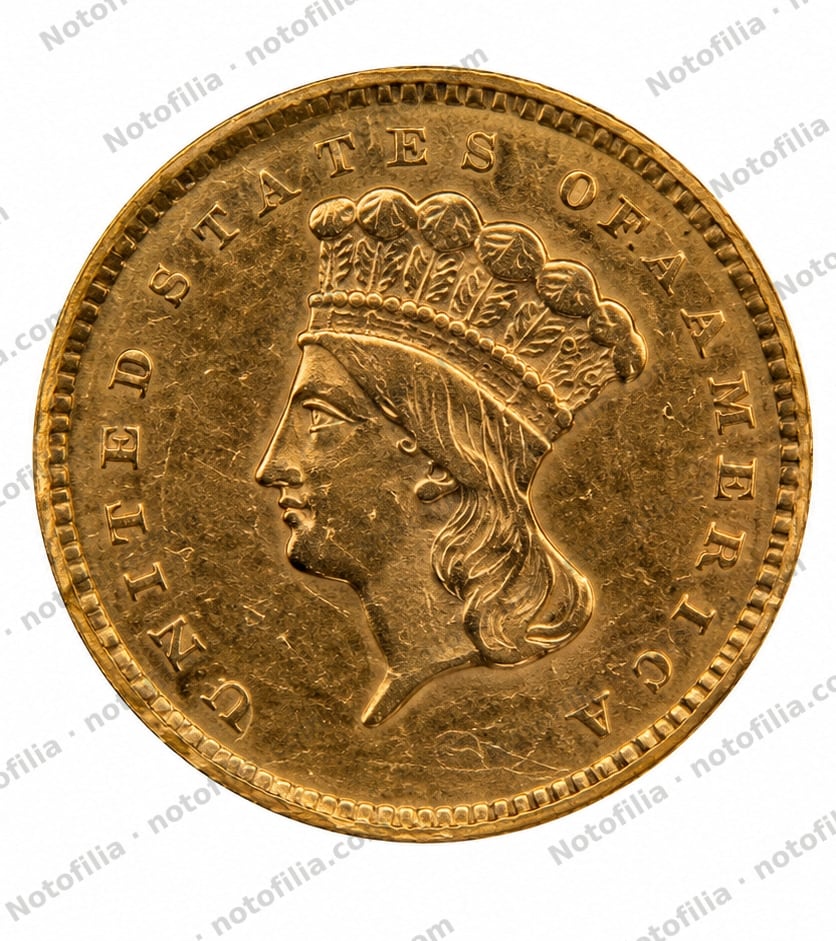
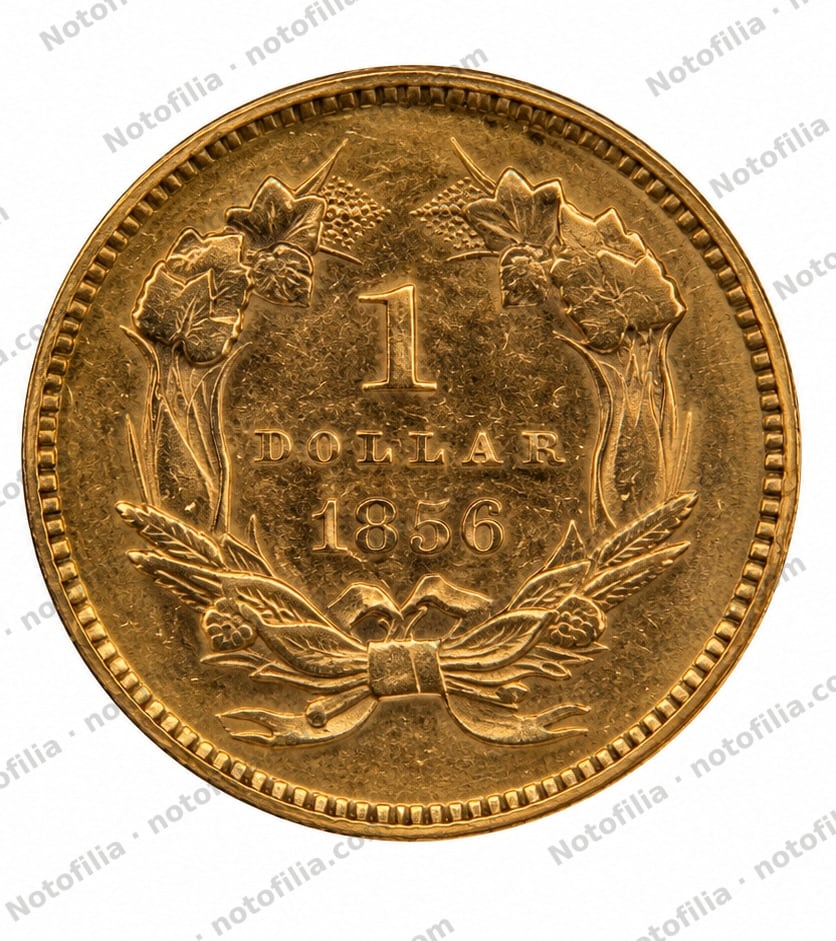
Philadelphia gold dollar, 1856, Longacre Type 3: large head and slanted 5. .900 gold, no mint mark, no serial, and unslabbed.
Catalog facts
- Year
- 1856
- Mint
- Philadelphia (no mint mark)
- Denomination
- Gold dollar
- Composition
- Gold .900 (90% Au, 10% Cu) (published fineness of the type; this specimen was not assayed)
- Weight
- 1.672 g, 25.8 grains (type weight; this specimen was not weighed). Calculated fine gold: 1.505 g (0.04838 troy oz)
- Diameter
- 15 mm (type measurement; this specimen was not measured)
- Edge
- Reeded (published type; no separate edge photograph)
- Condition
- Unslabbed. Marks and scratches visible in the photographs; date and legends legible. Not a numerical grade.
- References
- KM# 86 · PCGS# 7540 · N# 23120
Obverse
Reverse
The coin
This piece is the 1856 gold dollar, James Barton Longacre’s Type 3, struck at Philadelphia with no mint mark. The obverse shows Liberty’s head facing left, in a feathered headdress with the band LIBERTY, and the legend UNITED STATES OF AMERICA. The reverse carries the agricultural wreath — corn, cotton, wheat, and tobacco — 1 DOLLAR, and the date 1856. The left side of the 5 slopes: that is the style PCGS numbers 7540 (Slanted 5). The upright 5 is variety 7541. There is no letter under the bow. The relief is high. The 1878 Liberty Head quarter eagle — Christian Gobrecht’s coronet — and the 1912 Indian Head — Bela Lyon Pratt’s incuse relief — are also Philadelphia .900 gold: each is another 2.50-dollar piece. Numista (N# 23120, KM# 86) gives 1.672 g — 25.8 grains, or 25 4/5 — 15 mm, and a reeded edge. The fine gold, 1.505 g or 0.04838 troy oz, is calculated from that type weight, not from an assay of this disc. PCGS prints 1.70 g and 14.30 mm on the type card; this page keeps Numista’s figures. This photograph shows obverse and reverse; the edge is outside the frame and the example was not weighed. The piece is raw, with no holder. PCGS separates the business strike (7540) from the proof (7606): wear on the cheek and hair belongs to a circulation piece. The photographs show surface marks and scratches; they do not settle a third-party authentication, a numerical grade, or earlier cleaning.
Legends
- Obverse
- UNITED STATES OF AMERICA · LIBERTY on the headdress band.
- Reverse
- 1 DOLLAR · 1856 · agricultural wreath. No mint mark. The 5 is the slanted style (PCGS 7540).
History
The act of 3 March 1849 (9 Stat. 397, chap. CIX) authorized the gold dollar and the double eagle. The dollar is legal tender for one dollar; the reverse omits the eagle; the weight tolerance is a quarter grain. In 1854 Longacre replaced the Type 1 Liberty head with the Indian Princess. Type 2, the small head, was struck at Philadelphia in 1854 and 1855 and, in 1856, at San Francisco only; the high relief left weak strikes. In 1856 he enlarged the head and revised the relief to improve metal flow: that is Type 3, from 1856 to 1889. CoinWeek calls that portrait the Large Head. This record describes the object in the collection; it does not value the issue.
Scarcity and type
CoinWeek and PCGS give 1,762,936 as the 1856 Philadelphia business-strike mintage, the highest of Type 3. That figure covers both date varieties — the slanted 5 (7540) and the upright 5 (7541) —; it is not a split between them and not a census of this example. Ken Bressett, cited by Craig Krueger in The Numismatist (April 2005), states that the breakdown sometimes attributed to Akers and Breen lacks firm corroboration: this record does not publish it as a verified mintage. Numista lists the 1856-D of Dahlonega at 1,460, with a D under the bow; that field is empty here. Stack’s Bowers places the 1856 Type 2 at San Francisco only. The slanted-5 proof is PCGS 7606. PCGS estimates about 2,250 slanted-5 survivors in all grades, 1,000 in MS60 or better, and 50 in MS65 or better. Those are expert estimates — they include raw pieces and coins certified by any service — not a certificate count and not a count of this example. Among Type 3 issues the slanted 5 is one of the more available dates in circulated grades; the upright 5 is substantially scarcer, and high-grade slanted 5 pieces are also much harder to find. None of this fixes the state of this piece. This record publishes neither a slab census nor a price.
Certification
The example is raw, with no NGC, PCGS, or other holder, and with no certification number. This module carries no serial number. The identity of this record is the photographed object — date 1856, slanted 5, no mint mark, large head — not a certificate. The photographs show marks and scratches; they do not settle a third-party authentication, a numerical grade, or earlier cleaning. The weight, diameter, and fine gold on this record are the issue specifications, not a measurement of this piece. If it is later slabbed, the cert number will replace this note.
Sources
- Numista — 1 dollar Large Indian Head, Type 3 (N# 23120) (opens in a new tab)
KM# 86; 1856–1889; .900 gold; 1.672 g (25 4/5 grains); 15 mm; reeded edge; published fine gold 0.048 oz. 1856 varieties: slanted 5 and upright 5. The 1,762,936 sits on the upright-5 line as the Philadelphia total. 1856-D, 1,460. Prices are not republished.
- CoinWeek — Gold dollar, Type 3 (large head), 1856–1889 (opens in a new tab)
Longacre enlarged the head in 1856 to improve metal flow. Highest business-strike mintage of the type: 1,762,936 in 1856, the Philadelphia total. .900 alloy. Prices are not republished.
- PCGS CoinFacts — 1856 gold dollar, slanted 5 (7540) (opens in a new tab)
James Barton Longacre; Philadelphia; Type 3. Printed mintage 1,762,936. Survival estimate: 2,250, 1,000 in MS60 or better, and 50 in MS65 or better. The type card prints 1.70 g and 14.30 mm. The upright 5 is 7541 and the slanted-5 proof is 7606. Prices and a certification population are not republished.
- The Numismatist — Craig Krueger, the 1856 upright 5 (April 2005) (opens in a new tab)
Ken Bressett: there is no concrete evidence for a split between the upright 5 and the slanted 5. The Red Book has at times published only the combined 1,762,936. The upright 5 is the scarcer variety. The Akers–Breen split is not republished as a mintage, and no price is given.
- FRASER — Coinage Act of 1849, 9 Stat. 397 (opens in a new tab)
3 March 1849, chap. CIX: authorizes the gold dollar, legal tender for one dollar, with no eagle on the reverse, and a quarter-grain tolerance.
- Stack’s Bowers — Indian Head gold dollar, Type 2 (small head) (opens in a new tab)
The 1856 Type 2 was struck at San Francisco only. The type wreath gathers corn, cotton, wheat, and tobacco. Prices are not republished.
Related pieces
Another piece in the United States collection.