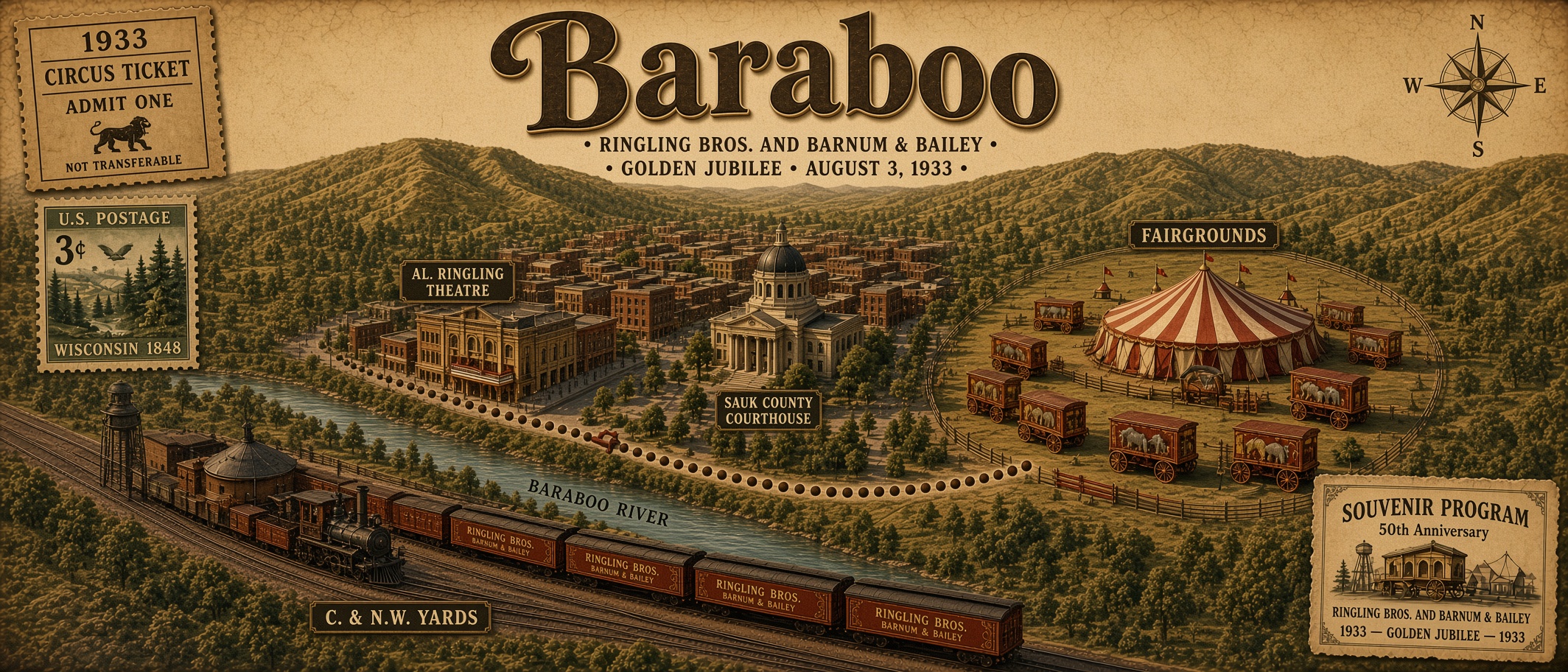
In 1933 the Ringling Bros. and Barnum & Bailey Circus returned to Baraboo, Wisconsin, for its 50th anniversary — the Golden Jubilee. The Chamber of Commerce issued scrip from 5¢ to $1 — Shafer WI100. This record holds the 5¢ note with John Ringling’s portrait, serial A4895, the 10¢ with Chas. Ringling’s portrait, serial A2844, the 15¢ with Al. T. Ringling’s portrait, serial A2819, the 50¢ with A. C. Ringling’s portrait, serial A1054, and the $1 with the Ringling Bros. group portrait, serial A2002.
Baraboo winter quarters
Baraboo holds a special place in circus history as the original birthplace and winter quarters of the Ringling Brothers Circus. The five brothers founded their touring company there in 1884 — the jubilee scrip prints the span 1883–1933 — and wintered the operation in the town until 1918.
The Golden Jubilee celebration in Baraboo took place on 3 August 1933. That season’s route card places the train in Baraboo that day, between Winona and Rockford, before the long Chicago stand. Despite the massive financial strain of the Great Depression — which severely cut attendance and revenues — the logistical operation still rolled into town on the rails.
The Baraboo scrip
To commemorate the milestone, the town issued special Baraboo Scrip. These were not federal notes: they were ornate souvenir paper tokens, printed on currency-quality paper a trifle larger than Civil War shinplasters, redeemable in trade through the local Chamber of Commerce. The Baraboo News-Republic of 28 June 1933 announced the issue; the notes circulated as change and as souvenirs, and were redeemable through 1 November 1933.
The denominations — 5¢, 10¢, 15¢, 25¢, 50¢, and $1 — feature the Ringling brothers. The 5¢ shows John Ringling; the 10¢, Chas. Ringling; the 15¢, Al. T. Ringling (Alfred T.); the 25¢, Otto Ringling; the 50¢, A. C. Ringling (Albert, the eldest). The $1 shows the group. The face carries disks of transparent color; the green back shows the Big Top tent, bookended by a lion and a tiger. E. B. Trimpey of Baraboo’s Trimpey studio designed the notes from original photographs of the brothers. Printed signatures of the Chamber’s president and treasurer appear on the paper.
Merchants handed the scrip out in change and also sold it at face value as a souvenir. A Wisconsin State Journal account placed it in commerce as far as Madison. Sales covered almost all of the Chamber’s cost for the anniversary celebration. No record of the number printed survives; this record does not invent one.
What collectors look for today
These jubilee tokens sit on the border between notaphily and exonumia: they are not federal legal tender, but they are local Chamber bearer notes, issued in the same year the March 1933 bank holiday left many towns printing emergency scrip. Ralph A. Mitchell and Neil Shafer list them as WI100 (Shafer WI100) in the Standard Catalog of Depression Scrip, with a denomination suffix: WI100-.05a, WI100-.10a, WI100-.15a, WI100-.25a, WI100-.50a, and WI100-1a. A complete set of the six pieces — five fractionals plus the dollar — is the usual way to collect them.
Uncirculated examples — no folds, no pinholes — are the ones notaphilists and circus historians hunt. Notofilia does not publish market prices. This record documents the type under Miscellaneous; the notes belong in that case, not in the federal series. At Notofilia a serial — or a PMG, NGC, or PCGS certificate — is each note’s identity. The 5¢ John Ringling note, serial A4895, the 10¢ Chas. Ringling note, serial A2844, the 15¢ Al. T. Ringling note, serial A2819, the 50¢ A. C. Ringling note, serial A1054, and the $1 Ringling Bros. note, serial A2002, already have pages. The 25¢ Otto Ringling note (WI100-.25a) still waits for its serial or certificate: a serial is not invented here.
1933 and after
The 1933 season was one of the hardest in the circus’s history. The Depression cut the gate and the margin, and operational control was already slipping from the family: a 1929 loan, taken to buy other shows, had gone into default by 1932. A major creditor, Allied Owners, entered bankruptcy in 1933. The family did not regain full control until 1937. The show was reorganized and survived into the postwar era.
Baraboo, meanwhile, kept the winter-quarters ground. Circus World occupies that site today: the same town that watched the circus begin in the 1880s and that, in 1933, paid for its Golden Jubilee with 5-cent paper.
Notes in the collection
Each piece page needs the printed serial or, if the note is slabbed, the certificate number. Serials are not invented here.
-

5¢ · Baraboo Scrip · John Ringling · 1933
Pick Shafer WI100 · 5¢ · Serial A4895
Open the note page → -

10¢ · Baraboo Scrip · Chas. Ringling · 1933
Pick Shafer WI100 · 10¢ · Serial A2844
Open the note page → -

15¢ · Baraboo Scrip · Al. T. Ringling · 1933
Pick Shafer WI100 · 15¢ · Serial A2819
Open the note page → -

50¢ · Baraboo Scrip · Albert C. Ringling · 1933
Pick MS WI100-.50 · Serial A1054
Open the note page → -

$1 · Baraboo Scrip · Ringling Bros. · 1933
Pick Shafer WI100 · $1 · Serial A 2002
Open the note page →
Sources
- Wisconsin Depression Scrip — Baraboo (opens in a new tab)
Baraboo News-Republic, 28 June 1933: denominations, portraits (five brothers singly; the group on the dollar), Trimpey, redemption through 1 November. The 1933 route program places the train in Baraboo on 3 August.
- TIME — Fallen Ringling (1932) (opens in a new tab)
The 1929 loan and the loss of operational control. The New York Times, 11 December 1937, records that the family recovered full control.
- Obsolete Currency — Baraboo Scrip (Handini, 2012) (opens in a new tab)
Portrait-to-denomination concordance: John (5¢), Chas. (10¢), Alf T. (15¢), Otto (25¢), Al (50¢). Prices are not cited here.
- Depression Scrip.com — Wisconsin (Mitchell & Shafer numbers) (opens in a new tab)
Lists the set as MS WI100-.05, WI100-.10, WI100-.15, WI100-.25, WI100-.50, and WI100-1. The a-suffix form (WI100-.25a, WI100-.50a) is the usual listing on PCGS holders and set lots.