United States · Miscellaneous · Baraboo scrip
5¢ note, 1933
5¢ · Baraboo Scrip · John Ringling · 1933
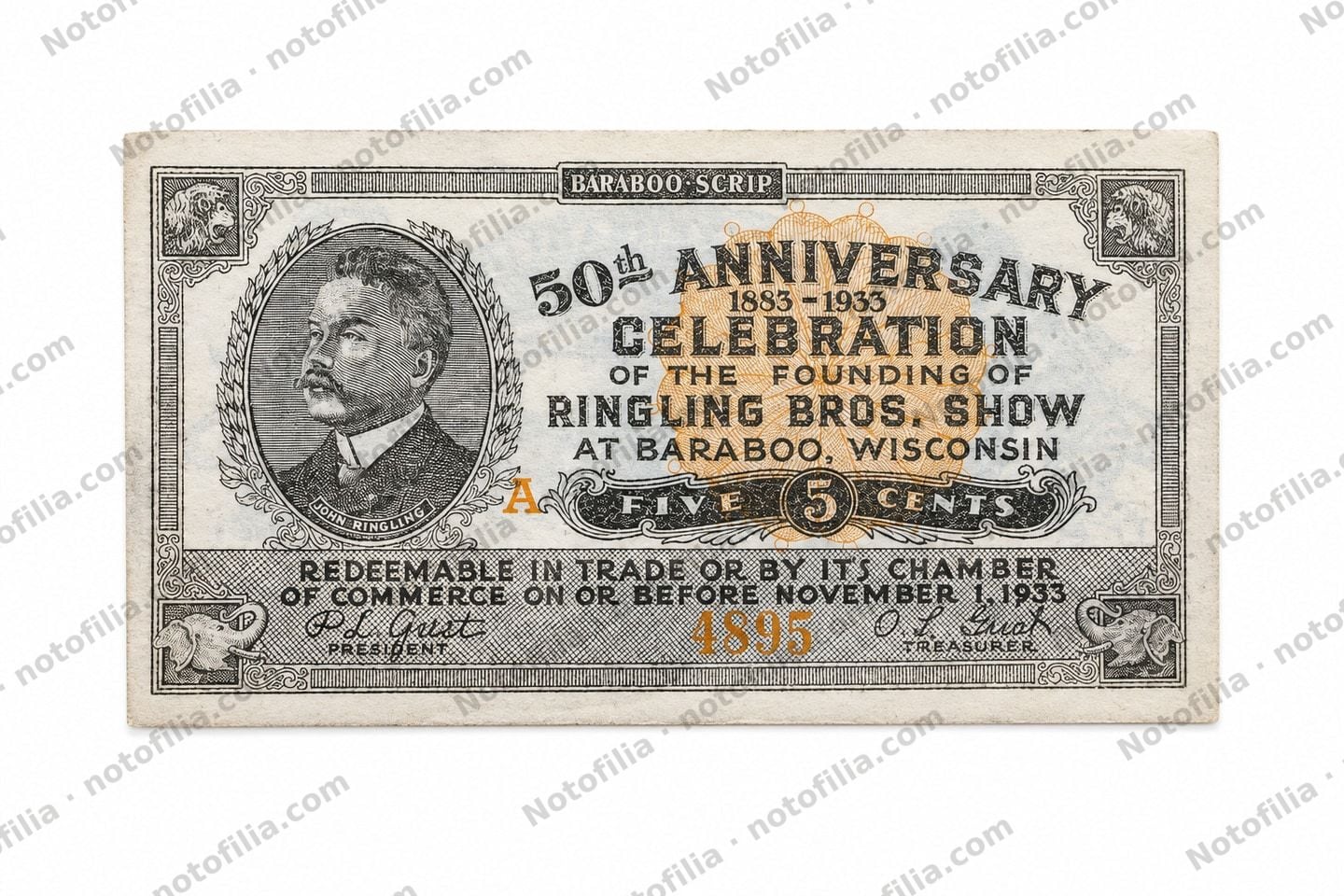
A 5-cent Baraboo Chamber of Commerce note for the 1933 Golden Jubilee: John Ringling’s portrait, series A, serial 4895, Shafer WI100.
Catalog facts
- Pick reference
- Shafer WI100 · 5¢
- Serial number
- A4895
- Signatures
- P. L. Gust (president) and O. L. Gust (treasurer), Baraboo Chamber of Commerce
- Condition
- Unslabbed (private collection)
- Printage
- E. B. Trimpey, Trimpey studio of Baraboo, for the Chamber of Commerce. Announced 28 June 1933; redeemable through 1 November 1933. No record of the number printed survives; this record does not invent one.
Face
Back
The note
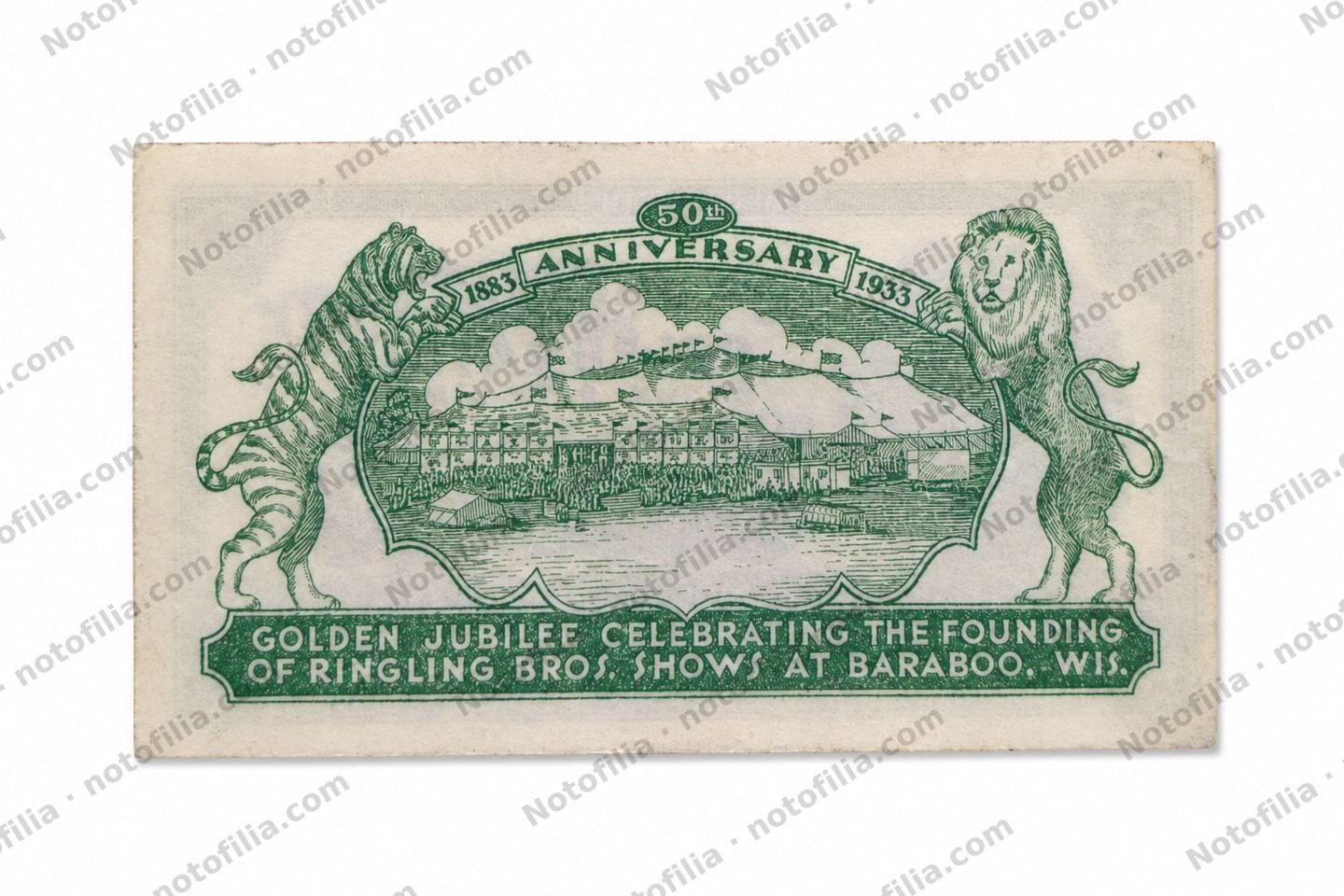
The Shafer WI100 5¢ is a Baraboo Chamber of Commerce bearer note, not a Federal Reserve Note. The face, black on cream paper with an orange disk, is titled BARABOO SCRIP. At left a circular portrait of John Ringling — moustache, parted hair, frock coat — sits in a laurel wreath, his name on the lower ribbon. The center announces the 50th anniversary, 1883–1933, CELEBRATION OF THE FOUNDING OF RINGLING BROS. SHOW AT BARABOO, WISCONSIN. At right a dark cartouche reads FIVE (5) CENTS; to its left the orange series letter A. Serial 4895 is printed in orange at the foot, between the printed signatures of P. L. Gust (president) and O. L. Gust (treasurer). The footer promises redemption in trade or by the Chamber on or before 1 November 1933. Corner medallions show lion heads above and elephant heads below. The green back shows the Big Top and crowd, 1883 / 50th ANNIVERSARY / 1933, a tiger at left and a lion at right, and the banner GOLDEN JUBILEE CELEBRATING THE FOUNDING OF RINGLING BROS. SHOWS AT BARABOO, WIS. This collection piece is shown unslabbed. It is not the other five notes of the set: John Ringling’s portrait, the 5-cent face, and serial A4895 distinguish it.
The Golden Jubilee scrip
Baraboo was the birthplace and winter quarters of the Ringling Brothers Circus. The five brothers founded the touring company in 1884 — the scrip prints the span 1883–1933 — and wintered there until 1918. On 3 August 1933 the Ringling Bros. and Barnum & Bailey Circus returned for the Golden Jubilee; that season’s route card places the train in Baraboo between Winona and Rockford.
The Chamber of Commerce announced the scrip on 28 June 1933 in the Baraboo News-Republic. These were not federal notes: ornate souvenir tokens, printed on currency-quality paper a trifle larger than Civil War shinplasters, redeemable in trade through 1 November. E. B. Trimpey of Baraboo’s Trimpey studio designed the set from original photographs of the brothers. The lower denominations show each brother singly; the $1 shows the group. This example is the 5¢: John Ringling.
Scarcity and printage
Baraboo scrip was not a federal issue. Wisconsin Depression Scrip lists the set as Shafer WI100; a complete run of the six notes is the usual way to collect it. No record of the number printed survives. This record does not invent a printage or a census. This piece’s interest is the 5¢ John Ringling face and serial A4895, not an invented type rarity.
Population
A PMG or PCGS census for serial A4895 has not been independently verified. The note is shown unslabbed, with no certificate number.
Sources
- Wisconsin Depression Scrip — Baraboo (opens in a new tab)
Baraboo News-Republic, 28 June 1933: denominations, portraits (five brothers singly; the group on the dollar), Trimpey, redemption through 1 November. Shafer WI100.
Related pieces
Other records from the same issuer or era in this case.