United States · Miscellaneous · Giori proof
Giori test note note, n.d.
Giori test note · Lincoln Memorial · ca. 1970s
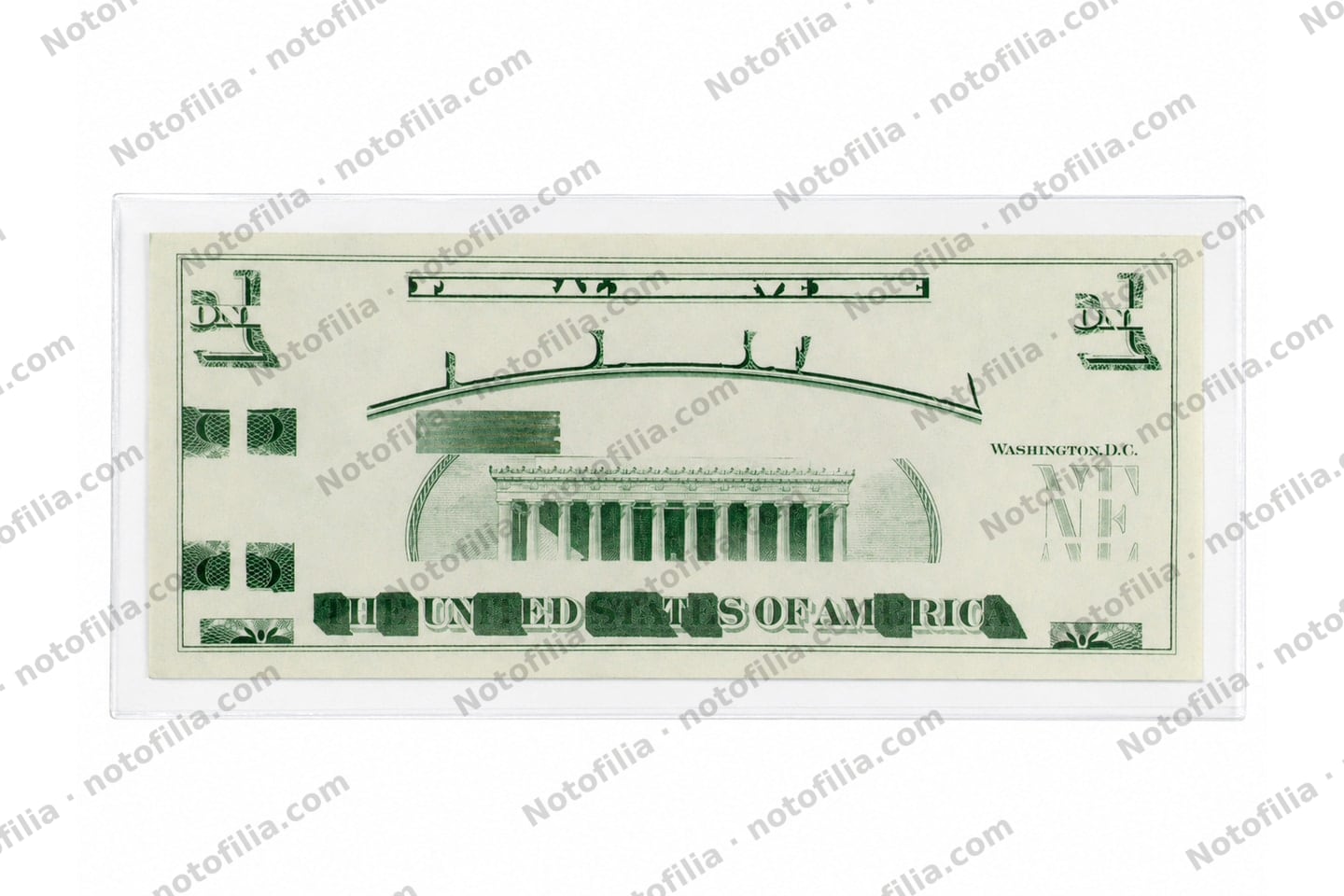
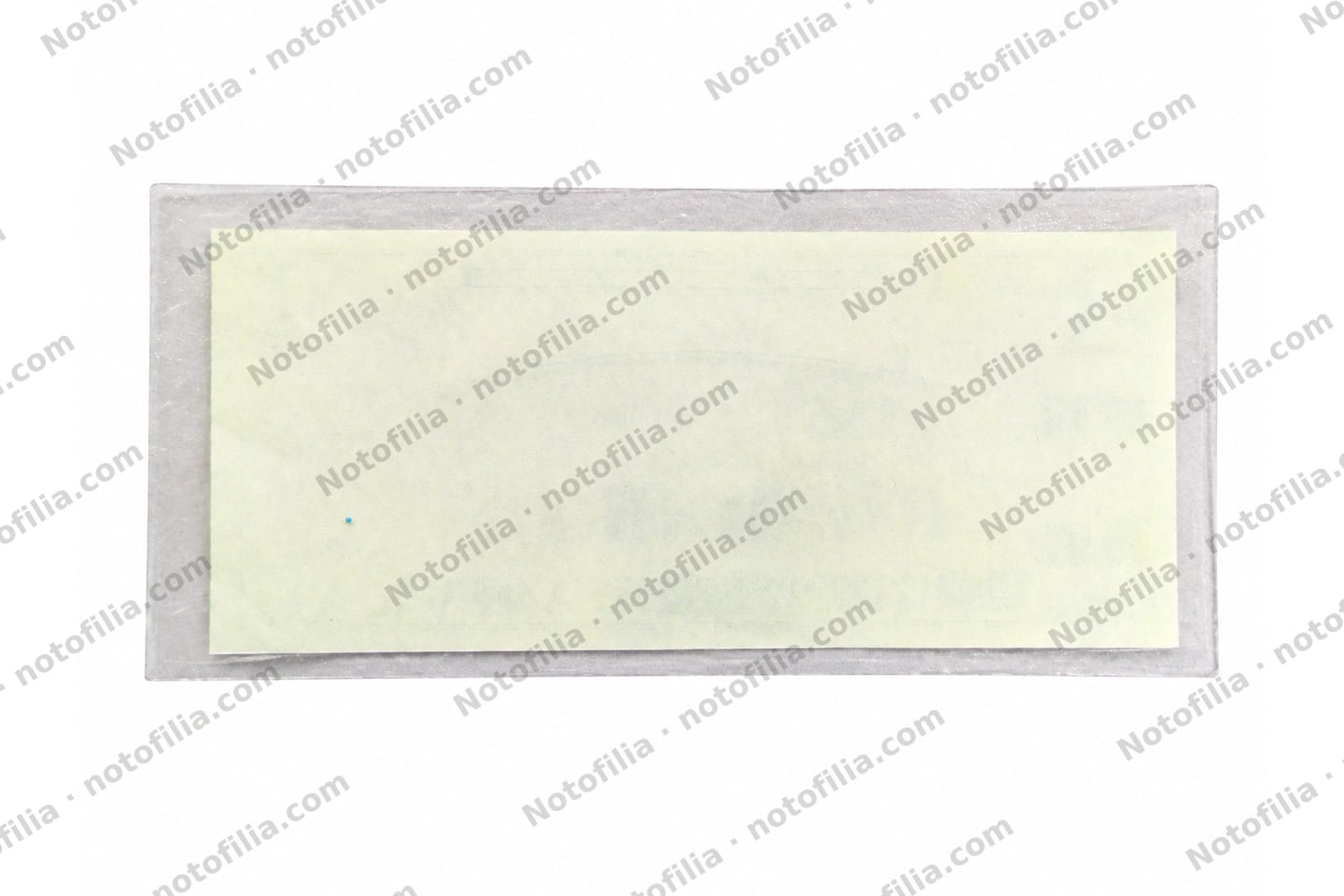
A uniface Giori press test note, ca. 1970s: a green face with the Lincoln Memorial and $1 design elements; a blank back; no serials or seals. It is not legal tender.
Catalog facts
- Pick reference
- Giori · Lincoln Memorial (uniface)
- Serial number
- —
- Signatures
- None (uniface test note)
- Condition
- Unslabbed, in a sleeve (private collection)
- Printage
- Giori press (Gualtiero Giori). Ca. 1970s. The E-Sylum places trials with BEP “nonsense” plates at Geneva, New York, in that decade; other test runs are attributed to press evaluations in Germany. This record does not invent a printage for the type or for this piece.
Face
Back
The note
This piece is a press test, not a Federal Reserve Note. The face, in a single grass-green ink on cream paper, gathers fragments of circulating plates: at center, the Lincoln Memorial engraving the BEP uses on the back of the $5; in the upper corners, the 1 with ONE set vertically, taken from the back of the $1; below, THE UNITED STATES OF AMERICA in shadowed capitals; at right, WASHINGTON. D.C. and a tall ONE. A thin arch spans the memorial; scalloped pattern blocks sit at left. There are no serials, Treasury seal, district seal, or signatures: the BEP tried the Giori press with cancelled or “nonsense” plates so that a complete circulating plate would not leave the bureau. The back of this example is blank: it is uniface. It is not the green back of a circulating $5 — it lacks the FIVE DOLLARS setting of that memorial and instead carries the $1 corner 1s — nor the two-sided Giori tests with Jefferson at center. This collection piece is shown in a sleeve, unslabbed.
The Giori press
At the end of the Second World War the Italian Gualtiero Giori devised an intaglio press that could lay two or three colours in a single pass, with cut rubber rollers inking different areas of the same plate. The E-Sylum summarises that leap: faster than the Bureau of Engraving and Printing’s earlier machines. The BEP commissioned evaluations of the press; to test it without releasing a complete circulating plate, it sent cancelled segments of types then in use.
The E-Sylum (2012) records the so-called Pigman hoard: Edgar L. Pigman, an American Can Company engineer in Geneva, New York, designed and tested Giori presses as an American Bank Note Company subcontractor for the BEP, in the 1970s. The “nonsense” plates mixed vignettes — Washington from the $1, Lincoln from the $5, Grant from the $50 — on sheets of 32. Those tests were not legal tender; for years the BEP treated private ownership as unlawful because the paper resembled genuine currency. A later policy change allowed collector trade. Other two-sided Giori tests, often with Jefferson at center, are attributed to trials in Germany. This record describes the physical object; it does not claim that this example comes from the Pigman hoard.
Scarcity and printage
Giori test notes were not a circulating issue. The E-Sylum notes that trial sheets were meant to be destroyed or otherwise kept aside; some survived and, once the BEP restriction was lifted, entered the collector market. There is no Pick or Friedberg number for this uniface Lincoln Memorial collage. This record does not invent a printage or a census.
Population
A PMG or PCGS census for this example has not been independently verified. The note is shown in a sleeve, unslabbed, with no certificate number.
Sources
- The E-Sylum — American Can Company and the Giori test notes (vol. 15, no. 53, 23 December 2012) (opens in a new tab)
Gualtiero Giori; American Can / Edgar L. Pigman in Geneva, N.Y.; BEP nonsense plates; private ownership later made legal.
- Calkins — United States test notes (opens in a new tab)
Giori types: two-sided Jefferson notes and green uniface tests without serials (Pigman hoard).
- Wikipedia — Gualtiero Giori (opens in a new tab)
Inventor of the multi-colour intaglio press; origin of the tests that bear his name.
- Bureau of Engraving and Printing — History (opens in a new tab)
Context for the federal printer; these tests are not a BEP circulating series.
Related pieces
Other records from the same issuer or era in this case.