United States · Miscellaneous · Where’s George?
$1 note, n.d.
$1 · Series 2006 · Dallas · Where’s George?
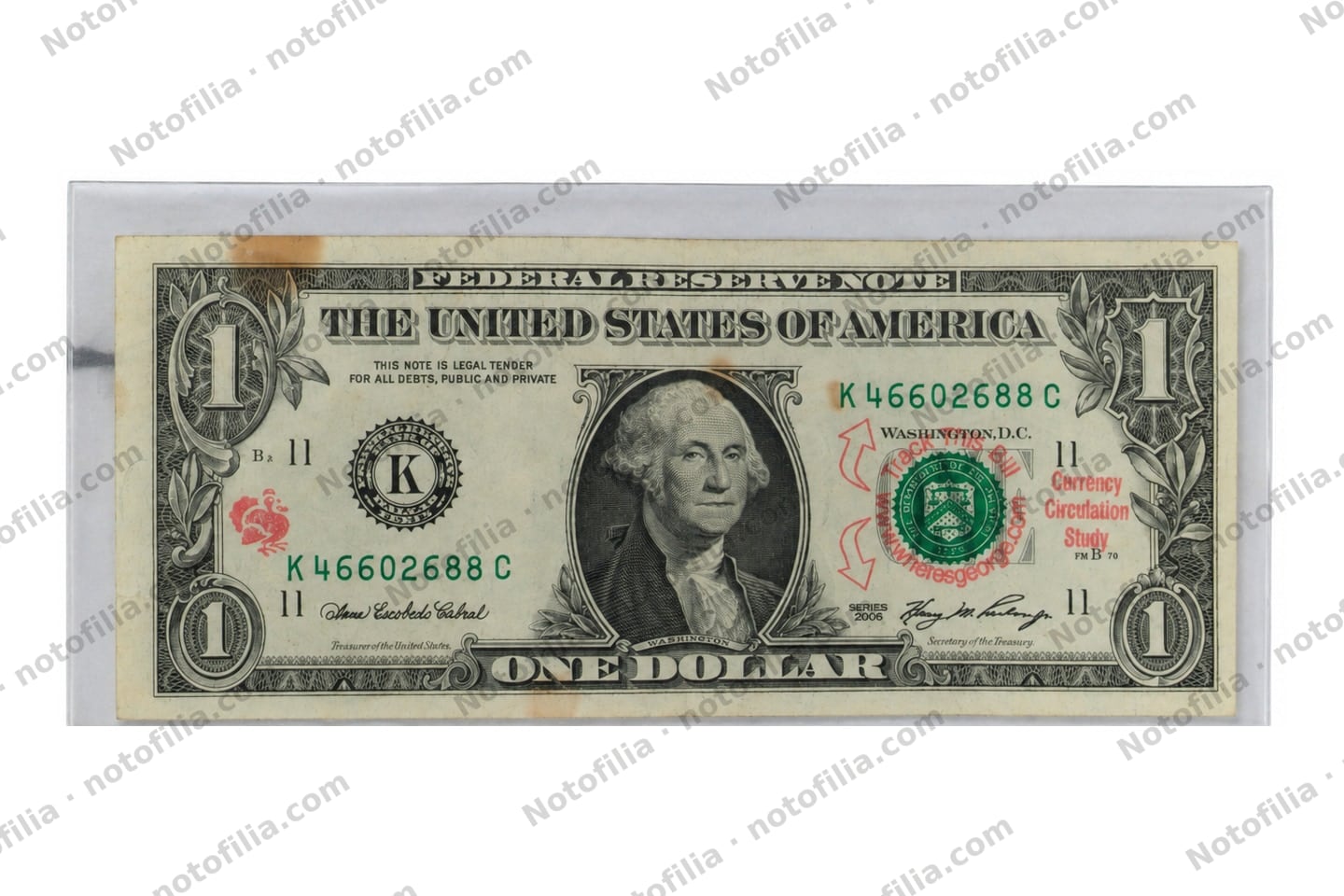
A Series 2006 $1 Federal Reserve Note of the Dallas district (K / 11), serial K46602688C, with red Where’s George? stamps that ask finders to track its circulation.
Catalog facts
- Pick reference
- P#523a · Fr. 1933-K
- Serial number
- K46602688C
- Signatures
- Anna Escobedo Cabral (Treasurer) and Henry M. Paulson, Jr. (Secretary of the Treasury)
- Condition
- Circulated, unslabbed, in a sleeve (private collection)
- Printage
- BEP. USPaperMoney.Info places Series 2006 $1 notes from March 2007 through November 2010 (Cabral–Paulson signatures). Dallas printed 569,600,000 regular notes in six blocks. Serial K46602688C (KC block) falls in that district’s March 2008 production. This record does not invent a printage for the KC block alone.
Face
Back
The note
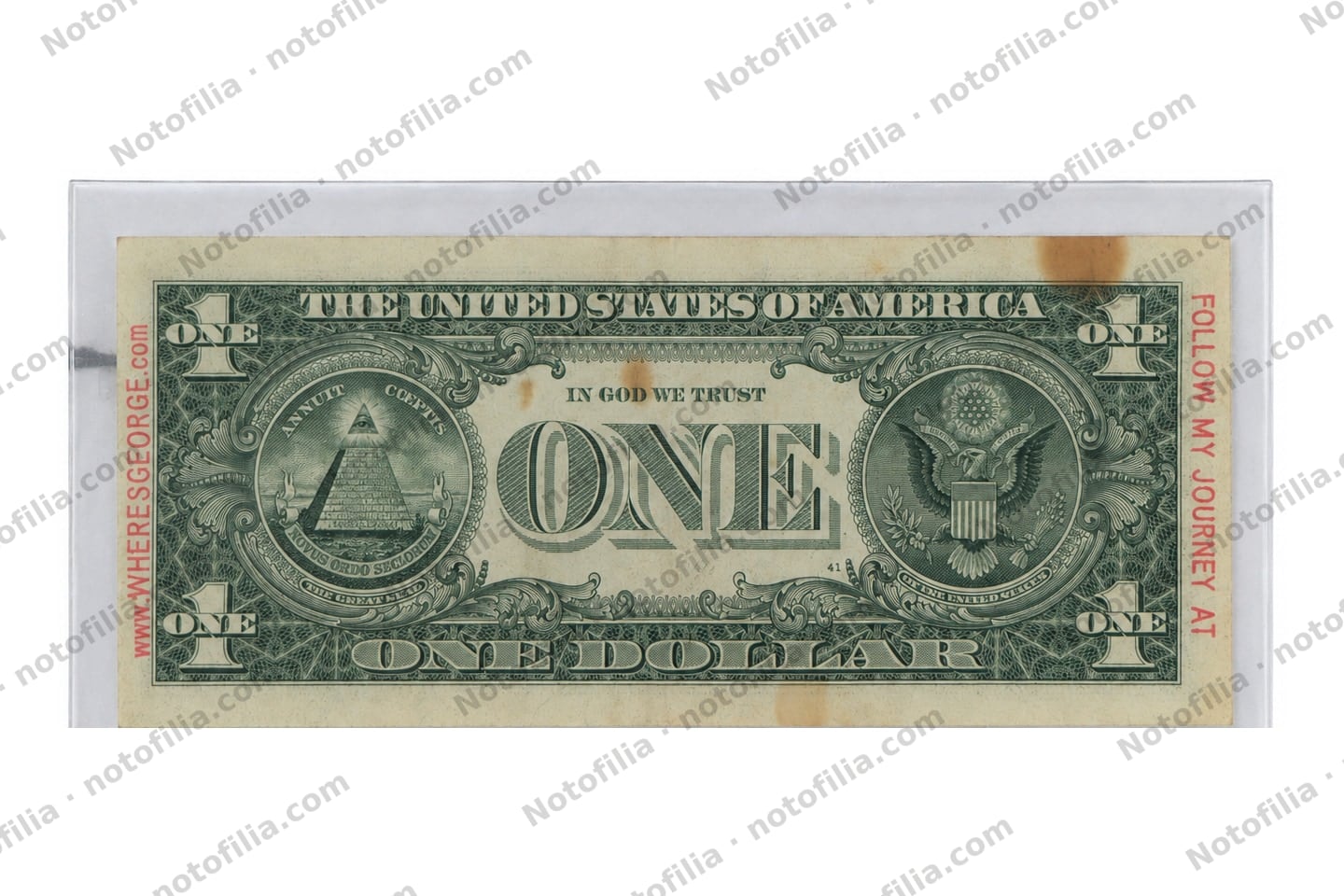
The Series 2006 $1 (Pick 523a, Friedberg 1933-K) is a small-size Federal Reserve Note of the Dallas district: a black seal with K, 11s in the four inner corners, and the bank legend “FEDERAL RESERVE BANK OF DALLAS TEXAS.” The black face with green seal and serials carries George Washington in an oval and, at right, the Treasury seal over ONE. The signatures are Anna Escobedo Cabral and Henry M. Paulson, Jr.; the printed series, 2006, sits beside the Secretary. Serials K 46602688 C repeat at lower left and upper right (KC block). The green back shows both faces of the Great Seal — the pyramid and the eagle — flanking ONE, with IN GOD WE TRUST above. On that everyday type a previous holder applied red-ink stamps that are neither BEP nor Treasury work: to the right of the portrait, a circular “Track this bill” / www.wheresgeorge.com stamp; beside it, “Currency Circulation Study / FM B 70”; at left, a turkey pictogram; on the back margins, vertical “FOLLOW MY JOURNEY AT” and www.WHERESGEORGE.com. This collection piece, circulated and unslabbed, is shown in a sleeve, with foxing along the edges. It is not the Series 2003 Atlanta star $1, serial F05033622★: Series 2006, district K / 11, Cabral–Paulson signatures, this serial, and the stamps distinguish it.
Where’s George?
Where’s George? (opens in a new tab) is a web project that follows the geographic path of United States paper money. Hank Eskin, a database consultant in Brookline, Massachusetts, launched it on 23 December 1998. The name points to Washington on the $1, though the site also accepts $2, $5, $10, $20, $50, and $100 notes; the $1 accounts for most entries. The mechanism is deliberately simple: enter denomination, series, serial number, and ZIP code. If someone later enters the same serial, the site logs a hit — city, distance, and travel time. The official FAQ answers “Why does this site exist?” with “for fun and because it had not been done yet.”
The point of the site is to document natural circulation, not to manufacture itineraries. The rules ask users to spend the note in everyday life and forbid mailing it or passing it to acquaintances in order to generate hits. Stamps and writing on the paper — as on this piece — are the prompt for the next holder to visit www.wheresgeorge.com (opens in a new tab) and enter the serial. In 2006 Dirk Brockmann, Lars Hufnagel, and Theo Geisel used that register in Nature as a proxy for human travel in the United States. This record describes the physical object and the project; it does not republish the hit map for serial K46602688C.
Scarcity and printage
Series 2006 $1 notes — Cabral–Paulson signatures, all twelve districts — were everyday Reserve paper. The Bank Note Museum numbers the type P-523a. Fr. 1933-K is Dallas. The type is common; Dallas printed 569,600,000 regular notes in the series. This piece’s interest is not FRN scarcity but the Where’s George? stamps on an ordinary serial. This record does not invent a printage by block.
Population
A PMG or PCGS census for serial K46602688C has not been independently verified. The note is shown in a sleeve, circulated, unslabbed.
Sources
- Where’s George? — official site (opens in a new tab)
Enter denomination, series, serial, and ZIP code; a hit is a later re-entry.
- Where’s George? — FAQ and rules (opens in a new tab)
23 December 1998; natural circulation; “for fun and because it had not been done yet.”
- Wikipedia — Where’s George? (opens in a new tab)
Hank Eskin; the $1 accounts for most entries.
- Brockmann, Hufnagel and Geisel — The scaling laws of human travel (Nature, 2006) (opens in a new tab)
The Where’s George? register as a proxy for human travel.
- Bank Note Museum — P-523, Series 2006 $1 Federal Reserve Note (opens in a new tab)
P-523a: Series 2006, Cabral and Paulson signatures; district K = Dallas.
- USPaperMoney.Info — Series 2006 $1 serial ranges (opens in a new tab)
Dallas: 569,600,000 regular notes in six blocks. March 2008 includes the KC block.
- U.S. Currency Education Program — $1 (opens in a new tab)
Washington on the $1 since 1869; both faces of the Great Seal on the back since 1935.
Related pieces
Other records from the same issuer or era in this case.