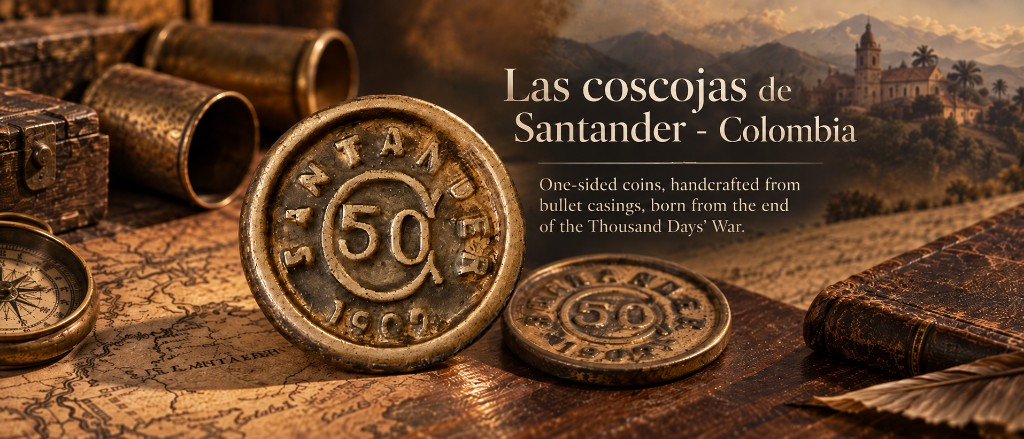
One-faced coins, handmade from cartridge cases, born at the end of the War of a Thousand Days.
Facts
- Issuer
- State of Santander
- Authority
- Ramón González Valencia
- Type
- Necessity coinage
- Year
- 1902
- Denominations
- 10, 20, and 50 centavos
- Metal
- Brass
- Manufacture
- Handmade, one face
- Place
- Bucaramanga
- Workshop
- Penagos brothers
- Tender
- Forced, only in Santander
- Ref. (50 c)
- 1.45 g · 23.1 mm
The 1902 10, 20, and 50 centavos are in the collection. 10 centavos · Santander · 1902 · 20 centavos · Santander · 1902 · 50 centavos · Santander · 1902
In the collection


A country without coin
The War of a Thousand Days ran from 17 October 1899 to 21 November 1902, when the Treaty of Wisconsin was signed. By 1902 the conflict had emptied the public treasuries, and the regions lacked the small change used for daily purchases and for paying the troops. Both sides had already turned to paper: Rafael Uribe Uribe’s liberals put into circulation notes of the «Gobierno Provisional Liberal», printed in black ink on notebook paper, and also the so-called Peralonso notes in the zones they controlled. The government overprinted private-bank notes in red to make them legal tender.
Santander was the hardest theatre. Peralonso was fought on 15 and 16 December 1899. Palonegro, beside Bucaramanga, lasted from 11 to 25 May 1900: fourteen days of trenches. The government held the ground, and the field was left covered with cartridge cases.
Chronology
These are necessity coins of the State of Santander in wartime, not the national silver 10, 20, and 50 centavos of those years, not the exclusive coin of the lazarettos, and not a Peralonso note.
| Date | Event |
|---|---|
| 17 October 1899 | The War of a Thousand Days begins. |
| 15 and 16 December 1899 | Battle of Peralonso. |
| 11 to 25 May 1900 | Battle of Palonegro, beside Bucaramanga. |
| 19 July 1902 | González Valencia decrees the fractional coinage, forced tender only inside Santander. |
| 21 November 1902 | Treaty of Wisconsin. The war ends. |
| 29 January 1903 | Decree 102: exchange for national paper and melting of the metal turned in. |
The metal of the battle
In Santander the answer was more material. General Ramón González Valencia, governor and civil and military chief of the department, decreed a fractional metal coinage on 19 July 1902. El Tiempo speaks of copper for small transactions. The decree, according to the numismatic notes, authorized 750,000 pesos, forced tender only inside Santander, to pay the troops and keep small trade moving.
There were no silver, copper, or nickel blanks. The raw material came from Palonegro. The notes say detachments were sent to gather rifle cases — chiefly Mauser or Gras — and that the final tonnage points to about 300,000 casings. That is the other nickname: “bloody coins.” The work was done in Bucaramanga, in the workshop of the Penagos brothers, an agro-industrial machinery shop that then served as an improvised mint. Cartridge brass, copper and zinc, was melted, cleaned of slag, and rolled by hand.
A handmade piece
There were no industrial dies and no screw press. The punches were cut by hand. Each coin carries on the obverse the denomination inside a large «C». On the 50 centavos the legend is «SANTANDER 50 C 1902»; on the 20, «SANTANDER C 20 1902»; on the 10, «SANTANDER 10 C». There is no bust, arms, or portrait. The reverse is not engraved separately: the blow sinks the obverse relief, which is read from the back. On all three, SANTANDER sits in an arc and the value sits inside the large C. The 10 carries no date. The 20 and the 50 carry 1902 below that circle. The catalogue alignment is medal. The edge is plain: Montaña notes it on the 10 and the 20, and Numista on the 50. There were several sets of punches. Recutting left doubled lettering; on the 50 centavos, a thick 50, a thin 50, and the round zero. Montaña also publishes a badly fractured 50-centavo die. That irregular workmanship is what sets the pieces apart from an official striking.
Of the 750,000 pesos authorized, the same notes record 393,100 put into circulation: 684,000 pieces of 50 centavos, 130,500 of 20, and 250,000 of 10. CoinVarieties leaves the 50-centavo mintage unknown, and CGB leaves the quantity minted blank. The figures in the table are not a Casa de Moneda record: they are those notes, and the counts Montaña takes from Pinilla and Vivas, Moneda y banca en Santander (1990). The measurements are catalogue figures. This case did not weigh or measure a specimen.
Numista does not give a thickness for the 20 centavos. Alexander Montaña, in Monedas de Colombia no. 5 (2019), measures 0.2 to 0.3 mm on the flat sheet and 0.6 to 0.7 mm on the relief. The table uses that second span, the one that sits beside the 0.62 mm of the 10 centavos. It is not a weighing of this case.
| Denomination | Catalogue | Weight | Diameter | Thickness | Legend | Pieces (notes) |
|---|---|---|---|---|---|---|
| 50 centavos | KM# A3 · Restrepo 412 · Hernández 326 | 1.45 g | 23.1 mm | 1.1 mm | SANTANDER 50 C 1902 | 684,000 |
| 20 centavos | KM# A2 · Restrepo 387 · Hernández 325 | 0.7 g | 20 mm | 0.6–0.7 mm | SANTANDER C 20 1902 | 130,500 |
| 10 centavos | KM# A1 · Restrepo 375.1 · Hernández 324 | 0.5 g | 15.5 mm | 0.62 mm | SANTANDER 10 C | 250,000 |
Legend varieties
Montaña names, within each denomination, the legend varieties left by recut punches and by the different die sets. The three records above show the ordinary legends. This page does not reproduce the plates in that bulletin.
| Variety | Denomination | Trait |
|---|---|---|
| Ordinary | 10 centavos | SANTANDER 10 C. No date. |
| Recut legend | 10 centavos | Thick letters and numerals. The recut may be full or partial. |
| Ordinary | 20 centavos | SANTANDER C 20 1902. |
| Recut 2 | 20 centavos | The 2 of the denomination is visibly recut. |
| Undated model | 20 centavos | Rosettes on either side of the value. It was not adopted. It is known restruck under a 50 centavos. |
| Thick 50 | 50 centavos | The usual type: SANTANDER 50 C 1902. |
| Thin 50 | 50 centavos | The 50 is finely cut. |
| Recut legend | 50 centavos | A full or partial recut. Some letters are filled or incomplete. |
| Round zero | 50 centavos | Restrepo 412-1a (2012). A different style of letter and numeral. The zero is nearly round. |
How to recognize an original piece
Montaña separates the original 10- and 20-centavo pieces from the later castings made for collectors. The original is struck, on a flat and very thin planchet, with a plain edge. The incuse reverse stays hollow: that hollow may hold dirt, not more brass. A casting tends to look thicker, with curved edges, a poor design, and the hollow filled with metal. The 50 centavos is the denomination on which those castings are least often seen. This page neither grades nor prices a piece. A doubtful attribution is settled with the coin in hand and with someone who studies it.
Why «coscojas»
People in Santander named them that for their tiny size, and the nickname displaced any official denomination. El Tiempo records the authorization of 750,000 pesos in low-denomination pieces.
In saddlery, a coscoja — also called a pontezuela — is the small metal ring on a horse’s bit, the one that tinkles as the horse walks. The name transferred to these pieces because of the rough brass, the thin sheet, and that same tinkling. The nickname was used later, and in another sense, for the exclusive coin of the lazarettos.
The exchange and the melting
The Treaty of Wisconsin ended the war on 21 November 1902. On 29 January 1903, José Manuel Marroquín, vice president in charge of the executive, signed decree 102. The numismatic notes give it three steps: it recognized González Valencia’s pieces for a time, still only inside Santander; it ordered the Treasury Ministry to open windows where they could be exchanged for national paper; and it ordered the exchanged metal melted. Most of what the Penagos workshop struck went back into the crucible. What stayed out of that melting is what survives today. Montaña notes that, of what missed the crucible, the 50 centavos is the piece most often met, and the 10 and the 20 the scarce ones.
That withdrawal sits inside the monetary settlement after the war. Law 33 of October 1903 forbade further indiscriminate paper issues, fixed the gold peso as the unit, and created the National Amortization Board to retire the depreciated paper. At the Casa de Moneda Museum, and in Banrepcultural’s commented work, these pieces are shown beside the Peralonso notes.
A note on the sources
El Tiempo’s capsule speaks of copper; El Tiempo Colecciones and Numista, of brass. This page adopts brass, which is what the catalogue records with measured specifications. The Penagos workshop, the quantities struck, the estimated 300,000 casings, and decree 102 of 1903 come from the notes “Las monedas sangrientas.” The thickness of the 20 centavos, the legend varieties, the signs of a casting, and the note on what survived the melting come from Montaña, 2019. The National Museum glossary (2006) calls them bracteate or incuse coins, ordered by González Valencia from cartridge cases gathered, according to Barriga Villalba, at Palonegro. Montaña notes that no document is known which ties the battle of 1900 to the order of 1902. Numista lists KM# A1, A2, and A3. CGB writes the 50 as KM20/A3 and publishes neither a mintage nor a price this page records. Numista lists Restrepo 375 for the 10 centavos; CoinVarieties and this collection’s record specify 375.1, and that is the figure in the table. They are not a weighing or a record of this case.
The same nickname names, on another page, the exclusive coin of the lazarettos. That is a different issue. Numismatics of the Lazarettos
Sources
-
El Tiempo, “Cápsula de El Tiempo. Aparecen las coscojas”
The decree of 19 July 1902 and the authorization of 750,000 pesos. That text speaks of copper.
- El Tiempo, “Rarezas en la historia de monedas colombianas” (opens in a new tab)
Brass, the order of General Ramón González Valencia, Palonegro cartridge cases, and a handmade one-faced piece.
- Numista, 50 Centavos (Province of Santander), 1902 (opens in a new tab)
Brass, Bucaramanga, 1.45 g, 23.1 mm, and 1.1 mm on the 50 centavos. Prices are not published.
- Numista, 20 Centavos (Province of Santander), 1902 (opens in a new tab)
0.7 g and 20 mm. Legend SANTANDER C 20 1902.
- Numista, 10 Centavos (Province of Santander), 1902 (opens in a new tab)
0.5 g, 15.5 mm, and 0.62 mm. Legend SANTANDER 10 C.
- El numismático1975, “Las monedas sangrientas” (opens in a new tab)
Penagos workshop, 684,000, 130,500, and 250,000 pieces, decree 102 of 1903, and the later melting.
- Alexander Montaña Rodríguez, Monedas de Colombia no. 5 (October 2019) (opens in a new tab)
Thickness of the 20 centavos, the legend varieties, and the note on what escaped the melting. Plates and prices are not reproduced.
- Banrepcultural, Obra comentada: billetes de Peralonso y coscojas de Palonegro (opens in a new tab)
The cultural site of the Banco de la República places these pieces beside the Peralonso necessity notes.
-
Museo Nacional de Colombia, Piezas en diálogo
- Museo Nacional de Colombia, Numismatic glossary (2006) (opens in a new tab)
Bracteate or incuse coin and necessity coin: González Valencia, cartridge cases according to Barriga Villalba, and Palonegro.
- CoinVarieties, Colombia 1902 50 centavos (opens in a new tab)
Leaves the 50-centavo mintage unknown. Its price is not published.
- CGB, 50 centavos, province de Santander, 1902 (opens in a new tab)
Reference KM20/A3. The quantity minted is left blank. The lot price is not published.
- Wikipedia, Guerra de los Mil Días (opens in a new tab)
Span of the war: 17 October 1899 to 21 November 1902.