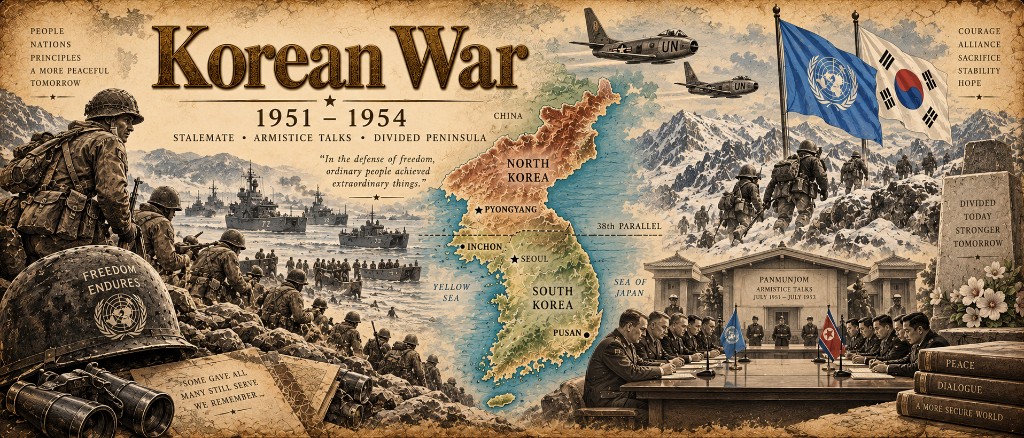
At the height of the Korean War the United States Department of Defense fielded a closed-loop instrument — the Military Payment Certificate, or MPC — to keep wartime inflation out of fragile civilian economies and to cut black-market currency arbitrage. Series 481 entered circulation on 20 June 1951 and was demonetized overnight on 25 May 1954. It was the first MPC issue to leave purely geometric lathework for classical allegorical vignettes.
A military payment certificate is not a Treasury note and not United States legal tender. It circulated only among authorized personnel, on base, and converted into local currency, never the other way. C-Day — a surprise, worldwide conversion — left the outgoing series worthless. Silver Recyclers places the paper in Europe, the Mediterranean, the Pacific, and Korea, not in Vietnam. Forbes Lithographic and Tudor Press, in Boston, are documented for the series; the BEP handled design, finishing, and shipping. Printing is offset, not intaglio. Series 641, 661, 681, and 692 have their own case.
The 5-cent Pick M22a, Friedberg M831, serial D02536728D, regular D–D issue, sheet position 66, already has a note page. It is unslabbed. Further Series 481 denominations will be published as they are photographed.
Series 481
- Type denominations
- Seven values: 5, 10, 25, and 50 cents and $1, $5, and $10. In this case, the 5-cent note (US$0.05). The others wait for a photograph and serial.
- Printing
- Offset lithography; Forbes Lithographic and Tudor Press (series); BEP for design and shipping.
- Authority
- Department of Defense. An armed-forces instrument; not a Treasury note.
Series 481 is not a Vietnam issue. The Vietnam theater begins with Series 641 (1965).
1951–1954
In this case
Issued 20 June 1951 to 25 May 1954: overseas-base paper, not a Vietnam series.
Series 481 carries no printed calendar year: “SERIES 481” is its designation. It circulated from 20 June 1951 to 25 May 1954. Silver Recyclers places the paper in Austria, Belgium, England, France, Germany, Greece, Hungary, Iceland, Italy, Japan, Korea, Morocco, the Philippines, the Ryukyus, Scotland, Trieste, and Yugoslavia. It is not one of the four series confined to Vietnam (641, 661, 681, and 692). Forbes Lithographic Manufacturing Co. and Tudor Press, in Boston, are documented for this series; the Bureau of Engraving and Printing handled design, finishing, and shipping. Printing is offset lithography from engraved artwork, not direct intaglio. This case currently holds the collection’s 5-cent Pick M22a; the Vietnam series remain in their own case.

Series 481 denominations
| Denomination | Schwan | Pick | Sheet |
|---|---|---|---|
| 5 cents | 831 | P-M22 | 84-subject |
| 10 cents | 832 | P-M23 | 84-subject |
| 25 cents | 833 | P-M24 | 84-subject |
| 50 cents | 834 | P-M25 | 84-subject |
| $1 | 835 | P-M26 | 70-subject |
| $5 | 836 | P-M27 | 50-subject |
| $10 | 837 | P-M28 | 50-subject |
The rest of the federal, colonial, and obsolete paper is documented in the United States case. United States
The series used only in Vietnam — 641, 661, 681, and 692 — live in the Vietnam MPC case. MPC - Vietnam War (1955-1975)
1946–1951
The monetary architecture of military scrip
The program was built to cut arbitrage between the federal dollar and local currencies wrecked by war.
In late 1946 the military payment certificate replaced a defective Second World War arrangement: troops paid with Federal Reserve Notes, yellow-seal silver certificates, or Allied military currency. The dollar had worldwide purchasing power; personnel converted depreciated local cash into official instruments, and the Treasury absorbed disbursements that did not match the payroll. The Army answered with an internal fiat, in dollars and cents, with no legal-tender status in the United States and valid only in accredited military channels. In June 1950 the Eighth Army reached Korea on Series 472. Won advances that the Republic of Korea supplied to the United Nations Command — civilian labor, construction, and theater logistics — were later settled in hard foreign exchange. Had greenbacks circulated freely on the peninsula, dollar flight would have broken the Bank of Korea’s exchange controls. Series 481 was made to close that perimeter: troop spending could be watched, contained, and kept apart from the host banking system and from the United States money supply.
1951–1954
Service life and Conversion Day
Almost three years in use — combat, Panmunjom, and early reconstruction — and a worldwide C-Day on 25 May 1954.
Series 481 replaced Series 472 on 20 June 1951; Series 521 withdrew it on 25 May 1954. The scrip could be turned into exchange-store goods, so commercial rings, black-market operators, and entertainment houses took it outside the wire, at a premium to local cash. High command answered with secret, synchronized Conversion Day — C-Day — drills. That morning compounds locked down: troop movement stopped, mail and telegraph were restricted, and security closed the perimeter. At verification counters, soldiers, Army civilians, and authorized auxiliaries presented pay records, identification, and their Series 481 holdings. Conversion caps had to match the payroll ledgers, exposing anyone acting as a courier for local rings. When the day closed, unredeemed notes were demonetized. Anyone hoarding them off base lost that capital overnight.
1951–1954
Rules and containment
The use restriction is printed on face and back: military establishments and authorized personnel only.
Every certificate carries the legend that limits use to United States military establishments and to authorized personnel, under the applicable rules. The scrip paid the Army and Air Force Exchange Service, mess halls, officers’ and NCO clubs, base theaters, and finance offices. Transfer to unauthorized foreign nationals, or spending it in off-post civilian shops, was forbidden. Anyone on leave in a Korean town or a Japanese city had to change an allotted MPC balance into won or yen at the official counter. Holding Federal Reserve Notes in the Far East Command without special authority was contraband. Trafficking or possessing unapproved currencies could bring a court-martial under the Uniform Code of Military Justice.
1951
Production and typology
The first MPC series to replace geometric lathework with classical allegory; Boston offset, not BEP intaglio.
Series 461, 471, and 472 relied on repetitive scrollwork and numerical type. With Series 481 the Bureau of Engraving and Printing moved the design to allegorical vignettes in the late-nineteenth- and early-twentieth-century American manner, and put the run out to The Tudor Press and Forbes Lithographic Manufacturing Co., in Boston. Forbes printed several multi-color offset passes. Seven denominations, two formats: 5, 10, 25, and 50 cents on 84-subject sheets; the $1 on 70-subject sheets; the $5 and $10 on 50-subject sheets. The fractionals share a face — a seated woman with compass and globe, at left — and a Great Seal reverse. The $1 is aqua and black over a light-blue and brown underprint, with two neoclassical female portraits at the top; the reverse, purple and blue, again the Great Seal. The $5, light green and tan on the face and violet and light blue on the back, carries the “Mechanics” vignette, a nineteenth-century industrial engraving. The $10, the series’ highest face value, shows a seated figure in geometric borders, the same face palette, and a blue-and-violet reverse. Exact dimensions for each format are not published here: the 5-cent type in this collection is cited at about 111 × 55 mm.
1951–1954
Geographic distribution
The Korean War explains the volume; the same paper ran in eighteen overseas jurisdictions.
In the Far East Command, circulation centered on South Korea — the Eighth Army and tactical airfields — and on rear nodes in Japan and the Ryukyus (Okinawa). The same series served the European theater: West Germany, Austria, France, England, Scotland, Italy, Belgium, the Netherlands, Greece, Hungary, Iceland, the Free Territory of Trieste, and Yugoslavia, plus base complexes in French Morocco and the Philippines. One worldwide series avoided logistical splintering, but it required a simultaneous C-Day: if one theater converted earlier than another, networks could move voided paper into a theater where it still bought. 25 May 1954 ran at once across four continents. Inside Korea, 5-, 10-, and 25-cent notes dominated the line — aid stations, field messes, outposts — while the $5 and $10 concentrated in rear depots such as Pusan and Incheon, in officers’ messes, and at regional finance.
1954–
Printings, replacements, and survival
Mandatory redemption and incineration left few survivors against the published print totals. Prices are not republished here.
Fred Schwan sorts three or four press runs by sheet marks, plate varieties, and serial ranges. The 5-cent note had four printings: the first is cited through D05152000D; a fourth covers D14784001D–D24192000D. Late 50-cent deliveries, including a third printing catalogued as Pick S834-3, circulated hard just before the 1954 demonetization. Military replacements do not use a star: a regular note has eight digits between the same letter (D12345678D); a replacement drops the suffix letter and ends on a digit. Those replacements — especially the 50-cent and the $5 — are the scarcest of the type. Published tables give the $5 the lowest print total in the series; on C-Day it was redeemed ahead of the fractionals. This case does not invent a census or a piece-level printage, and it does not copy dealer price lists.
Sources
- Numista — 5 Cents (Military Payment Certificate), N#223126 (opens in a new tab)
Pick M22 / M22a, 1951, paper about 111 × 55 mm, regular issue with prefix and suffix letters.
- Antique Money — Series 481 (opens in a new tab)
Circulation 20 June 1951 to 25 May 1954; Boston printers and the BEP for design and shipping.
- Silver Recyclers — Military Payment Certificate Series 481 (opens in a new tab)
Dates 20 June 1951–25 May 1954 and the overseas theater list. Replacements, on that page, end the serial with a digit; regular issues end with a letter. It cites the Standard Catalog of United States Paper Money. Prices are not republished.
- Bureau of Engraving and Printing — Military Payment Certificates (fact sheet) (opens in a new tab)
Places Series 481 in the MPC program’s 1951–1954 period.
- GreatCollections — Military Payment Certificates archive (opens in a new tab)
Places the Series 481 5-cent first printing (S831-1) through serial D05152000D. Prices are not republished.
- APMEX — What is a Military Payment Certificate? (opens in a new tab)
1946 origin of the program, use limited to military channels, and C-Day as administrative cancellation.
- Numista — MPC Series 481 (opens in a new tab)
Groups the seven denominations Pick M22–M28 (Schwan 831–837).