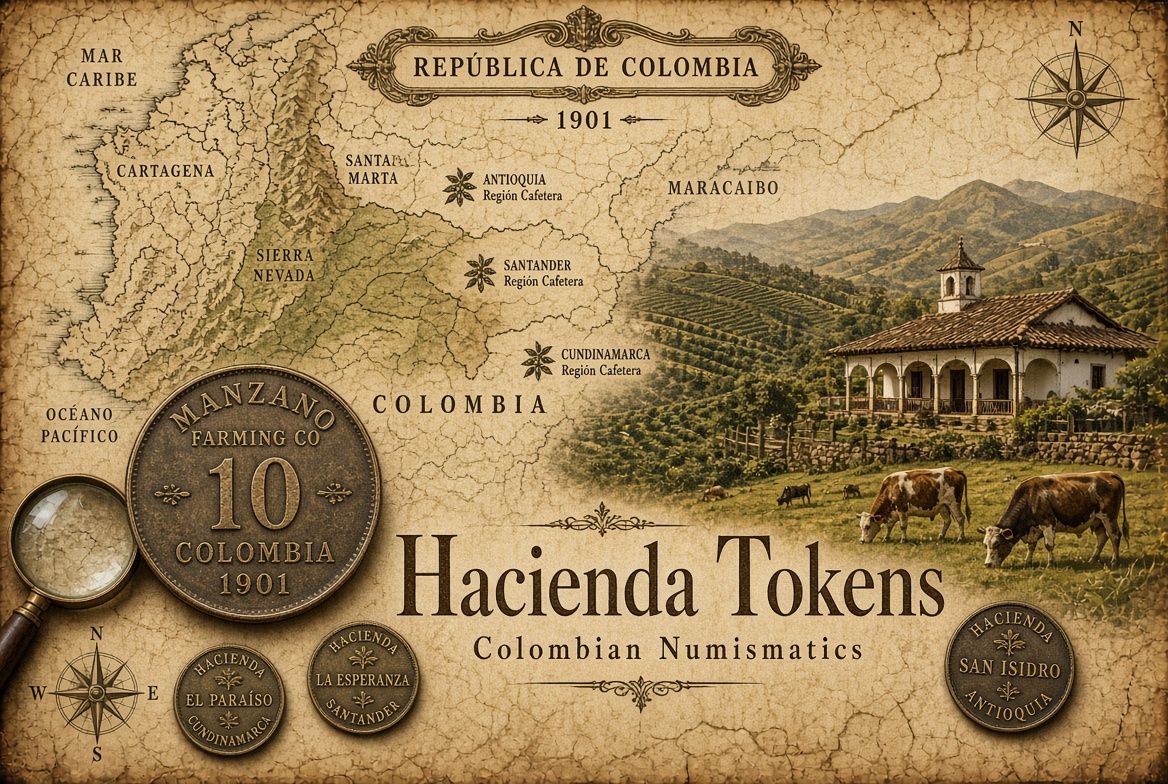
Manzano Farming Co. is a firm of Sotaquirá and Paipa that Fernando Barriga del Diestro names among the private tokens of the War of a Thousand Days. This collection holds the token of 10, dated 1901. Another collection published a different one, valued 25.
· Yezid Acosta
In brief
- Issuer
- Manzano Farming Co., of Sotaquirá and Paipa (Boyacá), according to Fernando Barriga del Diestro, Credencial Historia no. 128 (August 2000).
- Piece in this collection
- 10, 1901. The unit is not inscribed. These photographs show no letter countermark. The record hangs from this page.
- Published piece
- 25, 1901, bronze, 28.5 mm, 1.5 mm, plain edge, counterstamp JB. The Absoluti collection describes it. It is not in Notofilia, and the table does not give a unit for the 25.
- Reverse
- Papayo y Sativa; Manzano, Carreño, Soconsuca; Sotaquirá y Paipa. The 1970 listing prints Satira, not Sativa.
- Statute as cited
- Resolution 13 of 22 February 1910, by Treasury Minister Antonio José Cadavid, as Barriga gives it. This page has not collated the Diario Oficial.
Tokens
 10 · Manzano Farming Co. · 1901 View the 1901 token of 10
Who names it
Fernando Barriga del Diestro, in Credencial Historia no. 128 (August 2000), describes the private tokens of the War of a Thousand Days: notes or coin-like pieces that a shop, a mine, or an estate put into circulation when small change ran short. They passed among the issuer’s customers and, if someone asked, were exchanged at the cash desk for notes of the Banco Nacional.
Among the coin-shaped examples he names Grau & Cía. and the firm Manzano Farming Co., of Sotaquirá and Paipa. The Manuelita note-tokens of 1900 sit in the same paragraph, as paper. This page does not fold them together. The essay on hacienda tokens follows the commissary, La Amalia, and article 136 of the 1950 labor code. The subject here is this firm in Boyacá.
Barriga does not describe the die, does not give a diameter, and does not publish a catalog number. The sentence is enough to place the issuer. It is not enough for a piece record.
The 1901 piece Absoluti published
The Absoluti collection (CFMR) publishes a token of 25, dated 1901. The table does not say whether that 25 is centavos. This page does not supply a unit.
The same table gives bronze, a diameter of 28.5 mm, a thickness of 1.5 mm, and a plain edge. The obverse has the value in the center, “COLOMBIA” beneath it, the upper circular legend “MANZANO FARMING CO.”, the date below, and a counterstamp JB. The reverse reads “PAPAYO Y SATIVA” in the center, “MANZANO, CARREÑO, SOCONSUCA” above, and “SOTAQUIRA Y PAIPA” below. The mintage is given as unavailable. The provenance note says the piece was a gift of Carolina Martínez. That is Absoluti’s record, not Notofilia’s.
This case does not reproduce that photograph. The image stays on Absoluti’s page. It is not the token of 10 that Notofilia holds.
The token of 10
Notofilia holds a token of 10, dated 1901. The unit is not inscribed. The obverse carries MANZANO FARMING CO., 10, COLOMBIA, 1901, stars, and a toothed border. In the pair photograph the reverse reads PAPAYO, Y, and SATIVA, and around it MANZANO, CARREÑO, SOCONSUCA, and SOTAQUIRA Y PAIPA. That side is softer; the lettering was not reconstructed. These photos show no letter counterstamp. The record gathers the entry.
The index of Alexander Montaña Rodríguez’s bulletin, Medallas, fichas y monedas de Colombia, no. 6 (December 2015), lists “Hacienda Manzano Farming Co. 10 Centavos 1901, Resello BJ.” Entry 47, on page 13, gives 24.3 mm, 4.7 g, and brass for a countermarked example. Those measurements and that countermark are not carried over to this disc. Other listings say bronze. This piece’s metal is unverified.
The names on the reverse
Sotaquirá and Paipa are municipalities of Boyacá. Barriga gives them as the firm’s place, and the reverse repeats them. In Absoluti’s transcription the lower legend has no accent: “SOTAQUIRA Y PAIPA.”
Carreño and Soconsuca are on the metal as well. The Sotaquirá municipal development plan for 2020–2023 lists 29 veredas. Carreño, Soconsuca de Blancos, and Soconsuca de Indios are among them. The die says “SOCONSUCA,” in the singular. This page does not decide which of the two present veredas it names. The boundary table of the land-use scheme puts Carreño, on the north, against the municipality of Paipa.
Papayo does not appear in that list of 29 veredas. The plan does name papayuela among the permanent crops. That is not the same as reading “PAPAYO” on the die, and they are not equated here.
Absoluti’s reading of the reverse center is “PAPAYO Y SATIVA.” The pair photograph of the token of 10 reads SATIVA, not Satira. The Numismatic Scrapbook Magazine of 24 December 1970, page 38, lists “Manzano Farming Co Papayo y Satira 1901.” Satira and Sativa are not the same spelling. Boyacá also has the municipalities of Sátiva Norte and Sátiva Sur. This page does not identify the legend with either of them.
The firm’s name
The same municipal plan counts the apple tree among Sotaquirá’s deciduous fruits, with plum, peach, and pear. The firm’s English name uses that word. The plan is from 2020–2023 and is not a ledger of the company in 1901. It describes the municipality’s crops, not an inventory of the estate.
The resolution of 1910
Barriga dates the ban on these tokens to 1910. He cites resolution no. 13 of 22 February of that year, by Treasury Minister Antonio José Cadavid: the circulation of private vouchers, tokens, or bonds meant to replace the national currency is forbidden, and workers have the right to be paid in the currency that circulates under the guarantee of the State. Whoever still had such pieces out was to call them in within two months of publication in the Diario Oficial, and exchange them for national currency.
That quotation is the article’s. This page has not collated the wording with the Diario Oficial. It is not article 136 of the 1950 Substantive Labor Code, which the hacienda-token essay treats separately. They are two statutes, forty years apart.
What this case holds
The 25 that Absoluti published is not a Notofilia piece. The counterstamp JB stays as initials and is not assigned to the 10.
The 1901 token of 10 is in this collection: token of 10, 1901. It carries no serial, no grading certificate, and no verified Henao, Restrepo, or KM number. The mintage is unpublished. This disc’s weight, diameter, and edge were not measured.
Sources
- Fernando Barriga del Diestro — Private tokens in the War of a Thousand Days (Credencial Historia no. 128, August 2000) (opens in a new tab)
It names Manzano Farming Co., of Sotaquirá and Paipa, among the coin-shaped tokens. It quotes resolution 13 of 1910. This page has not collated the Diario Oficial.
- Biblioteca Luis Ángel Arango — the same article, capture of 10 July 2016 (opens in a new tab)
The text read for this page. The current Banrepcultural record is the address above.
- Alexander Montaña Rodríguez — Medallas, fichas y monedas de Colombia, no. 6 (December 2015) (opens in a new tab)
The index lists “Hacienda Manzano Farming Co. 10 Centavos 1901, Resello BJ.” Entry 47, page 13, measures a countermarked example: 24.3 mm, 4.7 g, brass. Those figures are not the token of 10, and this page does not republish the plate.
- Absoluti collection (CFMR) — Colombian tokens, Manzano Farming Co., 25, 1901 (opens in a new tab)
Bronze, 28.5 mm, 1.5 mm, plain edge, counterstamp JB. Obverse and reverse legends. A gift of Carolina Martínez. It is not a Notofilia piece, and this page does not republish the photograph.
- Newman Numismatic Portal — The Numismatic Scrapbook Magazine, 24 December 1970, p. 38 (opens in a new tab)
It lists “Manzano Farming Co Papayo y Satira 1901.” Satira is not the SATIVA reading of the token of 10.
- Municipality of Sotaquirá — Municipal Development Plan 2020–2023 (opens in a new tab)
It lists 29 veredas, among them Carreño, Soconsuca de Blancos, and Soconsuca de Indios. There is no vereda named Papayo. It counts apple trees and papayuela among the permanent crops. It is not a 1901 ledger of the firm.
- Sotaquirá land-use scheme — table of vereda boundaries (opens in a new tab)
Carreño borders the municipality of Paipa on the north.
View the 1901 token of 10 Back to hacienda tokens Back to Colombia-Numismatics