United States · United States Mint
2.50 dollars coin, 1878
2.50 dollars · Liberty Head · 1878
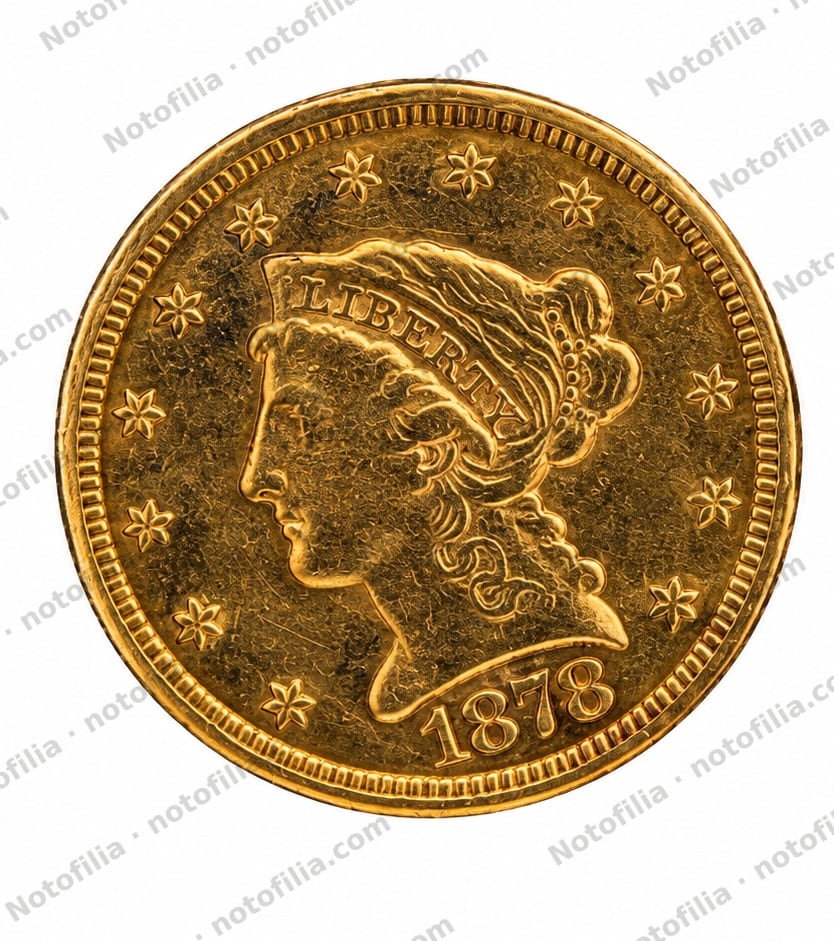
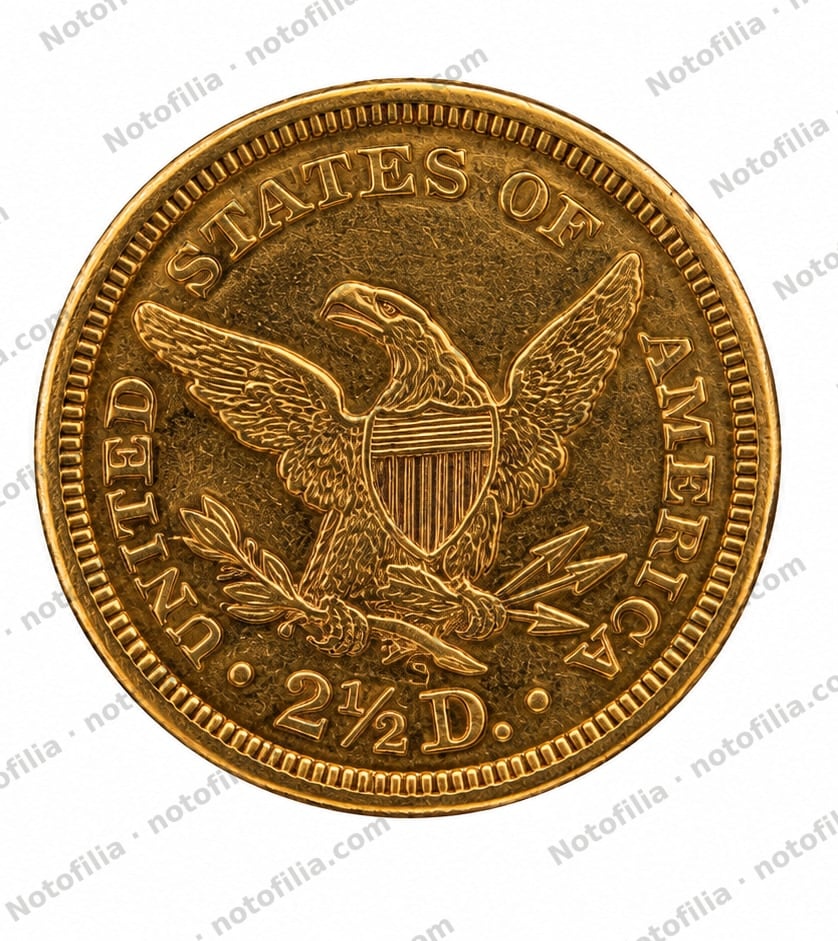
Philadelphia .900 gold quarter eagle, 1878, with no mint mark. Christian Gobrecht Liberty Head, in raised relief. No serial, and unslabbed.
Catalog facts
- Year
- 1878
- Mint
- Philadelphia (no mint mark)
- Denomination
- 2.50 dollars (quarter eagle)
- Composition
- Gold .900 (90% Au, 10% Cu)
- Weight
- 4.18 g (64.5 grains; type weight)
- Diameter
- 18 mm (type measurement)
- Edge
- Reeded (published type; the photographs do not show the edge)
- Condition
- Unslabbed. Circulation wear on the hair and the eagle; date and legends legible. Not a numerical grade.
- References
- PCGS #7828 · Numista N#13432
Obverse
Reverse
The coin
This piece is the 1878 2.50-dollar quarter eagle from the Philadelphia mint, with no mint mark. The obverse is the Liberty Head of Christian Gobrecht, also called the Coronet type: a left-facing bust, hair drawn back with a string of beads, a coronet inscribed LIBERTY, thirteen stars, and the date 1878. The relief is raised, not incuse. The reverse carries a heraldic eagle with a shield, an olive branch, and arrows; the legend is UNITED STATES OF AMERICA and 2 1/2 D., with a dot on each side of the value. Above the value, where a mint mark would sit, there is no letter. The photograph shows neither E PLURIBUS UNUM nor IN GOD WE TRUST, and no 1848 CAL. punch. It is not this collection’s 1912 Indian Head quarter eagle — Bela Lyon Pratt incuse relief, a feathered headdress, IN GOD WE TRUST, and 2½ DOLLARS — not the Classic Head of 1834–1839, and not a Gold Certificate. The piece is raw, with no holder. PCGS separates the 1878 business strike (7828) from the proofs (7904): this photograph shows circulation wear and is not identified as a proof.
Legends
- Obverse
- LIBERTY on the coronet · thirteen stars · 1878.
- Reverse
- UNITED STATES OF AMERICA · 2 1/2 D. · dots on both sides of the value. No mint mark under the eagle.
History
The Coinage Act of 2 April 1792 named the quarter eagle: one quarter of the 10-dollar eagle, worth 2.50 dollars. The weight fell from 67.5 grains to 64.5 grains (4.18 g) with the act of 28 June 1834; the act of 18 January 1837 set the fineness at .900. Wikipedia, citing Yeoman, places the fine gold of quarter eagles from 1837 onward at 0.121 troy ounces: that is the statutory content of the type, not an assay of this disc. In 1840 Christian Gobrecht adapted, for this 18 mm module, the coronet head he had used on the eagle. The type was struck without a major change through 1907. The mint mark was placed under the eagle; Philadelphia uses none. In 1908 Bela Lyon Pratt’s incuse Indian Head replaced it and was struck through 1929. The denomination was withdrawn in 1933, with the end of the gold standard; the last date issued is 1929. This record describes the object in the collection; it does not value the issue.
Scarcity and type
PCGS CoinFacts publishes 286,240 Philadelphia business strikes for 1878 (PCGS# 7828). That is a delivery figure, not a survival census and not a census of this example. The 1878-S (PCGS# 7829) is a different coin: it carries an S and PCGS gives it 178,000 pieces. The 1878 proofs (PCGS# 7904, 20) are another product. This photograph shows circulation wear on the hair and the eagle; it is not identified as a proof and it is not given a numerical grade. This record publishes neither a slab census nor a price.
Certification
The example is raw, with no NGC, PCGS, or other holder. This module carries no serial number. The identity of this record is the photographed object — date 1878, LIBERTY coronet, 2 1/2 D., and no mint mark — not a certificate. If it is later slabbed, the cert number will replace this note.
Sources
- PCGS CoinFacts — 1878 2.50 dollars, business strike (7828) (opens in a new tab)
Christian Gobrecht; reeded edge; 18 mm; 4.18 g; Philadelphia; 90% gold and 10% copper; 286,240 business strikes. Prices are not republished.
- PCGS CoinFacts — 1878 2.50 dollars, proof (7904) (opens in a new tab)
20 published proofs. A different product: this photograph is not identified as a proof. Prices are not republished.
- Stack’s Bowers — Liberty Head quarter eagle, 1840–1907 (opens in a new tab)
Gobrecht; LIBERTY coronet; eagle with shield, olive branch, and three arrows; 90% gold and 10% copper; 4.18 g (64.50 grains); 18 mm; reeded edge. Prices are not republished.
- Wikipedia — Quarter eagle (opens in a new tab)
Name in the Coinage Act of 1792; 1834 weight; .900 fineness in 1837; Gobrecht Liberty Head, 1840–1907; mint mark under the eagle. The price cited there for the 1848 CAL. is not republished.
- Numista — 2½ dollars Coronet Head, quarter eagle (N# 13432) (opens in a new tab)
Type of 1840–1907; .900 gold and .100 copper; 4.18 g; 18 mm; legend UNITED STATES OF AMERICA and 2½ D.
Related pieces
Another piece in the United States collection.