United States · Colonial paper · Continental Congress
$5 note, 1779
$5 · Continental Currency · 14 January 1779
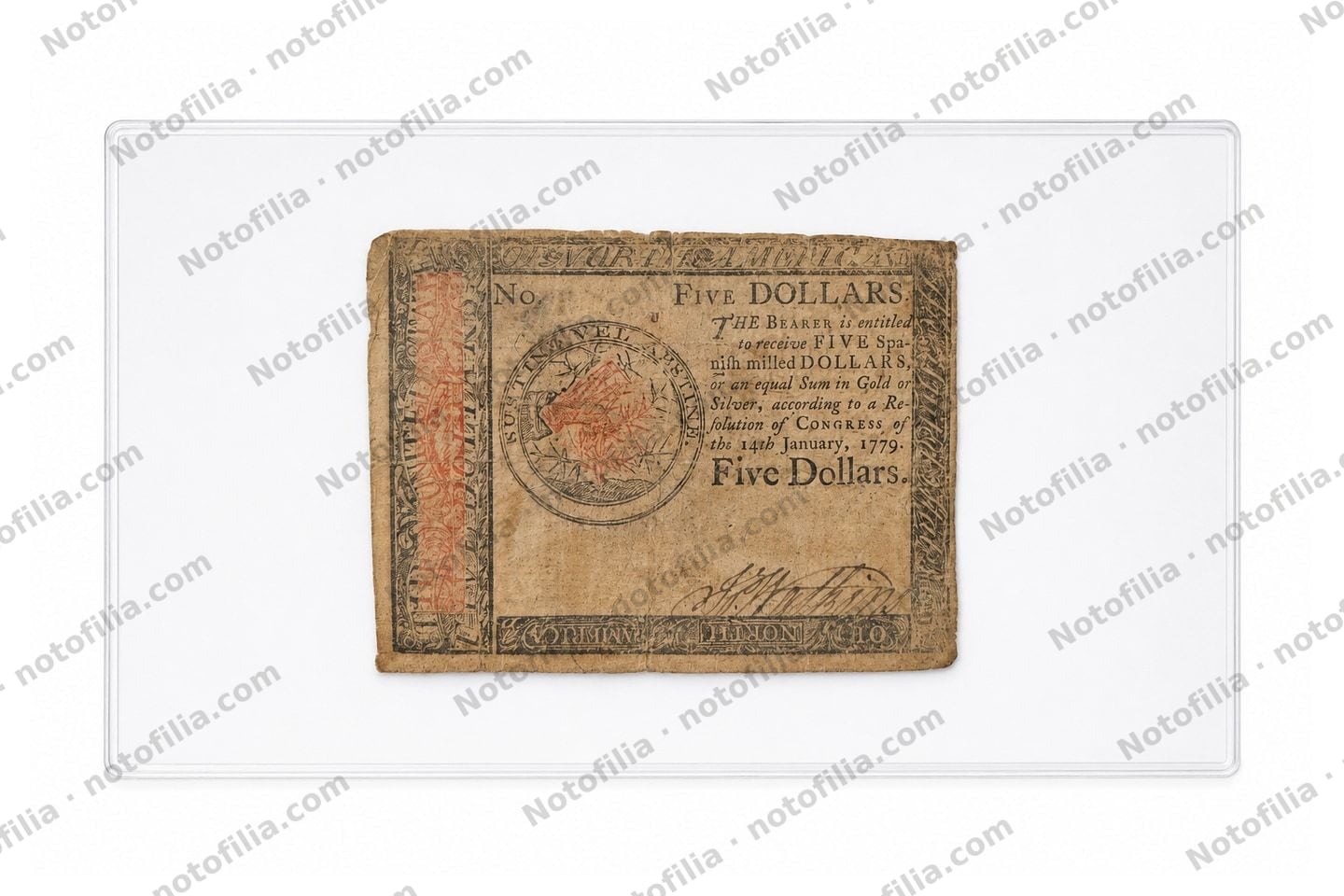
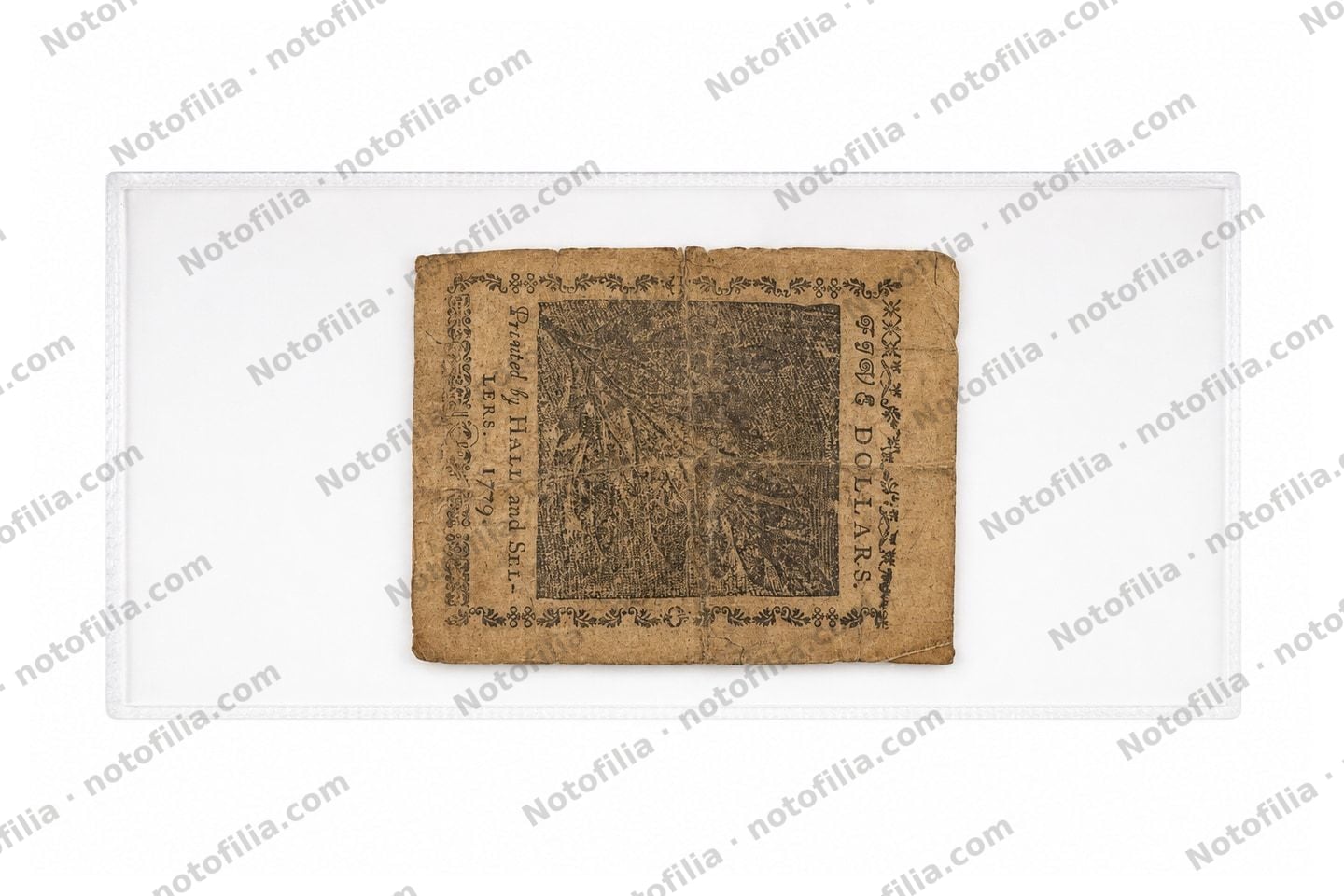
Black and red face with the SUSTINE VEL ABSTINE emblem; Hall and Sellers nature-print back, 1779. Resolution of Congress of 14 January 1779. The manuscript serial is not readable on this photograph.
Catalog facts
- Pick reference
- Fr. CC-91
- Serial number
- —
- Signatures
- Watkins (lower right); the second, red signature is not readable
- Condition
- Circulated, unslabbed, in a sleeve (private collection)
- Printage
- Hall and Sellers, Philadelphia, 1779. Ivy Mills paper (Chester County, Pennsylvania), with blue fibers and mica. Notre Dame puts emissions authorized by seven resolutions between 14 January and 29 November 1779 at $95,051,695, of which $50,000,000 was to exchange the 20 May 1777 and 11 April 1778 issues. This record does not invent a printage for the $5 or for this piece.
Face
Back
The note
The $5 of 14 January 1779 (Friedberg CC-91) is the five of the Continental Congress’s last Continental Currency issue. The face, black and red on Ivy Mills paper from Chester County, Pennsylvania, entitles the bearer to FIVE Spanish milled DOLLARS, or an equal sum in gold or silver, according to the resolution of Congress of 14 January 1779. At left a circular emblem shows a hand bleeding as it tries to pull up a hawthorn; the Latin motto is SUSTINE VEL ABSTINE. Benjamin Franklin explained it, under the name Clericus, in the Pennsylvania Gazette of 20 September 1775: the bush is America and the bleeding hand Britain; “Bear with me, or let me alone.” THE UNITED STATES runs in red on the left border; NORTH AMERICA sits in the top and bottom borders. FIVE DOLLARS is at right. The No. field carries a manuscript serial in red that is not readable on this photograph. A dark manuscript signature, Watkins, sits at lower right; the second, red signature is not distinguishable. The back shows a leaf nature print — Franklin and Hall and Sellers’ anti-counterfeit device — with “Printed by HALL and SEL-LERS. 1779” at left and FIVE DOLLARS at right. It is not the $5 of 26 September 1778 (the same emblem, an earlier date; Numista N#335875), nor the $30 CC-93 of this same issue. The collection note, circulated and unslabbed, is shown in a sleeve.
The last Continental issue
The Continental Congress authorized paper in May 1775 to finance independence. The notes promised Spanish milled dollars or their equal in gold or silver; they paid no interest. Hall and Sellers printed them in Philadelphia, successors to Benjamin Franklin’s press, on Ivy Mills paper with blue fibers and mica. The backs used nature prints of leaves and cloth, hard to engrave by hand. Inflation and British counterfeits — economic warfare — coined the phrase “not worth a Continental.” The U.S. Currency Education Program and the Newman Numismatic Portal place that collapse at the war’s end; the distrust delayed federal paper until the greenbacks of 1861–1862.
The resolution of 14 January 1779 was the last. Notre Dame describes a new border with “United States of North America,” smaller emblems, and part of the emblem and left border in red. Francis Hopkinson designed the $35, $45, $70, and $80; other hands, the $55 and $65. Denominations on this date run from $1 to $80, with unusual values — $35, $45, $55, $65 — forced by inflation. On that date Congress valued the paper at $7.42 Continental to $1 in specie. The serial and the second signature were in red; the first, in brown. This record describes the physical object; it does not assert a plate state or a grading census for this example.
Scarcity and printage
14 January 1779 closes the 11 Continental Currency resolutions Friedberg numbers CC-1 through CC-102; the $5 of that date is CC-91. Notre Dame does not publish a printage by denomination. This record does not invent a census or an auction rarity for the type or for this example with an illegible serial.
Population
A PMG or PCGS census for this example with an illegible serial has not been independently verified. The note is shown in a sleeve, unslabbed, with no certificate number.
Sources
- University of Notre Dame — Continental Currency, 14 January 1779 (opens in a new tab)
Hall and Sellers, Philadelphia; Ivy Mills paper; United States of North America border; SUSTINE VEL ABSTINE emblem and Franklin’s explanation (Clericus, Pennsylvania Gazette, 20 September 1775); $95,051,695 authorized across seven resolutions; serial and second signature in red.
- U.S. Currency Education Program — History of U.S. Currency (opens in a new tab)
Massachusetts 1690 and Continentals of 1775; the phrase “not worth a Continental.”
- Wikipedia — Continental currency banknotes (opens in a new tab)
The 14 January 1779 issue, including the $5 denomination; cites Notre Dame.
- Numista — Continental Currency $5, 26 September 1778 (N#335875) (opens in a new tab)
The same SUSTINE VEL ABSTINE emblem and Hall and Sellers nature print, an earlier date. Not this 1779 piece.
Related pieces
Other records from the same issuer or era in this case.