United States · Colonial paper · State of Rhode Island
20 shillings note, 1786
20 shillings · Rhode Island · May 1786
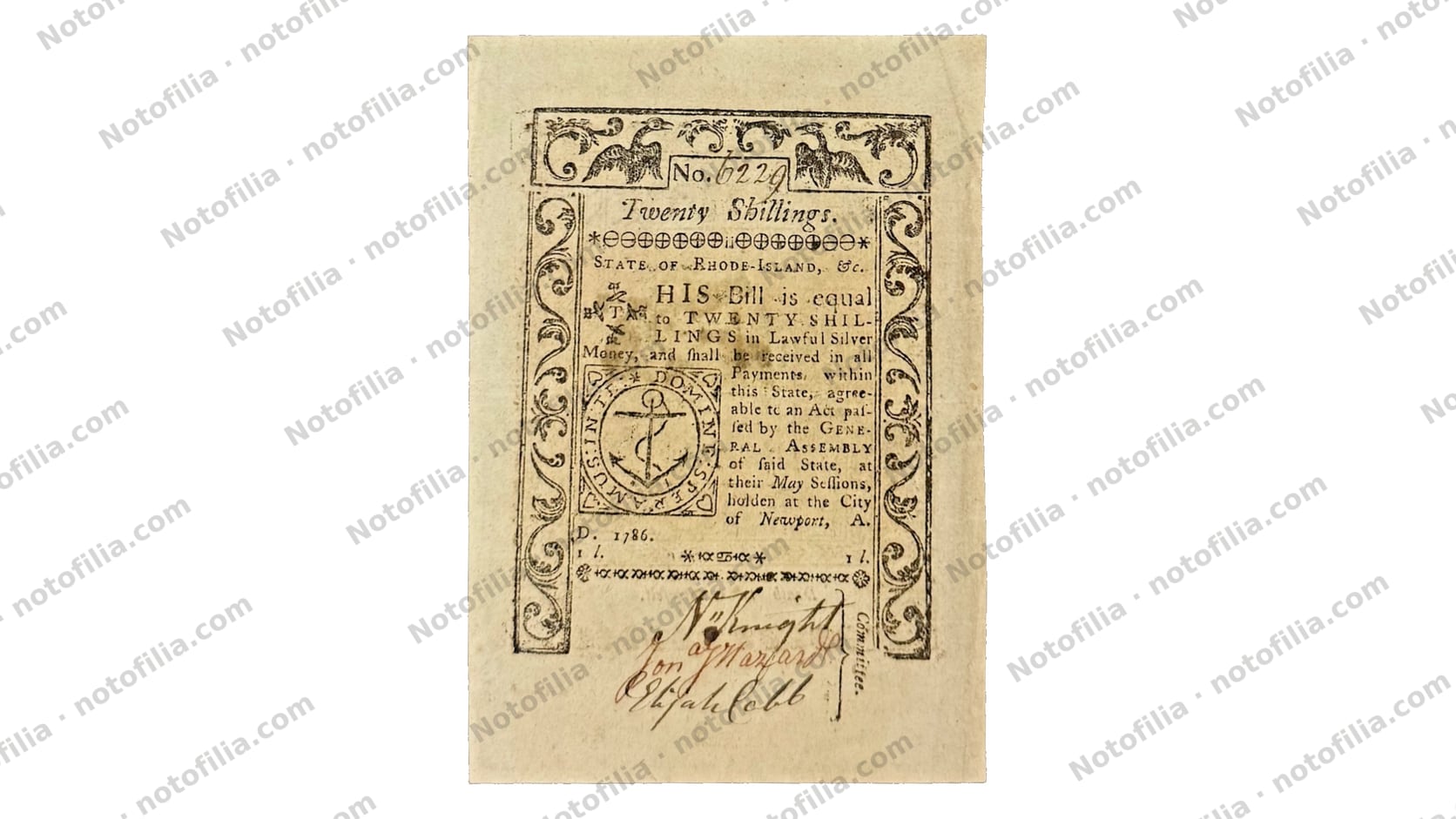
Twenty shillings — one pound — of Rhode Island, May 1786, Newport. Anchor and DOMINE SPERAMUS IN TE. Manuscript serial 6229.
Catalog facts
- Pick reference
- Fr. RI-298
- Serial number
- No. 6229
- Signatures
- N. Knight (dark ink); Jonathan Hazard and Elijah Cobb (a redder ink). Committee is printed vertically beside the signatures.
- Condition
- Wide margins, cream paper, light creases, and scattered dark marks. The dark mark beside the upper signature has not been examined in transmitted light. Unslabbed (private collection). No numerical grade is assigned.
- Printage
- Southwick and Barber, Newport, 1786. The acts of May, June, and August 1786 authorized £100,000 in legal-tender bills of credit, at 4 percent for seven years, secured by real estate; Greysheet calls that emission the Tenth Bank. This record does not invent a printage for the 20 shillings or a serial range for 6229.
Face
Back
The note
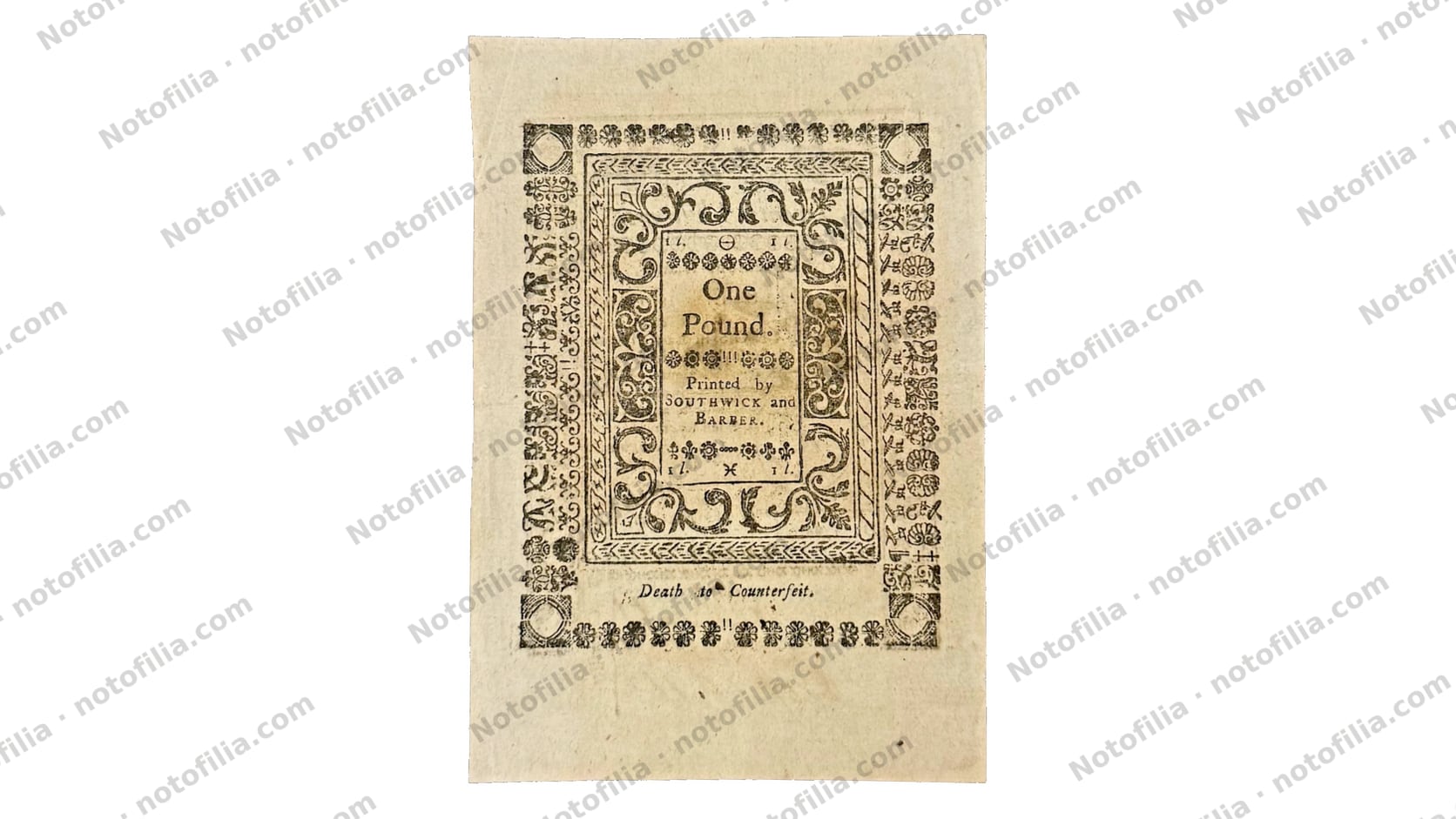
The 20 shillings of May 1786 (Friedberg RI-298) is a State of Rhode Island bill of credit, equal to one pound of lawful silver. The face, in black, titles Twenty Shillings and State of Rhode-Island, &c. The text promises that the bill is equal to TWENTY SHILLINGS in Lawful Silver Money and shall be received in all payments within the State, agreeable to an act of the General Assembly at their May sessions, holden at the City of Newport, A.D. 1786. At left a circular emblem carries an anchor and the motto DOMINE SPERAMUS IN TE. The No. field carries manuscript serial 6229. There are three manuscript signatures: N. Knight, in dark ink, above; Jonathan Hazard and Elijah Cobb, in a redder ink, below. Beside them, Committee is printed vertically. No plate letter is confidently readable. The back, black and with an ornamental border, centers One Pound, the legend Printed by SOUTHWICK and BARBER, and, under the frame, Death to Counterfeit. It is not the Pennsylvania 20 shillings of 1 October 1773 (Fr. PA-169), nor the other denominations of this Rhode Island issue: 6d RI-290, 9d RI-291, 1s RI-292, 2s6d RI-293, 3s RI-294, 5s RI-295, 6s RI-296, 10s RI-297, 30s RI-299, 40s RI-300, and £3 RI-301. Greysheet notes that the four lowest denominations were issued with blank backs; this 20 shillings carries the printed back. Greysheet lists Samuel Allen, Elijah Cobb, Job Comstock, Jonathan Hazard, and N. Knight as authorized signers, and calls for three signatures on the three highest denominations and two on the others; this example shows three. The note, unslabbed, is shown on a neutral ground.
The 1786 Tenth Bank
After independence, Rhode Island financed real-estate loans with paper. In May 1786 the General Assembly, meeting at Newport, authorized bills of credit. Greysheet describes £100,000 of legal tender, under the acts of May, June, and August 1786, at 4 percent for seven years, secured by real estate, and calls the emission the Tenth Bank. Southwick and Barber printed them in Newport, on bluish or cream paper. Death to Counterfeit was to appear on the bills; Greysheet notes that it was omitted on the four lowest denominations, which had blank backs. This 20 shillings — one pound — carries the printed back. The £100,000 figure is the monetary total of the authorization, not the number of pieces and not the printage of this denomination.
The statute that compelled acceptance of the paper, and trial without a jury, led to Trevett v. Weeden (Newport, September 1786). The formal judgment of the Superior Court of Judicature dismissed the complaint: the information “does not come under the cognizance of the Justices” and is dismissed. It is not a ruling that abolished the emission. Greysheet records that the December 1786 act repealed the penal features and kept legal tender, and that the September 1789 act withdrew that tender once the paper had fallen to about 10 percent of face. Greysheet adds that the State burned more than 96 percent of the issue between 1793 and 1803. This record describes the physical object; it does not assert a plate state or a grading census for serial 6229.
Scarcity and printage
Friedberg numbers the 20 shillings of May 1786 as RI-298. The £100,000 figure is the authorization for the whole issue, not a printage of this denomination and not a serial range. A quantity printed by denomination, and the full numbering interval, have not been verified. Examples of this type with sheet margins have been offered in the trade; the broad margins of serial 6229 do not by themselves establish an exceptional rarity.
Population
A certification total for serial 6229 has not been verified. The note is shown unslabbed, with no certificate number. Grading-service populations count certified notes and do not establish how many survive.
Sources
- Smithsonian — National Museum of American History, 20 Shillings, Rhode Island, 1786 (opens in a new tab)
A type example, date on object 1786-05, printer Southwick and Barber, NU.69.217.319. Not serial 6229.
- Greysheet — Issue of May 1786, Rhode Island (opens in a new tab)
£100,000, the Tenth Bank, 4 percent seven-year loans; Southwick and Barber; signers; Trevett v. Weeden; legal tender until September 1789; depreciation to about 10 percent; more than 96 percent burned between 1793 and 1803; denominations RI-290 through RI-301.
- Greysheet — May 1786 20s Rhode Island (Fr. RI-298) (opens in a new tab)
A different example of the same type, graded PMG About Uncirculated 53, is listed as sold for 183 dollars on 14 June 2026. That is a comparison sale, not a valuation of serial 6229.
- Online Review of Rhode Island History — Trevett v. Weeden, 1786 (opens in a new tab)
The court dismissed the complaint for want of cognizance. The judgment did not stop the paper-money program and is not a technical precedent for judicial review.
- Encyclopedia.com — Trevett v. Weeden (Rhode Island, 1786) (opens in a new tab)
Text of the judgment: the complaint does not come under the cognizance of the justices and is dismissed.
Related pieces
Other records from the same issuer or era in this case.