United States · Colonial paper · Province of Pennsylvania
5 shillings note, 1773
5 shillings · Pennsylvania · 1 October 1773
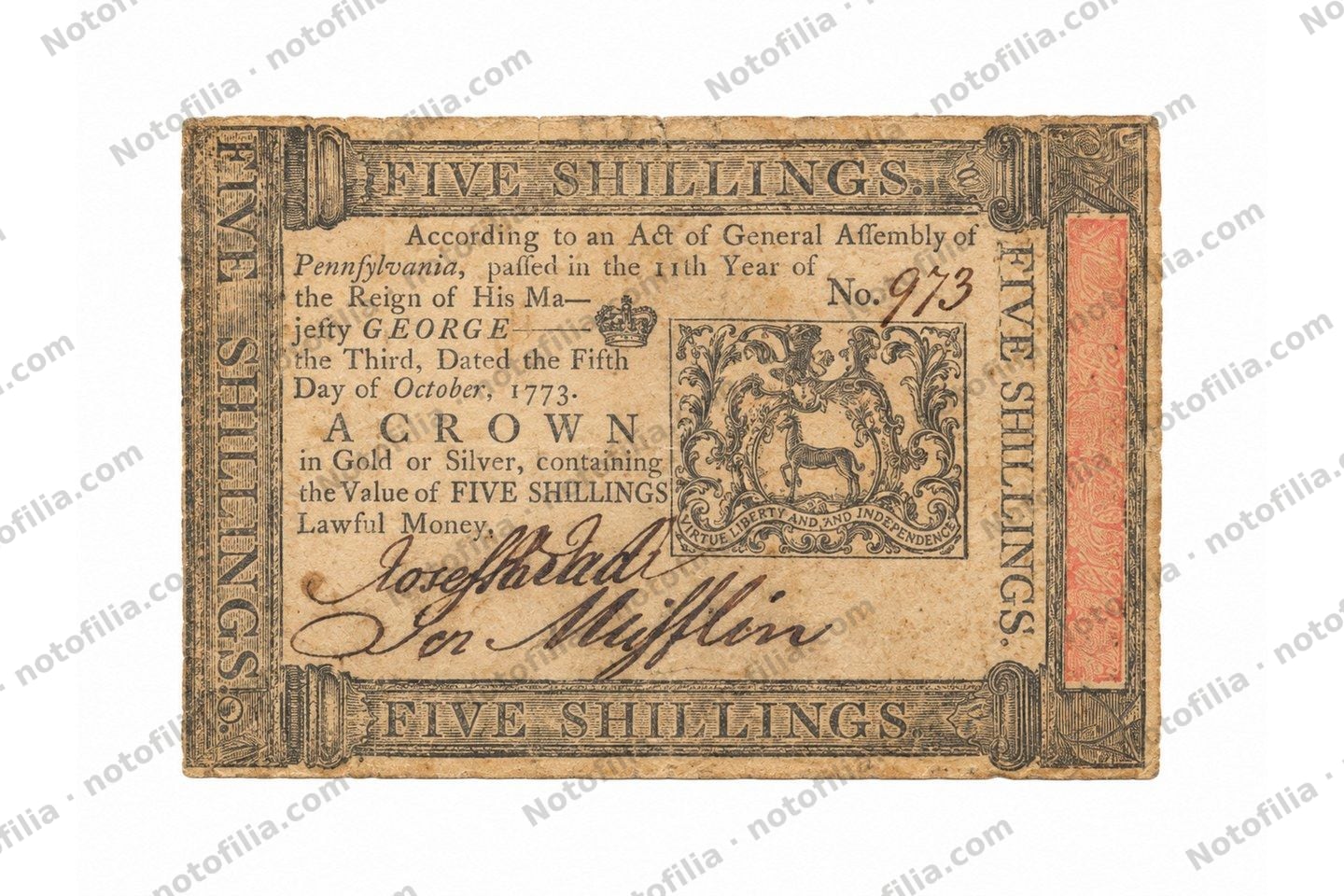
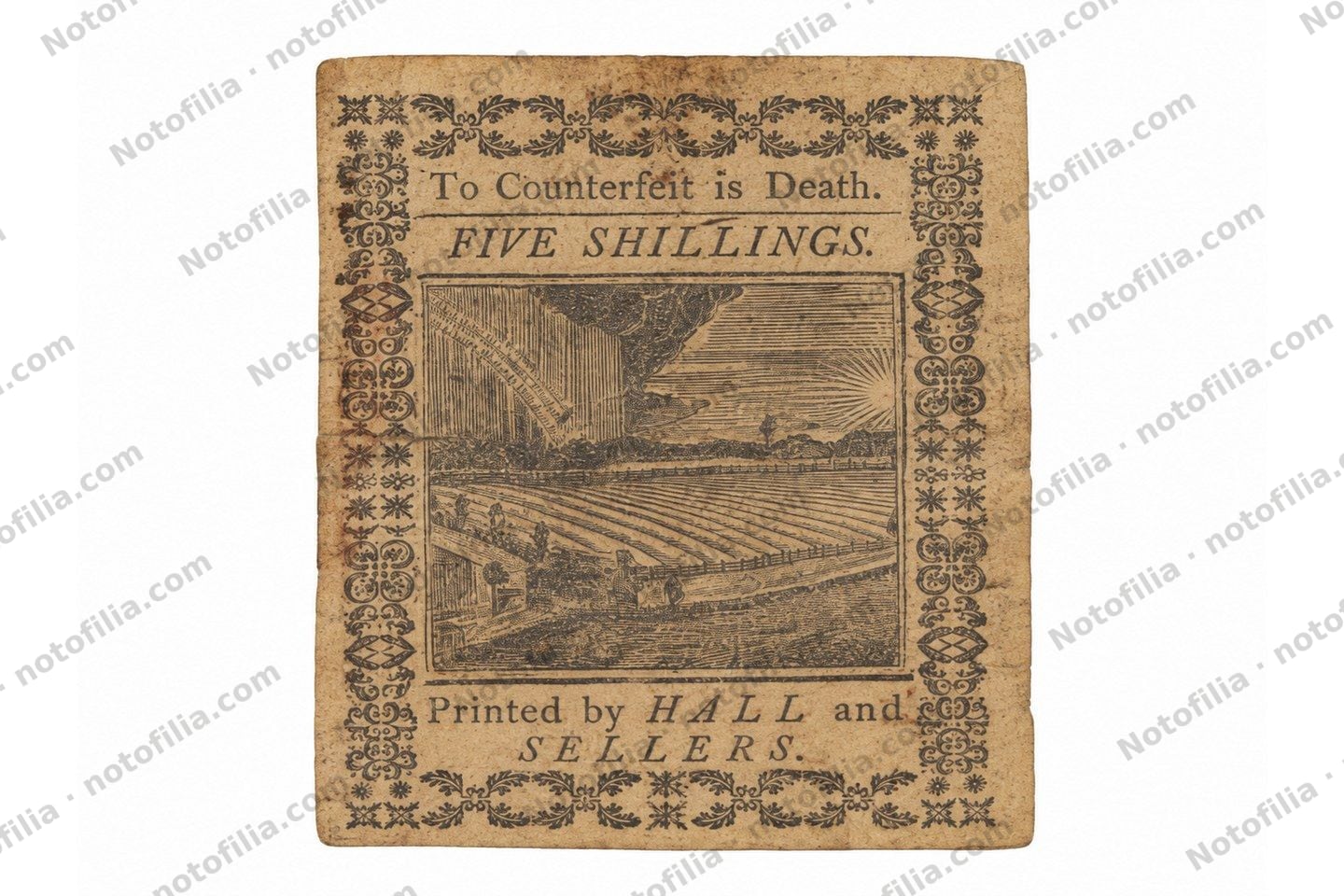
A 5-shilling bill of credit — one crown, a quarter pound of lawful money — of the Pennsylvania General Assembly, 1 October 1773 (not the 5th). Face with the arms and a red stripe; farm reverse and “To Counterfeit is Death.” Serial 9733.
Catalog facts
- Pick reference
- Fr. PA-166 · P# S-2540 · N#406969
- Serial number
- No. 9733
- Signatures
- Two manuscript signatures in dark ink; the lower one reads Mifflin. Newman gives three signers per note — one often in red — and lists Joseph Mifflin, James Stephens, Thomas Leech, William Fisher Jr., and Barnaby Barnes among the issue’s authorized hands. The upper signature on this example is not confidently transcribed; it is not assigned here to Joseph Redman or John Mifflin.
- Condition
- Circulated, unslabbed (private collection)
- Printage
- Hall and Sellers, Philadelphia, 1773. Newman describes paper with mica flakes and blue fibers. The act of 1 February 1773 authorized £150,000 to revive the Loan Office; this record does not invent a printage for the 5 shillings or for serial 9733. Numista gives the type as 90 × 70 mm.
Face
Back
The note
The 5 shillings of 1 October 1773 (Friedberg PA-166; Pick S-2540; Numista N#406969) is a Province of Pennsylvania bill of credit, not a Continental of Congress. The face, black with a vertical red stripe at right, titles FIVE SHILLINGS on all four sides and cites an act of the General Assembly “passed in the 13th Year of the Reign of His Majesty GEORGE the Third. Dated the First Day of October, 1773.” The long s in First (Firſt) is often read as Fifth: the printed date is the 1st, not 5 October; the Smithsonian transcribes the same formula on the 15 shillings of this issue (nmah_1823921). The text promises A CROWN in Gold or Silver, containing the Value of FIVE SHILLINGS Lawful Money: in sterling a crown is five shillings, a quarter pound, tied to provincial lawful money. Newman notes that the number of crowns on the type is keyed to the five highest denominations; this five has one. At center sit the arms with a horse and the printed motto VIRTUE LIBERTY AND INDEPENDENCE — the motto on this example, not the Penn family’s Mercy Justice sometimes described for the type. The No. field carries manuscript serial 9733. There are two manuscript signatures; the lower one reads Mifflin. The back is not the leaf nature print of the Continentals or of the higher denominations of this same date: Newman describes a cast cut of a farming scene — fields, a fence, and a sun on the horizon. Above it stand To Counterfeit is Death and FIVE SHILLINGS; below, Printed by HALL and SELLERS. It is not the 1779 Continental $5 from the same shop (Fr. CC-91), nor the other October 1773 values: 18d PA-163, 2s PA-164, 2s6d PA-165, 10s PA-167, 15s PA-168, 20s PA-169, and 50s PA-170. The collection note, circulated and unslabbed, is shown on a neutral ground.
The 1773 Loan Office
On 1 February 1773 the Pennsylvania Assembly authorized £150,000 in bills of credit to revive the Loan Office: a land-bank of mortgage loans that returned the paper to the treasury. Newman dates the printed issue to 1 October 1773 — Friedberg PA-163 through PA-170 — and places the shop with Hall and Sellers, Philadelphia, successors to Benjamin Franklin’s press. The paper carries mica and blue fibers. On the four highest denominations the face was printed red and black at once; Newman points to papier-mâché stencil plates. On this 5 shillings the red ink marks the right border. Newman does not publish a printage by denomination; the portal numbers beside each value (e.g. 28,318 next to the 5s) are plate references, not a census of 28,300 notes.
Two years later the Continental Congress would use the same shop — and, on the backs, leaf nature prints — for the paper of independence. This 1773 five is still dated in the 13th year of George III and promises a crown in gold or silver, not Spanish milled dollars. To Counterfeit is Death is the penal formula on the back. Newman calls for two or three manuscript signatures for a note to circulate; this example shows two. This record describes the physical object; it does not assert a plate state or a grading census for serial 9733.
Scarcity and printage
Friedberg numbers the 5 shillings of 1 October 1773 as PA-166. Newman’s portal extract does not publish a printage by denomination: the £150,000 figure is the authorization for the whole act, not for this type. This record does not invent a census or an auction rarity for the type or for serial 9733.
Population
A PMG or PCGS census for serial 9733 has not been independently verified. The note is shown unslabbed, with no certificate number.
Sources
- Newman Numismatic Portal — Early Paper Money of America / Pennsylvania / 1773 October 1 (opens in a new tab)
Act of 1 February 1773, £150,000; Hall and Sellers; mica and blue-fiber paper; farm scene on the back; crowns keyed to denomination; red-and-black printing; signers including Joseph Mifflin.
- Numista — 5 Shillings, Colony of Pennsylvania (N#406969) (opens in a new tab)
Pick S-2540; 90 × 70 mm; Hall & Sellers; arms on the face; farm reverse and “To Counterfeit is Death.”
- University of Notre Dame — Pennsylvania, 1 October 1773 (opens in a new tab)
Text of the provincial issue of that date, in the same series this case uses for the Continental of 14 January 1779.
- Smithsonian — National Museum of American History, 5 Shillings, Pennsylvania, 1773 (opens in a new tab)
A type example, date on object 1773-10-01, printer Hall & Sellers. Not serial 9733.
- Smithsonian — 15 Shillings, Pennsylvania, 1773 (nmah_1823921) (opens in a new tab)
Same issue: transcribes “DATED THE FIRFT DAY OF OC-TOBER, 1773.” Confirms 1 October against a Fifth reading of the long s.
- U.S. Currency Education Program — History of U.S. Currency (opens in a new tab)
Context for colonial paper before the Continentals of 1775.
Related pieces
Other records from the same issuer or era in this case.