United States · Colonial paper · State of Connecticut
20 shillings note, 1780
20 shillings · Connecticut · 1 June 1780
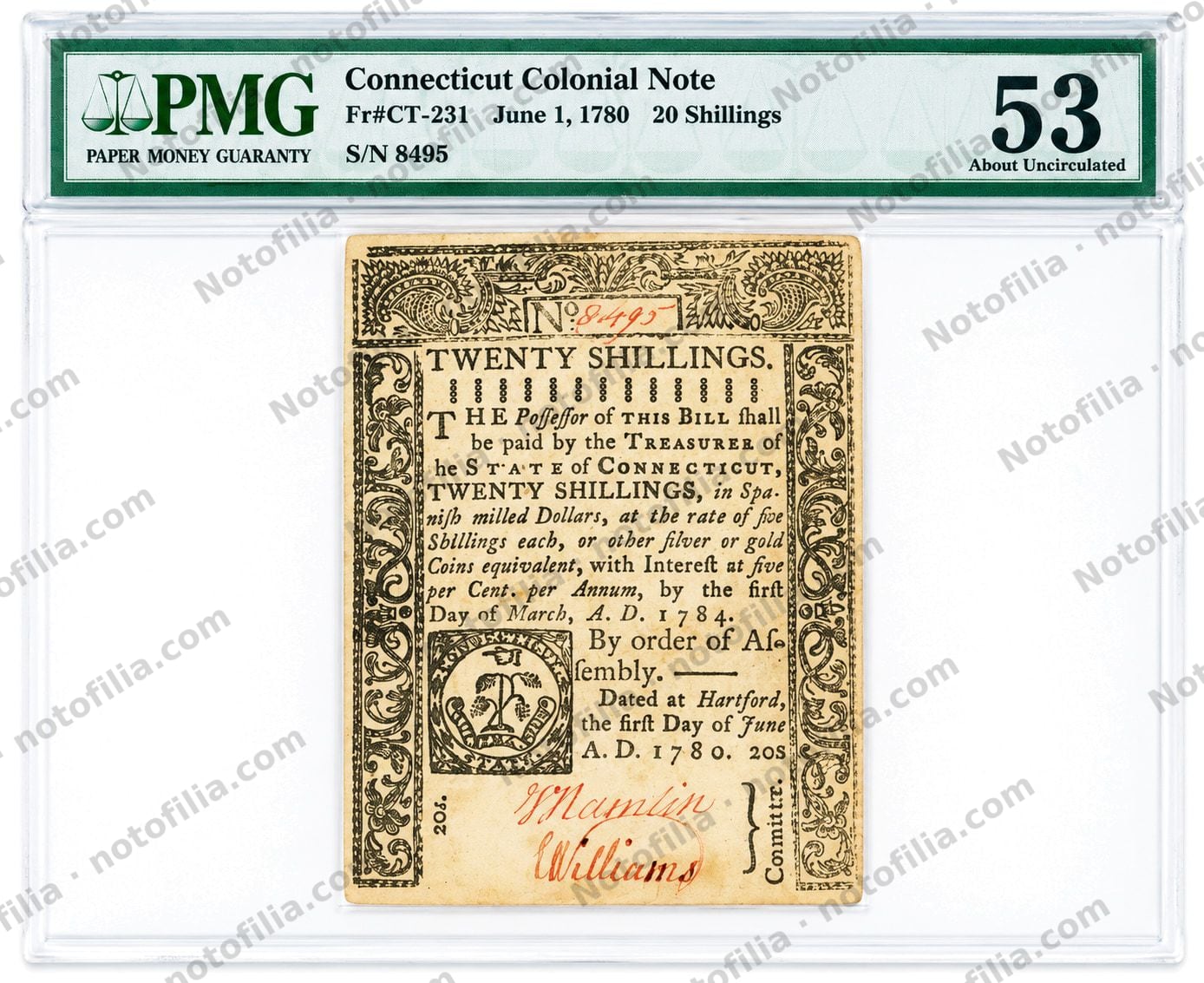
Twenty shillings — one pound — of Connecticut, 1 June 1780, New London. Manuscript serial 8495. PMG 53, certificate 1072657-023.
Catalog facts
- Friedberg reference
- Fr. CT-231
- Serial number
- Nº 8495
- PMG comments
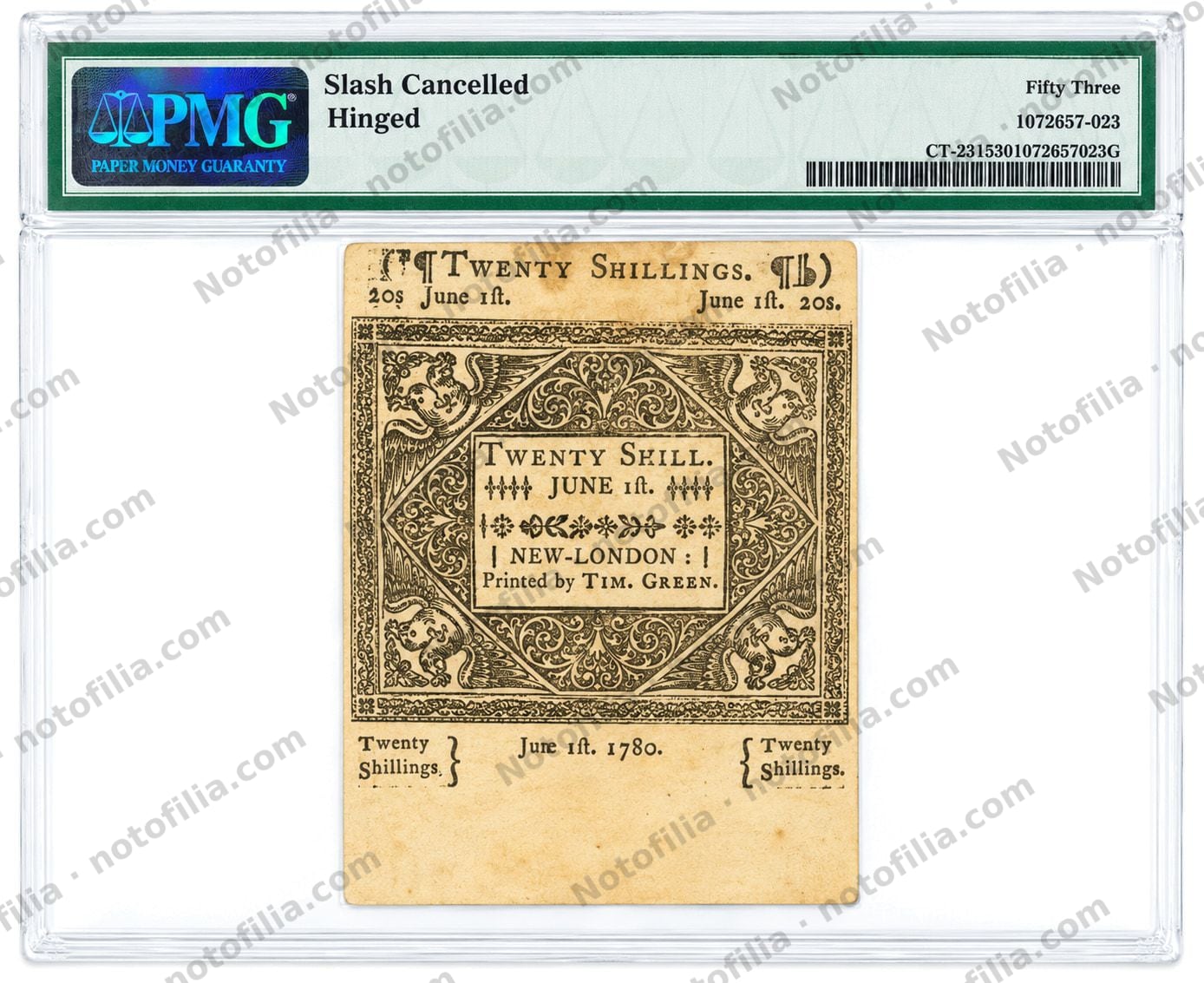
- Slash Cancelled; Hinged
- Signatures
- J. Hamlin and Williams, manuscript in red ink. Newman includes Jabez Hamlin and Elisha Williams on the emission’s signer list; the given name Elisha is not written out on this example. Comittr. is printed vertically beside the brace.
- Condition
- PMG 53 · certificate 1072657-023
- Inks
- Black printing; manuscript serial and signatures in red ink.
- Printage
- Timothy Green II, New London, 1780. Newman puts the authorization for the whole 1 June 1780 emission at £50,000 — 166,667 Spanish milled dollars — at 5 percent, payable 1 March 1784.
Face
Back
The note
The 20 shillings of 1 June 1780 (Friedberg CT-231) is a State of Connecticut treasury note, equal to one pound, payable in Spanish milled dollars. The face, black and framed by scrollwork, titles TWENTY SHILLINGS. The text promises that the possessor shall be paid by the Treasurer of the State of Connecticut TWENTY SHILLINGS in Spanish milled dollars, at six shillings each, or in other silver or gold coin equivalent, with interest at five percent per annum, by the first day of March 1784. The long s in first (firſt), in “the first Day of June” and “the first Day of March,” is often read as fifth: the printed dates are 1 June 1780 and 1 March 1784, not the 5th. It stands “By order of Assembly” and is dated at Hartford. At left a small circular seal shows three grapevines, the device of the Connecticut arms; the motto is not transcribed from this photograph. The Nº field carries manuscript serial 8495, in red ink. The two signatures, also in red, read J. Hamlin and Williams. Beside the brace, Comittr. is printed vertically. Newman gives the 1 June signers as those of 1 March — John Chester, Jabez Hamlin, Benjamin Payne, Elisha Williams, and George Wyllys — plus William Pitkin. The pair on this example matches Jabez Hamlin and Elisha Williams; the given name Elisha is not written out. Jabez Hamlin was judge of the probate court for the Middletown district and is named on the committee the Assembly appointed to prepare and sign the bills. The Elisha Williams of that committee is the Wethersfield colonel born on 31 January 1717/18 who died on 30 May 1784, son of the Yale rector of the same name, who had died in 1755. The back, in black, centers TWENTY SHILL., JUNE 1st., NEW-LONDON, and Printed by TIM. GREEN, inside a scrollwork frame with winged figures in the corners. Denomination and date repeat above and below, with June 1st. 1780. It is not the Rhode Island 20 shillings of May 1786 (Fr. RI-298, serial 6229), nor the Pennsylvania 20 shillings of 1 October 1773 (Fr. PA-169), nor the Connecticut 20 shillings of 1 March 1780. The note is slabbed. The PMG label prints About Uncirculated 53, certificate 1072657-023, and the comments Slash Cancelled and Hinged. It does not print EPQ. A cut or a hole is not confidently located on the photograph: the cancellation and the hinge are recorded from the label.
The 1 June 1780 emission
On 18 March 1780 the Continental Congress resolved to draw in depreciated Continental currency, generally at forty to one, and to guarantee new state issues payable in Spanish milled dollars; that paper reached Connecticut too late, and the 1 June treasury notes, at 5 percent, were issued in its place. The motto of the Connecticut arms is Qui Transtulit Sustinet — it is not transcribed from this photograph — and Comittr., printed vertically, abbreviates Committee. New London, where Timothy Green II printed the note, was burned on 6 September 1781 in Benedict Arnold’s raid.
Newman describes £50,000 in treasury notes dated 1 June 1780, payable in Spanish milled dollars on 1 March 1784, with 5 percent interest, under the act of May 1780. The emission stood in lieu of, and was exchangeable for, the guaranteed paper Congress authorized on 18 March 1780, which arrived too late to be used. Timothy Green II printed them in New London. They were similar to the 1 March 1780 notes, with the same signers plus William Pitkin, and were customarily slash- or hole-cancelled on redemption. The £50,000 figure is the authorization for the whole emission, not the number of pieces and not the printage of the 20 shillings.
On the portal’s list the denominations are 9d, 1s3d, 2s6d, 5s, 10s, 20s, and 40s; the 20s and the 40s carry the CF mark. Greysheet catalogues, separately, a contemporary counterfeit of this type. The holder of this example names it Fr. CT-231.
Scarcity and printage
Friedberg numbers the 20 shillings of 1 June 1780 as CT-231. Newman’s £50,000 is the authorization for the whole emission, not a printage of this denomination and not a serial range.
Population
Certificate 1072657-023 and the grade printed on the holder, About Uncirculated 53, with the comments Slash Cancelled and Hinged, are recorded. A certification census does not say how many examples survive.
What this entry does not claim
- This record does not invent a printage for the 20 shillings or for serial 8495.
- No census of survivors and no plate state are claimed.
- The PMG population for Fr. CT-231 at 53 and above, and certificate 1072657-023, have not been checked online.
- No price is published.
Sources
- Newman Numismatic Portal — Early Paper Money of America / Connecticut / 1780 June 1 (opens in a new tab)
£50,000; act of May 1780; payable 1 March 1784 at 5 percent in Spanish milled dollars; in lieu of the guaranteed paper of 18 March 1780; Timothy Green II; the 1 March signers plus William Pitkin; customarily slash- or hole-cancelled; denominations, with a CF mark on the 20s and the 40s.
- Newman Numismatic Portal — Connecticut / 1780 March 1 (opens in a new tab)
Signer list for 1 March, which the June record reuses: John Chester, Jabez Hamlin, Benjamin Payne, Elisha Williams, and George Wyllys. Not this example’s emission.
- Smithsonian — 10 Shillings, Connecticut, 1780 (nmah_988286) (opens in a new tab)
Same date on the object, 1780-06-01, printer Timothy Green II, New London. A 10 shillings, not the 20 shillings and not serial 8495.
- Smithsonian — 20 Shillings, Connecticut, 1780 (nmah_988281) (opens in a new tab)
Twenty shillings of the same colony and printer, date on object 1780-03-01. Not 1 June and not serial 8495.
- Greysheet — Jun 1, 1780 20s Connecticut (Fr. CT-231) (opens in a new tab)
Confirms Friedberg CT-231 for the 20 shillings of 1 June 1780 and catalogues, separately, a contemporary counterfeit of the type. Price columns are not republished.
- Massachusetts Historical Society — Paper Currency of the Revolution, 1775–1781 (opens in a new tab)
The 1 June 1780 issue, printed by Timothy Green of New London; the notes it lists under that heading are payable 1 March 1784. None is serial 8495. The next heading dates some bills 1 June 1780 and due 1 March 1785: that date is not the one printed on this example and is not used here.
- PMG — Certificate verification 1072657-023 (opens in a new tab)
The holder prints Fr. CT-231, 1 June 1780, 20 shillings, serial 8495, About Uncirculated 53, Slash Cancelled, and Hinged. The online record has not been opened.
- University of Notre Dame — Colonial Currency: The Devaluation (opens in a new tab)
Resolution of 18 March 1780: Congress drew in Continental currency, generally at forty to one, and the states could issue new paper guaranteed by the United States and payable in Spanish milled dollars. Connecticut printed a guaranteed emission and did not release it. The 1 March 1780 issue was an independent 5 percent emission. That the 1 June treasury notes stood in its place is taken from Newman, not from this page.
- Public Records of the State of Connecticut, vol. 3 (Hoadly) (opens in a new tab)
Names Jabez Hamlin judge of the probate court for the Middletown district. The October 1780 act — for a later emission, not the 1 June issue — names Jabez Hamlin, William Pitkin, George Wyllys, Benjamin Payne, Elisha Williams, and John Chester a committee to prepare and sign the bills. That word is the one the note abbreviates as Comittr. Newman ties 1 June to the act of May 1780.
- Dexter — Biographical Sketches of the Graduates of Yale College (Elisha Williams) (opens in a new tab)
Elisha Williams of Wethersfield, eldest son of the Yale rector of the same name (died 1755), was born on 31 January 1717/18, was a colonel of militia, and served on the Assembly committee that signed bills of credit. He died in Wethersfield on 30 May 1784. He is not the rector. Dexter calls that paper “Continental currency”; this record does not repeat that name.
- Connecticut portal — The State Motto (opens in a new tab)
The motto of the arms is Qui Transtulit Sustinet. It is not claimed to be readable on the photograph of this example.
- Connecticut History — Benedict Arnold Turns and Burns New London (opens in a new tab)
On 6 September 1781 Benedict Arnold’s raid burned New London. It is not claimed that Timothy Green II’s shop burned.
Related pieces
Other records from the same issuer or era in this case.