United States · Silver Certificate · Emergency
$1 note, 1935
$1 · Yellow seal C–C · Series 1935 A
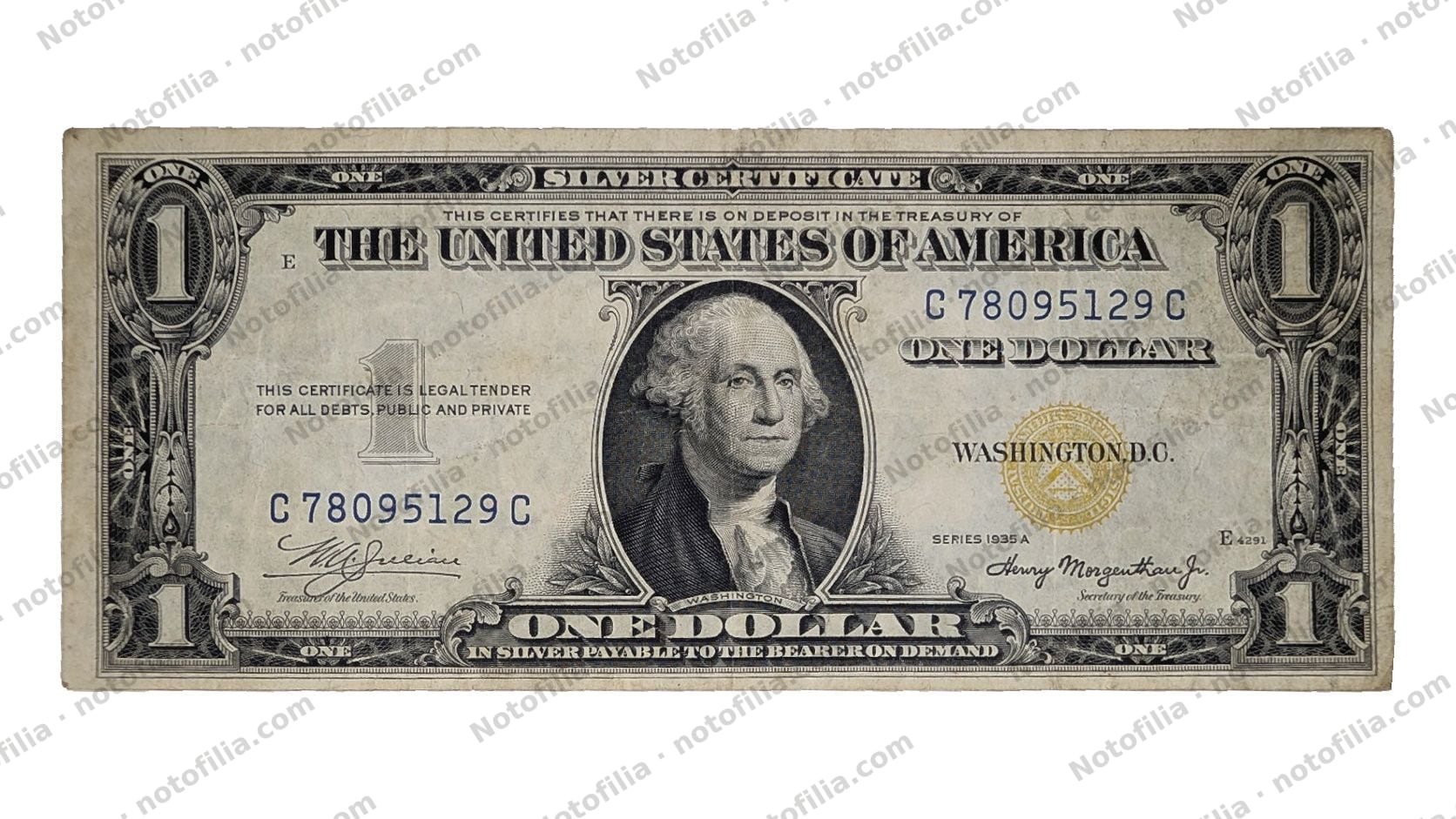
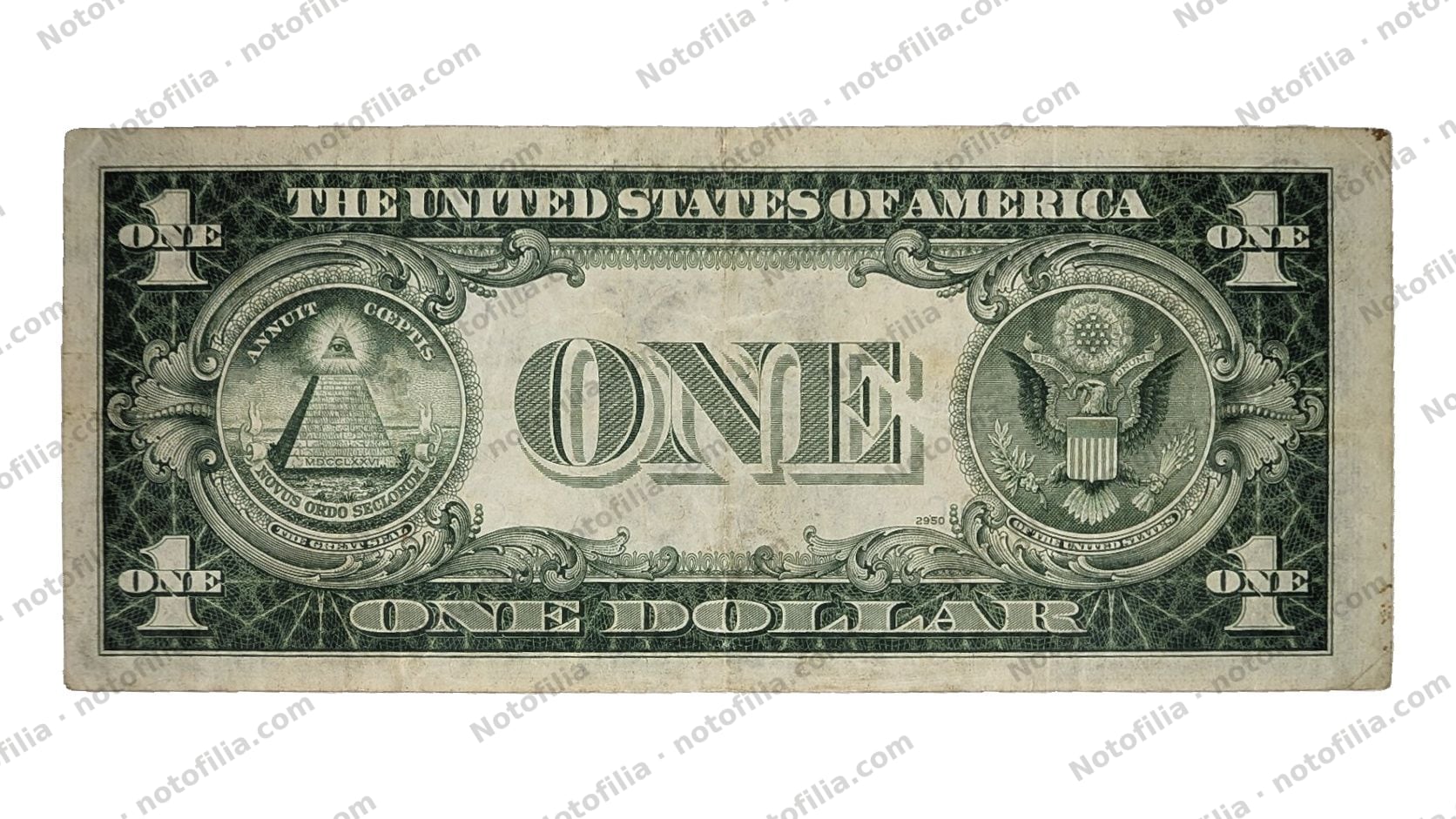
Face with Washington, a yellow Treasury seal, and blue serials C78095129C; back with the Great Seal and no IN GOD WE TRUST. Series 1935A, Fr. 2306, C–C block. Circulated, unslabbed.
Catalog facts
- Friedberg number
- Fr. 2306
- Pick / SCWPM
- P#416AY
- Serial number
- C 78095129 C
- Plate position
- E
- Face plate
- E4291
- Back plate
- 2950
- Printer
- Bureau of Engraving and Printing
- Format
- Small size (1928 standard), approx. 156 × 66 mm (6.14 × 2.61 in) — nominal, not a measurement of this piece
- Issued for
- U.S. forces, Operation Torch (North Africa), 1942; later Sicily and Italy
- Seal / serials
- Yellow Treasury seal, blue serial numbers, no overprint
- Block / run
- C–C block; second yellow-seal run, C78000001C–C79904000C
- Series date
- 1935A (printed "SERIES 1935 A"). The series designation is not the year this piece was printed.
- Signatures
- William Alexander Julian (Treasurer of the United States) and Henry Morgenthau Jr. (Secretary of the Treasury)
- Condition
- Circulated, unslabbed; condition documented by the supplied photographs (private collection)
- Printage
- Friedberg gives 26,916,000 regular notes for Fr. 2306. USPaperMoney.Info sets off, inside the C–C block, the run C78000001C–C79904000C (1,904,000 notes). Serial C78095129C falls in that run, at numerical position 95,129.
Face
Back
The note
The Series 1935A $1 Silver Certificate with a yellow Treasury seal (P#416AY; Friedberg 2306) is emergency paper for United States forces in North Africa and, later, in Sicily and in the first weeks in Italy. The ordinary blue-seal certificate of the same series is catalogued as P#416a. The HAWAII $1 is Hawaii P#36, Fr. 2300, serial S40499058C. This piece is Fr. 2306: a yellow circular Treasury seal and blue serials. The signatures are William Alexander Julian and Henry Morgenthau Jr. The black face on cream paper carries George Washington, the legend SILVER CERTIFICATE, a large 1 at left, and, at right, the yellow seal over WASHINGTON, D.C. Blue serials C 78095129 C repeat at lower left and upper right (C–C block). The printed series, SERIES 1935 A, sits beside the Secretary. Plate position E is read at upper left; the face-plate marking E4291 sits in the lower-right margin. The green back shows a central ONE, the unfinished pyramid and the Eye of Providence at left — ANNUIT COEPTIS, NOVUS ORDO SECLORUM, and MDCCLXXVI — and the eagle with E PLURIBUS UNUM at right. The motto IN GOD WE TRUST is absent: it came onto the $1 in later series. Back plate 2950 sits below the lettering, toward the right. Friedberg opens a mule on the 1934 ten-dollar note (Fr. 2308m) and does not open a mule number for Fr. 2306. The serial has a C prefix and a C suffix: a regular issue, with no replacement star. USPaperMoney.Info sets off, inside the C–C block, the runs C60000001C–C62000000C (2,000,000) and C78000001C–C79904000C (1,904,000). Table color marks the special printings, North Africa among them; a collector compilation on the Paper Money Forum identifies those two runs as the yellow-seal runs of the block, and their sum is the 3,904,000 already recorded for C–C. C78095129C falls in the second. Counted from C78000001C, it occupies numerical position 95,129, about 5% of the way through the run. That position is arithmetic: it does not say in what order the note circulated. The photographs show circulation folds, handling soil, corner wear, and brown spotting beside the right edge of the back, with margins that appear complete. No numerical grade is assigned from the photographs: paper body, washing, and repairs cannot be read with certainty from the image. A wartime provenance is not asserted for this serial. This collection piece, circulated and unslabbed, is documented by those photographs. The collection’s other Fr. 2306 is serial B52497547C, B–C block.
The North Africa yellow seal
Before Operation Torch (November 1942) the Treasury needed to pay troops in North Africa with a dollar that could be invalidated if a depot fell to the Axis, without touching the blue-seal certificate circulating at home. The mark is the yellow seal. The serials stay blue. There is no HAWAII overprint. Those notes served in North Africa, in Operation Husky (Sicily, July 1943), and in the first weeks in Italy. Printed Series 1935A names the type: yellow-seal production began in 1942, and that designation does not date the manufacture of this piece. The C–C block carries two yellow-seal runs, C60000001C–C62000000C and C78000001C–C79904000C, separated by blue-seal production. This piece belongs to the second.
The frame for those issues — Hawaii, the yellow seal, AMC, Bernhard — is on the World War II emergency-banknotes case, under Notaphily. This page is the C–C example of Fr. 2306: serial C78095129C, not a type illustration. The B–C example, serial B52497547C, has its own page.
Scarcity and printage
Fr. 2306 is the yellow-seal $1, Julian–Morgenthau signatures, a regular issue. Friedberg prints 26,916,000 notes. Collector literature divides that figure across the B–C block (about 3,000,000, in three runs), C–C (3,904,000), F–C (12,000), I–C (10,000,000), and R–C (10,000,000). F–C is the short block. C–C is not: its two yellow-seal runs add to 3,904,000, and a lower block total does not by itself establish a surviving rarity. This piece falls in the second, C78000001C–C79904000C (1,904,000). Paper Money for January–February 2019 (SPMC, vol. LVIII, no. 319) has been cited at 17,012,000 regular notes. This record keeps both figures and uses Friedberg’s, which matches the block sum. The serial has a C prefix and a C suffix. This record does not republish prices.
Population
A PMG or PCGS census for serial C78095129C has not been independently verified. The note is shown unslabbed.
Sources
- Bank Note Museum — P-416AY, $1 yellow seal, 1935A (opens in a new tab)
Numbers the type 416AY: $1, 1935A, yellow-seal silver certificate, for military use in North Africa and Sicily. On the P-416 page, 416a is the blue-seal 1935A, Julian–Morgenthau signatures.
- Friedberg / Berman — Emergency Notes (Fr. 2306) (opens in a new tab)
1935-A $1, Julian–Morgenthau signatures, yellow seal: 26,916,000 regular notes. The star row has no printage in that extract. There is no Fr. 2306m; the mule in the chapter is Fr. 2308m.
- USPaperMoney.Info — Series 1935–1935D serial ranges (opens in a new tab)
The C–C block sets off the runs C60000001C–C62000000C and C78000001C–C79904000C. Table color marks the special printings, North Africa among them.
- Paper Money Forum — 1935A blocks and ranges, Hawaii and North Africa (opens in a new tab)
The two yellow-seal runs in the C–C block add to 3,904,000: C60000001C–C62000000C (2,000,000) and C78000001C–C79904000C (1,904,000). The block split that sums to 26,916,000 is in that collector compilation.
- SPMC — Paper Money, vol. LVIII, no. 319 (January–February 2019) (opens in a new tab)
This issue has been cited for 17,012,000 regular notes. This record keeps Friedberg’s total, 26,916,000, and notes the other figure.
- Bureau of Engraving and Printing — History (opens in a new tab)
In 1935 both faces of the Great Seal appeared together on the $1. Silver Certificates from 1878.
- National Museum of American History — $1 Silver Certificate, Series 1935A (opens in a new tab)
The series back carries the pyramid, the eye, the eagle, and the Great Seal legends. The motto IN GOD WE TRUST does not belong to this design.
- U.S. Currency Education Program — History of U.S. Currency (opens in a new tab)
Silver certificates from 1878; redemption in silver until 1968. They remain legal tender at face value.
Related pieces
Other records from the same issuer or era in this case.