United States · Obsolete note · Connecticut
$5 note, n.d.
$5 · City Bank of New Haven
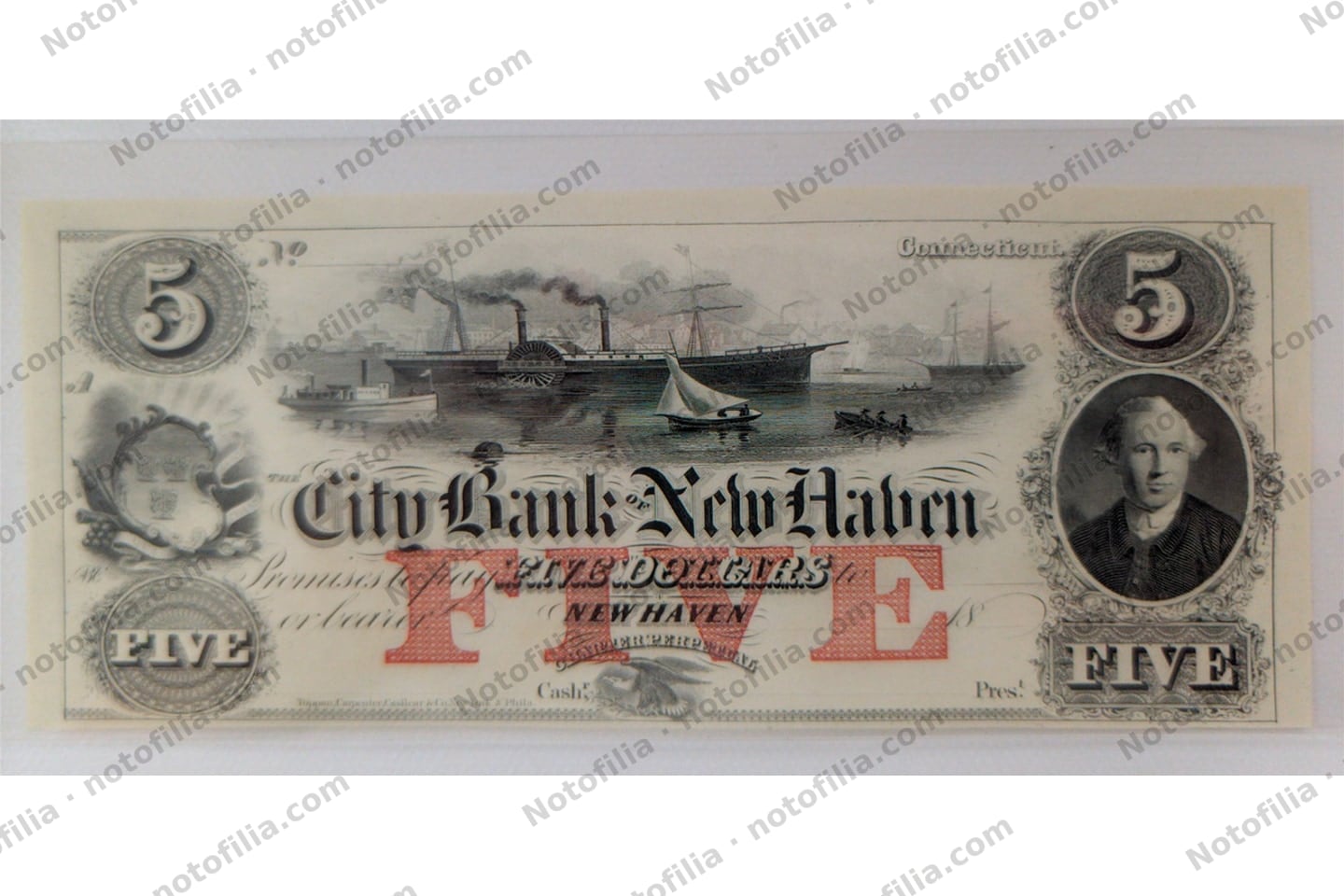
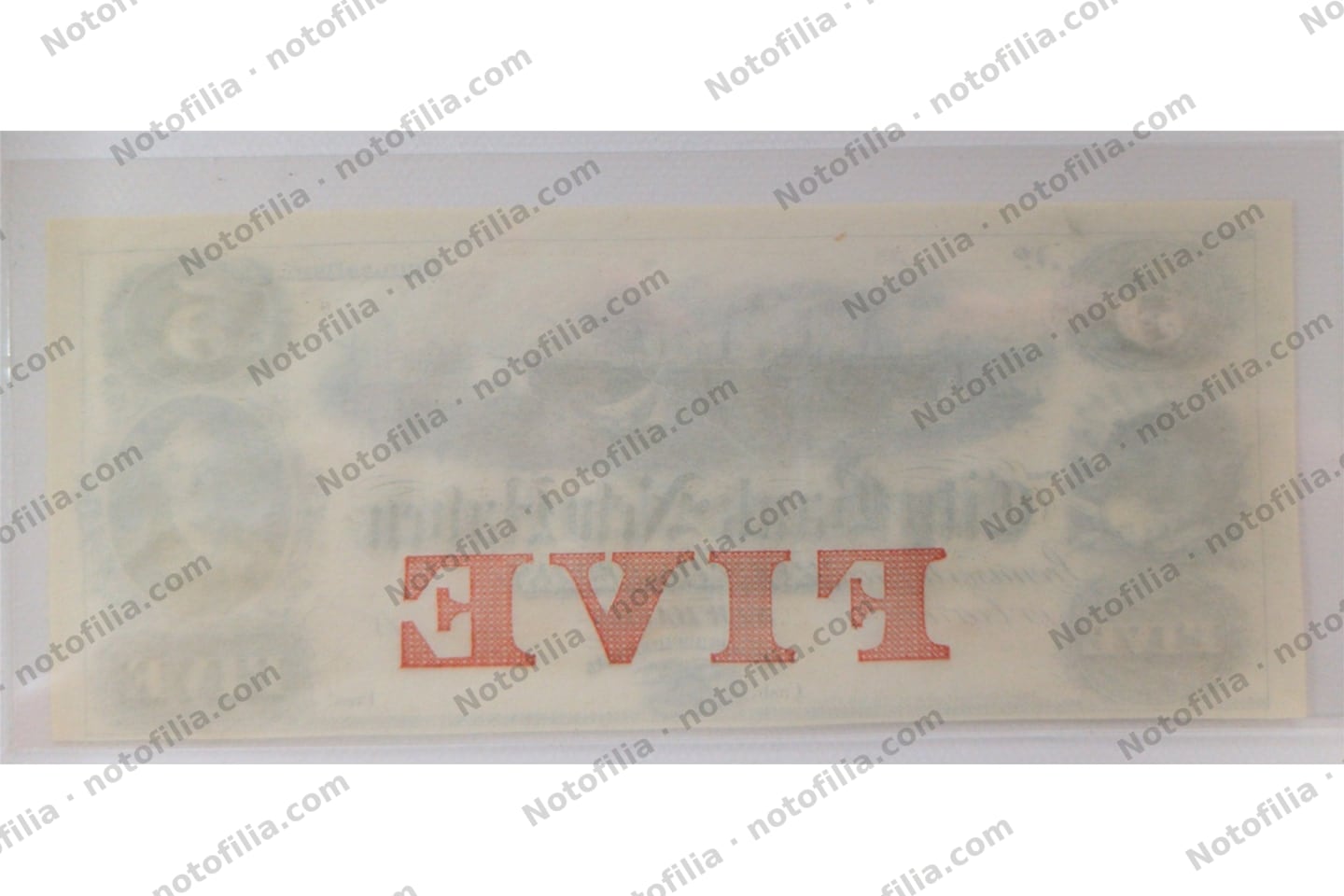
A $5 remainder of the City Bank of New Haven: blank No., plate A, an 18__ date, and a red FIVE protector; see-through back, in a sleeve.
Catalog facts
- Pick reference
- Haxby CT-265 G52b
- Serial number
- —
- Signatures
- None (Cash.r and Pres.t blank; remainder)
- Condition
- Remainder, unslabbed (private collection)
- Printage
- Ca. 1850. Toppan, Carpenter, Casilear & Co., New York and Philadelphia. A remainder from the late-1850s to 1860s plates (Beast Coins). This record does not invent a printage for the type or for this piece.
Face
Back
The note
The $5 Haxby CT-265 G52b is an obsolete remainder of The City Bank of New Haven, Connecticut. The face, black intaglio on cream paper, carries a large red FIVE protector. At top a harbor with a sidewheel steamer; at right a male portrait in an oval — this record does not name the engraving; at left wheat sheaves; at bottom an eagle. The title “THE City Bank OF New Haven” is in gothic lettering. Connecticut sits at upper right. The No. field is blank; the plate letter is A, at left. The printed date stops at 18__. The Cash.r and Pres.t lines are unsigned: this is a remainder, not a note placed in circulation. The imprint is Toppan, Carpenter, Casilear & Co. New York & Phila. Beast Coins catalogues type G52b with an American Bank Note Company monogram; this photograph does not support asserting that the monogram is visible. The back has no separate engraved design: the paper is thin and the red FIVE protector reads reversed as a see-through, with the face engraving in shadow. The piece is shown in a sleeve, unslabbed. It should not be confused with the State Bank at New Brunswick $1 remainder (Haxby NJ-350 G16a, serial 9890 · B).
The bank
Beast Coins places The City Bank of New Haven (Haxby CT-265) from 1832 to 1915 and records its fate: a merger with the New Haven National Bank. The SPMC Bank Note History wiki, on the National New Haven Bank page (charter 1243), notes that in January 1915 the City Bank’s stockholders approved a merger agreement with the National New Haven Bank and the New Haven County National Bank; the combined house would be styled the New Haven Bank, National Banking Association, with capital of $1,200,000. The formal merger was planned for August 1915. Remainders of these Toppan, Carpenter, Casilear & Co. plates — no serial, no signatures, an 18__ date — belong, per Beast Coins, to the late 1850s and 1860s, when the 10 percent tax on state-bank paper (1865–1866) ended private issue.
Scarcity and printage
Beast Coins illustrates unissued, unsigned G52b remainders on plates A, B, and C, from the late 1850s and 1860s. This record does not invent a census or an auction rarity for the type or for this piece. Fully issued notes — a serial, a completed date, and both circulating signatures — are not documented here.
Population
A PMG or PCGS census for this unsigned remainder has not been independently verified. The note is shown in a sleeve, unslabbed, as an original remainder.
Sources
- Beast Coins — Connecticut obsolete notes, CT-265 G52b (opens in a new tab)
City Bank of New Haven, 1832–1915; $5 Haxby CT-265-G52b, plates A–C, unissued and unsigned, late 1850s–1860s; Toppan, Carpenter, Casilear & Co. New York and Philadelphia; type catalogued with an ABNCo monogram; fate: merged with the New Haven National Bank.
- SPMC Bank Note History — National New Haven Bank / New Haven Bank N.B.A. (charter 1243) (opens in a new tab)
January 1915: City Bank stockholders approved a merger with the National New Haven Bank and the New Haven County National Bank; the combined house, New Haven Bank, National Banking Association; formal merger planned for August 1915.
Related pieces
Other records from the same issuer or era in this case.