United States · Obsolete note · Louisiana
$50 note, n.d.
$50 · Canal Bank, New Orleans
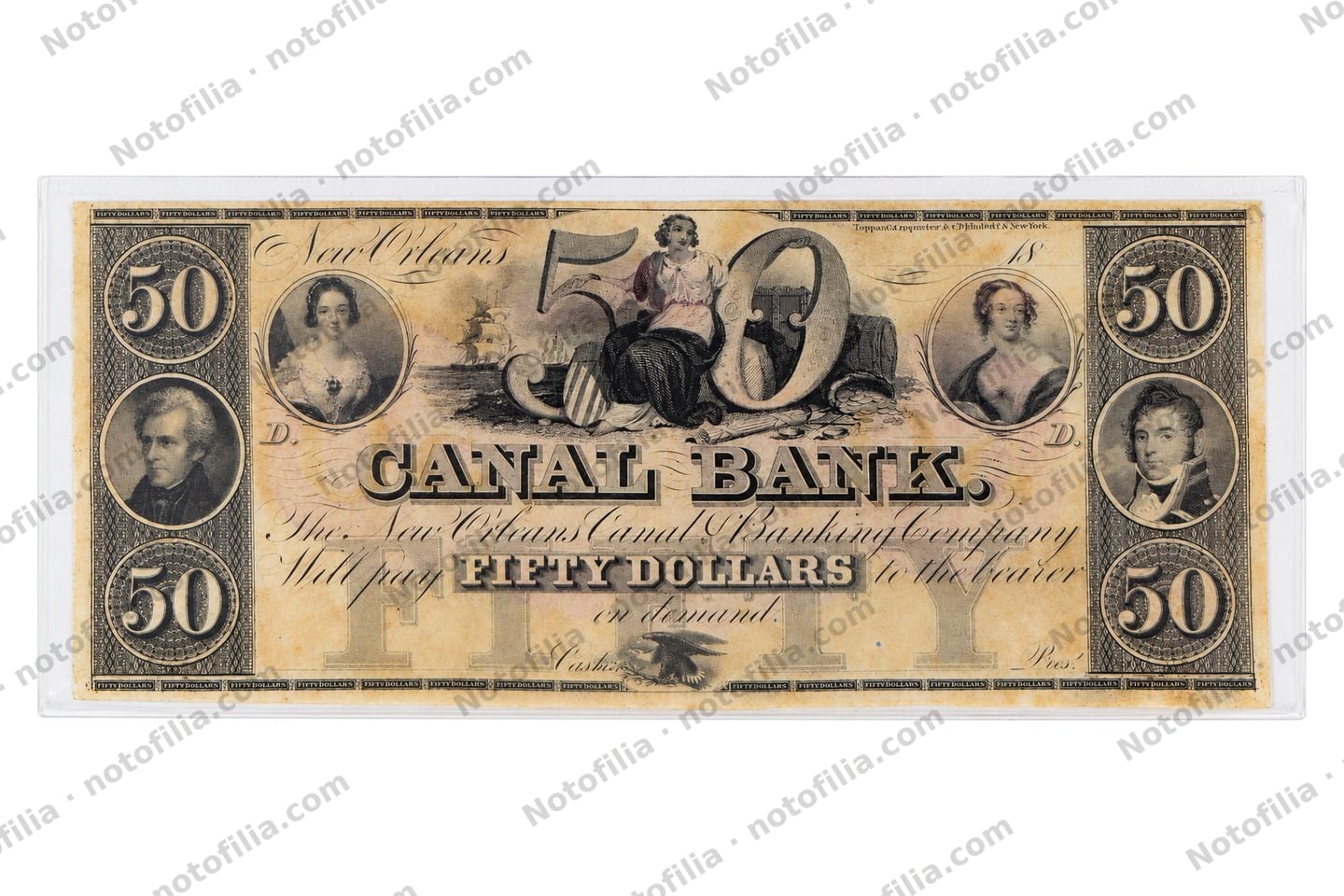
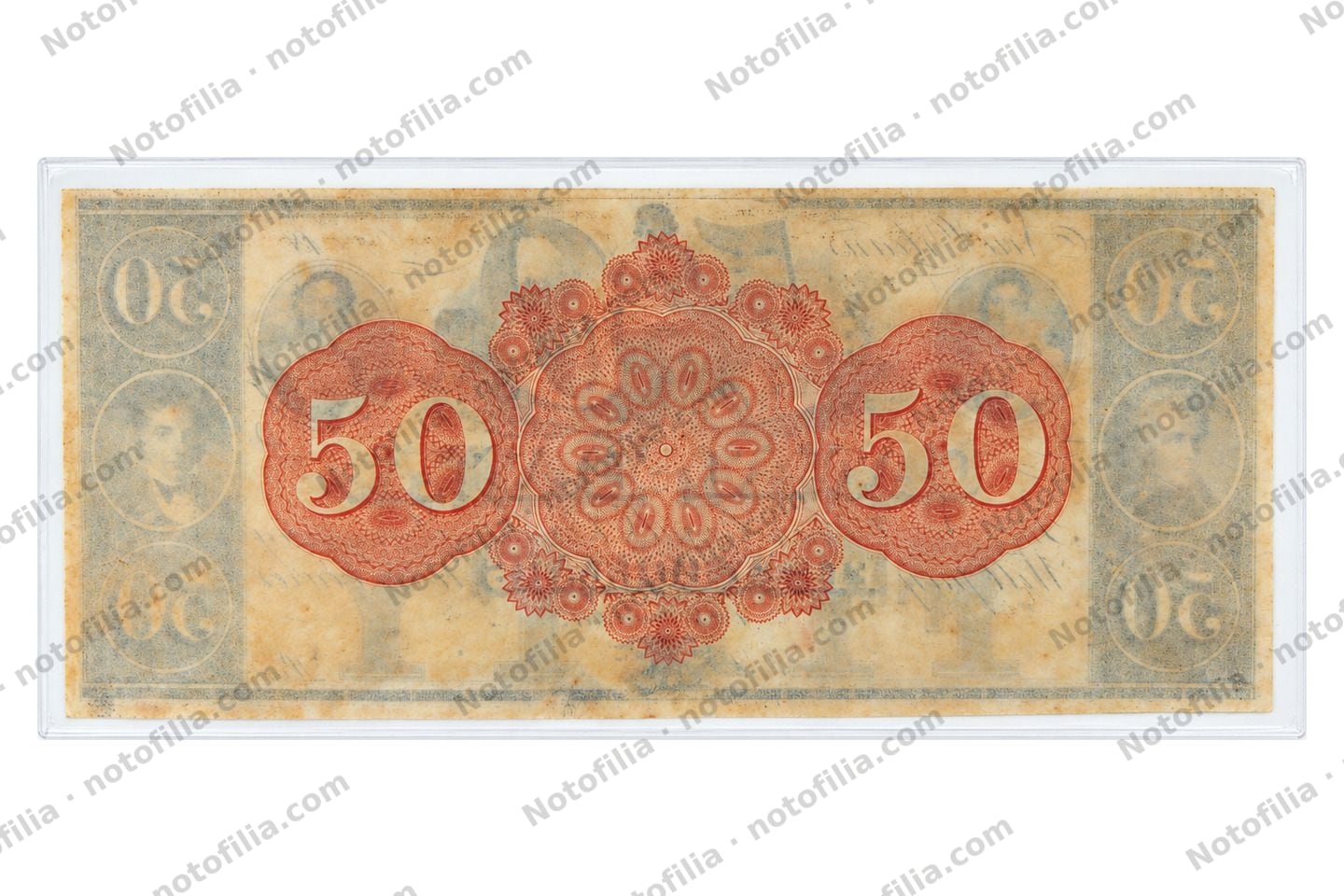
A $50 remainder of the Canal Bank of New Orleans: plate D, an 18__ date, no serial and no signatures, and the red back that earned the type its “Redback” nickname.
Catalog facts
- Pick reference
- Haxby LA-105 G46a · N#206863
- Serial number
- —
- Signatures
- None (Cash.r and Pres.t blank; remainder)
- Condition
- Remainder, unslabbed (private collection)
- Printage
- Toppan, Carpenter & Co., Philadelphia and New York. Beast Coins dates plate D of this type to the late 1840s and Numista gives the type as 1849. No printage is published for the type or for this piece.
Face
Back
The note
The $50 Haxby LA-105 G46a (Numista N#206863) is an obsolete remainder of The New Orleans Canal & Banking Company, Louisiana. Numista gives the type as 183 × 76 mm. The face, black intaglio over a gray protector panel spelling FIFTY in giant letters, is titled CANAL BANK in shaded capitals, with “New Orleans” in script at upper left and the date stopped at 18__ at upper right. The engraved line reads “The New Orleans Canal & Banking Company Will pay FIFTY DOLLARS to the bearer on demand.” At center a seated female figure leans against a monumental 50, with sailing ships at left, a striped shield at her feet, and bales and barrels at right; an eagle sits below. Four corner medallions repeat the 50. Numista identifies the lower-left portrait as Andrew Jackson, the lower-right — in naval uniform with epaulettes — as Captain James Lawrence, and the right-hand female oval as Anne Florence de Grey; the second female oval, left of center, is unnamed in that record and no name is assigned to it here. The plate letter is D, printed on both sides of the title. The imprint at upper right is Toppan, Carpenter & Co. Philad’a & New York. There is no serial box, the date was never completed, and the Cash.r and Pres.t lines are blank: this is a remainder, not a note placed in circulation. The back does carry a design of its own, in orange-red: two 50s over lathework rosettes and a central medallion of guilloche, with the face and its FIFTY DOLLARS border showing through reversed. That back is the source of the “Redback” nickname Numista keeps in the type’s title. It should not be confused with the $50 LA-105 G48a, a different design printed by Rawdon, Wright, Hatch & Edson, which is the variety auction houses usually list.
The bank
This note came from a bank that paid for its charter by digging a canal. Louisiana carried public involvement in banking further than any other state in the 1830s: the EH.net encyclopedia and the Historic New Orleans Collection describe three kinds of house — commercial banks for merchants, property banks for plantation mortgages, and improvement banks required by charter to build public works. The New Orleans Canal & Banking Company, of 5 March 1831, was the improvement bank of the New Basin Canal. Per the Preservation Resource Center of New Orleans, the charter called for a channel 60 feet wide and at least six feet deep, with levees, a toll road and a towpath, a turning basin in the city and a harbor at the lake; in exchange the company held exclusive toll rights for 35 years, after which the canal reverted to the state. Authorized capital was four million dollars. The first half of the route, from Mobile Landing to Metairie Road, was finished in August 1834 and the rest in 1835; the canal opened to navigation in 1838. Thousands of Irish laborers dug it by hand, and cholera and yellow fever took them without anyone keeping a record: the PRC cautions that the figure of 10,000 dead usually repeated is probably an overestimate, conflated with the cholera epidemic of 1832–1833 — which takes nothing away from how brutal the work was. Tulane’s archive follows the bank’s corporate trail from 1831 to the Canal Bank and Trust Company of 1 January 1926 and records its closure in the 1930s. In 1933 The National Bank of Commerce in New Orleans, charter 13689, was organized: the SPMC record transcribes its organization report, which states that it would succeed the Canal Bank & Trust Company. The liquidation was still being litigated before the Louisiana Supreme Court well into the 1940s.
Scarcity and printage
Numista gives the type a rarity index of 87 among its members — a measure of presence in collections, not of auction supply — and records that 92 percent of the examples logged are the undated remainder, against 8 percent carrying the issued date of 10 February 1849. The remainder row is labelled “Series A” there; this piece carries plate letter D, which is the plate Beast Coins illustrates for G46a. Canal Bank remainders are plentiful in high grades because they never circulated; cut cancels, splits, and old repairs are routine for the type. This record does not invent a census or a valuation for this piece.
Population
A PMG, PCGS, or Legacy census for this remainder — which has neither a serial nor a certificate number — has not been independently verified. The note is shown in a sleeve, unslabbed.
Sources
- Numista — 50 Dollars, Canal Bank “Redback” (N#206863) (opens in a new tab)
Reference H# LA 105-G46a; Toppan, Carpenter & Co. imprint; 183 × 76 mm; portraits of Andrew Jackson, Captain James Lawrence, and Anne Florence de Grey; undated remainder (92 percent) against the issued date of 10 February 1849 (8 percent); rarity index 87.
- Beast Coins — Louisiana obsolete notes, LA-105-G46a (opens in a new tab)
New Orleans Canal & Banking Company, c. 1831–1860s; $50 Haxby LA-105-G46a, unissued and unsigned, late 1840s, plate D, Toppan, Carpenter & Co. Philadelphia and New York; Type I, payable at the bank in New Orleans. The G48a in the same tables is the Rawdon, Wright, Hatch & Edson variety.
- Howard Bodenhorn — Antebellum Banking in the United States (EH.net Encyclopedia) (opens in a new tab)
In the 1830s Louisiana chartered commercial banks, property banks, and improvement banks; among the latter, the New Orleans Canal and Banking Company, which built the canal to Lake Pontchartrain.
- Historic New Orleans Collection — Financing Progress (Money, Money, Money) (opens in a new tab)
The Canal and Banking Company (1831) heads the list of Louisiana improvement banks, required by charter to fund canals, railroads, hotels, or gas streetlights.
- Preservation Resource Center of New Orleans — Before I-10, the New Basin Canal flowed through New Orleans (opens in a new tab)
Charter of 5 March 1831: a channel 60 feet wide and six deep, levees, a toll road and towpath, a turning basin and a lake harbor; exclusive tolls for 35 years. First half finished in August 1834, the rest in 1835. The figure of 10,000 dead Irish laborers is probably an overestimate, conflated with the 1832–1833 cholera epidemic.
- Tulane University — Canal Bank records (Archives and Special Collections) (opens in a new tab)
New Orleans Canal and Banking Company from 5 March 1831; Canal Bank of New Orleans (1895), Canal Bank and Trust Company (1903), Canal-Louisiana (1905), Canal-Commercial (1919), and Canal Bank and Trust Company from 1 January 1926; closed in the 1930s.
- SPMC — U.S. National Bank Lookup, charter 13689 (National Bank of Commerce in New Orleans) (opens in a new tab)
Organized 24 April 1933 and chartered 20 May 1933; the organization report notes that it would succeed the Canal Bank & Trust Company of New Orleans.
- Liquidation of Canal Bank & Trust Co., 211 La. 803 (1947) — CourtListener (opens in a new tab)
The bank’s liquidation was still before the Louisiana Supreme Court in April 1947.
Related pieces
Other records from the same issuer or era in this case.