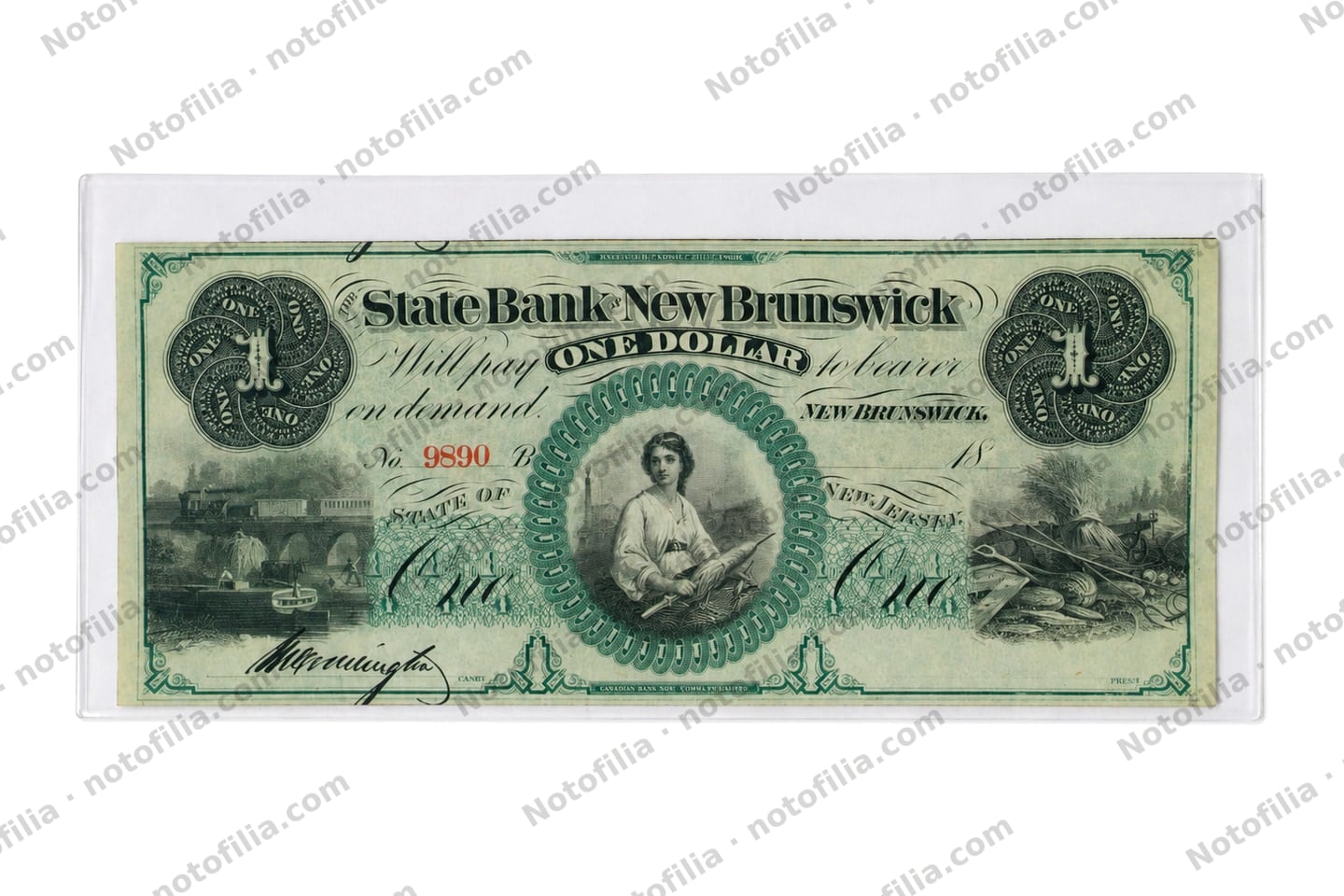
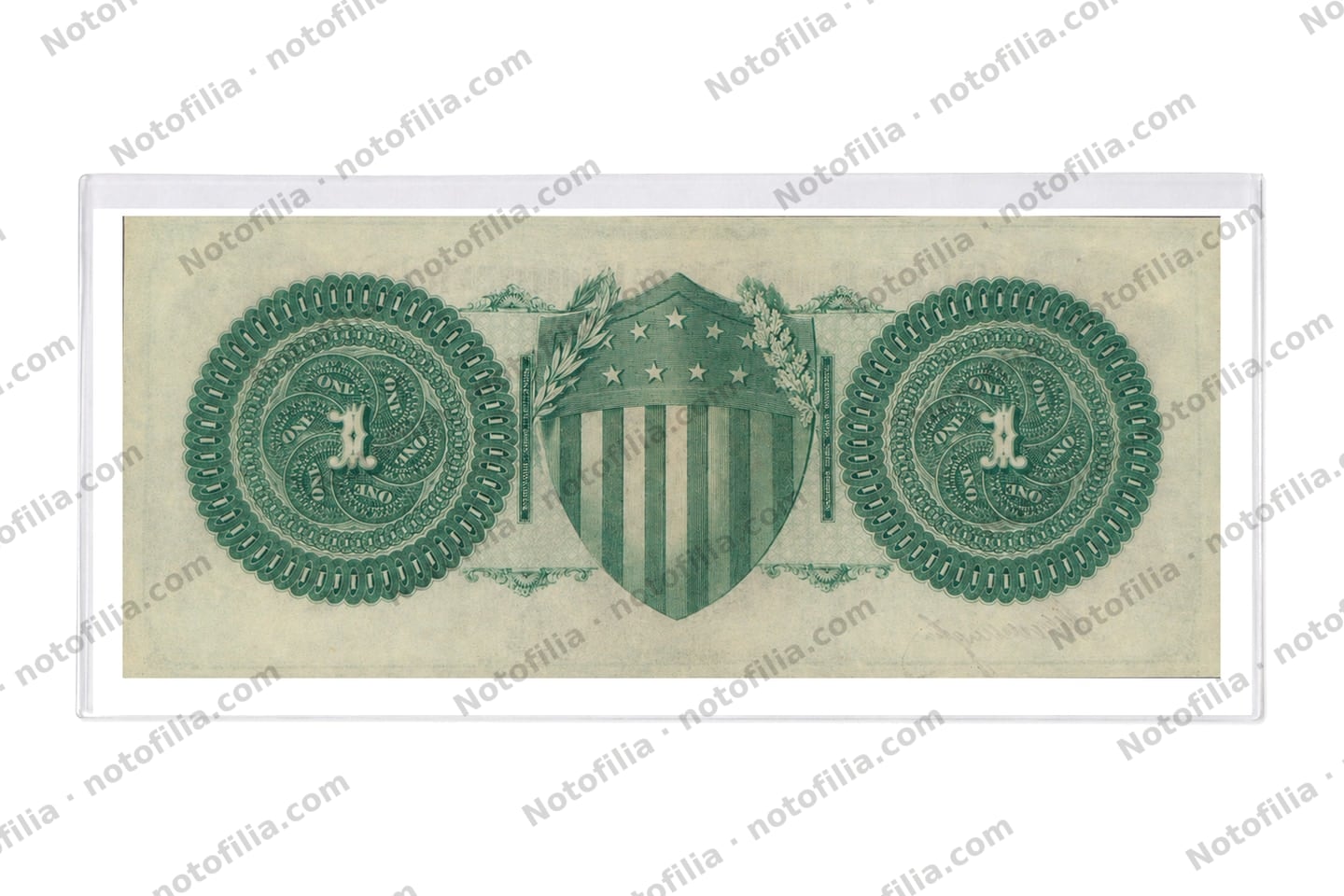
A $1 remainder of the State Bank at New Brunswick: red serial 9890, plate B, an incomplete 18__ date, and the National Bank Note Company’s green back.
Catalog facts
- Pick reference
- Haxby NJ-350 G16a · N#334975
- Serial number
- 9890 · B
- Signatures
- Manuscript cashier; president blank (remainder)
- Condition
- Remainder, unslabbed (private collection)
- Printage
- National Bank Note Company, New York. A remainder from the 1860s plates (patent of 23 April 1860). No circulating printage is published for this type.
Face
Back
The note
The $1 Haxby NJ-350 G16a (Numista N#334975) is an obsolete note of the State Bank at New Brunswick, New Jersey. The face, black on green tints, is titled “The State Bank at New Brunswick” and promises to pay one dollar to the bearer on demand. A fine line at the top records registration at the state comptroller’s office. At center a female figure with a sheaf of grain, a factory behind her, sits in an oval ringed with 1s; at left a locomotive crosses an arched bridge above a boat; at right a harvest — scythe, sheaf, and squash. Corner medallions repeat ONE around the figure 1. Serial 9890 is stamped in red at left, beside plate letter B. The printed date stops at 18__, with no manuscript year. A signature sits on the cashier’s line and the president’s (PREST.) line is blank: this is a remainder, not a note placed in circulation. The imprint is the National Bank Note Company’s. The green back carries the United States shield between two medallions with 1 and the word ONE; Numista also transcribes “PATENTED APRIL 23rd 1860.” That guilloche back is NBNC’s, of the same technical family as the First Charter $1 National Bank Note reverse, not a national note of this town. It should not be confused with the State Bank of New Jersey at New Brunswick (Haxby NJ-345), which in 1864 became the National Bank of New Jersey, charter 587, or with the Canadian Bank of New Brunswick.
The bank
On 28 January 1812 the New Jersey legislature authorized six State Banks — Camden, Trenton, New Brunswick, Elizabeth, Newark, and Morris — after the First Bank of the United States lost its charter. George R. Prowell dates the act; the Library Company of Philadelphia finding aid and Sylla and Wright’s inventory place New Brunswick’s authorized capital at $400,000, level with Newark and below Camden. The issuer of this record is The State Bank at New Brunswick (Haxby NJ-350), not the State Bank of New Jersey at New Brunswick (NJ-345), which in 1864 became the National Bank of New Jersey, charter 587. In the September 1874 term the Middlesex County Court of Oyer and Terminer tried Robert N. Woodworth for conspiracy to defraud the bank; the New Brunswick pamphlet names Greenleaf W. Appleton as “late cashier, now a fugitive from justice.” On 31 March 1877 the bank closed at one in the afternoon; The New York Times reported it the next day and noted that the officers refused to issue a statement. Haxby lists the bank as closed. The 10 percent tax on state-bank paper (1865–1866) and that closure explain why so many remainders of these National Bank Note Company plates survive.
Scarcity and printage
Almost all G16a $1 notes on the market are remainders: an 18__ date, often one signature or none, a red serial, and the green back. Fully issued pieces — a completed date and both circulating signatures — are far scarcer. Numista flags the type as an undated remainder (1860–1877) and gives it a rarity index of 87 among its members, a measure of presence in collections, not of auction supply. Heritage and obsolete-note dealers treat the remainder as a common type in high grades; the bank closed in 1877 and the NBNC plates were left unsigned.
Population
A PMG or PCGS census for serial 9890 has not been independently verified. The note is shown in a sleeve, unslabbed, as an original remainder.
Sources
- Numista — 1 Dollar, State Bank at New Brunswick (N#334975) (opens in a new tab)
Haxby NJ-350; National Bank Note Company imprint; shield back and “PATENTED APRIL 23rd 1860”; undated remainder, 1860–1877.
- Beast Coins — New Jersey obsolete notes, NJ-350 (opens in a new tab)
State Bank at New Brunswick, c. 1814–1877; $1 Haxby NJ-350 G16a, National Bank Note Company; fate: closed.
- George R. Prowell — History of Camden County, banking chapter (NJGenWeb) (opens in a new tab)
Act of 28 January 1812: State Banks at Camden, Trenton, New Brunswick, Elizabeth, Newark, and Morris.
- Library Company of Philadelphia — McAllister, State Bank at Camden (McA MSS 014) (opens in a new tab)
The same 1812 act; authorized capital of New Brunswick and Newark, $400,000 each.
- Richard Sylla and Robert E. Wright — U.S. corporate census, 1790–1860 (INET, WP 224) (opens in a new tab)
State Bank at New Brunswick, 1812, New Jersey; capital $400,000.
- Trial of Robert N. Woodworth (New Brunswick, 1874) — University of Notre Dame catalog (opens in a new tab)
Middlesex County, September term 1874: Woodworth tried with Greenleaf W. Appleton, “late cashier, now a fugitive,” for conspiracy to defraud the State Bank at New Brunswick.
- The New York Times — A New-Jersey Bank Suspends, 1 April 1877 (opens in a new tab)
Closed on 31 March 1877 at one in the afternoon; the officers refused to issue a statement.
Related pieces
Other records from the same issuer or era in this case.