Spain · Royal Mint of Madrid
½ escudo coin, 1757
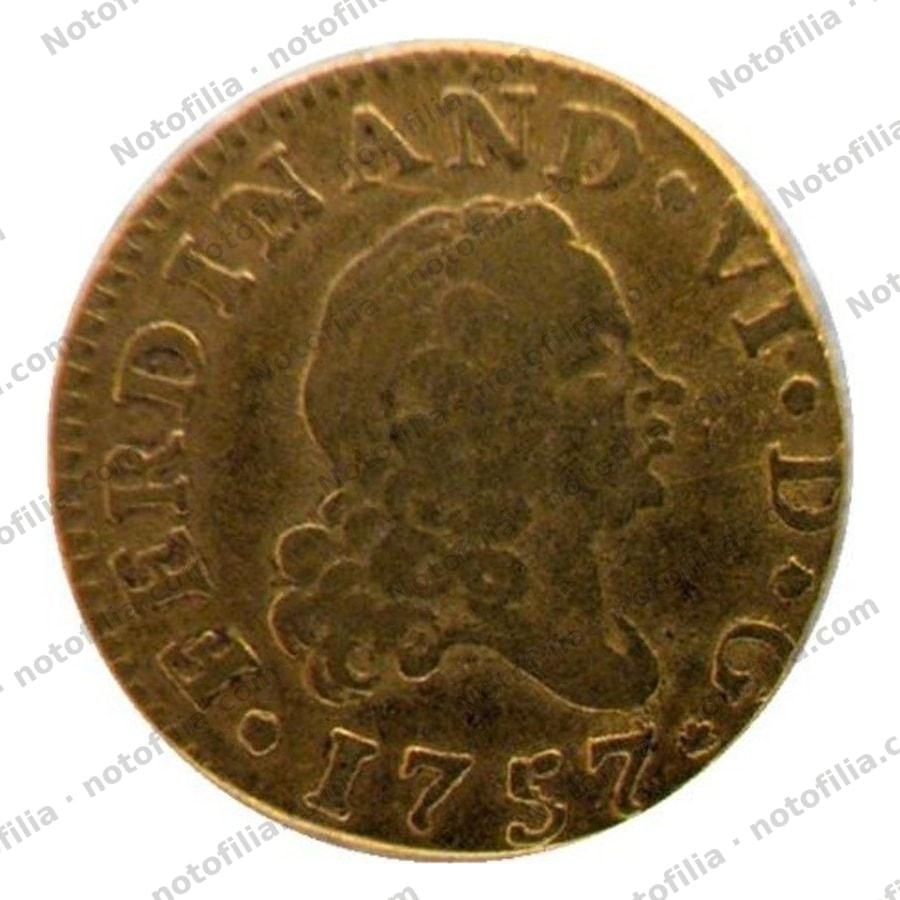
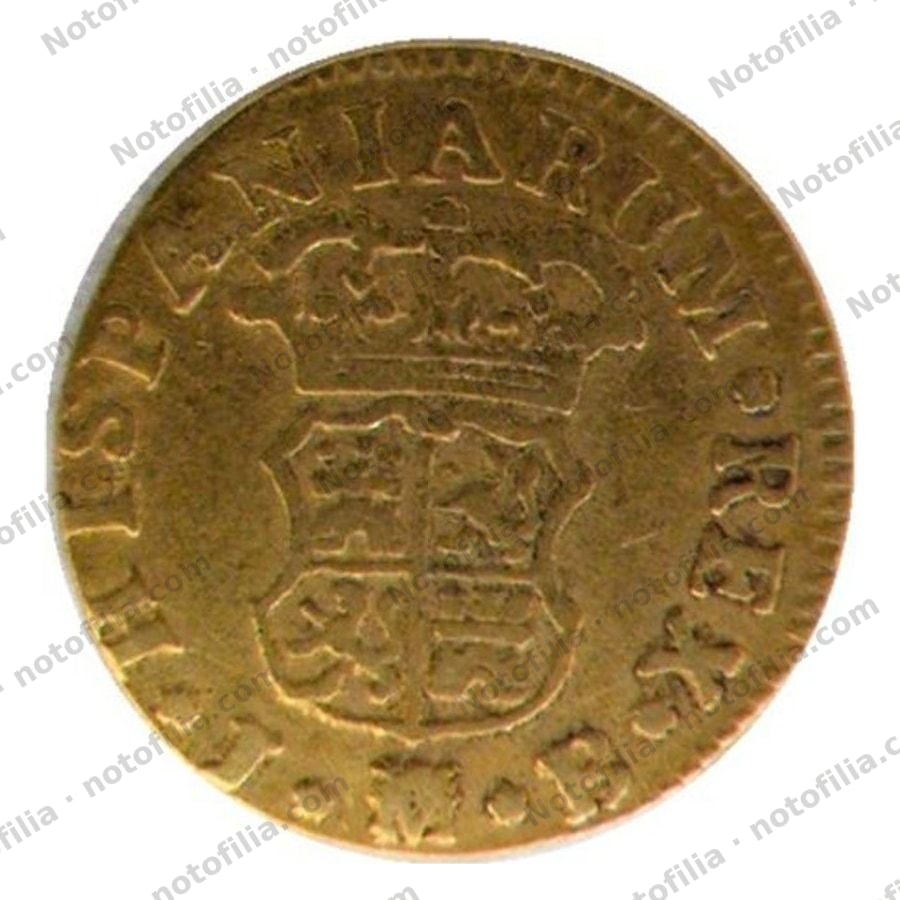
½ escudo · Ferdinand VI · Madrid 1757 JB
Ferdinand VI gold half escudo, 1757, Madrid mint and assayers JB. No serial and unslabbed. Not an 1810 Ferdinand VII and not Indies gold.
Catalog facts
- Year
- 1757
- Mint
- Madrid (crowned M); assayers JB
- Denomination
- ½ escudo
- Composition
- Gold .917 (NGC / Numista type specification; not an assay of this specimen)
- Weight
- Not weighed. Published type figures: Numista 1.7 g; NGC 1.69 g; one Sedwick example 1.75 g; one BnF example 1.77 g. None is assigned to this piece.
- Diameter
- Not measured. Type ≈ 15 mm; the BnF records 14.9 mm on a 1757 Madrid piece that is not this disc.
- Edge
- Milled striking (type technique). This specimen’s edge was not photographed.
- Condition
- Unslabbed. Visible wear to the portrait and shield; date and principal legends remain readable. Not a numerical grade.
- References
- KM#378 · Fr#274 · Áureo & Calicó#561 · Calicó 2008#255 · Numista N#26320
Obverse
Reverse
The coin
This piece is a gold half escudo of the Spanish monarchy, struck at Madrid in 1757. The obverse shows Ferdinand VI’s bust facing right, curled hair, with the legend FERDINAND · VI · D · G · and the date 1757 below the truncation. The formula expands to Ferdinandus VI Dei Gratia: “Ferdinand VI, by the grace of God.” The reverse carries the quartered arms of Castile and León, crowned, and the legend HISPANIARUM · REX — “king of the Spains” — without ET IND. Below the shield, with the piece upright, are J, a crowned M, and B: José Tramullas y Ferrer and Bernardo Muñoz de Amador, with the mark of the Royal Mint of Madrid. Catalog photographs show the reverse with the crown at the top; that does not establish die axis. Krause KM#378 (1748–1759); Friedberg Fr#274; Calicó 2008#255 and Áureo & Calicó 2019#561 (fourth portrait in that table for the 1757 Madrid JB). Numista N#26320 gives gold .917, about 1.7 g and 15 mm as type figures, and names Tomás Francisco Prieto Martín as engraver. Those metal and module figures were not measured on this specimen. It is not a colonial Indies half escudo, not a full escudo, and not a Ferdinand VII.
Legends
- Obverse
- FERDINAND · VI · D · G · 1757 — Ferdinandus VI Dei Gratia: “Ferdinand VI, by the grace of God.”
- Reverse
- HISPANIARUM · REX — “King of the Spains.” Below the shield: J · crowned M · B (Madrid, assayers José Tramullas y Ferrer and Bernardo Muñoz de Amador).
History
Ferdinand VI held the throne from 1746 to 1759. Madrid’s bust half escudo with assayers JB covers 1748–1759; 1757 is a date documented by Sedwick, GreatCollections, the BnF, and Numista. The piece circulated as peninsula small gold. No hammer and no slab census are published here. The BnF describes a 1757 Madrid of 14.9 mm and 1.77 g that is not this disc.
Scarcity and type
The 1757 Madrid JB is a date of type KM#378, not a unique issue. Numista lists it with Calicó#255 / Áureo#561. No mintage, rarity-index census, or auction prices are published. Sedwick and GreatCollections document the date-mint-assayer combination as comparables; they are not this specimen.
Certification
The example is raw, with no NGC, PCGS, or other holder. Coins of this module carry no serial number. The identity of this record is the photographed object — Ferdinand VI bust, 1757, Madrid J-M-B — not a certificate. If it is later slabbed, the cert number will replace this note.
Sources
- Numista — ½ escudo, Ferdinand VI, Madrid, second type (N#26320) (opens in a new tab)
KM#378; Calicó 2008#255 and Áureo & Calicó 2019#561 for 1757 M JB; type gold .917; assayers JB. The price table is not republished.
- BnF — ½ escudo, Ferdinand VI, 1757, Madrid (opens in a new tab)
Reference specimen 14.9 mm and 1.77 g. Not this piece; those measurements are not copied onto the collection disc.
- NGC — Spain ½ escudo, KM#378 (1748–1759) (opens in a new tab)
Type specification: gold .917; reference weight 1.69 g. Not an assay or a grade of this specimen. Prices are not republished.
- Sedwick — Madrid ½ escudo, Ferdinand VI, 1757 JB (opens in a new tab)
Auction comparable for the date and assayers. Not this specimen; the hammer is not published. Sedwick cites 1.75 g on a different disc.
- GreatCollections — 1757 M JB ½ escudo, KM#378 (comparable) (opens in a new tab)
Documents the 1757–Madrid–JB cross and Fr#274 / KM#378. Not this piece; the price is not republished.
Related pieces
Another piece in the Spain collection.