Spain · Seville mint
2 escudos coin, 1566–1587
2 escudos · Philip II · 1566–1587
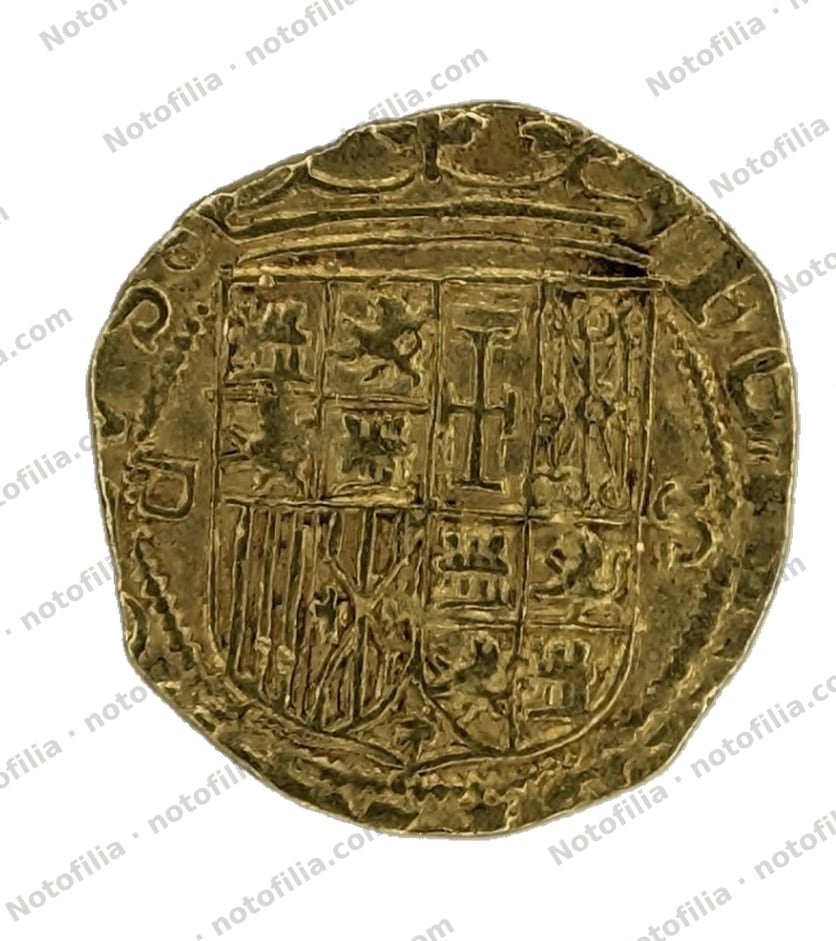
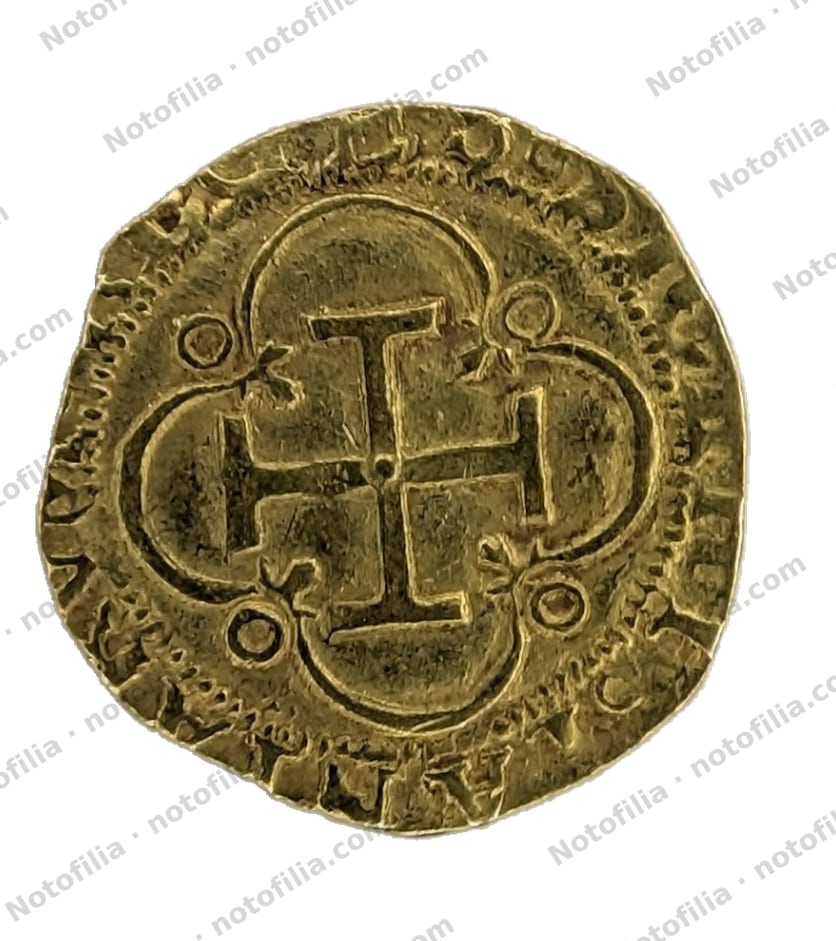
Hammered 2-escudo doubloon, Philip II, Seville, undated (1566–1587), square D assayer under the S. No serial and unslabbed. This disc was not weighed.
Catalog facts
- Year
- ND (1566–1587)
- Mint
- Seville (S); square D assayer
- Denomination
- 2 escudos
- Composition
- 22-karat gold (.917), the escudo standard from 1537; not an assay of this specimen
- Weight
- Not weighed. A 2 escudos of the type is about 6.77 g; Sedwick publishes 6.69–6.74 g on Cal-828 comparables that are not this disc. A single escudo is 3.38 g. Without a scale reading, the face value is read from the II mark.
- Diameter
- Not measured. A hammered planchet is irregular; no catalogue module is copied onto this disc.
- Edge
- Hammer-struck. This specimen’s edge was not photographed separately.
- Condition
- Unslabbed. Shield and Jerusalem cross well struck; the legend is incomplete on the irregular edge. Not a numerical grade.
- References
- Áureo & Calicó#828 · Fr#169 · Tauler-31
Obverse
Reverse
The coin
This piece is a gold 2 escudos of Philip II, hammer-struck at Seville, with no year on the planchet. The obverse carries the crowned Habsburg shield, Granada at the point, and no readable Portugal inescutcheon. To the left of the shield, under the crown, the Seville S sits over a square (Gothic) D. To the right, a stacked mark reads as the value II. That arrangement — mint and assayer on the left, denomination on the right — is the one Sedwick and Tauler publish as Áureo & Calicó 828 (Friedberg 169, Tauler 31), the undated type of 1566–1587. Calicó 827 is the sister variety, with the marks placed differently; it is not this die. The type obverse legend is PHILIPPVS · II · DEI · GRATIA; on this disc part of it falls off the planchet. The reverse shows the Jerusalem cross inside a four-lobed tressure, with trefoils in the angles and four annulets beside the cross. The legend reads HISPANIARVM; the type formula closes · REX. Seville’s square D in that span is attributed to Melchor Damián. 22-karat gold (.917) and 6.77 g for the 2 escudos are figures of the escudo system from 1537, not a weighing or an assay of this specimen. Without a weight, the face value rests on the II and on the type die. It is not the 1757 Madrid half escudo, not an Indies escudo, and not a dated Seville 2 escudos: the 1588 of assayer D, for example, carries the digits beside the shield.
Legends
- Obverse
- PHILIPPVS · II · DEI · GRATIA — type legend; on this planchet the rim is incomplete. Left of the shield: S over a square D. Right: II.
- Reverse
- HISPANIARVM · REX — “King of the Spains.” This example reads HISPANIARVM in the legend. Jerusalem cross in a four-lobed tressure, with annulets and trefoils.
History
Philip II held the throne from 1556 to 1598. Seville marked its gold with an S. The square-D assay belongs to the span in which the house was not yet dating these pieces: Tauler places Cal-828 in 1566–1587. From 1588, 2-escudo coins of the same mint and assayer appear with a date beside the shield; that year is another type, and no year is readable on this planchet. The lack of a Portugal inescutcheon does not by itself separate Philip II from the earliest Seville gold of Philip III. The attribution here follows the die published as Cal-828: S over D on the left, II on the right, undated. The 2 escudos — the doubloon, a pistole in European markets — was the small multiple of peninsula gold. No hammer and no slab census are published.
Scarcity and type
No mintage is published for this die. Tauler calls type Cal-828 rare. That is not a slab census and not a price. Sedwick’s Treasure Auction 38, lot 3, and Tauler & Fau auction 160, lot 155, document the same mark arrangement on other discs; they are not this specimen. No Krause number is assigned: the records consulted do not give a stable KM for this gold.
Certification
The example is raw, with no NGC, PCGS, or other holder. These hammered pieces carry no serial number. The identity of this record is the photographed object — Philip II’s shield, S over a square D, II, Jerusalem cross — not a certificate. If it is later slabbed, the cert number will replace this note.
Sources
- Sedwick — Seville 2 escudos, Philip II, Gothic D, Cal-828 (comparable) (opens in a new tab)
Treasure Auction 38, lot 3: S over Gothic D on the left, II on the right, Fr-169. Not this specimen; the hammer is not published. Sedwick cites 6.74 g on a different disc.
- Tauler & Fau — 2 escudos ND (1566–1587), Seville, Cal-828, Tauler-31 (comparable) (opens in a new tab)
Auction 160, lot 155: square D, mint and assayer on the left, with the king’s ordinal. Not this specimen; the hammer is not published.
- Sedwick — Seville 2 escudos, 1588, Gothic D assayer (another type) (opens in a new tab)
Dated comparable: the digits sit beside the shield. This planchet does not show them. The hammer is not published.
- Catálogo de monedas — Seville square D, Melchor Damián (opens in a new tab)
Attributes Seville’s square D (1566–1588) to Melchor Damián. The illustrated model has D on both sides of the shield; this disc is the variety with mint and assayer on the left only (Cal-828).
Related pieces
Another piece in the Spain collection.