United States · Federal Reserve Note · Emergency
$20 note, 1934
$20 · HAWAII · Series 1934 A
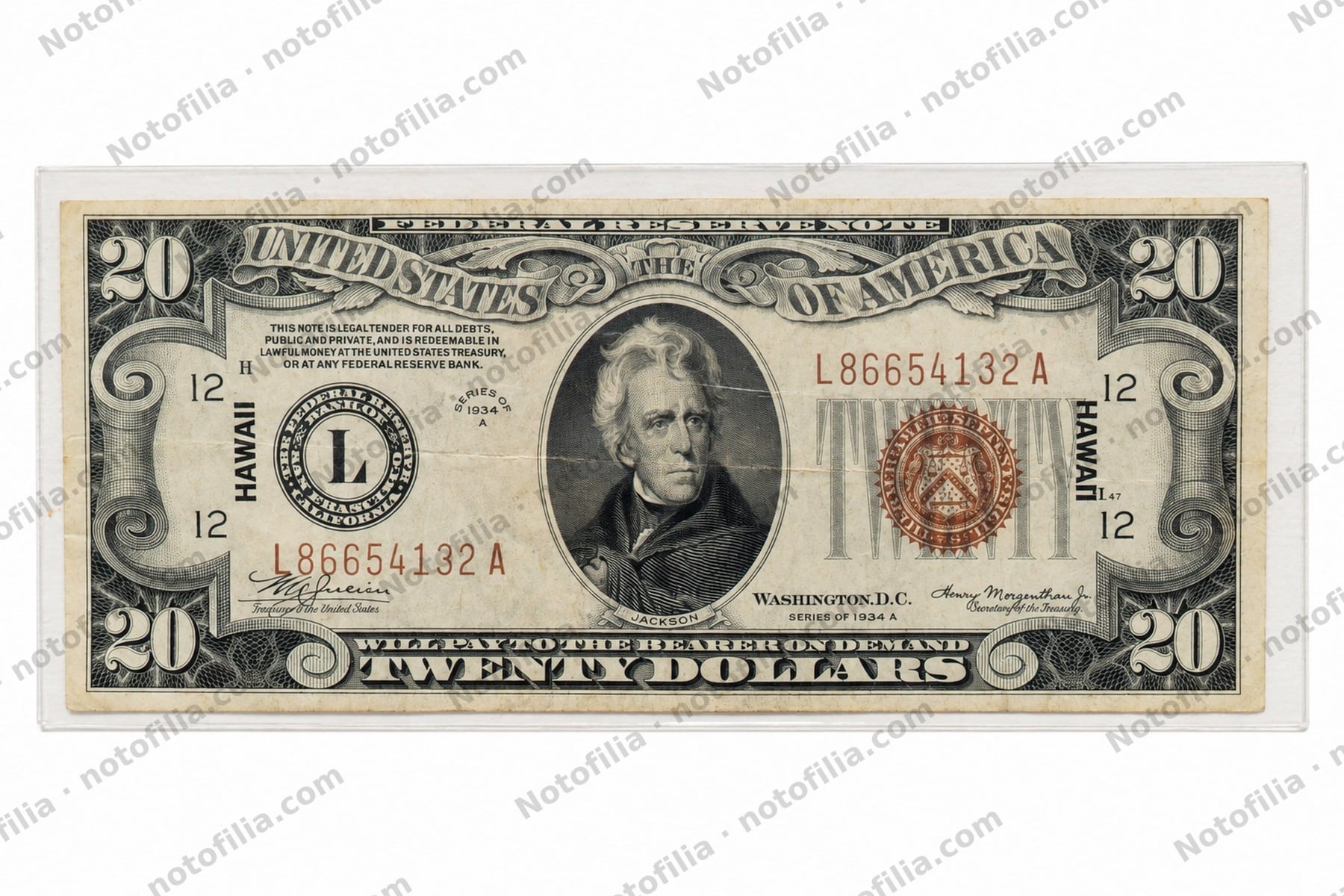
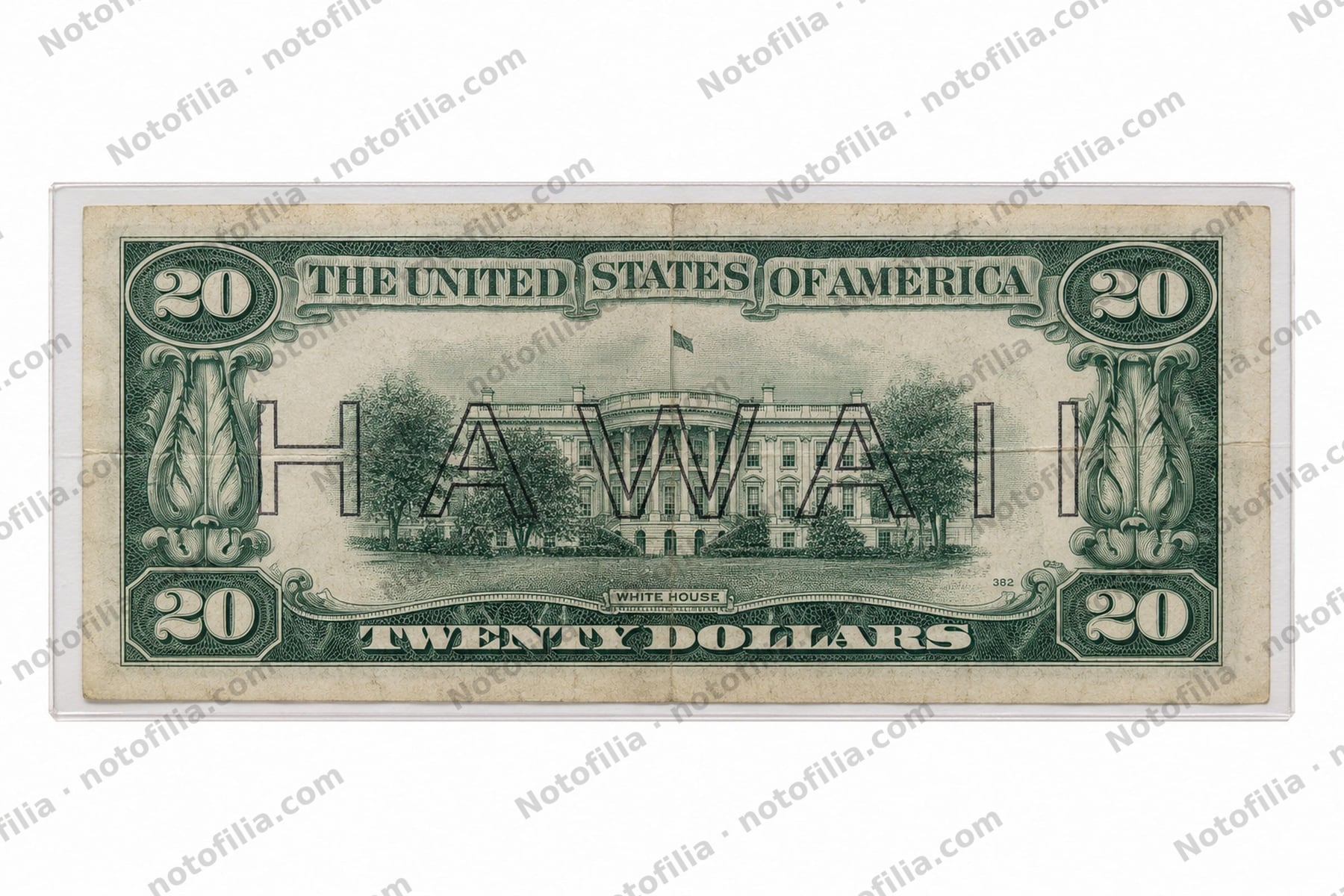
Face with Jackson, brown seal and serials L86654132A, and HAWAII on both margins; back with the White House and HAWAII in hollow letters. Series 1934A, San Francisco, numbered in 1944. Circulated, unslabbed.
Catalog facts
- Pick reference
- Fr. 2305
- Serial number
- L86654132A
- Signatures
- William Alexander Julian (Treasurer of the United States) and Henry Morgenthau Jr. (Secretary of the Treasury)
- Condition
- Circulated; visible folds, toning, and light soiling. Ungraded.
- Printage
- Series 1934A, printed as SERIES OF 1934 A: that designation is not the year this specimen was numbered. The Treasury introduced HAWAII currency on 25 June 1942. Peter Huntoon (Paper Money, May–June 2008, Table 1a) places serial L86654132A in the run L85536001A–L90036000A — 4,500,000 notes of Series 1934 and 1934A together — numbered in 1944. Those figures are the run’s numbering window, not the exact day this note was finished and not a Fr. 2305-only printage. The eight regular $20 HAWAII runs total 11,246,000 non-star notes, combining 1934 (Fr. 2304) and 1934A (Fr. 2305). The published format is about 155 × 66 mm (Numista); that is not a measurement of this piece. Bureau of Engraving and Printing; district L / 12, San Francisco.
Face
Back
The note
The Series 1934A $20 Federal Reserve Note with the HAWAII overprint (Friedberg 2305; Numista N#202426) is Treasury emergency paper for the Territory of Hawaii and Pacific operations, not a silver certificate: the $5, $10, and $20 of that issue are FRNs; the HAWAII $1 is a silver certificate. The series letter matters: the face prints SERIES OF 1934 A and sets it apart from Fr. 2304, Series 1934 without a letter. District L / 12, Federal Reserve Bank of San Francisco. Brown Treasury seal and serials; black bank seal; signatures of William Alexander Julian and Henry Morgenthau Jr. The black face on cream paper carries Andrew Jackson, the L seal at left, and the brown circular Treasury seal at right. Brown serials L86654132A repeat (L–A block). Solid black vertical HAWAII overprints flank the design. The face sheet-position letter is H at upper left; the face plate is 47 — neighboring lettering is partly covered by the right-hand HAWAII. The green back shows the White House, the caption WHITE HOUSE, and HAWAII in hollow letters across the field. Back plate 382 sits toward the lower right. That 382, with Series 1934A, is the regular non-mule variety; it is not the back-plate-204 variety. It is not a star replacement: the serial ends in A. It is not the Series 1935A HAWAII $1, serial S40499058C, nor the Series 1934A HAWAII $10, serial L45104670B, nor the Series 1934A HAWAII $5, serial L68013147A, nor an ordinary green-seal FRN. It is shown in a transparent sleeve, with no grading label. The notes remain legal tender at face value.
The HAWAII overprint
After Pearl Harbor the Treasury marked Territory of Hawaii dollars — and notes used in Pacific campaigns — so captured stocks could be invalidated if Japan took the islands. HAWAII currency was introduced on 25 June 1942: brown seals and serials and the word HAWAII on face and back. Printed Series 1934A names the type, not the numbering year of this specimen: the run L85536001A–L90036000A was serial-numbered in 1944. The emergency restrictions were lifted on 21 October 1944; after that, ordinary U.S. currency and HAWAII notes could circulate together in the designated areas. That date ends the restrictive arrangement, not a demonetization. Official withdrawal began in April 1946.
The frame for those emergency issues — Hawaii, the yellow seal, AMC, Bernhard — is on the World War II emergency-banknotes case, under Notaphily. This page is the documented Fr. 2305 example: serial L86654132A, not a type illustration.
Scarcity and printage
Fr. 2305 is the Series 1934A HAWAII $20, scarcer than the $1 Fr. 2300. Huntoon does not give a Fr. 2305-only total: this serial’s run is 4,500,000 mixed 1934/1934A notes, and the eight regular $20 runs total 11,246,000 non-star notes. The keys of the type are paper quality, the sharpness of the overprint, plate mules, and star replacements. This piece is neither a mule nor a star. This record does not republish prices.
Population
The photographs show a circulated specimen, with horizontal and vertical folds, paper toning, scattered stains, and corner wear. No grading label is present. No population census is quoted, and no claim is made about cleaning or repairs.
Sources
- Numista N#202426 — 20 Dollars (Federal Reserve Note; Brown Seal — Hawaii) (opens in a new tab)
Fr. 2305; Julian–Morgenthau signatures; published format about 155 × 66 mm. District L / 12.
- Huntoon — U.S. Hawaii & North Africa/Sicily Military Currency (Paper Money 255, May–June 2008) (opens in a new tab)
Table 1a: L85536001A–L90036000A, 4,500,000; numbered in 1944; Series 1934 and 1934A in the same run.
- Friedberg / Berman — Emergency Notes (HAWAII $20 printage) (opens in a new tab)
11,246,000 regular $20 HAWAII notes, Series 1934 and 1934A combined; a type figure, not this serial.
- U.S. Currency Education Program — History of U.S. Currency (opens in a new tab)
BEP as printer; wartime special-currency program.
Related pieces
Other records from the same issuer or era in this case.