Colombia · Errors · Butterfly cut
1,000 pesos note, 2011
1,000 pesos · butterfly-cut error · 2011
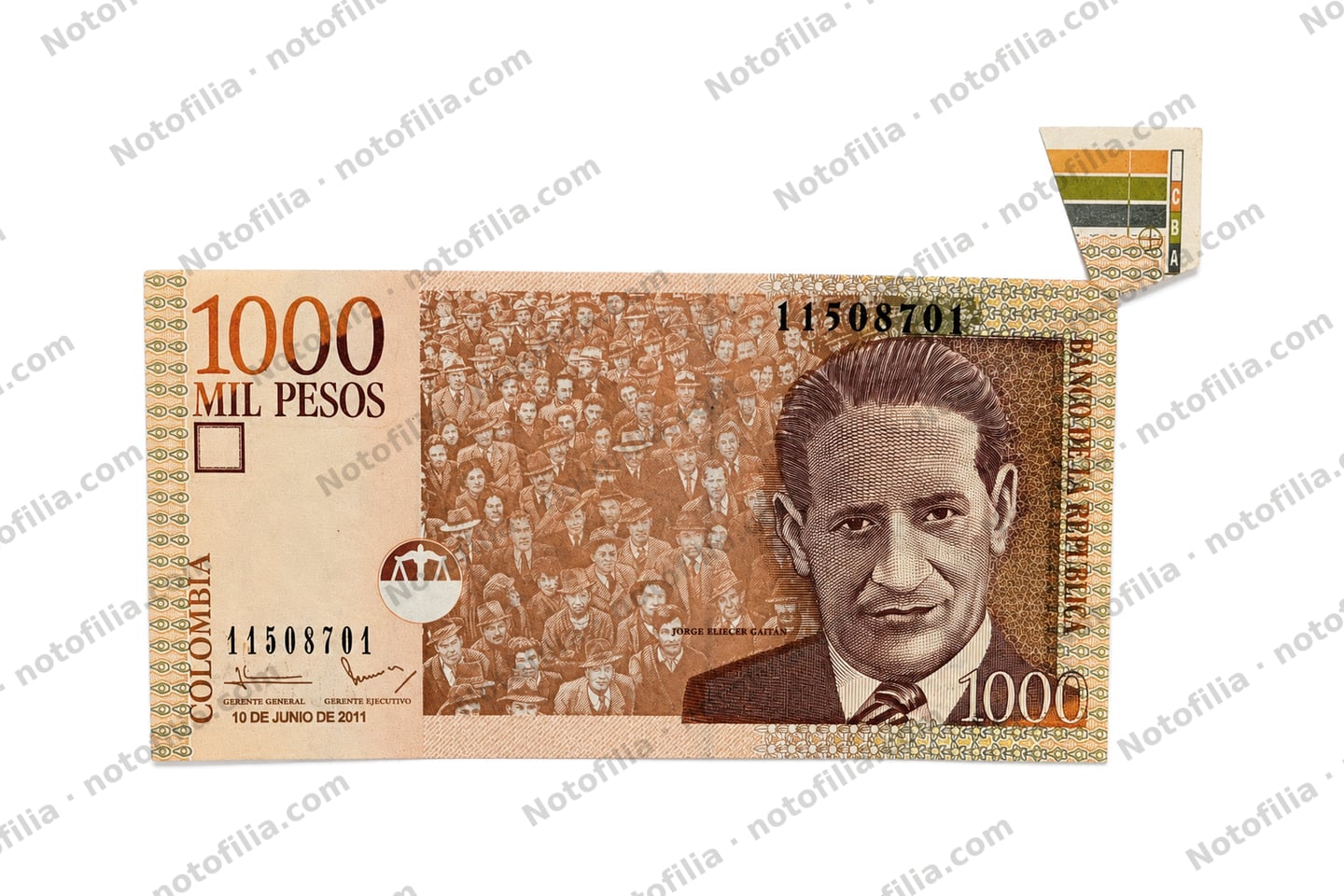
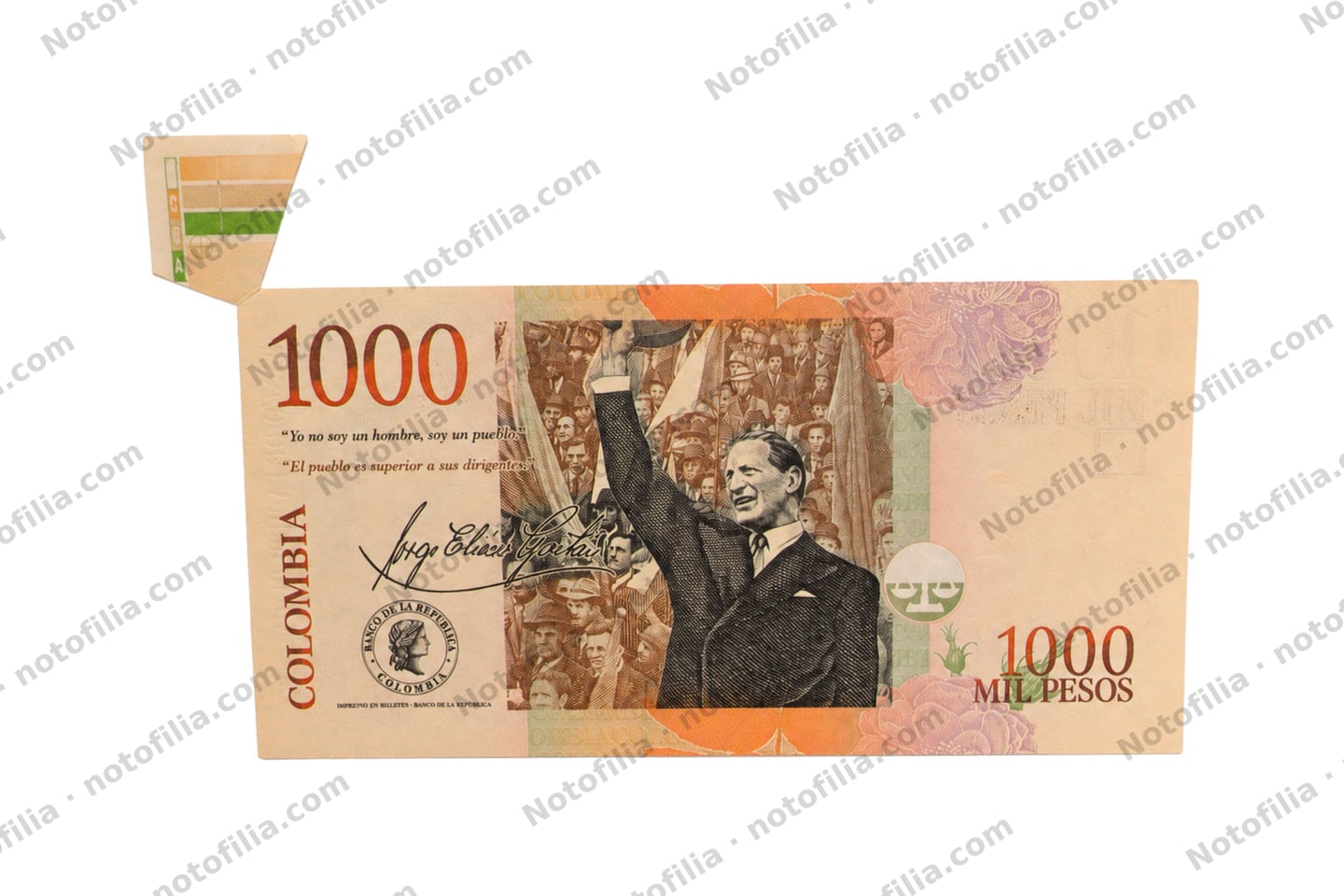
A Gaitán one-thousand-peso note, Pick 456n / TBB B986n: date 10 June 2011 and serial 11508701, with a butterfly-cut fold-over that retains the sheet-margin color bars and the A, B, and C boxes. This record gathers the face and back of the same unslabbed note.
Catalog facts
- Pick reference
- P# 456n / TBB B986n
- Serial number
- 11508701
- Signatures
- José Darío Uribe Escobar (gerente general) and José Tolosa Buitrago (gerente ejecutivo)
- Condition
- Unslabbed · apparently uncirculated · butterfly-cut error
- Printage
- Imprenta de Billetes, Banco de la República, Bogotá. Date printed on the face: 10 June 2011. Published size 130 × 65 mm; eight digits, no series letter; both serials on the face. This piece also keeps a sheet-margin flap that extends beyond the rectangle. González White 2019 numbers the date BG# 439-r/14 (p. 112). The Bank Note Museum lists 10.06.2011 as Pick 456n. Numista assigns TBB B986n and places the note into circulation on 27 February 2012. BanRep’s 2011 production of 1,000-peso notes is 196.1 million pieces, and Tesorería delivery that year matches: that is every note of that face value that year, not the printage of this date or this error. No printage is published here.
Face
Back
The note
The Jorge Eliécer Gaitán one-thousand in the reduced 130 × 65 mm format is Pick 456 (2005–2016) / TBB B986, printed by the Imprenta de Billetes. González White numbers the reduced dates BG# 439-r; this piece carries “10 DE JUNIO DE 2011,” BG# 439-r/14, which the Bank Note Museum marks 456n. The signatures are those of José Darío Uribe Escobar, general manager, and José Tolosa Buitrago, executive manager: the pair Numista assigns to that date (TBB B986n; Hernández# 453 on that record). Serial 11508701 appears twice on the face, in black, at upper right and lower left; it is not a low serial and not a collector pattern (radar, binary, solid, or ladder). The face, in orange and ochre, shows Gaitán at right and, at centre, the crowd as seen from Medellín’s Hotel Nutibara; at left, the scales registration device and the 1000. The back shows him waving his hat, with the quotations “Yo no soy un hombre, soy un pueblo” and “El pueblo es superior a sus dirigentes,” the Liberty seal, and the imprint “IMPRENTA DE BILLETES – BANCO DE LA REPÚBLICA.” What distinguishes this piece is the error, not the type: a trapezoidal flap of sheet margin remained attached to the upper-right corner of the face — the upper-left of the back. That flap carries the control color bars and the A, B, and C boxes with a circular registration mark: material the factory cut was meant to discard. In Colombian notaphily Hernández calls that paper wing a mariposa (butterfly); the as-made fold that left it attached is a production error, not a design variety. It should not be confused with the large 140 × 70 mm one-thousand (Pick 450), with that family’s 16.08.2000 cut (serial 693949988), with dates 11.06.2011 (456o) and 12.06.2011 (456p), or with 27.08.2014, 19.08.2015, or 02.08.2016. This record gathers both sides of the same unslabbed note.
The bank
Jorge Eliécer Gaitán (1903–1948) has occupied the Banco de la República one-thousand since the first date, 7 August 2001, put into circulation in 2002 at 140 × 70 mm. In 2005–2006 the bank cut the format to 130 × 65 mm, renewed the watermark, and kept printing at the Imprenta de Billetes. The face takes the crowd from a balcony of the Hotel Nutibara; the back, the candidate’s greeting of 23 September 1945. Numista dates this printed date, 10 June 2011, into circulation on 27 February 2012. The type ran through 2016; no replacements are recorded. This record does not document an ordinary circulating example: it documents a maculature that escaped the cut with the sheet margin still attached.
Scarcity and printage
González White 2019 (BG# 439-r/14, p. 112) publishes no emisión figure for 10 June 2011. The Bank Note Museum describes Pick 456 as the 2005–2016 130 × 65 mm type and marks 456n for that date. Numista groups the design under N# 205282 and marks the 10.06.2011 date’s frequency at 6% among owners of the type; that figure is for the ordinary date, not for maculatures. BanRep’s annual production table assigns 196.1 million pieces to every 1,000-peso note of 2011, and the Tesorería delivery table the same total: that is not the printage of one date, signature pair, or cutting error. A butterfly note that still carries the sheet’s color bars is a showcase piece; this record does not invent a population for that error.
Population
A PMG or PCGS census for serial 11508701 has not been independently verified. The note is shown unslabbed, apparently uncirculated. The error is a production fault, not a grading certificate.
Sources
- Bank Note Museum — Colombia P-456, 1,000 pesos (2005–2016) (opens in a new tab)
Reduced type, Imprenta de Billetes; Gaitán on face and back. This piece is 10.06.2011 (456n). The catalogue marks 456p as 12.06.2011 and corrects a non-existent 13.06.2011.
- Numista — Colombia 1,000 pesos (reduced format), N# 205282 (opens in a new tab)
10.06.2011 date: P# 456n, TBB B986n, Hernández# 453; signatures JDUE and JTB; circulation 27 February 2012; 6% frequency within the type. Price columns are not published here.
- Banco de la República — Banknote and coin production and circulation (opens in a new tab)
2011 production of 1,000-peso notes: 196.1 million pieces. Tesorería deliveries that year: 196.1 million (denomination totals for the year, not one Pick date or error).