Colombia · Errors · Numbering
50,000 pesos note, 2015
50,000 pesos · numbering error · 2015
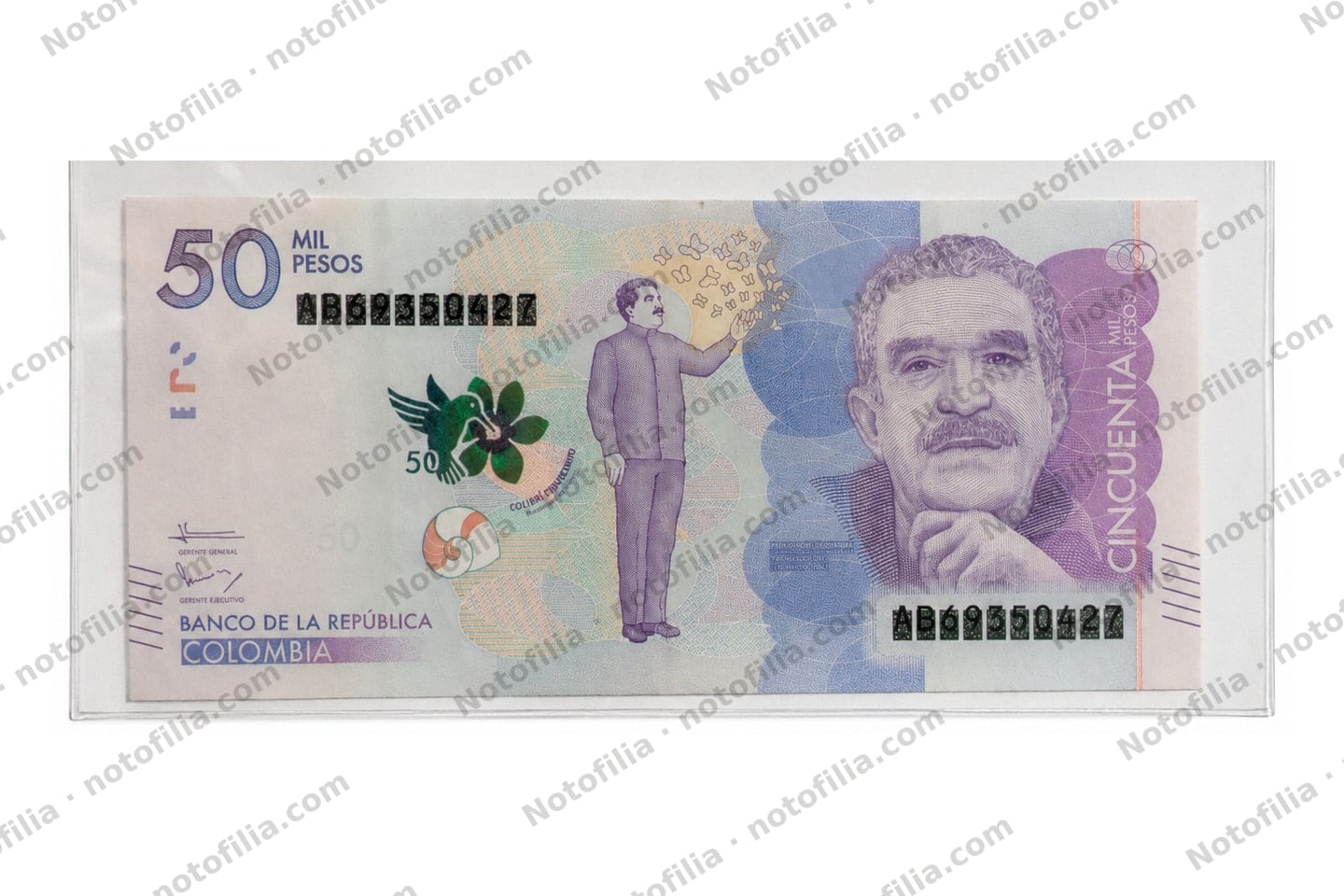
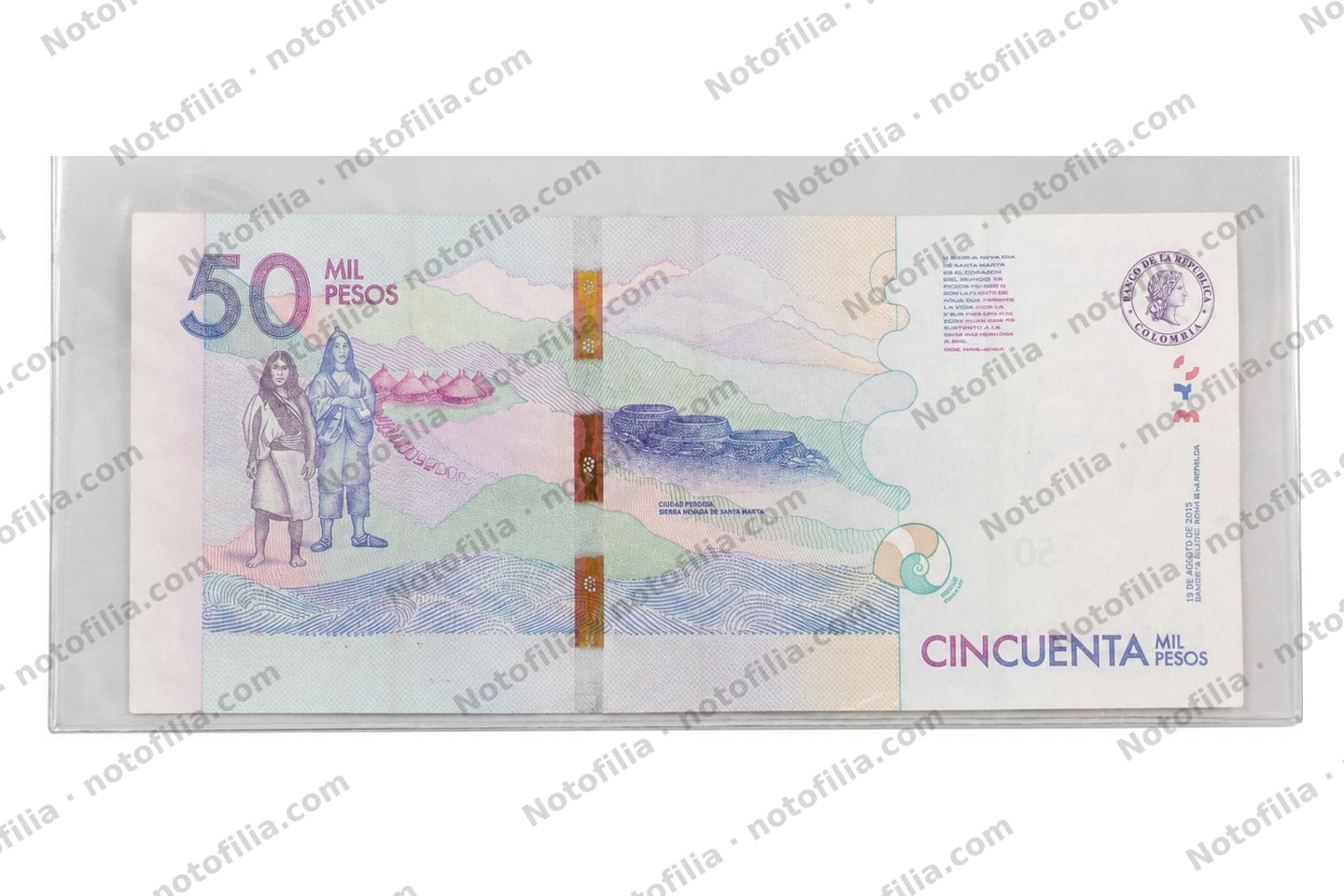
A García Márquez fifty-thousand-peso note, Pick 462a / TBB B997a: date 19 August 2015, series AB, and serial AB69350427, with a numbering error — heavy over-inking — that fills both face serials with black blocks. This record gathers the face and back of the same unslabbed note, in a sleeve.
Catalog facts
- Pick reference
- P# 462a / TBB B997a
- Serial number
- AB69350427
- Signatures
- José Darío Uribe Escobar (gerente general) and José Tolosa Buitrago (gerente ejecutivo)
- Condition
- Unslabbed · in a sleeve · apparently uncirculated · numbering error (over-inking)
- Printage
- Imprenta de Billetes, Banco de la República, Bogotá. Printed in inks on paper. Date printed on the right edge of the back: 19 August 2015. Size 148 × 66 mm; two-letter prefix and eight digits, series AB. González White 2019 numbers this date and series BG# NF50-2 (p. 152): signatures Uribe / Tolosa, emisión ¿?; it places series AB into circulation on 18 November 2016. BanRep’s 19 August 2016 communiqué puts the type — the third note of the New Family — into circulation that day. The Bank Note Museum marks 19.08.2015 as Pick 462a. Numista assigns TBB B997a and prefixes AA–AD to that date. BanRep’s 2015 production of 50,000-peso notes is 250.4 million pieces (the denomination total that year; the García Márquez family had not yet circulated). In 2016 production of every 50,000 is 259.2 million, and Tesorería delivery of the 2016 S family is 115.786 million: those are not the printage of this date, this series, or this error. No printage is published here.
Face
Back
The note
In 2016 the Banco de la República put a new family into circulation — 2,000 to 100,000 — with a size per denomination and an iconographic program that moves beyond independence heroes. On 19 August 2016 the fifty-thousand was the third note of that New Family: it would circulate alongside the Jorge Isaacs 50,000. The homage to Gabriel García Márquez fulfils article 5 of Law 1741 of 2014; the same design exalts Ciudad Perdida, the Sierra Nevada de Santa Marta, the short-billed hummingbird, and the burgao snail. González White numbers the 148 × 66 mm type as the NF50 listings; the Bank Note Museum, Pick 462 (2015–2022), printed by the Imprenta de Billetes in inks on paper. This piece carries the date “19 DE AGOSTO DE 2015” on the right edge of the back — the first date, 462a — and the imprint “IMPRENTA DE BILLETES - BANCO DE LA REPÚBLICA.” The signatures are those of José Darío Uribe Escobar, general manager, and José Tolosa Buitrago, executive manager: the pair Numista and González White assign to that date (BG# NF50-2, series AB; TBB B997a). The face, in violet and blue, shows García Márquez standing at centre with the butterflies and a close-up at right; at left, the short-billed hummingbird (Ramphomicron dorsale) in optically variable ink and the burgao as a registration device. Serial AB69350427 appears twice in black, at upper left and lower right: it is not a low serial and not a collector pattern (radar, binary, solid, or ladder). What distinguishes this piece is the error, not the type: both numberings left the machine heavily over-inked. Each character — the letters AB and the eight digits — is filled by a rectangular block of thick black ink; the serial can be read, but not as a clean figure on the ground. It is a numbering maculature, not a design variety. The back carries two indigenous people of the Sierra Nevada, the terraces of Ciudad Perdida, a fragment of the speech “La soledad de América Latina,” and the Liberty seal. It should not be confused with the Isaacs 50,000 (Pick 455), with this case’s 2008 mismatched-serial error (72461316 / 72411316), with dates 02.08.2016 (462b), 29.08.2017, 24.07.2018 or later, or with series AA or AE–AH of the same dates. This record gathers both sides of the same unslabbed note, in a sleeve.
The bank
Gabriel José de la Concordia García Márquez (Aracataca, 1927 – Mexico City, 2014) occupies the fifty-thousand of the 2016 family. Congress required the portrait (art. 5, Law 1741 of 2014). BanRep’s 19 August 2016 communiqué puts it into circulation that day in Santa Marta, the third note of the New Family, running alongside the Isaacs 50,000; the Banco Agrario in Aracataca was the first to receive it. González White records, for series AB of this printed date, circulation on 18 November 2016 (BG# NF50-2). The Bank Note Museum dates Pick 462 printed dates from 2015 to 2022: this piece is the first, 19.08.2015 (462a), with the signatures of Uribe and Tolosa. This record does not document an ordinary circulating example: it documents a numbering maculature that escaped with both serials filled.
Scarcity and printage
González White 2019 (BG# NF50-2, p. 152) publishes no emisión figure for 19 August 2015, series AB (¿?). The Bank Note Museum describes Pick 462 as the 2015–2022 type and marks 462a for that date. Numista groups the design under N# 205124, with a rarity index of 21, and marks the 19.08.2015 date’s frequency at 21% among owners of the type; that figure is for the ordinary date, not for maculatures. BanRep’s annual production table assigns 250.4 million pieces to every 50,000-peso note of 2015 — a year when this family had not yet circulated — and 259.2 million to those of 2016; the 2016 Tesorería delivery table assigns 115.786 million to the S family: that is not the printage of one date, signature pair, series AB, or numbering error. A serial filled in both positions is a showcase piece; this record does not invent a population for that error.
Population
A PMG or PCGS census for serial AB69350427 has not been independently verified. The note is shown in a sleeve, apparently uncirculated, unslabbed. The error is a production fault, not a grading certificate.
Sources
- Bank Note Museum — Colombia P-462, 50,000 pesos (2015–2022) (opens in a new tab)
2015–2022 type, Imprenta de Billetes; García Márquez on the face, Ciudad Perdida on the back. This piece is 19.08.2015 (462a). The catalogue marks 462b as 02.08.2016 and lists later dates unlettered in the Standard Catalog.
- Numista — Colombia 50,000 pesos, N# 205124 (opens in a new tab)
19.08.2015 date: P# 462a, TBB B997a; signatures JDUE and JTB; prefixes AA–AD; type issued 19 August 2016; 21% frequency within the type; rarity index 21. Price columns are not published here.
- Banco de la República — Communiqué: the 50,000-peso note enters circulation (19 August 2016) (opens in a new tab)
Third note of the New Family; homage to García Márquez under Law 1741 of 2014; it would circulate alongside the Isaacs 50,000. It does not name this printed date, this series, or this serial.
- Banco de la República — Banknote and coin production and circulation (opens in a new tab)
2015 production of 50,000-peso notes: 250.4 million pieces. 2016 production: 259.2 million. Tesorería deliveries of 50,000-peso S notes (2016 family) in 2016: 115.786 million (denomination totals that year, not one Pick date or error).