Published
Three Printers? Colombian Imprints
IBB, IBSFB, and Banco de la República look like three different printers, but they tell another story: one press and a city that changed its name.
- Reviewed by
- Yezid Acosta
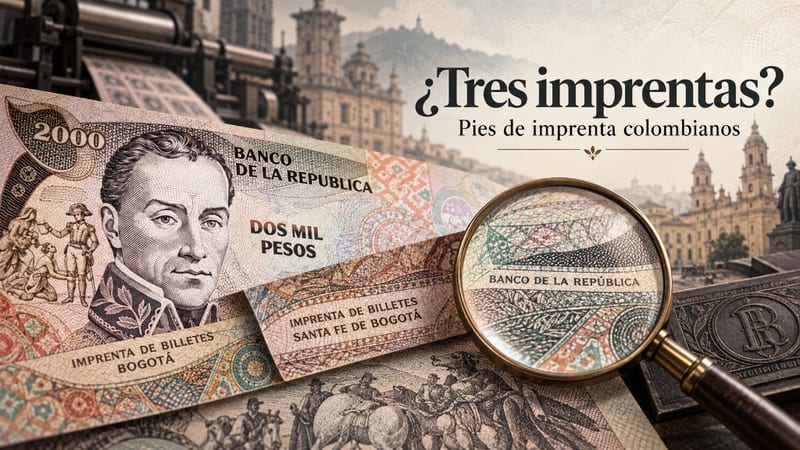
If you collect Colombian banknotes you have surely noticed it: between 1983 and 2014, Banco de la República notes carry three different imprints. Some read “Imprenta de Billetes – Bogotá”, others “Imprenta de Billetes – Santa Fe de Bogotá”, and the most recent simply “Banco de la República”. The Pick catalog even records them with different abbreviations: IBB and IBSFB. The question arises on its own: are we looking at two or three different firms?
The answer is that they are one and the same printing works, and the explanation is a small jewel of Colombian history hidden in paper money.
A press that is not a company
The Imprenta de Billetes is not a private firm hired by the central bank: it is an internal department of Banco de la República itself. It began operations formally on 23 October 1959, printing as its first job the 1-peso note designed by the Italian Mario Baiardi. Since then it has operated without interruption, first in Bogotá’s industrial zone and later in the complex we now know as the Central de Efectivo. In 1994 a Bank of England report praised its technical level, comparing it with European printers.
The city that changed its name (twice)
So why did the imprint change? The key is not the press, but the city where it works.
The Constitution of 1991 officially renamed the capital “Santa Fe de Bogotá”. The press, faithful to formality, updated its seal: that is why notes of the 1990s read “Imprenta de Billetes – Santa Fe de Bogotá”. It is the same reason people born in the capital between 1991 and 2000 are, technically, santafereños and not bogotanos.
An example that lets you study that stage closely is the Banco de la República 2,000 pesos oro note, present in the Notofilia catalog with different dates and printers.

In 2000, Legislative Act 01 restored the city’s traditional name: Bogotá D. C. But instead of reversing the seal, the notes went on to identify simply the issuing and printing entity: “Banco de la República”. A change of style, not of factory.
Before 1959: Colombian notes were printed abroad
The fact makes the history of this press even more valuable. For decades Colombia depended on foreign printers: the American Bank Note Company of New York printed the first Banco de la República notes in 1923 and the pesos oro series of the 1930s and 1940s; Waterlow & Sons of London produced early-twentieth-century Government notes; and Thomas De La Rue printed several denominations well into the 1980s.
The 2,000 pesos oro note is a perfect case study: its first dates (1983–1986) came from De La Rue’s London workshops, and the later ones (1986–1992), with the same design, from the Imprenta de Billetes in Bogotá. There were also occasional guests: the German Bundesdruckerei printed the commemorative 5,000 pesos of 1986, and the Banco de México press the 10,000 pesos of 1992.

The catalog now documents a 1994 Emberá 10,000-peso star replacement, printed by the Imprenta de Billetes in Santa Fe de Bogotá. The 1992 date of the same design, in pesos oro, came from the Banco de México press.
List of printers of Colombian banknotes
For the collector’s quick reference, these are the main companies and presses that have produced Colombia’s notes, with approximate periods and some outstanding issues:
| Printer | Pick abbr. | Country | Period and notable notes |
|---|---|---|---|
| Imprenta de Billetes of Banco de la República | IBB / IBSFB | Colombia | 1959–present. First job: 1-peso note (1959). Sole printer from the 1990s; printed the 50,000-peso note of 2000 dedicated to Jorge Isaacs and the entire 2016 family. |
| American Bank Note Company | ABNC | U.S. | c. 1880–1950s. Nineteenth-century private-bank notes and Banco Nacional; first Banco de la República notes (1923); pesos oro series of the 1930s and 1940s. |
| Waterlow & Sons Ltd. | W&S | England | c. 1900–1920s. Government notes of c. 1904 with portraits of Bolívar and other founding figures. |
| Thomas De La Rue & Co. | TDLR | England | 1960s–1980s. Several denominations; emblematic case: the 2,000 pesos oro of 1983–1986 (P-430), whose design later passed to the IBB. |
| Bundesdruckerei | BDDK | West Germany | 1986. Commemorative 5,000 pesos for the centenary of the Constitution of 1886, with Rafael Núñez. |
| Imprenta del Banco de México | — | Mexico | 1992. Commemorative 10,000 pesos for the 500th anniversary of Columbus’s voyage (P-437, with the Embera woman on the obverse). |
| National lithographers (the “Litografía Nacional” and Bogotá workshops) | — | Colombia | Nineteenth century–1902. Regeneración issues and emergency notes of the Thousand Days’ War. |
An honest caveat: in the nineteenth century dozens of private banks issued their own paper, and some individual notes are attributed in catalogs to other New York firms of the period —Homer Lee Bank Note Co., National Bank Note Co., among others. Those attributions are checked note by note in the Specialized Issues volume of the Pick catalog.
What this means for the collector
For cataloguing purposes, IBB and IBSFB are not two printers but two seal variants of the same institution, and that distinction creates very concrete collectible varieties: the same design can exist with two or even three imprints according to date. Checking that detail in the fine print of the note is one of those satisfactions only a notaphilist understands: in a space of millimeters sit the Constitution of 1991, a legislative act of 2000, and more than sixty years of monetary sovereignty printed at home.
Sources
- Banco de la República — “60 años de la imprenta de billetes” (opens in a new tab), Reportes del Emisor.
- Banco de la República — Memorias del Banco de la República en su primer siglo (opens in a new tab).
- Red Cultural del Banco de la República — “La Primera Impresión. 60 años de la imprenta de billetes” (opens in a new tab).
- Banco de la República — banknote production at the Central de Efectivo (opens in a new tab).
- Standard Catalog of World Paper Money (Albert Pick), Colombia and Specialized Issues sections.
Frequently asked questions
Are IBB and IBSFB two different printers?
No. They are the same in-house Banco de la República works. The imprint moved from “Imprenta de Billetes – Bogotá” to “Imprenta de Billetes – Santa Fe de Bogotá” and later to “Banco de la República” when the city’s official name, and later the note design, changed.
When did the Banco de la República start printing banknotes?
The Imprenta de Billetes opened in Bogotá on 23 October 1959; its first issue was the blue 1-peso (Pick 404). Before that the bank ordered paper mainly from the American Bank Note Company and Thomas De La Rue.
Does the Pick catalog treat IBB and IBSFB as different firms?
The Standard Catalog of World Paper Money records the IBB and IBSFB abbreviations on different rows because the printed imprint changes. That does not mean two firms: this collection documents them as one works of the issuing bank.