Colombia · Banco de la República · Star replacement
10,000 pesos note, 1994
10,000 pesos · star replacement · 1994
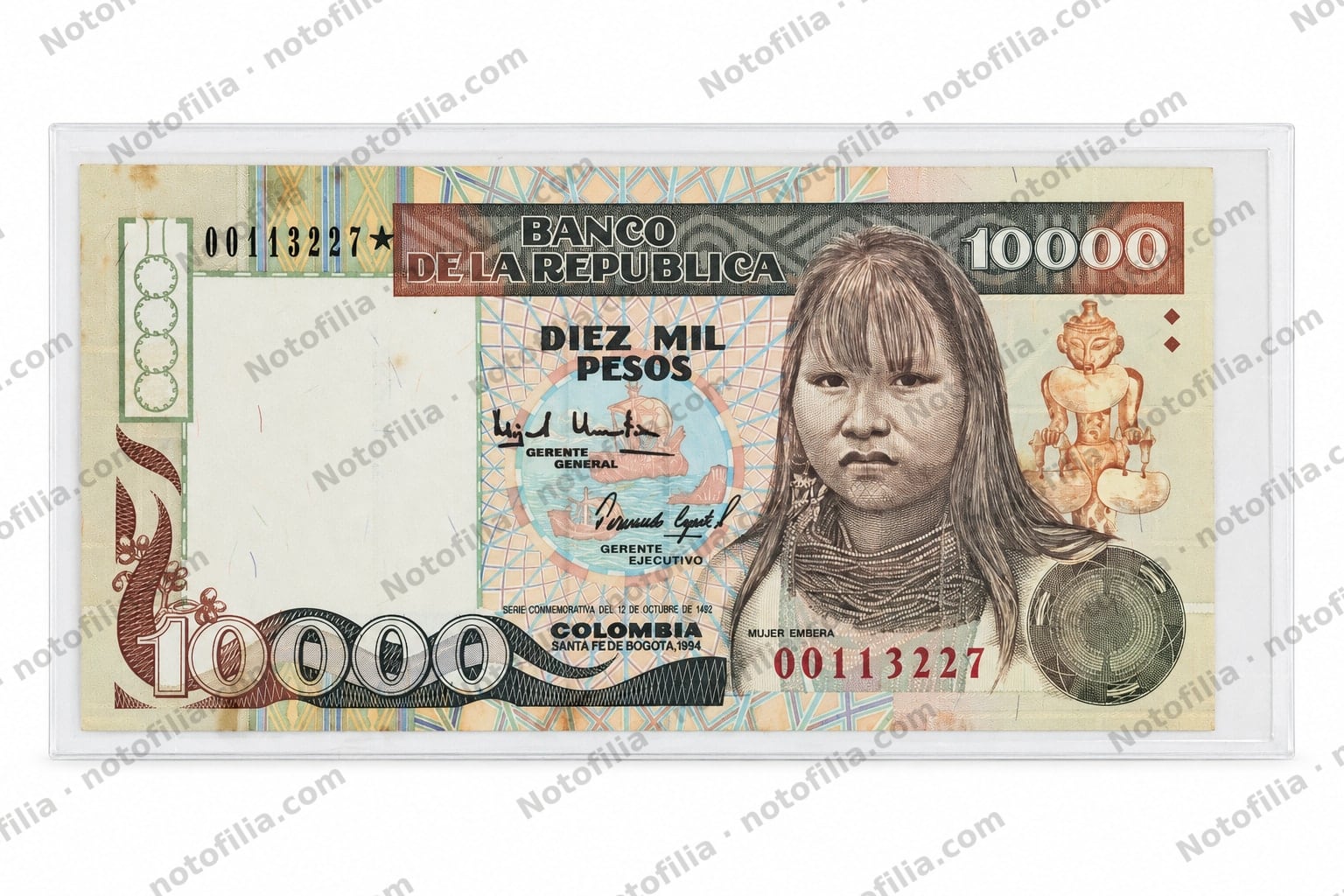
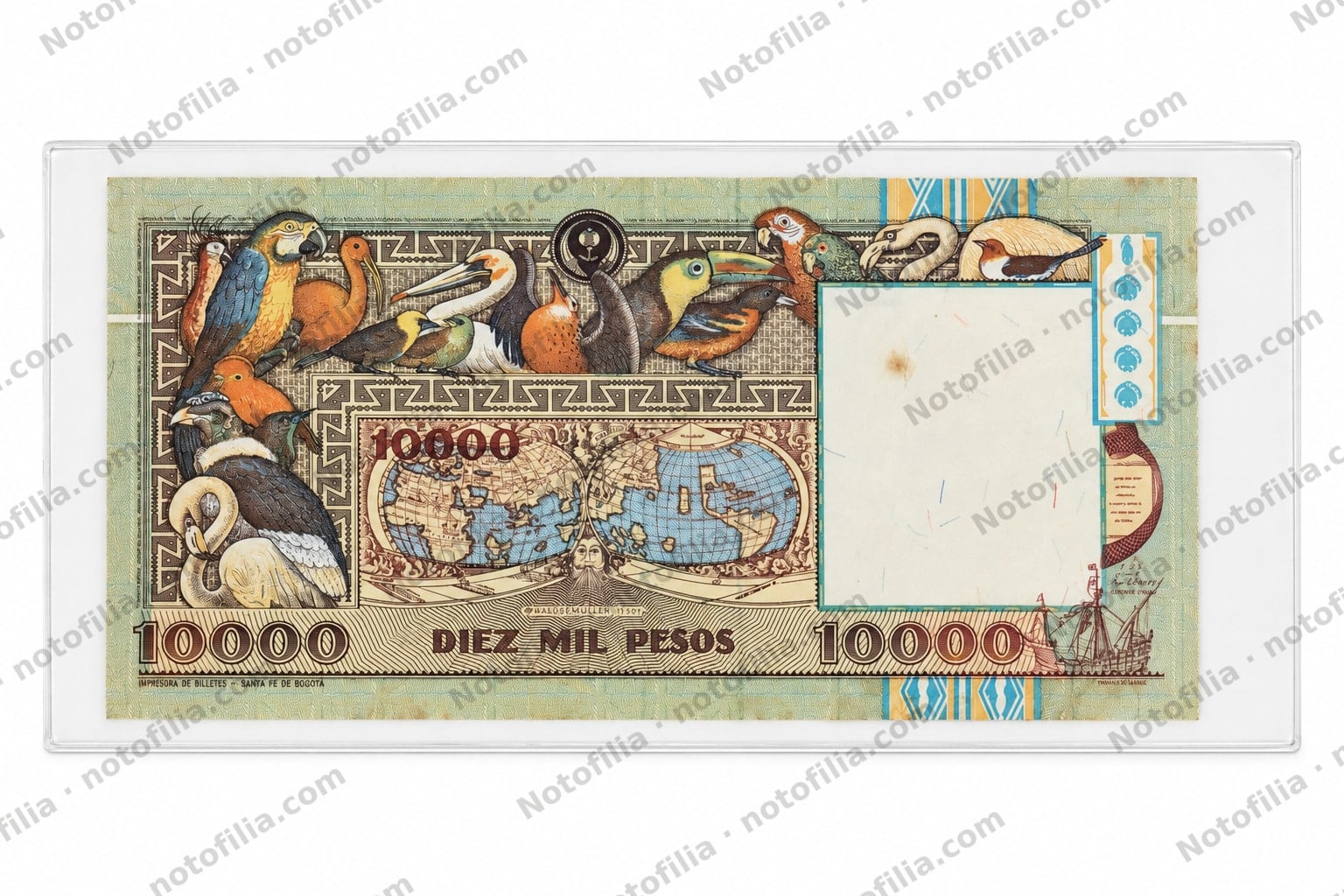
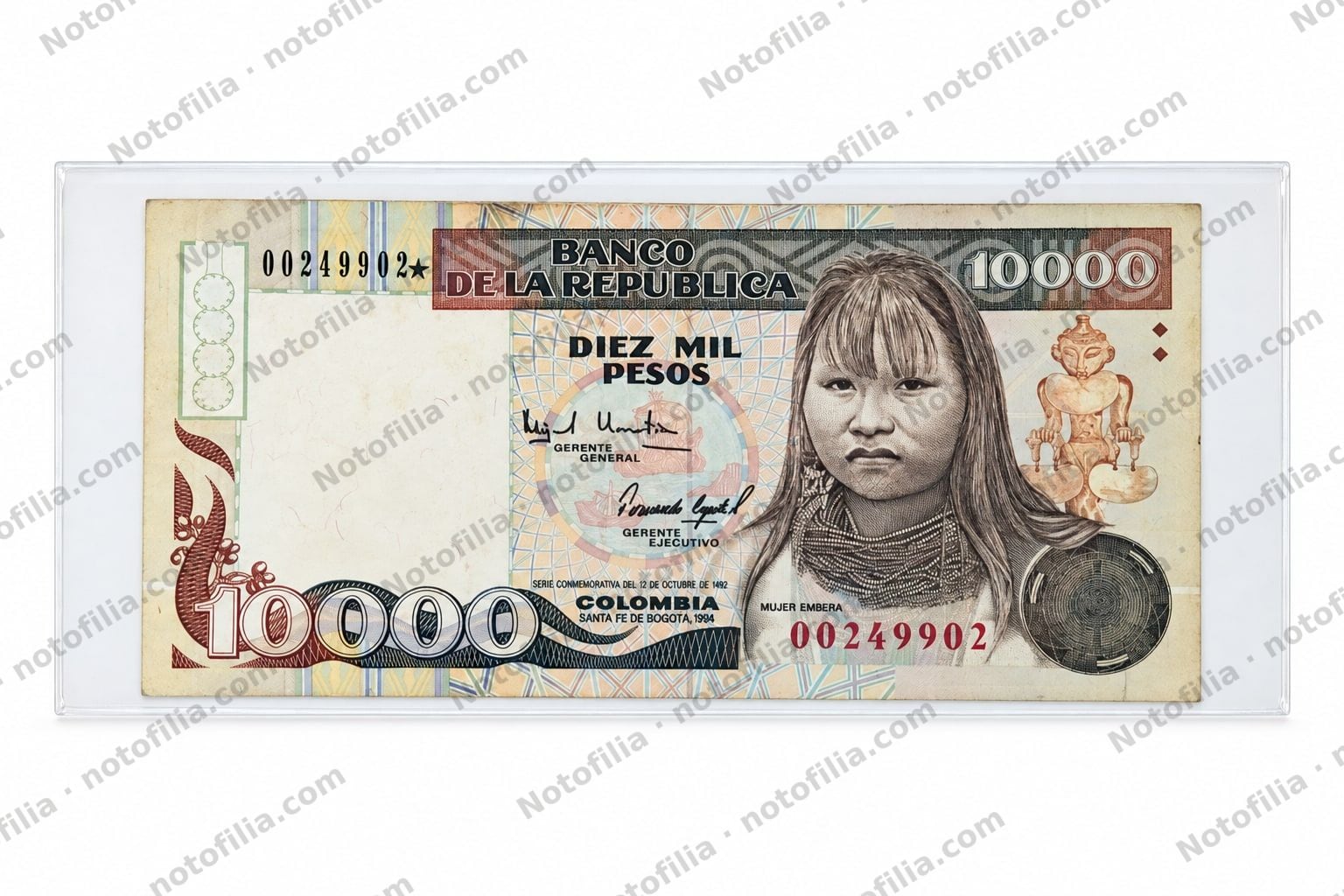
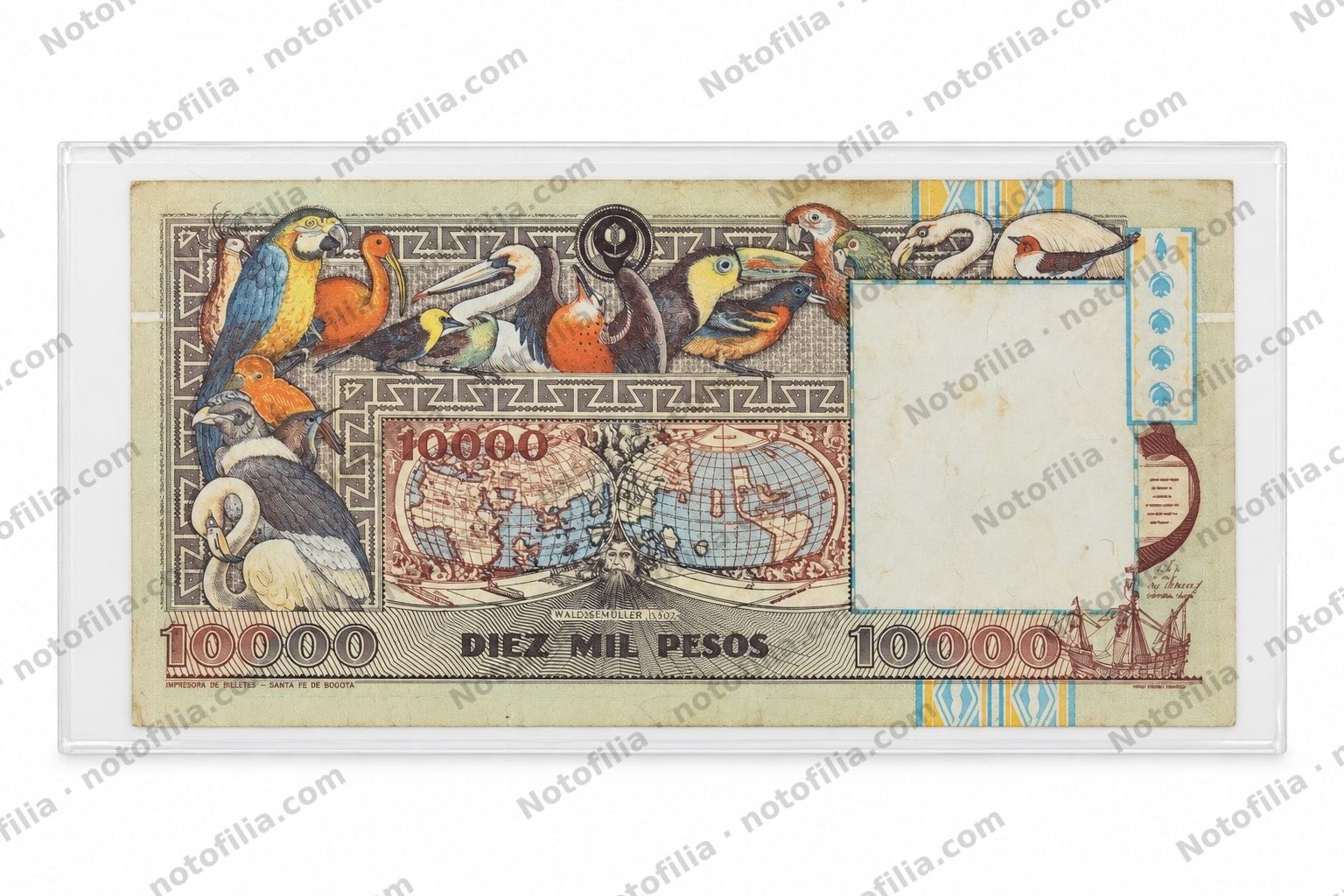
Two notes of the Emberá Pick 437A family, date 1994: serials 00113227 and 00249902, each with a replacement star. One record: one facts block and one type essay; both faces of each serial stacked below.
Catalog facts
- Pick reference
- P# 437A · TBB B980az
- Serial numbers
- 00113227 / 00249902
- Signatures
- Miguel Urrutia Montoya (gerente general) and Fernando Copete Saldarriaga (gerente ejecutivo)
- Condition
- Unslabbed · in a sleeve
- Printage
- Imprenta de Billetes, Santa Fe de Bogotá (IBSFB). Date printed on the face: Santa Fe de Bogotá, 1994. Published size 140 × 70 mm; eight digits, no series letter. A star sits to the right of the upper black serial. The Bank Note Museum numbers the 1992 10,000 pesos oro as Pick 437 (Banco de México) and refers later dates, already in “pesos,” to Pick 437A. Numista assigns the 1994 replacement to TBB B980az / Hernández 576. González White 2019 (pp. 127–128) lists the 1994 star replacement with serials 00.100.332–00.239.982. BanRep’s 1994 production of 10,000-peso notes is 123.05 million pieces: that is every note of that face value that year, not the printage of this replacement. No printage is published here.
Example 00113227
Face
Back
Example 00249902
Face
Back
The note
The Banco de la República put this ten-thousand into circulation in 1992 to mark the 500th anniversary of 12 October 1492. The design is Liliana Ponce de León’s — second prize in a 1991 contest whose first prize was declared vacant — and the engraving is attributed to Trento Cionini. The first date, 1992, reads “pesos oro” and came from the Banco de México press (Pick 437). These examples are 1994: they already read “DIEZ MIL PESOS,” without “oro,” and the back imprint is “IMPRESORA DE BILLETES – SANTA FE DE BOGOTÁ” (IBSFB). The Bank Note Museum and Numista number them Pick 437A / TBB B980az. On the face, at right, the engraving labelled “MUJER EMBERA,” with bead necklaces and earrings; beside her, an anthropomorphic Quimbaya poporo from the Museo del Oro; at centre, a medallion with caravels. The signatures are those of Miguel Urrutia Montoya, general manager, and Fernando Copete Saldarriaga, executive manager: the 1993–1994 pair. The back gathers Colombian birds — the “parrot note” — and Waldseemüller’s 1507 world map. González White places the 1994 star replacement at 00.100.332–00.239.982; 00113227 sits there; 00249902 (249,902) sits above that ceiling. It is not the 1992 R-prefix replacement (R00.100.009–R00.107.451), nor a Policarpa 10,000 (from 1995), nor an example from the serial ranges the bank published after the Valledupar robbery. The engraving is the subject of 2025 lawsuits: Adriana Martínez Dogirama and photographer Mauricio Pardo allege the bank used a photograph of her from around 1986, published in 1988 by the Museo del Oro; Banco de la República maintains the illustration gathers Emberá community traits, not a specific identifiable person. This record does not settle that dispute. It gathers two 1994 star notes, each in a sleeve, unslabbed.
The bank
From 1993 Banco de la República notes dropped the legend “pesos oro.” This ten-thousand had appeared the year before as a commemorative series for 12 October 1492: a nod to the 1991 Constitution and, on the back, to the country’s fauna. On 16–17 October 1994 the “robo del siglo” emptied the Valledupar vault: some 24.072 billion pesos in 2,000, 5,000, and 10,000 notes, much of it still unissued. The bank published serial ranges and, in 1995–1996, replaced those three denominations; the next 10,000 carries Policarpa Salavarrieta. González White notes, on the same 1994 spread, stolen ordinary serials that do not match these star replacements. In 2023 the architect Gildardo Tovar compared the engraving with a slide by Mauricio Pardo; El Tiempo (March 2025) and El País (June 2025) cover the suits by Pardo and by Adriana Martínez Dogirama. The bank denies that the portrait reproduces a specific person. This record documents two 1994 star examples — 00113227 and 00249902 — each in a sleeve, printed the same year as the robbery.
Scarcity and printage
González White 2019 (pp. 127–128) publishes the 1994 star-replacement serial band (00.100.332–00.239.982), not an emisión figure for that variety (¿? on the spread). 00113227 sits in that band; 00249902 (249,902) sits above it; the 1993 band (00.100.133–00.274.404) and the 1992 R prefix are not applied to a 1994-dated note. Numista groups the 1993–1994 design under N# 213677, with a rarity index of 46, and marks the 1994 star replacement’s frequency at 0.9% among owners of the type; that figure is a catalog-population estimate, not an official printage. BanRep’s annual production table assigns 123.05 million pieces to every 10,000-peso note of 1994: that is not the printage of one replacement, signature pair, or serial. This record does not invent a printage.
Population
A PMG or PCGS census has not been independently verified for 00113227 or 00249902. Both notes are shown in a sleeve, unslabbed; the watermark margin of 00113227 shows two foxing spots, and that of 00249902 shows slight yellowing.
Sources
- Numista — Colombia 10,000 pesos (1993–1994), N# 213677 (opens in a new tab)
1994 replacement: TBB B980az; Hernández 576; star beside the serial; signatures MUM and FCS; 0.9% frequency within the type; rarity index 46. 140 × 70 mm. Printer: Imprenta de Billetes, Santa Fe de Bogotá.
- Bank Note Museum — Colombia P-437, 10,000 pesos oro (1992) (opens in a new tab)
437: 1992, pesos oro, Banco de México; refers later dates in “pesos,” Imprenta de Billetes – Santa Fe de Bogotá, to Pick 437A. Emberá woman on the face; birds and the 1507 Waldseemüller map on the back.
- Banco de la República — Banknote and coin production and circulation (opens in a new tab)
1994 production of 10,000-peso notes: 123.05 million pieces (the denomination total that year, not one Pick replacement).
- El País — Adriana Martínez Dogirama and the Emberá 10,000-peso note (23 June 2025) (opens in a new tab)
Report on the design (Ponce de León, Cionini), Mauricio Pardo’s photograph, and the 2025 lawsuits. The bank denies that the engraving reproduces a specific person. Not a record of this serial.
- Liliana Ponce de León — “Billete sin suerte” (7 July 2010) (opens in a new tab)
The designer’s account of the 1991 contest, the vacant first prize, and the authorization to print the second.
Related pieces
Other records from the same issuer or era in this case.