Colombia · Errors · Off-center cut
1,000 pesos note, 2008
1,000 pesos · cutting error · 2008
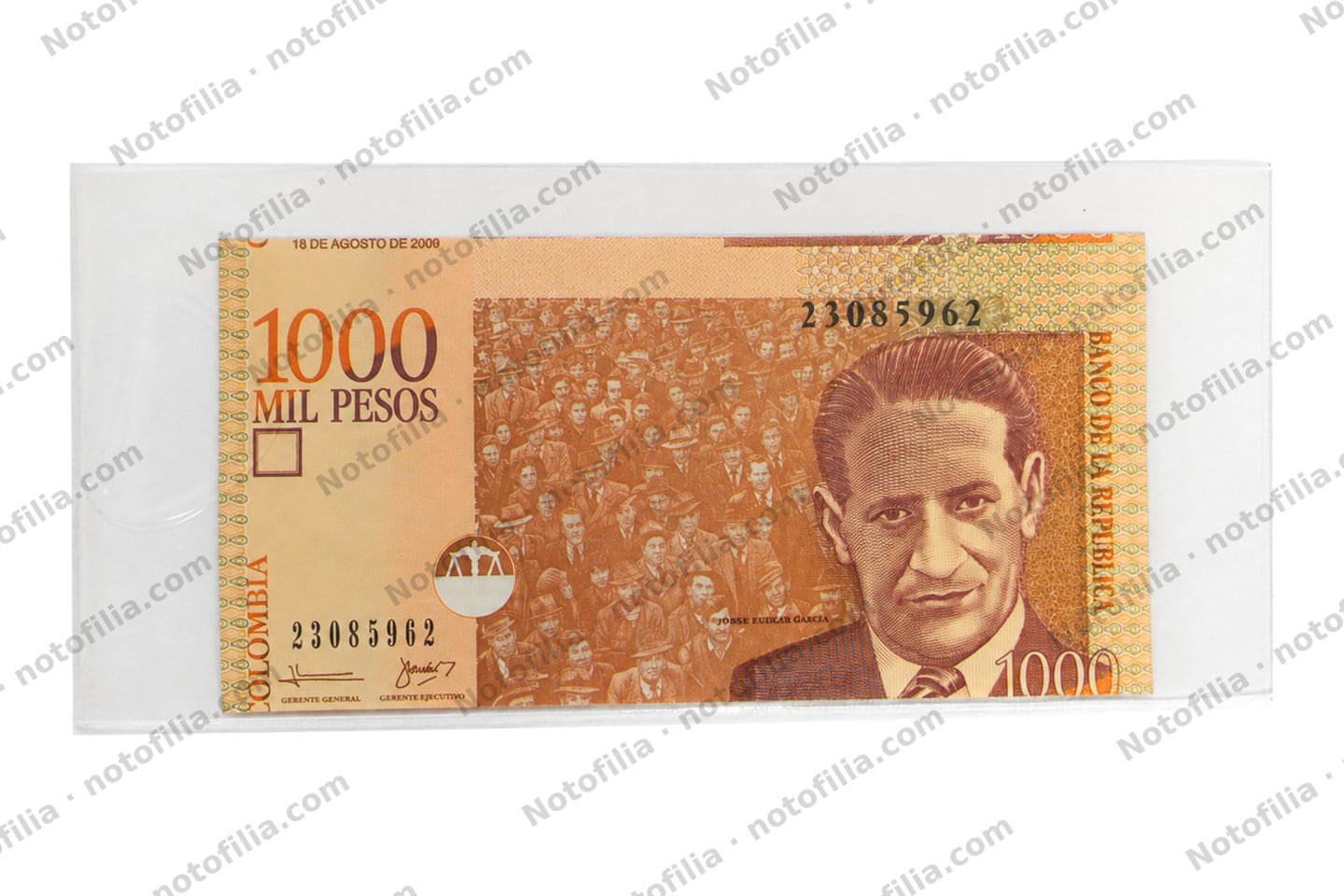
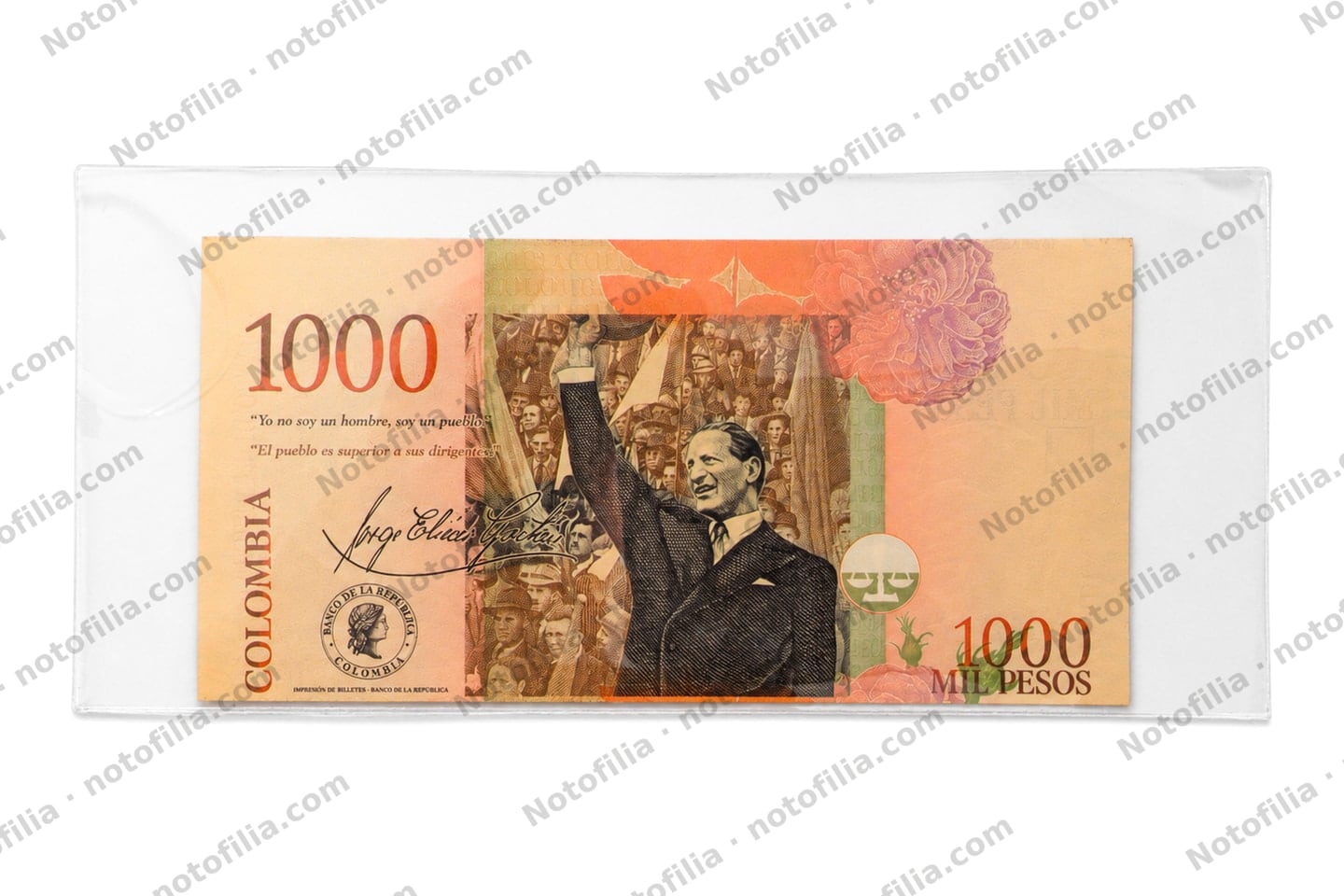
A Gaitán one-thousand-peso note, Pick 456 / TBB B986: date 18 August 2008 and serial 23085962, with a vertical cutting error that leaves the date on the upper-left edge — where it should not be — and crops the foot under the signatures. This record gathers the face and back of the same unslabbed note, in a sleeve.
Catalog facts
- Pick reference
- P# 456 / TBB B986
- Serial number
- 23085962
- Signatures
- José Darío Uribe Escobar (gerente general) and Gerardo Hernández Correa (gerente ejecutivo)
- Condition
- Unslabbed · in a sleeve · apparently uncirculated · off-center cutting error
- Printage
- Imprenta de Billetes, Banco de la República, Bogotá. Date read on the face, shifted to the upper-left edge by the cutting error: 18 August 2008. Published size 130 × 65 mm; eight digits, no series letter; both serials on the face. González White 2019 numbers the reduced dates BG# 439-r (pp. 111–112) and lists, for 2008, 27 and 28 August (439-r/10 and 439-r/11); 18 August is published as 2009 (439-r/12). The Bank Note Museum marks 27.08.2008 as 456j, 28.08.2008 as 456k, and 18.08.2009 as 456l: there is no Pick letter for an 18.08.2008. Numista groups the type under N# 205282 and assigns the JDUE / GHC pair to those three dates. BanRep’s 2008 production of 1,000-peso notes is 280.4 million pieces: that is every note of that face value that year, not the printage of this date or this error. No printage is published here.
Face
Back
The note
The Jorge Eliécer Gaitán one-thousand in the reduced 130 × 65 mm format is Pick 456 (2005–2016) / TBB B986, printed by the Imprenta de Billetes. González White numbers the reduced dates BG# 439-r. On the face of this piece the line “18 DE AGOSTO DE 2008” is read not under the signatures but in a strip along the upper-left edge: the factory cut shifted the design downward and captured the lower margin of the note printed above it on the sheet. The signatures are those of José Darío Uribe Escobar, general manager from January 2005, and Gerardo Hernández Correa, executive manager: the pair Numista assigns to the 2008 dates and to 18.08.2009, before the change to José Tolosa. Serial 23085962 appears twice on the face, in black, at upper right and lower left; it is not a low serial and not a collector pattern (radar, binary, solid, or ladder). The face, in orange and ochre, shows Gaitán at right and, at centre, the crowd as seen from Medellín’s Hotel Nutibara; at left, the scales registration device and the 1000. The back shows him waving his hat, with the quotations “Yo no soy un hombre, soy un pueblo” and “El pueblo es superior a sus dirigentes,” the Liberty seal, and the printer’s imprint. The same shift leaves on the back’s upper edge a strip from the neighbouring note’s foot — the type date “BOGOTÁ, 1.º DE NOVIEMBRE DE 2005” lives on the back of this family, distinct from the face plate date — and crops the lower margin. It is not a butterfly: it keeps no sheet-margin flap and no color bars. It is an off-center cut, a guillotine maculature. It should not be confused with the large 140 × 70 mm one-thousand (Pick 450), with that family’s 16.08.2000 cut (serial 693949988), with the catalogued dates 27.08.2008 (456j) and 28.08.2008 (456k), with 18.08.2009 (456l), or with this case’s 10.06.2011 butterfly (serial 11508701). This record gathers both sides of the same unslabbed note, in a sleeve.
The bank
Jorge Eliécer Gaitán (1903–1948) has occupied the Banco de la República one-thousand since the first date, 7 August 2001, put into circulation in 2002 at 140 × 70 mm. In 2005–2006 the bank cut the format to 130 × 65 mm, renewed the watermark, and kept printing at the Imprenta de Billetes. The face takes the crowd from a balcony of the Hotel Nutibara; the back, the candidate’s greeting of 23 September 1945. González White notes that the reduced type circulated from 17 November 2006. The type ran through 2016; no replacements are recorded. This record does not document an ordinary circulating example: it documents a maculature that escaped the cut with the design shifted on the paper.
Scarcity and printage
González White 2019 (BG# 439-r, pp. 111–112) publishes no emisión figure for the August 2008 dates (rows 439-r/10 and 439-r/11 point back to N.D.). It lists 18 August as 2009 (439-r/12), not 2008. The Bank Note Museum describes Pick 456 as the 2005–2016 130 × 65 mm type and assigns no letter to an 18.08.2008. Numista groups the design under N# 205282; the frequencies it marks for 27.08.2008, 28.08.2008, and 18.08.2009 are for those ordinary dates, not for maculatures. BanRep’s annual production table assigns 280.4 million pieces to every 1,000-peso note of 2008: that is not the printage of one date, signature pair, or cutting error. An off-center cut that carries the date to the opposite edge is a showcase piece; this record does not invent a population for that error.
Population
A PMG or PCGS census for serial 23085962 has not been independently verified. The note is shown in a sleeve, apparently uncirculated, unslabbed. The error is a production fault, not a grading certificate.
Sources
- Bank Note Museum — Colombia P-456, 1,000 pesos (2005–2016) (opens in a new tab)
Reduced type, Imprenta de Billetes; Gaitán on face and back. The catalogue marks 456j = 27.08.2008, 456k = 28.08.2008, and 456l = 18.08.2009. This piece carries 18.08.2008 on the edge; no Pick letter is assigned here.
- Numista — Colombia 1,000 pesos (reduced format), N# 205282 (opens in a new tab)
2005–2016 type, 130 × 65 mm; signatures JDUE and GHC on the 2008 dates and on 18.08.2009. Price columns are not published here. The 18.08.2008 date has no row of its own on that table.
- Banco de la República — Banknote and coin production and circulation (opens in a new tab)
2008 production of 1,000-peso notes: 280.4 million pieces (the denomination total for that year, not one Pick date or error). The Tesorería delivery table begins in 2010.