Published
How Colombian banknotes are valued
Notofilia does not publish price lists or “what a serial is worth.” Colombian banknotes are discussed by type, relative rarity, documented condition, certified population when it exists, and the context of where pieces sell. This guide sets out that method. Nothing in this collection is for sale. The object is unique: the serial number is.
Grading, rarity, and certified population: a method for discussing value without inventing a price.
- Reviewed by
- Yezid Acosta
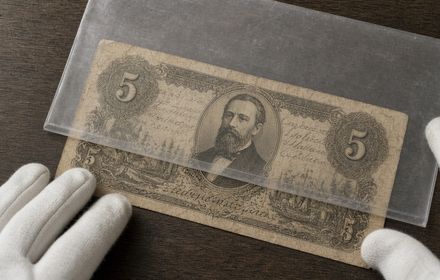
Notofilia does not publish price lists or “what a serial is worth.” Colombian banknotes are discussed by type, relative rarity, documented condition, certified population when it exists, and the context of where pieces sell. This guide sets out that method. Nothing in this collection is for sale.
How much is a Colombian banknote worth?
Worth, here, is a method: the type (Pick or BG#), the documented grade, whether it is certified, the population the grading service publishes, and the sale venue. Banco de la República (opens in a new tab) production tables measure print runs by denomination and year, not the price of a serial. PMG (opens in a new tab) population reports are cited only when they exist for that certificate. Auction archives are comparables; this guide publishes no prices and no estimates.
| Factor | What is checked | Public source |
|---|---|---|
| Type and rarity | Pick or BG#, denomination, and the print run published by denomination and year. | Production and circulation, Banco de la República (opens in a new tab) |
| Conservation grade | The grade printed on the holder label, or catalogue language when the note is not certified. | PMG and PCGS Banknote, glossary |
| Third-party certification | The service that encapsulated the piece and the certificate number, copied from the label. | Grading-companies guide |
| Known population | That service’s population report, only when it exists for the certificate. | PMG population report (opens in a new tab) |
| Auction venue | The house or archive that published the result. The result is not copied here as a price. | Editorial policy |
The object is unique: the serial number is its identity. Two examples of the same Pick and date are still two pieces. Confusing type with object is the costliest error in Colombian notaphily.
1. The grade, not a kitchen opinion
If the piece is slabbed, the grade is the one on the label: PMG or PCGS Banknote, NGC, or another named service. A slab is not reinterpreted. EPQ, PPQ, Star, or Details are copied from the holder. The grading-companies guide explains those houses; this page does not replace it.
If there is no holder, condition is described in catalogue language — uncirculated, details, visible folds — without inventing a Sheldon number. A “basement slab” is not PMG.
2. Type rarity and example rarity
Type rarity (how many were printed, how many survive as a class) is not serial rarity. Banco de la República production tables document print runs when the figure is an issue total, not a Pick-level tirada invented from a denomination-year. González White (7th ed., 2019) orders BanRep types by BG#; Hernández covers paper before 1923. Neither catalogue is republished here in price columns or plates.
Example rarity shows in the serial: a binary radar such as the 2008 2,000 pesos, serial 10000001, a replacement such as the 1979 5 pesos oro, serial 00141180, or a star such as serials 00113227 and 00249902 on the 1994 Emberá 10,000 pesos. The fancy-serial checker names those patterns only when they match a published object.
3. Certified population, with a source
A population report is cited only when PMG, PCGS, or another service publishes it for that certificate. If there is no figure, none is estimated. “Seldom seen” is not a census. The record for the 1983 2,000 pesos oro shows how a De La Rue BanRep type is documented without inventing a Pick print run.
4. Where it sells (no price)
Market context is the channel, not the figure: auction houses, fairs, private sale, grading services. A confirmed hammer is distinguished from an asking price. If there is no public source, the figure is not published. Heritage and other auction archives are comparables, not holdings: they are not imported as records and realized prices are not republished.
To compare the paper with a known type, use photo Identify and the counterfeit-note checklist. Neither tool authenticates at a distance or prices a piece.
5. How Notofilia corrects
The editorial policy uses the same test: no invented prices, two objects are not merged because they share Pick, and a serial error is corrected on the existing record. If you find a slip, write through Contact.
To value, on this site, is to describe the object with sources. A price, when it exists, will come from a cited hammer or asking price — never from this guide.