Colombia · Banco de la República · Replacement
5 pesos oro note, 1980
5 pesos oro · replacement · 1980
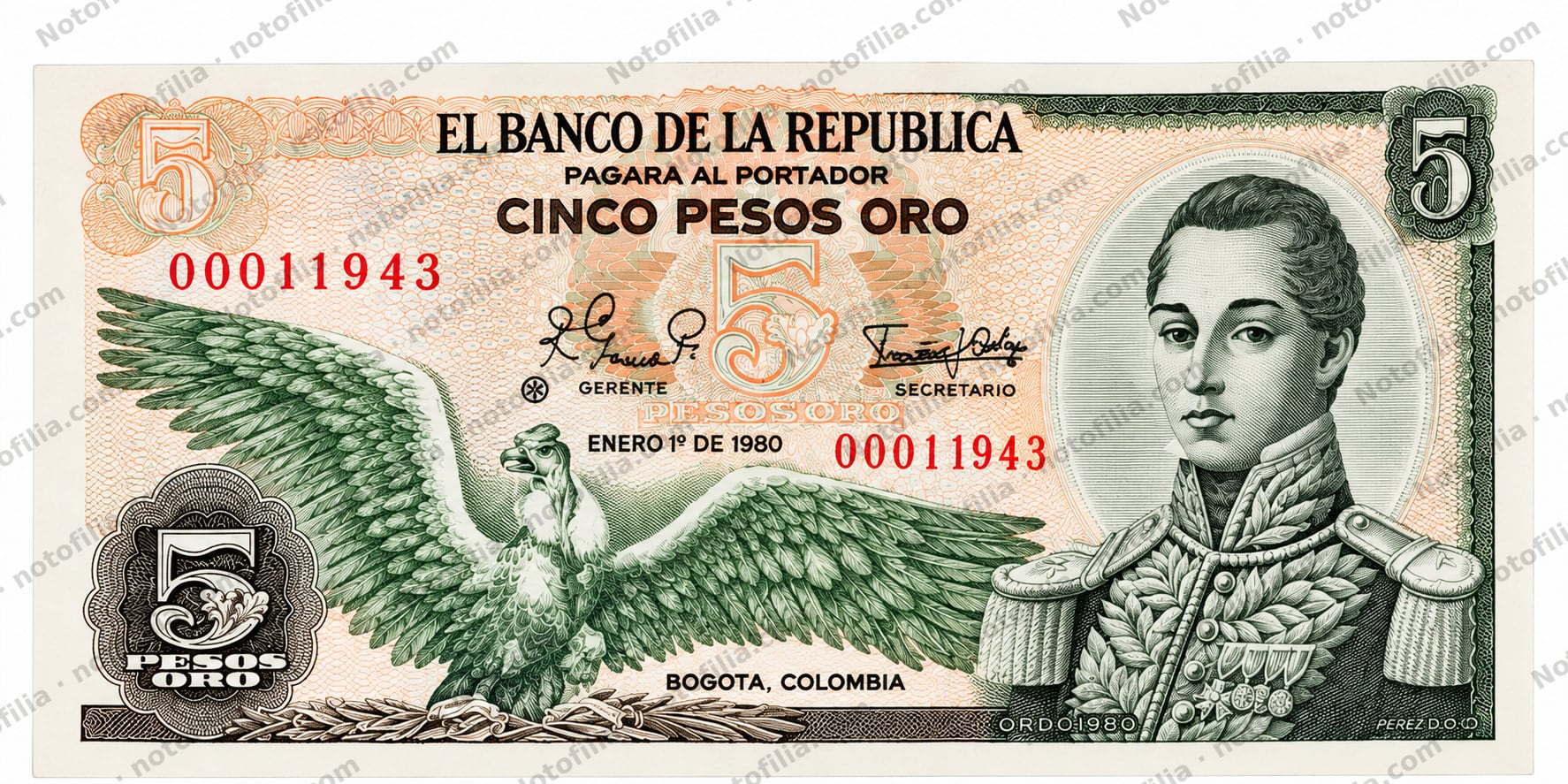
A replacement five-peso oro dated 1 January 1980: Pick 406f / Hernández 158. Serial 00011943. The asterisk on the face, between GERENTE and SECRETARIO, identifies the variety. This record gathers the face and back of the same unslabbed note.
Catalog facts
- Pick reference
- P# 406f · Hernández 158
- Serial number
- 00011943
- Signatures
- Rafael Gama Quijano (gerente) and Francisco José Ortega (secretario)
- Condition
- Unslabbed
- Printage
- Imprenta de Billetes, Bogotá. Banco de la República circulation issue; date on the note 1 January 1980. Eight digits, no series letter. This piece is the replacement variety: Hernández (8th ed., 2023) numbers it Cód. 158 — Numista concurs Hernández 158, distinct from Cód. 157 of the circulating note of the same date (P# 406f / TBB B949p). The diagnostic on this holding is the asterisk on the face, between the signatures, beside the title GERENTE. Annex 2 gives the 1 January 1980 asterisk interval as 00000004–00021090; serial 00011943 sits in that interval. González White 2019 (p. 60) lists a Reposición asterisco band 00.000.001–00.021.090, the same 21090 endpoint; 00.011.943 sits in it. The spread’s OCR jumbles BG# against dates: no guessed BG# is published here. The ordinary emisión of that date, 50,000,000 notes and serials 50,000,001–100,000,000, does not include this number. Published size: 140 × 70 mm. The Bank Note Museum groups type 406f under 01.10.1978, 01.04.1979, 01.01.1980, and 01.01.1981, without a security thread, and does not split the replacement. BanRep’s 1980 table records 49.5 million 5-peso notes — a denomination-year total, not this replacement’s printage. This record does not invent a printage or replace Hernández’s interval with that total.
Face
Back
The note
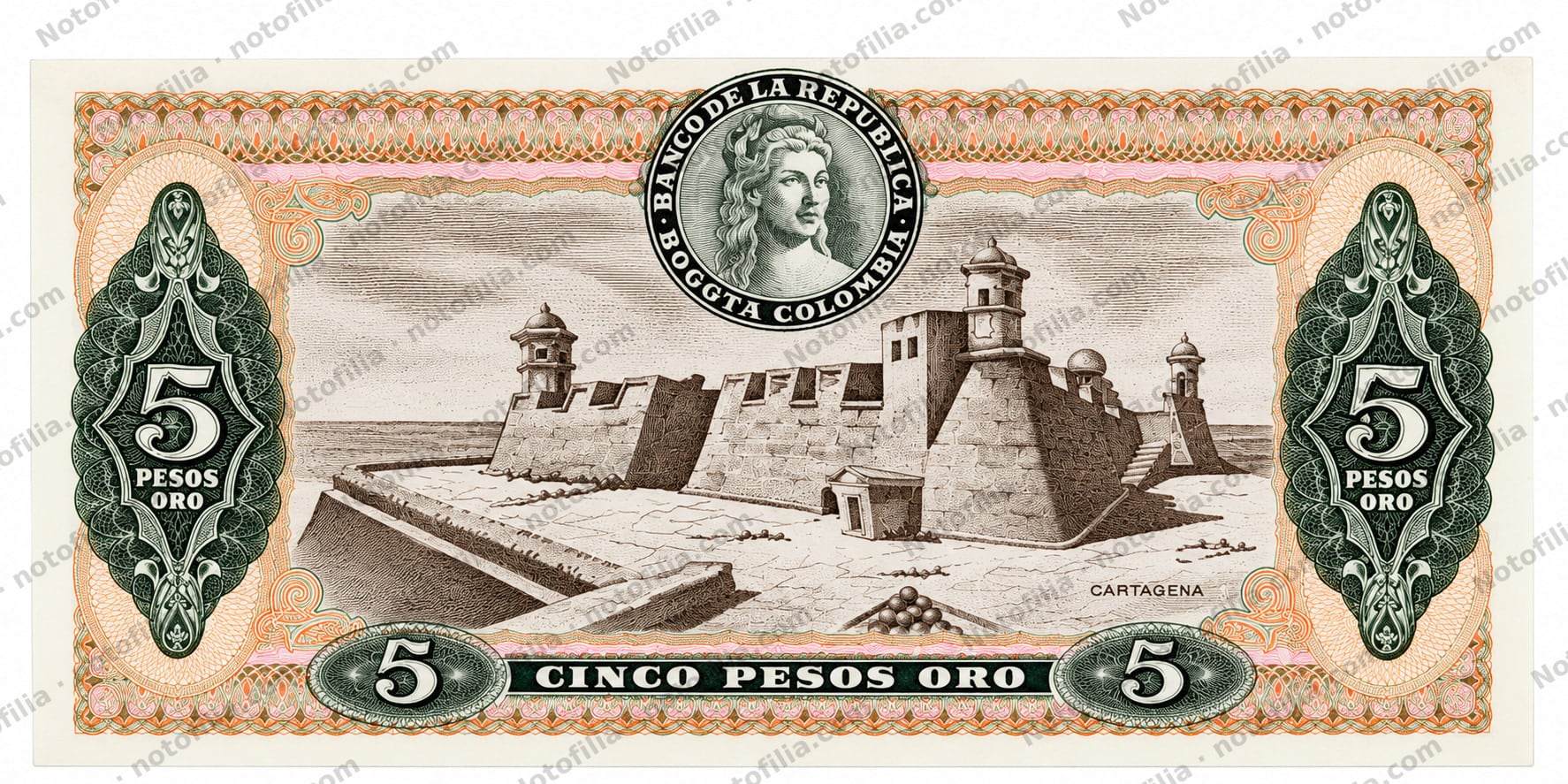
The Banco de la República ordered this five-peso oro of the Pick 406 family (1961–1981) from its own Imprenta de Billetes, opened in Bogotá on 23 October 1959. The face, green and brown on a multicolour underprint, carries an Andean condor with spread wings at left and José María Córdova’s portrait at right — the paper reads “CORDOBA,” the spelling González White notes on the type. At center is the promise to pay the bearer five gold pesos. The serials are in red: 00011943, once at upper left and once at lower right. There is no series letter. The printed date is “ENERO 1º DE 1980” over “BOGOTA, COLOMBIA.” The signatures are those of Rafael Gama Quijano (gerente) and Francisco José Ortega (secretario), the pair Numista assigns to the replacement of this date (RGQ, FJO). The replacement diagnostic is not in the serial: it is the asterisk on the face, between the signatures, beside the title GERENTE. Hernández (8th ed., 2023) numbers that row Cód. 158, distinct from circulating Cód. 157 of the same date. Numista labels row 158 “star on reverse”; on this holding the mark is on the face. Annex 2 gives the 1 January 1980 asterisk interval as 00000004–00021090, and 00011943 sits inside it. Pick numbers the ordinary type as 406f (TBB B949p for the circulating date) and does not split the replacement. The back shows the walls of Cartagena — labelled “CARTAGENA” — and the bank’s Liberty seal. English-language catalogs identify Castillo San Felipe de Barajas, the fortress that defended the port from which the Spanish fleets sailed with colonial silver and gold. The Banco’s numismatic-collection booklet places that view of the walls on the 5-peso note from 1961 to 1981. The back imprint reads “IMPRENTA DE BILLETES - BANCO DE LA REPUBLICA.” González White (p. 60) notes the type without a security thread through #159 and closes the denomination with the 1981 issue, then replaced by coin. Hernández places the last five-peso oro in 1981 and the successor in copper coins. BanRep’s banknote table records 49.5 million 5-peso notes in 1980 and 1.2 million in 1981; from 1982 the column is empty. This 1980 date is one of the last of the paper, the year before that close. Banknote World describes the 1 January 1980 printing with no thread and no watermark. The Bank Note Museum groups 406f without a security thread. Distinct from this case’s 1980 circulating example (serial 94658896, Hernández 157), from the 1 April 1979 replacement (serial 00141180, Hernández 156), from the 20 July 1977 replacement (serial 00120856, Hernández 150), and from the 1960 specimen (Pick 405s). This collection piece is shown unslabbed.
Scarcity and printage
The 1 January 1980 replacement is a recognized variety and substantially scarcer than the ordinary issue of that date (Hernández Cód. 157 / TBB B949p). Numista marks the Hernández 158 row’s frequency at 0% among owners of type N# 206002; that figure is a catalog-population estimate, not an official printage. The same table has a 1 January 1980 row with no Hernández number in the references, described as an asterisk at center left (0.3% frequency). Hernández’s annex 2 gives the asterisk interval 00000004–00021090 for this date; 00011943 sits inside it, which is why this record uses Cód. 158. González White 2019 (p. 60) publishes a Reposición asterisco band 00.000.001–00.021.090, with the same 21090 endpoint; 00.011.943 sits in it. That row gives no numeric emisión. Pick does not list replacements separately. The ordinary emisión of the date, serials 50,000,001–100,000,000, does not include this number. BanRep’s 1980 table records 49.5 million 5-peso notes: that is the year’s total for the face value, not this replacement’s printage. This record does not invent a printage or republish Hernández or Numista price columns.
Population
A PMG or PCGS census for serial 00011943 has not been independently verified. The note is shown unslabbed.
Sources
- Numista — Colombia 5 pesos oro, N# 206002 (opens in a new tab)
01.01.1980 replacement: Hernández 158; signatures RGQ and FJO; Numista labels the row “star on reverse” (0% frequency). On this holding the asterisk is on the face. Another row of the same date, with no Hernández number in the references, is described as an asterisk at center left (0.3% frequency). The circulating date is P# 406f / TBB B949p / Hernández 157, without a thread. Printer: Imprenta de Billetes, Bogotá. 140 × 70 mm.
- Bank Note Museum — Colombia P-406, 5 pesos oro (1961–1981) (opens in a new tab)
406f: 01.10.1978, 01.04.1979, 01.01.1980, and 01.01.1981; condor and José María Córdoba on the face; Cartagena on the back; no security thread. Distinct from Pick 405 (bank building, 1960). Does not split the replacement.
- Banco de la República — Banknote and coin production and circulation (opens in a new tab)
5-peso banknote production: 49.5 million in 1980 and 1.2 million in 1981; from 1982 the column is empty. That is each year’s total for the face value, not the printage of 1 January 1980 or of this replacement.
- Pedro Pablo Hernández — Coins and Banknotes of Colombia (Numista L100183) (opens in a new tab)
8th ed. 2023 (Numista L100183). Cód. 157: circulating 1 January 1980; Cód. 158: replacement of the same date. Annex 2 gives the asterisk interval 00000004–00021090, which includes 00011943. The last five-peso oro appears in 1981 and is then replaced by copper coins. Numista cites Hernández 158 for that row. Price columns and plates are not republished.
- Banknote World — Colombia 5 pesos oro 1980, P-406f.3 (opens in a new tab)
1.1.1980; Imprenta de Billetes; 140 × 70 mm; no thread and no watermark; signatures Rafael Gama Quijano and Francisco José Ortega; Castillo San Felipe de Barajas in Cartagena on the back.
- Banrepcultural — Casa de Moneda Museum (opens in a new tab)
The 5-peso note carried the view of the walls of Cartagena de Indias from 1961 to 1981. 140 × 70 mm.
Related pieces
Other records from the same issuer or era in this case.