Published
Fidel Castro on the Gaitán 1,000-peso note
In April 2012 the public thought it saw a young Fidel on the Gaitán one-thousand. The designer said no. The 1948 meeting happened. The portrait did not.
- Reviewed by
- Yezid Acosta
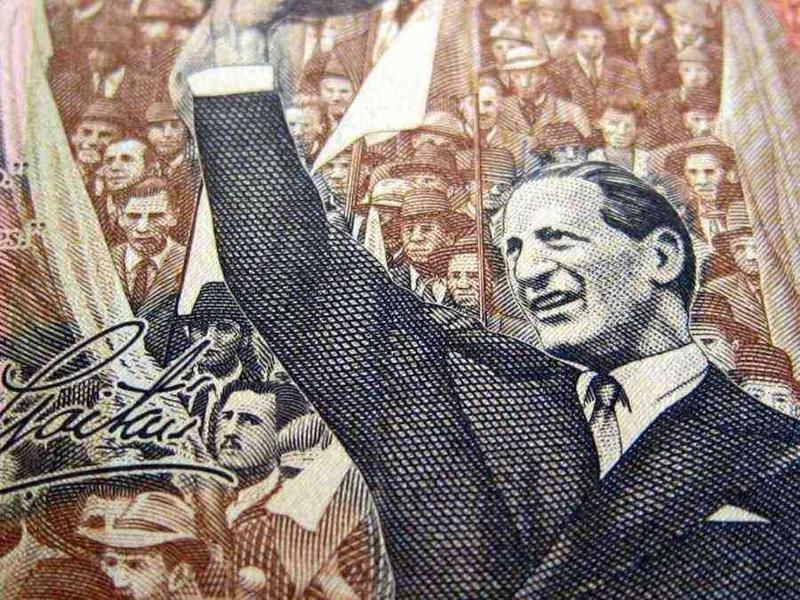
In the first days of April 2012 the Jorge Eliécer Gaitán one-thousand stopped being ordinary change. The Colombian and international press pointed to a face in the crowd — a sharp profile, no beard, a short moustache — and read it as a young Fidel Castro. The note had been in pockets for years. The 1948 meeting is documented. The portrait is not.
This note is not a collection record. The Gaitán pieces that are in the case are cutting maculatures: the 16 August 2000 note and the 10 June 2011 butterfly. What follows is the type, the week in 2012, and the sources that can be opened.
The 1948 record and the 2012 week
Two timelines, not a plate. The meeting is documented. The portrait is not.
Bogotá, March–April 1948
- 31 March. Castro reaches Bogotá for a student congress beside the Ninth International Conference of American States.
- 7 April. A meeting with Jorge Eliécer Gaitán.
- 9 April, 1:05 p.m. Juan Roa Sierra shoots Gaitán as he leaves his office. Castro misses the afternoon appointment. He takes part in the Bogotazo.
Colombia, 2004–2012
- 2004. The bank approves José Antonio Suárez Londoño’s design.
- 17 November 2006. The reduced 65 × 130 mm format enters circulation, the same drawing as 3 March 2005.
- 2–4 April 2012. The press points to a face in the crowd. Uribe says it is possible. Suárez says no.
- October 2012. The paper one-thousand gives way to a coin. The sources checked here do not present that as a purge of the face.
BanRep
On 2 April 2012 José Darío Uribe said on La W Radio it was possible that Castro was on the one-thousand. He had been looking for the artist for days.
Suárez
The next day the illustrator called it nonsense: he did not paint Castro. It was a man in the crowd whose lines happened to look like him.
The plate
The freehand drawing did not reach the plate intact. When the crowd became security tints, the contrasts changed. González White marks the large type IBBR.
April 2012
On 2 April, on La W Radio (opens in a new tab), Banco de la República general manager José Darío Uribe said it was possible that Castro was on the one-thousand. He had been looking for the artist for days. He also said the winner of the contest had been left free, and that it was not for the bank to recut the sketch years later.
The next day José Antonio Suárez Londoño, the Medellín illustrator who won the 2004 contest, cut both readings. In El Tiempo, on Caracol (opens in a new tab), and in Colombia Reports (opens in a new tab) he called it nonsense: he did not paint Castro. It was a man in the crowd whose lines happened to look like him. Over the years people had also seen Angelina Jolie, the Pope, the Beatles, and his grandmother in that same mass.
Suárez added a technical point that the press that week recorded, among others Infobae (opens in a new tab): the freehand drawing did not reach the plate intact. When the crowd became security tints, the contrasts changed. This house’s catalogue does not turn that interview into a printer’s imprint. González White 2019 marks the large type IBBR — the Banco de la República’s own note works — and 140 × 70 mm. Bank Note News, on 10 April, closed the case in a line: the one-thousand does not depict Fidel Castro (opens in a new tab).
The Gaitán one-thousand
The Liberal leader (1903–1948) has occupied the one-thousand since the first date the Colombian catalogue lists: 7 August 2001, put into circulation in 2002, 140 × 70 mm. González White 2019 numbers it BG# 439 (pp. 110–111) and opens with 439-a. The Bank Note Museum marks Pick 450 for that large format. In 1996 the paper one-thousand had given way to a coin; counterfeiting of those pieces, dated 1996, 1997, and 1998, sent the issuer back to paper. González White writes that on the same page. It does not come from Wikipedia.
The Banco de la República (opens in a new tab) describes the edition that entered circulation on 17 November 2006, dated 1 November 2005: the same design as the 3 March 2005 edition, now at 65 × 130 mm. That page is not the origin of the type. 3 March 2005 is a late large-format date, not the first.
On the records in this case the obverse has Gaitán at right and, at centre, the crowd as seen from a balcony of Medellín’s Hotel Nutibara — a drawing González White ties to a photograph by Sady González. The reverse shows him waving his hat on 23 September 1945, the day of his proclamation as a candidate, with the quotations “Yo no soy un hombre, soy un pueblo” and “El pueblo es superior a sus dirigentes.” The 2012 press put the figure “behind Gaitán” and often called that the reverse, and 1948. González White, on 3 April 2012, pointed to the face in the bank’s presentation booklet (page 12) and called a Castro on the 1945 greeting anachronistic: Castro was not in Bogotá that year. This page does not turn the wire-service “reverse” into a catalogue fact.
| Fact | What the source says |
|---|---|
| First catalogued date | 7 August 2001 (BG# 439-a); circulation 2002; 140 × 70 mm; IBBR |
| Reduced format | BanRep: edition 1 November 2005, circulation 17 November 2006; 65 × 130 mm. Same design as 3 March 2005 |
| Pick / TBB | Large format Pick 450 / TBB B985; reduced Pick 456 / TBB B986 in Bank Note News |
| Watermark and thread | BanRep: Gaitán’s face at transmitted light; thread “BR COLOMBIA” |
| Register and relief | BanRep: scales at backlight; BRC letters on the right shoulder |
| UV light | BanRep: seeds and motor-car in green, tricolour fibres, blue thread; on the back, “COLOMBIA” in green |
| 439-a emisión | 98,050,000 (González White 2019). Not the printage of the type, and not of the disputed figure |
April 1948
The visual claim lasted because the archive helps. Fidel Castro, 21, reached Bogotá in late March 1948 for a student congress beside the Ninth International Conference of American States. González White, on 3 April 2012, summarises the itinerary also told in Arturo Alape’s interview (opens in a new tab): arrival on 31 March; a meeting with Gaitán on 7 April; another appointment for the afternoon of the 9th. The hour of that second appointment is not the same in every 2012 note. This page does not pick one.
On 9 April, at 1:05 p.m., Juan Roa Sierra shot Gaitán as he left his office. Castro missed the appointment. He took part in the Bogotazo. That is enough to see why, sixty-four years later, a moustache without a beard under Gaitán’s arm was read in only one way. Infobae (opens in a new tab), on 9 April 2024, tied the two stories again. It does not add a portrait.
Why then, and not before
The design was approved in 2004. The reduced format had circulated since November 2006. The week of 2–4 April 2012 sat on the countdown to the Sixth Summit of the Americas in Cartagena (9–15 April) and on the argument over Cuba’s exclusion. On 2 April, the same day as Uribe on the radio, Rafael Correa said he would not go to Cartagena. The anniversary of the assassination fell on the 9th.
In that same week the bank said the paper one-thousand would stop being printed and, from October 2012, give way to a 1,000-peso coin. The coincidence fed the reading that the withdrawal was a purge of the face. The sources checked here have no communiqué that says so. The editorial policy asks that that suspicion not be turned into a catalogue fact.
No price on this page
The controversy and the withdrawal notice made people keep one-thousand-peso notes. That is not a hammer. No asking price is copied, and no 2012 dollar conversion is published. González White’s 3 April 2012 essay speaks of some 2.3 billion notes over ten years: that is an essay figure, not BanRep’s annual table. The production tables add every 1,000-peso note of the year. The 2019 catalogue’s estimate columns are not republished here.
A man in the crowd is not a portrait. Sharing the year 1948 does not turn a security line into Fidel Castro. More faces on Colombian paper are in the guide to figures on Colombian banknotes and in the Colombian banknotes case.
Primary sources
- Banco de la República — 1,000-peso note, Jorge Eliécer Gaitán commemorative (opens in a new tab)
- Banco de la República — commemorative edition PDF (node 7806) (opens in a new tab)
- La W Radio, 2 April 2012 — Uribe: Castro may be on the one-thousand (opens in a new tab)
- Caracol, 3 April 2012 — Suárez: he did not paint Fidel Castro (opens in a new tab)
- Colombia Reports, 3 April 2012 — the designer denies the portrait (opens in a new tab)
- Infobae, 3 April 2012 — the controversy and the drawing-to-plate step (opens in a new tab)
- Bank Note News, 10 April 2012 — the one-thousand does not depict Castro (opens in a new tab)
- Infobae, 9 April 2024 — the Bogotazo and the one-thousand legend (opens in a new tab)
- Territorial Masquerades — 1000 pesos and Fidel Castro (opens in a new tab)
- Pulzo — Fidel Castro on the $1,000 note (opens in a new tab)
- Ámbito — Does Fidel appear on the Colombian note? (opens in a new tab)
- Arturo Alape — Details of the Bogotazo (interview) (opens in a new tab)