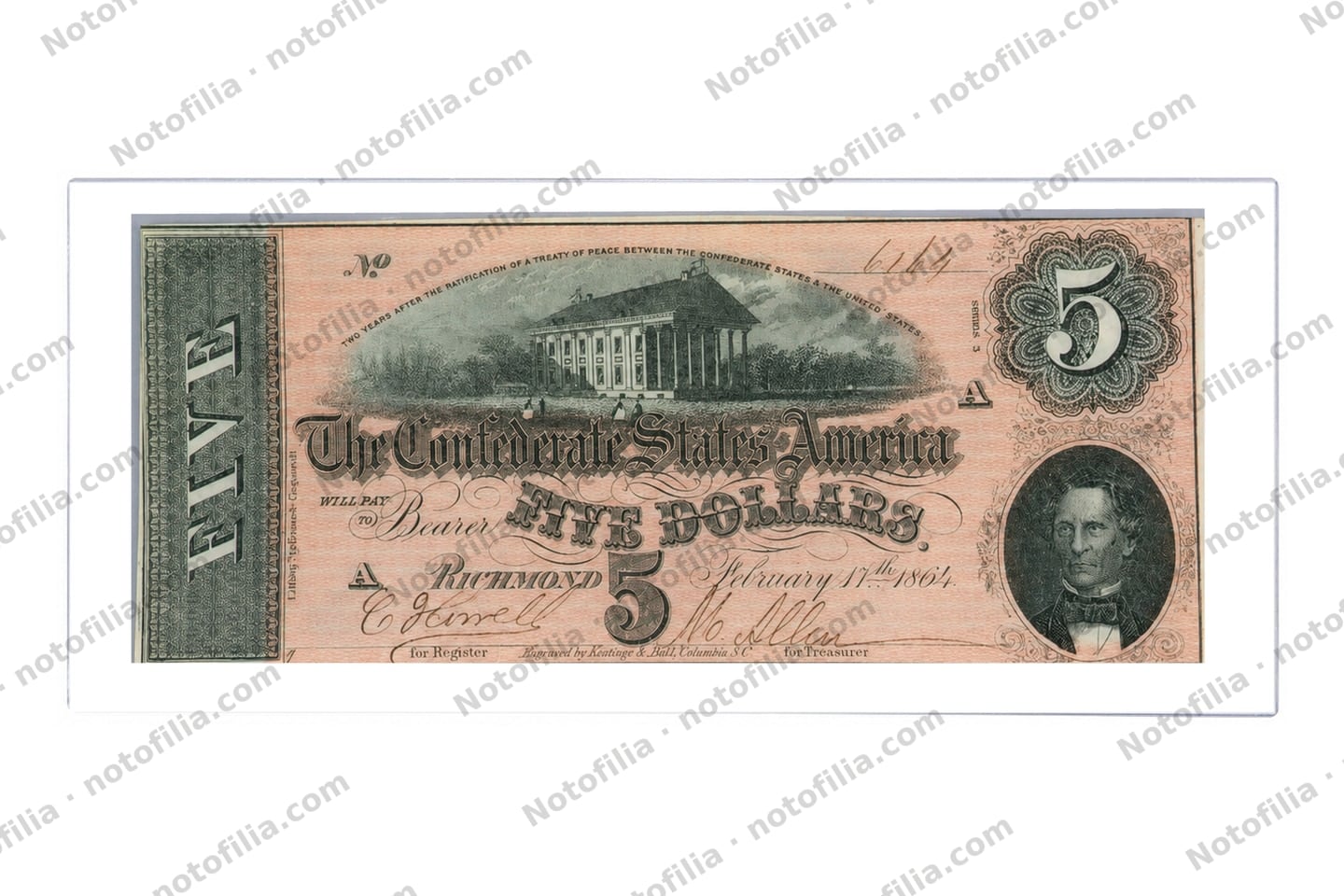
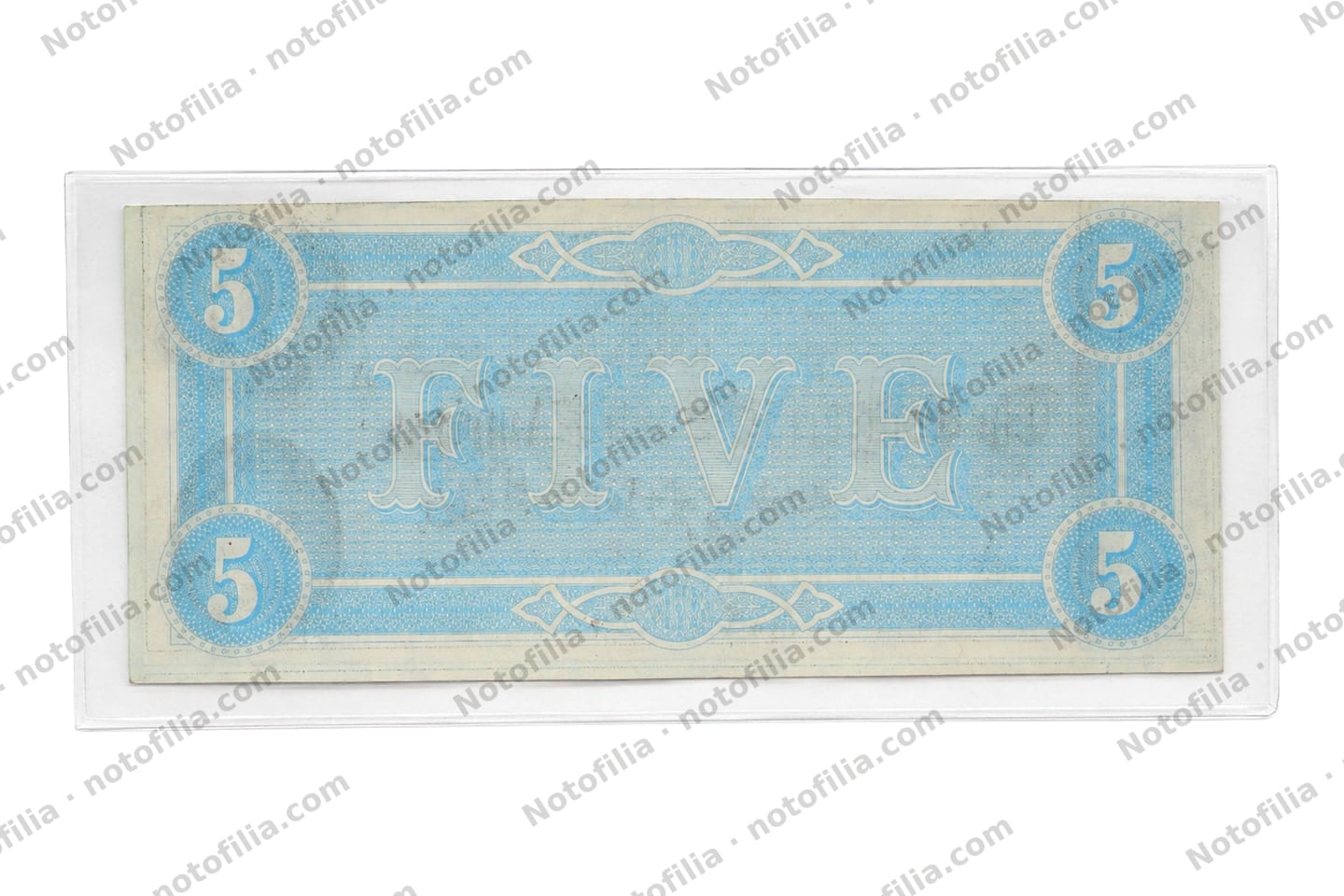
Pink face with the Virginia State Capitol and C. G. Memminger; blue back with FIVE. Richmond, 17 February 1864. Serial 6164, 3rd series, plate A.
Catalog facts
- Pick reference
- P#67 · T-69 · N#226718
- Serial number
- 6164 · 3 · A
- Signatures
- C. Howell (“for Register”) and M. Allen (“for Treasurer”)
- Condition
- Circulated, unslabbed (private collection)
- Printage
- Keatinge & Ball, Columbia, S.C.; lithographed by Evans & Cogswell. Wikipedia puts T-69 at about 5,526,100 notes. The act of 17 February 1864 authorized $200 million across all denominations.
Face
Back
The note
The $5 of 17 February 1864 (Pick 67, Criswell and Fricke T-69, Numista N#226718) is the five of the Confederate Treasury’s last issue. The black face on a pink tint carries the Virginia State Capitol in Richmond — pediment and colonnade among trees — at center and, at lower right, an oval portrait of Christopher G. Memminger, first secretary of the Treasury. The upper arc reads the redemption clause: “TWO YEARS AFTER THE RATIFICATION OF A TREATY OF PEACE BETWEEN THE CONFEDERATE STATES & THE UNITED STATES.” Beneath the vignette, “The Confederate States of America” promises to pay FIVE DOLLARS to the bearer; the printed date is “Richmond, February 17th 1864.” FIVE runs vertically at left; a scalloped 5 sits at upper right. Manuscript serial 6164 sits in dark ink beside the 5; the piece is 3rd series, plate A. The signatures are C. Howell (“for Register”) and M. Allen (“for Treasurer”). The engraving imprint is Keatinge & Ball, Columbia, S.C.; the Bank Note Museum and the Smithsonian also note Evans & Cogswell’s lithography. The blue back shows FIVE on a guilloche field and a 5 in each corner. The collection note, circulated and unslabbed, is shown in a sleeve.
The issue
The Confederate Treasury opened almost empty. Southern wealth sat in land and enslaved people, not in coin; the Union blockade cut off the cotton exports that might have bought gold. Wikipedia dates the first bills of credit to March–April 1861, at Montgomery, Alabama, before the capital moved to Richmond. Christopher G. Memminger, the portrait on this five, was the first secretary of the Treasury and the man who turned to the press: taxes and bonds covered only a fraction of the war. The grayback was not a redemption in gold. It was a promise to pay if the South won.
Almost all the engravers and bank plates sat in New York and Philadelphia. Wikipedia records the first plates of the National Bank Note Company and of its New Orleans branch, the Southern Bank Note Company, until that route closed. Keatinge & Ball engraved this five in Columbia and Evans & Cogswell lithographed it: the Bank Note Museum and the Smithsonian record both imprints. Hoyer & Ludwig and Archer & Daly covered other denominations, often by lithography, on uneven paper and plates under the blockade. The result was easy to copy. Samuel C. Upham of Philadelphia sold “fac-simile Confederate notes” as souvenirs from 1862; smugglers trimmed the imprint and passed them in the South.
The face of this T-69 is the capital the Confederacy still held: the Virginia State Capitol in Richmond, not the Nashville building that had fallen in 1862. Memminger — the portrait at right — resigned in 1864, the same year as this act. Manuscript signatures by clerks — the Treasury eventually hired as many as two hundred for each office, often women — were the rule on whole-dollar notes; only the 50-cent issue carried printed signatures. Early series promised payment six months after a treaty of peace. The 1864 clause, the one on this note, stretched redemption to two years.
Between 1861 and 1864 there were seven series. Wikipedia puts the authorized total at $1.7 billion and T-69 at about 5,526,100 notes. Unbacked by specie, the grayback sank with the bad news: by the end of 1863 it was worth about six cents in gold; by September 1864, three. The act of 17 February 1864 — the act behind this five — authorized $200 million in new paper and tried to force the exchange of old notes at a discount. It did not restore trust. After Appomattox the paper lost all value as currency. Section 4 of the Fourteenth Amendment holds debts incurred in aid of rebellion illegal and void: neither the United States nor any state may assume them.
Scarcity and printage
Wikipedia puts T-69 at about 5,526,100 notes. It is the most common 1864 five and, with T-67, the entry grayback of many type sets. The Bank Note Museum numbers it P-67 and records Evans & Cogswell with Keatinge & Ball. The market treats circulated examples as common; the keys are high grades, full margins, and the absence of cut cancels. This record does not invent a printage by series or letter.
Population
A PMG or PCGS census for serial 6164 has not been independently verified. The note is shown in a sleeve, circulated, unslabbed.
Sources
- Bank Note Museum — P-67, $5, 17 February 1864 (opens in a new tab)
Richmond Capitol and Christopher G. Memminger; Keatinge & Ball and Evans & Cogswell.
- Numista — 5 Dollars, Confederate States (N#226718) (opens in a new tab)
Richmond Capitol and Memminger; Keatinge & Ball; 180 × 80 mm; demonetized.
- Wikipedia — Confederate States dollar (opens in a new tab)
T-69, Keatinge & Ball, about 5,526,100; seven series and $1.7 billion; two-year peace clause.
- Smithsonian NMAAHC — Confederate States of America five dollar bill (opens in a new tab)
Virginia Capitol, two-year peace clause, Keatinge & Ball and Evans & Cogswell; blue back.
- Wikipedia — Samuel C. Upham (opens in a new tab)
Facsimiles sold in Philadelphia from 1862; the imprint was trimmed and the paper circulated in the South.
- Constitution Annotated — Fourteenth Amendment, Section 4 (opens in a new tab)
Neither the United States nor any state shall assume debts incurred in aid of rebellion; such debts are illegal and void.
Related pieces
Other records from the same issuer or era in this case.