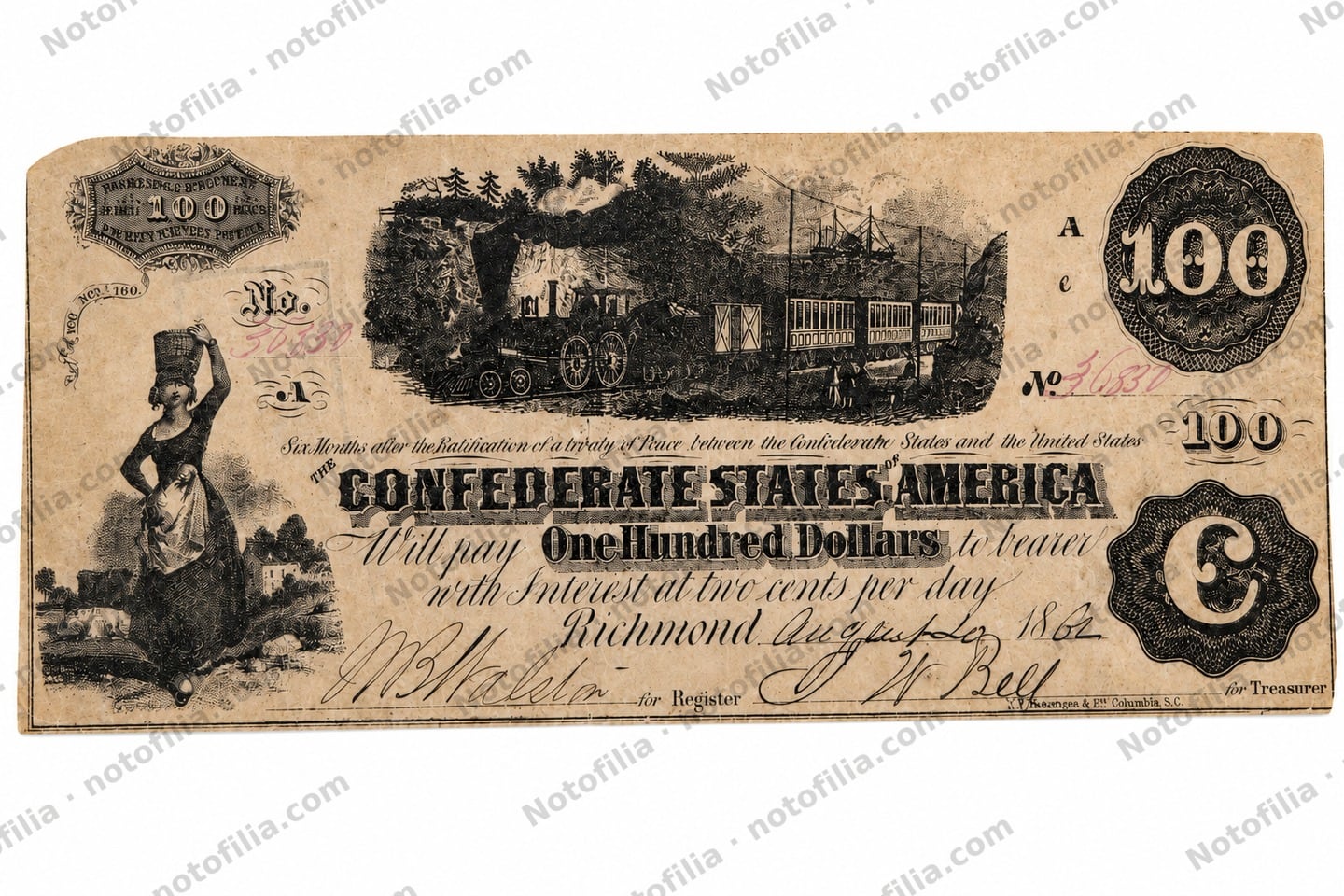
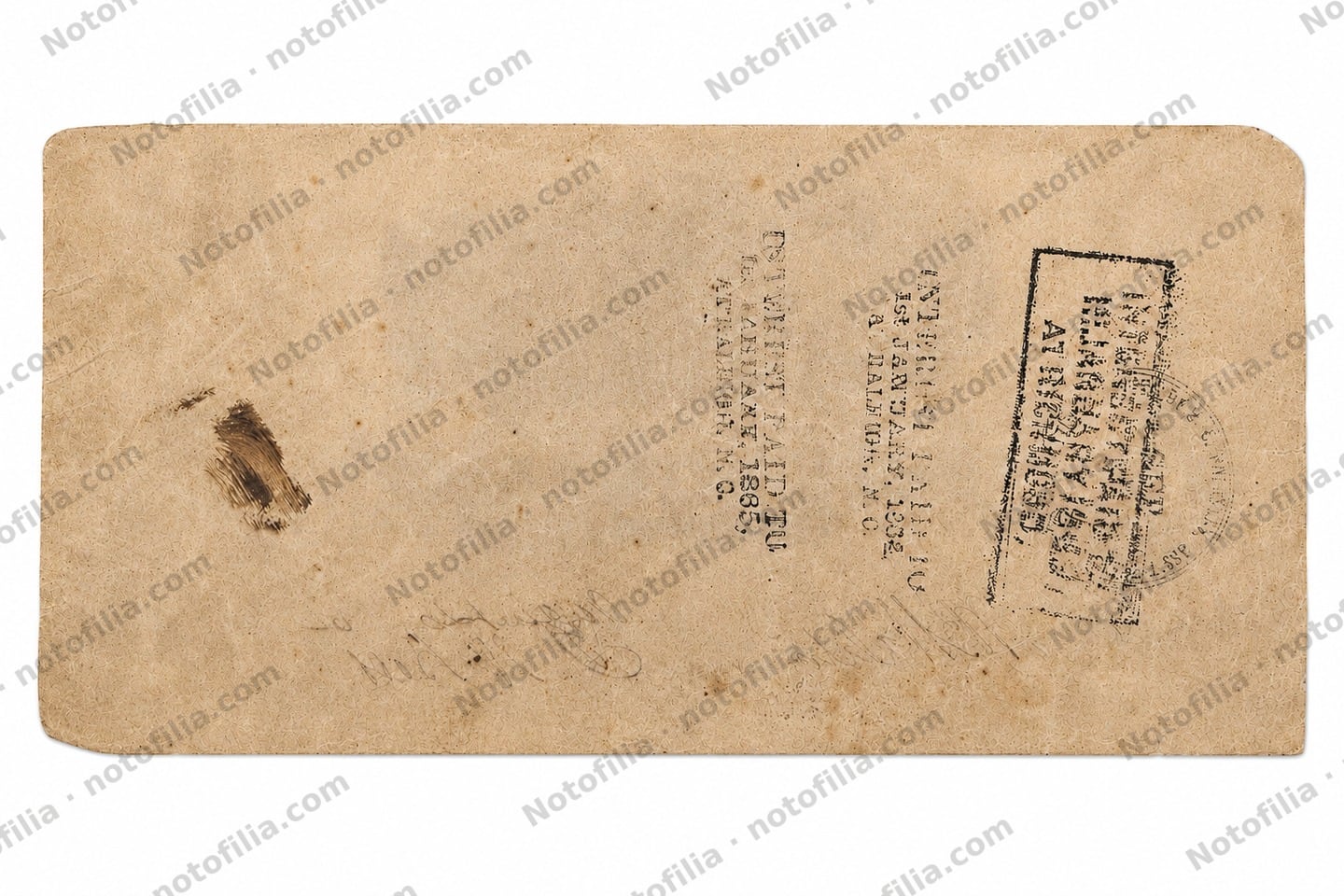
Milkmaid and a diffused-steam locomotive; interest at two cents a day. Richmond, 20 August 1862. Serial 36830, series Ac; back with interest-paid handstamps.
Catalog facts
- Pick reference
- P#44 · T-40 · N#208004
- Serial number
- 36830 · Ac
- Signatures
- M. B. Walston (“for Register”) and J. W. Bell (“for Treasurer”)
- Condition
- Circulated, unslabbed (private collection)
- Printage
- J. T. Paterson & Co., Columbia, S.C. Wikipedia puts the T-40 type —diffused steam— at about 214,400 notes; the figure is by type, without a breakdown by series or plate. The act of 17 April 1862, amended 23 September 1862, authorized $170 million in $1 and $2 notes and in these hundreds bearing interest at two cents a day.
Face
Back
The note
The $100 of 1862 (Pick 44, Criswell and Fricke T-40, Numista N#208004, a record shared with the straight-steam T-39/P-43) is the diffused-steam variety of the Confederate Treasury’s Fourth Series “Train Notes.” The black face on light paper carries a milkmaid with a basket on her head at left and, at center, a locomotive with its passenger train; the diffused smoke over the boiler is what sets the type apart from the straight-steam T-39. At right, two scalloped “100” counters sit on guilloche fields, with the letters A and c beside them — the “Series Ac” Numista assigns to the run printed by J. T. Paterson & Co. Beneath the vignette, “The Confederate States of America” promises to pay ONE HUNDRED DOLLARS to the bearer with interest at two cents a day — 7.3 percent a year; the manuscript date is “Richmond, August 20th 1862.” The manuscript serial in red ink, 36830, repeats beneath the ornamented “No.” at left and beside the counter at right. The manuscript signatures, by Treasury clerks, are M. B. Walston (“for Register”) and J. W. Bell (“for Treasurer”); the imprint is J. T. Paterson & Co., Columbia, S.C. The back carries no printed design — the note accrued interest and was brought to a depository to collect it — only ink handstamps: “INTEREST PAID TO 1st JANUARY, 1864, AT RALEIGH, N.C.” and “INTEREST PAID TO 1st JANUARY, 1865, AT RALEIGH, N.C.,” plus a third, boxed stamp overlapping a circular depository seal that is not fully legible in this photograph. The collection note, circulated and unslabbed, is shown in a sleeve.
The issue
The Fourth Series — the act of 17 April 1862, amended 23 September — introduced the first $1 and $2 notes and, at the other end, these interest-bearing hundreds. Unlike the non-interest series of 1861, the Treasury offered 7.3 percent a year here, paid when the bearer presented the note at a depository. The underlying clause stayed the same: payment six months after a treaty of peace between the Confederacy and the United States. Wikipedia documents seven series between 1861 and 1864 totaling $1.7 billion.
Collectors call T-39, T-40, and T-41 the “Train and Hoer notes”: two share the locomotive — straight or diffused steam — and the third swaps the vignette for slaves hoeing and a portrait of John C. Calhoun. The Newman Numismatic Portal records that the Treasury, in Richmond, hand-dated these notes between 9 May 1862 and 8 January 1863; this note’s date, 20 August 1862, falls within the range the SPMC documents for T-40 (9 August 1862 to 16 January 1863). Many of these hundreds were put into circulation by Confederate commissioners or army officers buying supplies in the field, with their own endorsements on the back; this piece carries no such issuer’s signature, only the interest stamps.
Interest was collected once a year, and each payment left a stamp on the back: that is why these notes, unlike the non-interest issues, carry no engraved design on the reverse. This piece records at least two payments at Raleigh, North Carolina — 1 January 1864 and 1 January 1865 — and a third, boxed stamp overlapping a circular depository seal that the photograph does not allow to be read with certainty. The Confederate defeat left both the principal and the accrued interest worthless; Section 4 of the Fourteenth Amendment holds debts incurred in aid of rebellion void.
Scarcity and printage
Wikipedia puts the T-40 — diffused steam, J. T. Paterson & Co. — at about 214,400 notes, a figure Criswell gives by type and does not break down by series or plate letter. It is one of the more attainable Confederate hundreds of the Fourth Series, alongside the straight-steam T-39 (about 284,000) and the hoeing-slaves T-41 (about 670,400). The market draws no premium from the interest stamps; the value keys are condition, margins, and the legibility of signatures and date. This record does not invent a printage by serial or by plate.
Population
A PMG or PCGS census for serial 36830 has not been independently verified. The note is shown in a sleeve, circulated, unslabbed.
Sources
- Bank Note Museum — P-44, $100, diffused steam, 1862 (opens in a new tab)
Milkmaid and diffused-steam locomotive; interest-paid markings on the back; cross-refers to the straight-steam P-43.
- Numista — 100 Dollars, Confederate States (N#208004) (opens in a new tab)
Shared P-43/P-44 record; diffused steam printed by J. T. Patterson & Co. as “Series Ac”; interest-paid stamps on the back.
- Wikipedia — Confederate States dollar (opens in a new tab)
Fourth series, act of 17 April 1862 amended 23 September; T-40, J. T. Patterson & Co., about 214,400 notes.
- Society of Paper Money Collectors — An Overview of Confederate Currency Series and Types (opens in a new tab)
T-40 dated between 9 August 1862 and 16 January 1863; 7.3 percent annual interest; act of 17 April 1862.
- Constitution Annotated — Fourteenth Amendment, Section 4 (opens in a new tab)
Neither the United States nor any state shall assume debts incurred in aid of rebellion; such debts are illegal and void.
Related pieces
Other records from the same issuer or era in this case.