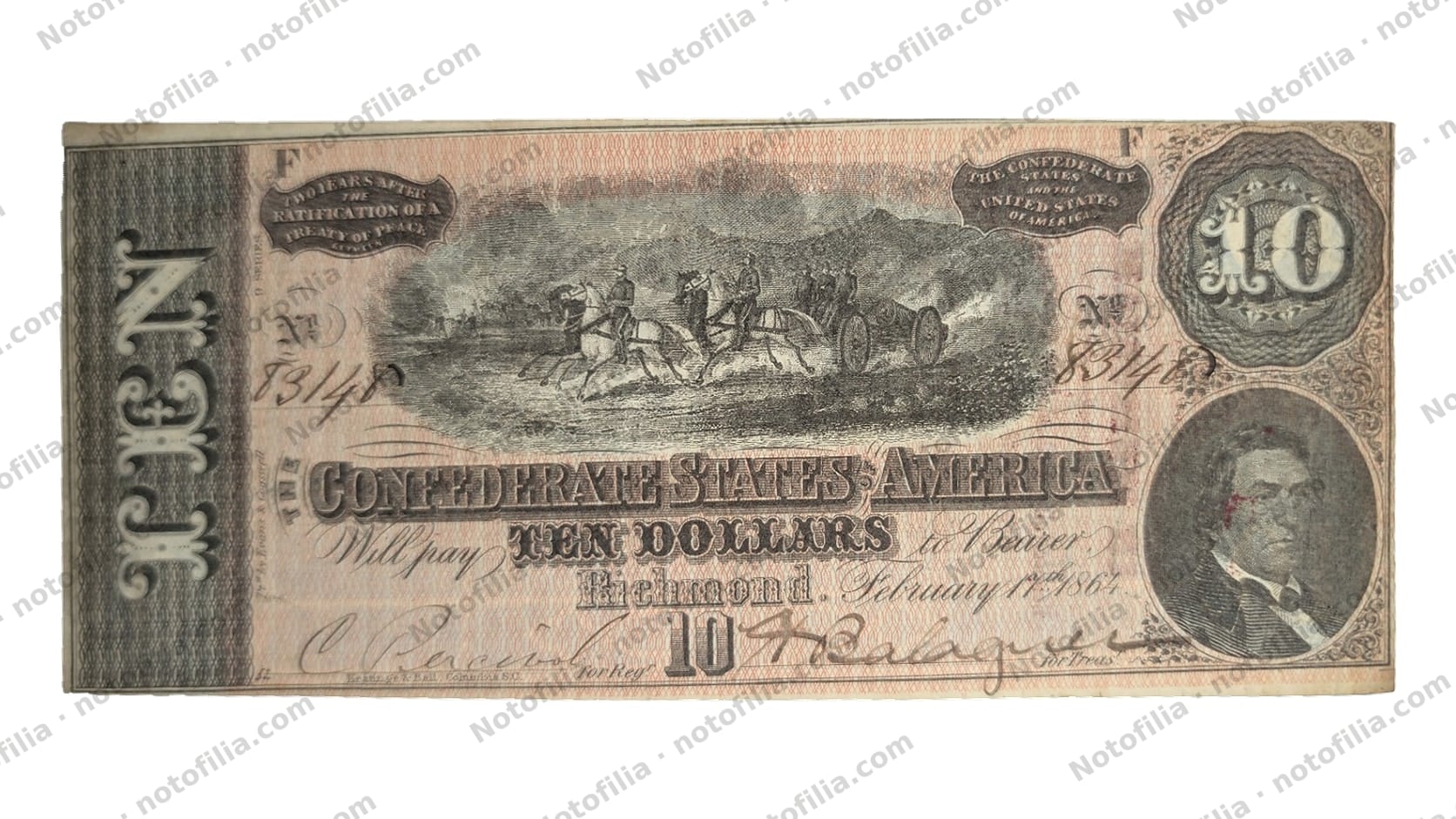
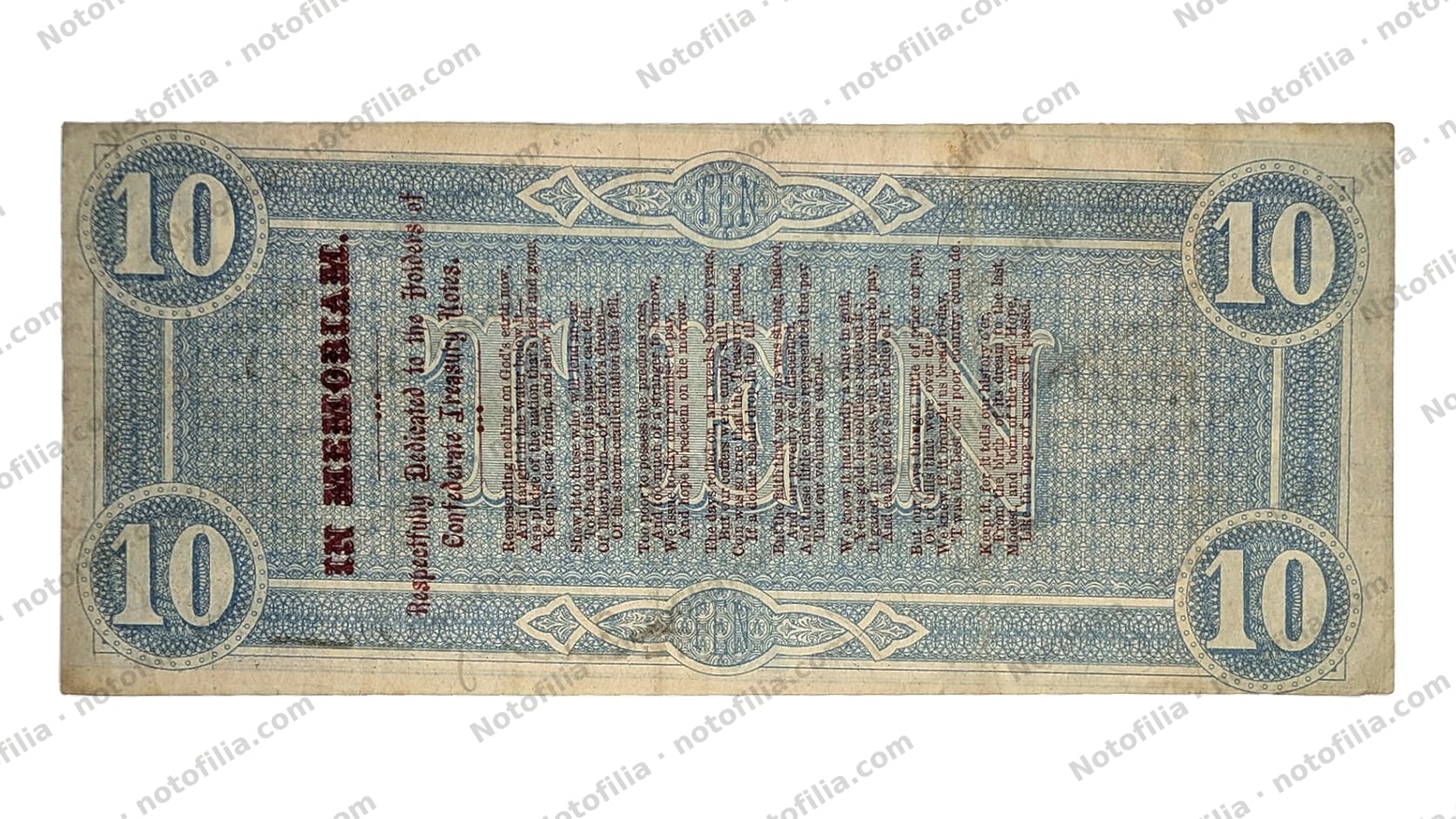
Artillery horses and Hunter. Richmond, 17 February 1864. Serial 83148, 9th series, plate F; back with the In Memoriam poem.
Catalog facts
- Pick reference
- P#68 · T-68 · N#207970
- Serial number
- 83148 · 9 · F
- Signatures
- C. Purcell (“for Register”) and Balaguer (“for Treasurer”); the initial of the second signature cannot be read with certainty
- Condition
- Circulated, unslabbed; no grade is stated
- Printage
- Keatinge & Ball, Columbia, S.C., the imprint visible on this example. The photograph shows “9 SERIES” and the letter F in both upper corners. Wikipedia and Numista put the type at about 9,071,000 notes. Numista publishes 177 × 76 mm as the type size, not as a measurement of this serial. The act of 17 February 1864 authorized $200 million across all denominations.
Face
Back
The note
This $10 of 17 February 1864 (Pick 68, Criswell and Fricke T-68, Numista N#207970) is the ten of the Confederate Treasury’s last issue. It is not the T-69 $5, serial 6164, nor the T-67 $20, serial 74523, which already have pages in this case. This example, in black on a pink tint, carries a team of horses pulling a cannon at center and, at lower right, an oval portrait of Robert Mercer Taliaferro Hunter. The cartouche at left reads “TWO YEARS AFTER THE RATIFICATION OF A TREATY OF PEACE.” Beneath the vignette, “The Confederate States of America” promises to pay TEN DOLLARS to the bearer; the printed date is “Richmond, February 17th 1864.” TEN runs vertically at left and a scalloped 10 sits at upper right. Manuscript serial 83148 repeats beside the TEN and beside the 10. “9 SERIES” is printed beside the cartouche, and the letter F sits in both upper corners: 9th series, plate F. The manuscript signatures read “for Register” and “for Treasurer”; on this photograph the first reads C. Purcell and the second a surname like Balaguer, whose initial is not clear. The imprint is Keatinge & Ball, Columbia, S.C. A red spot falls on the cheek of the portrait. The blue back shows TEN on guilloches and a 10 in each corner, with a poem printed over it in red that opens “IN MEMORIAM. Respectfully Dedicated to the Holders of Confederate Treasury Notes.” That lettering is not part of the 1864 design: it is a postwar poem stamped on Confederate notes. PCGS NoteFacts separately lists a third-series variety lithographed by Evans & Cogswell; the 9th series and plate F of this example are not taken from that record. The piece, circulated and unslabbed, carries no third-party grade.
The issue
The Seventh Series came from the act of 17 February 1864. Wikipedia puts that authorization at $200 million, in denominations from 50 cents to $500, payable two years after ratification of a treaty of peace. The grayback was still unbacked by specie: a promise if the South won, not a redemption in gold. Wikipedia credits T-68 — artillery horses and Robert M. T. Hunter — to Keatinge & Ball, in Columbia, and puts it at about 9,071,000 notes. Numista publishes the same figure as the type total and 177 × 76 mm as the type size. Neither figure is the printage of serial 83148, nor of the 9th series or plate F printed on this example.
In this case the T-69 $5 carries the Virginia Capitol and Memminger, and the T-67 $20 the Tennessee Capitol and Stephens. T-68 changes those vignettes for the gun on the move and for Hunter. Clerks signed the 1864 whole-dollar notes “for Register” and “for Treasurer”; only the 50-cent issue carried printed signatures. On the photograph of this example the letter F sits in both upper corners and “9 SERIES” is printed beside the cartouche. The manuscript signatures read C. Purcell (“for Register”) and a surname like Balaguer (“for Treasurer”); the initial of the second is not clear.
Wikipedia puts the authorized total of the seven series at about $1.7 billion. Unbacked by specie, the grayback fell with the bad news: by the end of 1863 it was worth about six cents in gold, and by September 1864 about three. The act behind this ten tried to force the exchange of the old paper. It did not restore trust. After Appomattox the paper lost its value as currency. Section 4 of the Fourteenth Amendment holds debts incurred in aid of rebellion illegal and void.
Scarcity and printage
Wikipedia and Numista put T-68 at about 9,071,000 notes, a type total and not the printage of the 9th series or of plate F. It is one of the 1864 graybacks most often met with. PCGS NoteFacts separates a third-series variety printed by Evans & Cogswell; this record does not choose that variety for serial 83148 or invent a premium for the number.
Population
A PMG or PCGS census for serial 83148 has not been independently verified. There is no certificate number and no numeric grade.
Sources
- Numista — 10 Dollars, Confederate States (N#207970) (opens in a new tab)
Pick 68; artillery horses and Hunter; Keatinge & Ball; 177 × 76 mm; 9,071,000 as the type total; blue back with TEN. The size and the printage are not those of this serial.
- Wikipedia — Confederate States dollar (opens in a new tab)
T-68, Keatinge & Ball, about 9,071,000; Seventh Series, act of 17 February 1864, $200 million; two-year peace clause.
- Bank Note Museum — P-68, $10, 17 February 1864 (opens in a new tab)
Artillery horsemen and Robert Mercer Taliaferro Hunter; Treasury of the Confederate States.
- PCGS NoteFacts — T-68, $10, 1864, third series (opens in a new tab)
Record of a third-series variety, Evans & Cogswell. It does not identify serial 83148. The “9 SERIES” and the letter F on this note are read from the photograph, not from that record.
- Constitution Annotated — Fourteenth Amendment, Section 4 (opens in a new tab)
Neither the United States nor any state shall assume debts incurred in aid of rebellion; such debts are illegal and void.
Related pieces
Other records from the same issuer or era in this case.