
Colombian coin was born in Santa Fe, not in a central bank. Around 1590 Philip II ordered a mint that never opened. In 1620 Philip III authorized Alonso Turrillo de Yebra; the next year he hammered gold — for the first time in the Americas — and silver, the N.R. cobs, in a rented low house in La Candelaria. The Banco de la República dates that founding to 1620; the Casa de Moneda Museum recalls the work of 1621. Until then trade ran on tejuelos and gold dust. Those escudos and reales, with cob silver arriving from Mexico and Peru, were the viceroyalty’s circulating coin.
In the eighteenth century the Crown took the mint into royal administration and mechanized it. Viceroy Solís reopened the house in 1756; screw presses made round, reeded coin. Reserved cédulas of 1771 and 1786 secretly cut fineness. Popayán was authorized in 1729 and struck from 1758; Banrepcultural’s encyclopedia records the 1766 royal cédula. Until independence, Santa Fe and Popayán refined Antioquia and Cauca gold and collected the royal fifth.
War broke that order. In 1811 Cartagena’s junta struck half-real and two-real coppers — already with Castilian legends; in 1813 Nariño ordered the china coin for the Southern Campaign; Bolívar, master of the mints after Boyacá, asked for the same type. Adolfo Meisel also records royalist issues from Popayán and Santa Marta and the low-fineness caraqueña. The Cúcuta Congress tried to restore Spanish fineness; Santander evaded the rule with antedated issues. In 1836 the regime was unified — granadino de plata and de oro; in 1846–1847, under Mosquera, Lino de Pombo and Florentino González imposed 0.900 fine metal and the decimal system, and the cob was withdrawn.
The Republic of 1886 inherited the peso. The mints stalled about 1890; the 50-centavo cocobolas, with Soledad Román’s profile, were ordered in New York. The Banco de la República, on its own timeline, took over the Bogotá mint in 1946 and bought Medellín in 1953. On 9 April 1948 the house held in the Bogotazo. A first public numismatic museum opened in the early 1960s; restoration of the cloister at Calle 11 no. 4-93 finished in 1982, the same year Ibagué began making planchets. In 1987 striking moved there. Law 31 of 1993 folded the house into the issuing bank. The permanent exhibition opened in December 1996. The 2012 family — biodiversity and water — won the next year’s prize for best circulating series. This case gathers that arc: from the cobs of Santa Fe to the peso now in the pocket.
Paper money from the same periods is documented in the notaphily case. Colombia · Free banking and the Banco de la República
The visual catalog gathers the types with search, four to a row, and no prices. Visual coin catalog
The catalog
Five cases in one row, left to right: colonial Santa Fe, Independence and Gran Colombia, New Granada, the Republic, and Lazarettos. Individual type pages will be published as they are documented, as in the Philippines case and the Colombian paper case.
-
1620–1819
The Santa Fe mint
Period · 1620–1819
Read the chapter → -
Independence and Gran Colombia
Period · 1810–1830
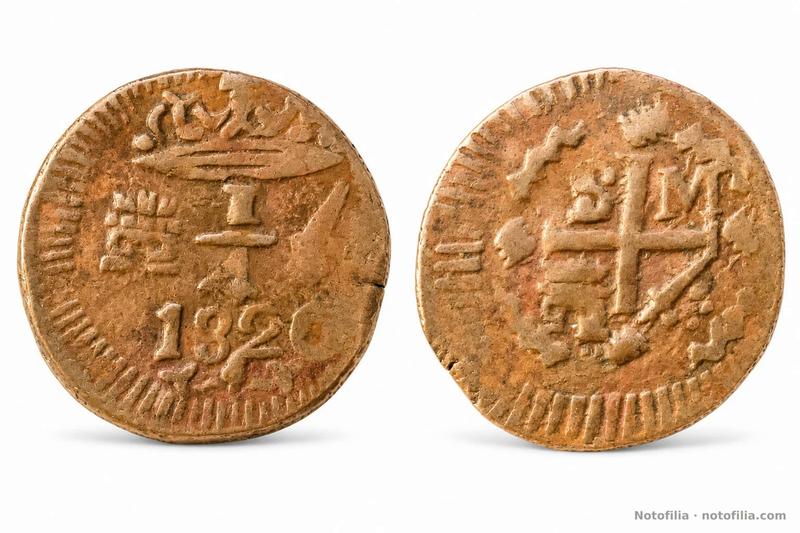
1/4 real · Santa Marta · 1820
Read the chapter → -
1831–1886
New Granada and the United States of Colombia
Period · 1831–1886
Read the chapter → -
from 1886
The Republic and the coin factory
Period · from 1886
Read the chapter → -
from 1598
Lazarettos
Period · from 1598
Read the catalog →
1620–1819
The Santa Fe mint
The mint of the New Kingdom: hammered cobs, then milled coin with a reeded edge, and the sister house at Popayán.
Around 1590 Philip II ordered a mint at Santafé that never opened. The Banco de la República dates the effective founding to 1620: Philip III authorized the engineer Alonso Turrillo de Yebra to strike silver and, for the first time in the Americas, gold. Turrillo began in 1621 in a rented low house in La Candelaria and for a time kept an office at Cartagena de Indias, closed about 1634. Until then the New Kingdom paid mainly in tejuelos, bars, and gold dust. The first pieces were hammered cobs — metal poured into moulds, thinned by hammer, cut with shears, and struck between two dies: 1- and 2-escudo gold and ½, ¼, 1, 2, 4, and 8 reales silver, with mintmark N.R. The Mesuno hoard holds Santafé doblones of 1629–1636. In the seventeenth century the works were a smithy: Antioquia and Chocó gold was refined. In 1751 the Crown took the mint into royal administration. Almost half a century later, under Ferdinand VI, the house was enlarged for circular-coin machinery; the 1753 architectural reform was directed by Tomás Sánchez Reciente under Viceroy Alfonso Pizarro. Viceroy Solís reopened it in 1756 — the year is still on the stone doorway — and screw presses made round reeded coin so clipping of the edge would show. Reserved cédulas of 1771 and 1786 secretly lowered gold and silver fineness. Popayán was authorized by a royal cédula of 1729; Pedro Agustín de Valencia began reeded coin there in 1758 as a private treasurer. Banrepcultural’s encyclopedia records the closure after disputes and the 1766 royal cédula; the 1996 exhibition booklet places the transfer to royal property in 1770. Adolfo Meisel lists the eighteenth-century finenesses: gold at 0.916½, 0.901, and 0.875; silver near 0.902. Peruvian and Mexican cobs arriving with situados joined that local coin.
1810–1830
Independence and Gran Colombia
Cartagena coppers, Nariño and Bolívar’s china coin, and the jumble of finenesses after Boyacá.
In 1811 the Santafé mint went into crisis as gold output fell and funds were diverted to the patriot cause; even private financing was used to keep it open. Cartagena’s junta ordered half-real and two-real coppers, struck through 1815: from then on legends are in Castilian — colonial coin had been in Latin. In Santa Fe, Nariño ordered the provincial china coin in 1813 — the Indian bust, “libertad americana” — to fund the Southern Campaign; it was struck from 1814 to 1816. After Boyacá, Bolívar took the Bogotá and Popayán mints and, on 18 August 1819, asked for the same type. Popayán stayed in royalist hands until 1821; they took the dies when they fled. Meisel, following Barriga Villalba and Restrepo, also records royalist coppers at Popayán (1813), the 1816 patriot feble, Santa Marta silver ordered by Viceroy Montalvo — and the 1820 copper siege cuartillo — and the low-fineness caraqueña that came with Morillo. The Cúcuta Congress of 1821 tried to restore Spanish weight and fineness; Santander evaded the rule with low-fineness issues antedated to 1821. The museum booklet records the first republican peso of 1825 — equal to 8 silver reales or ½ gold escudo. Banrepcultural’s encyclopedia also records low-fineness cobs struck on the Caracas pattern in Casanare.
1/4 real · Santa Marta · 1820
A copper siege cuartillo: a crown over 1/4 and 1820; on the other side, a cross dividing the letters S and M of Santa Marta.
Open the piece →1831–1886
New Granada and the United States of Colombia
The 1836 unification, the 1846–1847 decimal reform, and the mints of a country that changed its name three times.
After Gran Colombia dissolved, the law of 20 April 1836 repealed the Cúcuta rules and tried to unify fineness, weight, value, type, and denomination, with gold to silver at 1 to 16: the eight-real piece was named granadino de plata and the gold peso granadino de oro. Cobs and clipped coin stayed in the market; their withdrawal, already ordered in 1826, was not finished until about 1848. In Tomás Cipriano de Mosquera’s first government, Lino de Pombo and Florentino González imposed 0.900 fine metal and a decimal system in 1846–1847: base coinage stopped and what was taken in was restruck. The peso, which in 1837 had replaced the real at eight reales to the peso, was split into ten reales — later décimos, from 1853. In 1813 Juan del Corral had asked Caldas for machinery for a Medellín mint; the reconquest aborted the project. The 1996 exhibition booklet dates the State of Antioquia’s first work to 1862 — a gold peso of that year, one of the two examples it records. The Bank’s Numismatic Collection places the Medellín house at 1866–1947. The measure of 26 May 1866 authorized a cut in silver fineness except the peso, and the public hoarded those pesos. In the 1880s Bogotá and Medellín installed steam presses from Ralph Heaton & Sons, Birmingham. Under the Granadine Confederation and the United States of Colombia (1863–1886) silver pesos and gold from the three mints remained convertible, while free-banking paper began to circulate beside them.
from 1886
The Republic and the coin factory
The Regeneración peso, administration by the Banco de la República, and the move of striking to Ibagué.
The 1886 constitution restored the name Republic of Colombia; the gold peso remained the standard while Banco Nacional paper and the Thousand Days’ War wrecked convertibility. Popayán ceased in 1881 and did not return. Bogotá and Medellín closed about 1890; the shortage of coin led to an order in New York for 50-centavo silver with the profile of Soledad Román de Núñez — the cocobolas. Under Reyes (1904–1909) paper-money pesos were struck in cupronickel — 1, 2, and 5 pesos p/m, equal to 1, 2, and 5 centavos — with a Peace bust; Hernández dates the module at Brussels and Bogotá from 1907 to 1916. They are not banknotes. Distinct, and earlier, are the Palonegro necessity coscojas (1902): Bucaramanga brass with a Santander legend, made from rifle-cartridge cases. After Reyes, Bogotá resumed in 1906 and Medellín in 1914. The last gold was struck at Medellín in 1930 — 5 pesos, the Colombian libra. The war with Peru (1932) drove large 50-centavo silver strikes; in the Second World War nickel ran short and the 1-, 2-, and 5-centavo pieces switched to copper. In 1947–1948 the last 50-centavo silver, 0.500 fine, was struck. On 9 April 1948 Antonio María Barriga and the staff defended the house in the Bogotazo with refining chlorine and the workshop masks. The Banco de la República, on its Coin Factory timeline, took over the Bogotá mint by contract in 1946 (the 1996 booklet dates that contract to 1942) and bought the Medellín mint in 1953. Luis Ángel Arango pushed, at mid-century, to conserve the building; a first public numismatic museum opened in the early 1960s (1961 in a 2020 classroom presentation; 1962 in the Bank’s 2023 *Tesoros* catalog). Decree 1584 of 11 August 1975 declared it a national monument. From the 1970s the colonial cloister — Calle 11 no. 4-93 — was restored, work that finished in 1982, the same year Ibagué, separately, began making planchets. In 1980 planchets were still imported; director Luis Guillermo Correa proposed making them in Colombia. In 1982 the Ibagué plant opened and in 1987 striking moved there: Santa Fe ceased after 366 years. Some Ibagué presses reach four hundred pieces a minute. Law 31 of 1993 folded the mint into the issuing bank, and that year the first bimetallic 500-peso was struck. The permanent exhibition opened in December 1996. In 2012 the family that honors biodiversity and water appeared; the next year it took first place worldwide as best circulating series. BanRep’s tables later record 10,000-peso commemoratives (2021 and 2023) and 20,000-peso commemoratives (2023–2024: the Bank’s centenary, the Antioquian carriel, and Santa Marta’s fifth centenary). This case will gather, as they are documented, colonial, independence, and republican types — as the Philippines notes and Colombian paper already do.
Sources
-
Banco de la República — History of the Coin Factory
(opens in a new tab)
Official timeline: founding in 1620, Bank administration in 1946, Ibagué planchets in 1982, the 1987 move of striking, Law 31 of 1993, and the 2012 family. The 1996 exhibition booklet adds Turrillo, the Cartagena office, and the 1953 purchase of Medellín.
-
Banrepcultural — Reopening of the Casa de Moneda Museum
(opens in a new tab)
Striking from 1621, the 1756 reopening under Viceroy Solís, the end of work at Santa Fe in 1987, and the permanent exhibition from December 1996.
-
Banrepcultural Encyclopedia — The Popayán mint
(opens in a new tab)
Opening in 1758, closure and the 1766 royal cédula; 1816 base coppers for republican troops.
-
Banrepcultural Encyclopedia — Financing independence
(opens in a new tab)
Bolívar’s 18 August 1819 order to strike the Indian type, and the low-fineness Casanare cobs.
-
Adolfo Meisel Roca — The metallic standard, 1821–1879
(opens in a new tab)
Independence chaos, the 1836 law, Pombo and González’s decimal reform (1846–1847), and the withdrawal of cobs by about 1848.
-
Banrepcultural — Banco de la República Numismatic Collection
(opens in a new tab)
Casa de Moneda Museum: Santafé (1621–1987), Medellín (1866–1947), and the Ibagué factory. The 1996 exhibition booklet — prologue by Jorge Orlando Melo — covers Turrillo, the cocobolas, and the Bogotazo.
-
Banrepcultural — Casa de Moneda Museum
(opens in a new tab)
Permanent exhibition opened in December 1996 at Calle 11 no. 4-93; decree 1584 of 11 August 1975 (national monument); first public museum in the early 1960s.
-
Boletín Cultural y Bibliográfico — Numismatic Collection insert (2019)
(opens in a new tab)
The cloister opened to the public in December 1996; the collection holds more than 18,000 pieces.
-
Pedro Pablo Hernández — Coins and Banknotes of Colombia, 8th ed. 2023 (Numista L100183)
(opens in a new tab)
P/m pesos of 1907–1916 and Palonegro coscojas of 1902. Price columns are not published.
-
Banco de la República — Production and circulation
(opens in a new tab)
Annual coin production: 10,000-peso commemoratives (2021, 2023) and 20,000-peso commemoratives (2023–2024). A denomination-year total is not a single-type mintage.