
In 1766 Puerto Rico became the first Spanish overseas province to print 8-real papeletas. For centuries the Mexican situado propped up the island treasury; when Spanish American independence cut that subsidy, Governor Salvador Meléndez Bruna authorized provincial paper on 31 August 1812. By 1813 the papeleta issue reached 500,000 pesos. Intendant Alejandro Ramírez, who arrived on 11 February 1813, amortized it by 1816.
The disgrace of that paper stopped new issues for decades. Paper returned with the Ten Years’ War. From New York, the Central Republican Board of Cuba and Puerto Rico — chaired by José Morales Lemus, with Puerto Rican secretary Dr. José Francisco Basora — served as a government-in-exile support body: fundraising, managing the external finances of the Republic of Cuba in arms, and linking Cuban and Puerto Rican anti-colonial politics among donors, printers, and exile communities. On 1 June 1869, the Republic authorized a twenty-million-peso loan; weeks later Morales Lemus and Basora were arrested under U.S. neutrality laws.
At century’s end the island still lacked its own coin: worn macuquinas, Mexican pesos, Morgan dollars, and other foreign silver — much of it fleur-de-lis countermarked from 1884 — flooded commerce. The shortage of official and fractional coin pushed sugar and coffee haciendas, merchants, and some municipalities to issue their own paper — vales or rustic notes — often with brass tokens. That private scrip paid day wages and kept daily trade moving while metropolitan currency fell short.
In that same shortage of circulating money, the island’s banking landmark was the Banco Español de Puerto Rico. Authorized by royal decree on 5 May 1888 and opened on 1 February 1890, it was the only institution with a monopoly of banknote issue. The American Bank Note Company of New York printed the 5, 10, 20, 50, 100, and 200 peso series (Pick 8–31). The Overseas Ministry’s single-peso exchange note is not part of those series.
The royal decree of 17 August 1895 created the 1-peso exchange note (Pick 7): a short-lived instrument, equivalent to 25 g of .900 silver, to gather that silver and strike provincial coin in Madrid. Three years after the decree, the Treaty of Paris closed the Spanish colonial chapter.
Paper did not stop with the treaty. The United States Congress respected the Spanish charter; the bank was reorganized as Banco de Puerto Rico (Bank of Porto Rico), lost its exclusive monopoly, and kept issuing transitional notes — stamped and adapted to the dollar — the so-called Puerto Rican dollar (Pick 32 and 41–48). In 1902, the First National Bank of Porto Rico, in San Juan, began issuing United States National Bank Notes (Pick 33–41).
The Spanish charter expired in 1913 and the bank was liquidated. Between 16 and 24 January 1916, a liquidation commission gathered the island notes still in circulation; in January 1925, the recovered pieces were incinerated. That is why Banco Español and Banco de Puerto Rico notes are scarce today: only a fraction of what was issued survives. This case does not invent holdings of those series: it documents the context and the three pieces in the collection.
Notes in the collection
1869 Central Board circulating 1-peso note (P#61, No. 13085), provisional fundraising receipt (No. 32, below), and 1895 exchange note (P#7b, radar serial 4548454).
-
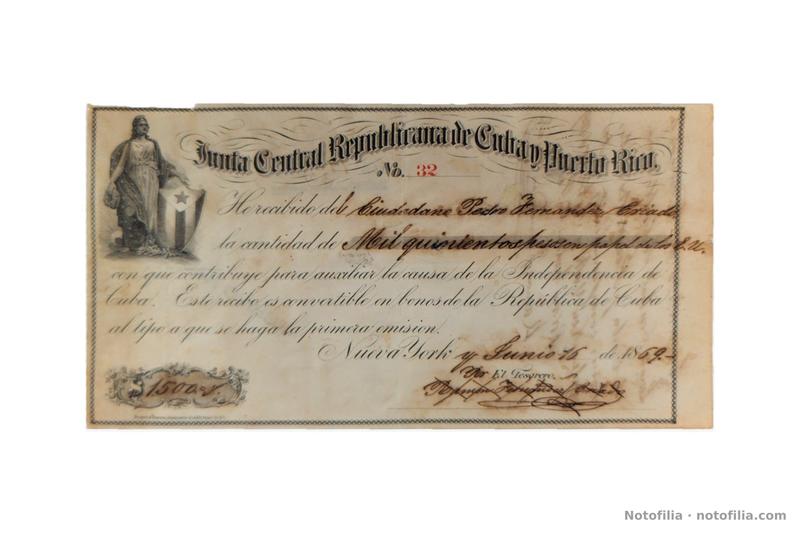
1,500 Dollars · Provisional Fundraising Receipt · 1869
Pick Recibo de contribución provisional · Serial N.º 32
Open the note page → -
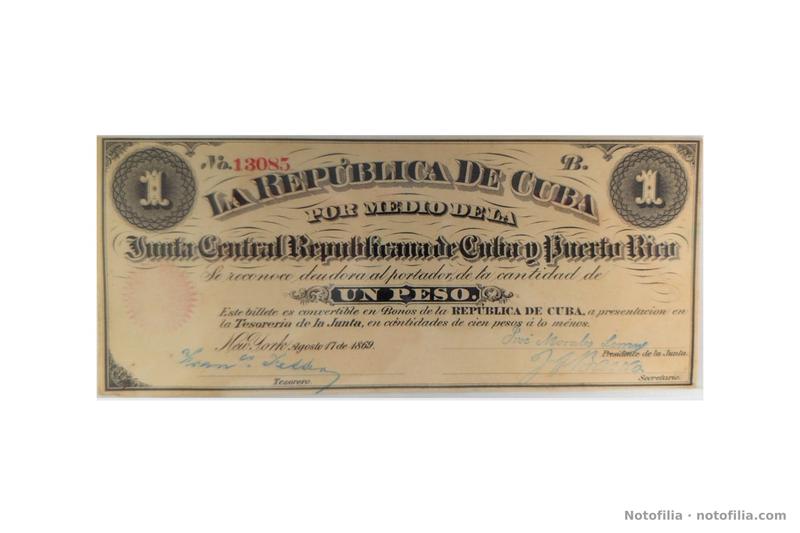
1 Peso · Central Republican Board · 1869
Pick P#61 · Serial N.º 13085 · serie B
Open the note page → -
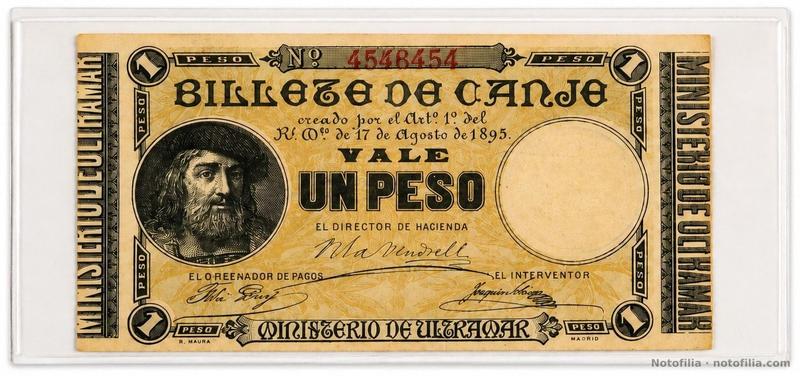
1 Peso · Exchange Note · 1895
Pick P#7b · Serial N.º 4548454
Open the note page →
Sources
-
Wikipedia — Puerto Rican peso
(opens in a new tab)
The situado, 1812–1815 papeletas, the 1869 Central Republican Board, and the 1895 exchange note.
-
Wikipedia — Currencies of Puerto Rico
(opens in a new tab)
Banco Español (1888–1890), Bank of Porto Rico, the First National Bank of Porto Rico, and the 1916–1925 withdrawal.
- Bank Note Museum — Puerto Rico (National Treasury, Overseas Ministry, and banks) (opens in a new tab)
-
Documenta & Instrumenta — New findings on nineteenth-century fractional paper money in Puerto Rico
(opens in a new tab)
Documents the 1813–1814 papeletas authorized by Salvador Meléndez Bruna.
-
The E-Sylum — Puerto Rican paper money
(opens in a new tab)
Summarizes the situado crisis, the 1812–1813 papeletas, and Ramírez’s amortization by 1816.
-
Documenta & Instrumenta — Exchange of Mexican currency for the provincial peso (1895–1896)
(opens in a new tab)
Royal decree of 17 August 1895, exchange-note counterfoils, and AHN Ultramar file 6316.
-
Biography of the Riches of Puerto Rico — Coins
(opens in a new tab)
Macuquinas, 1884 countermarks, and the exchange-note silver equivalent (25 g .900).