Puerto Rico · National Treasury
25 pesos note, 1813
25 pesos · National Treasury · 1813
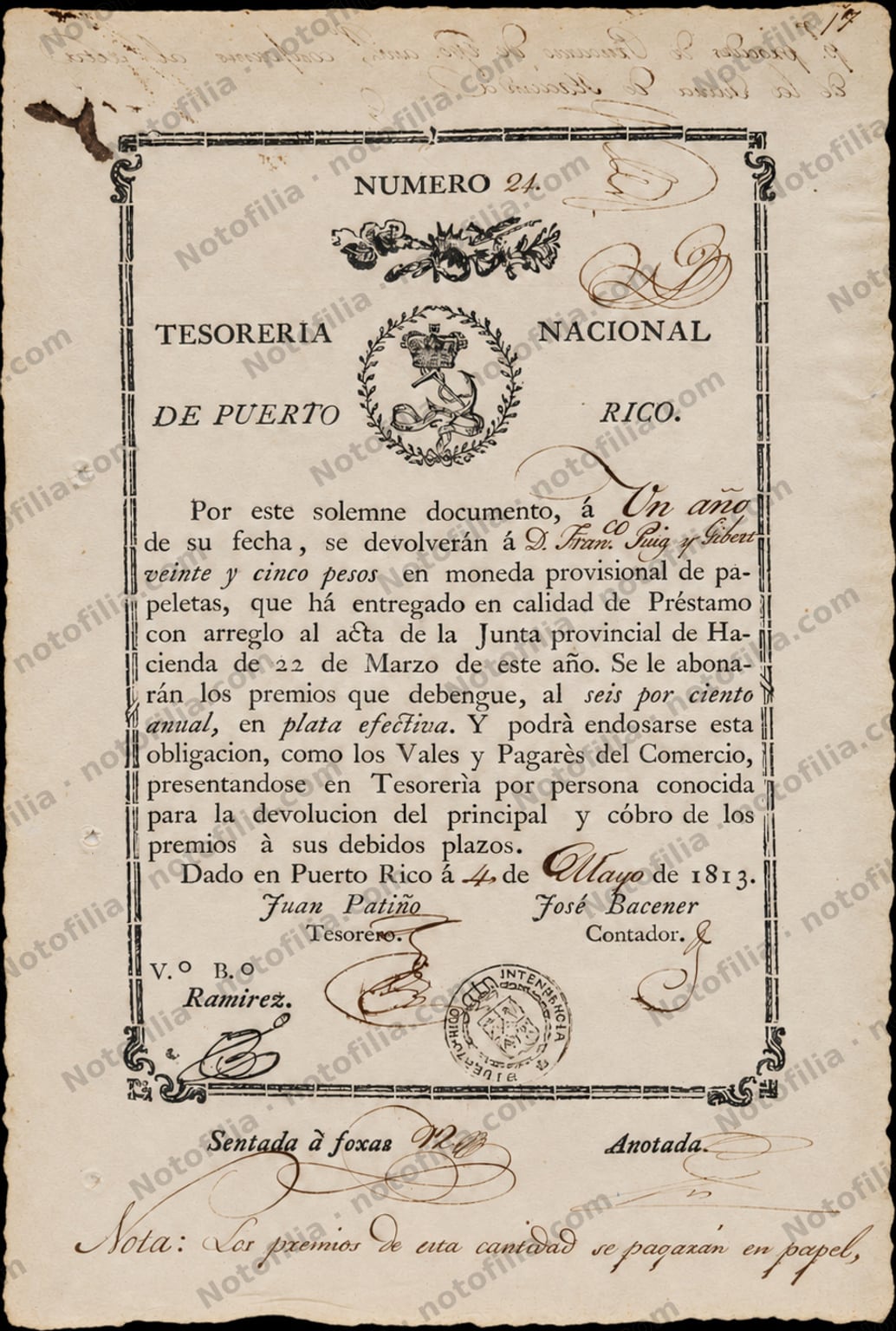
National Treasury obligation for 25 pesos, 4 May 1813, No. 24. A handwritten note makes the printed 6% interest payable in paper.
Catalog facts
- Pick reference
- B113a · Pick PNL · Edifil 2021: 4
- Serial number
- N.º 24
- Signatures
- Alejandro Ramírez (V.º B.º, approval); Juan Patiño (Treasurer); José Bacener (Accountant)
- Condition
- Unslabbed; holes along the left margin, irregular edges, and dark ink (private collection)
- Printage
- 4 May 1813, Puerto Rico. Partly printed obligation completed by hand, transferable by endorsement. Handwritten term of one year. Principal in provisional papeleta currency. Printed interest of 6% a year in silver; the foot note moves it to paper. Resolution of the Provincial Finance Board of 22 March 1813. Printer, watermark, and sheet dimensions are not recorded on this page.
Face
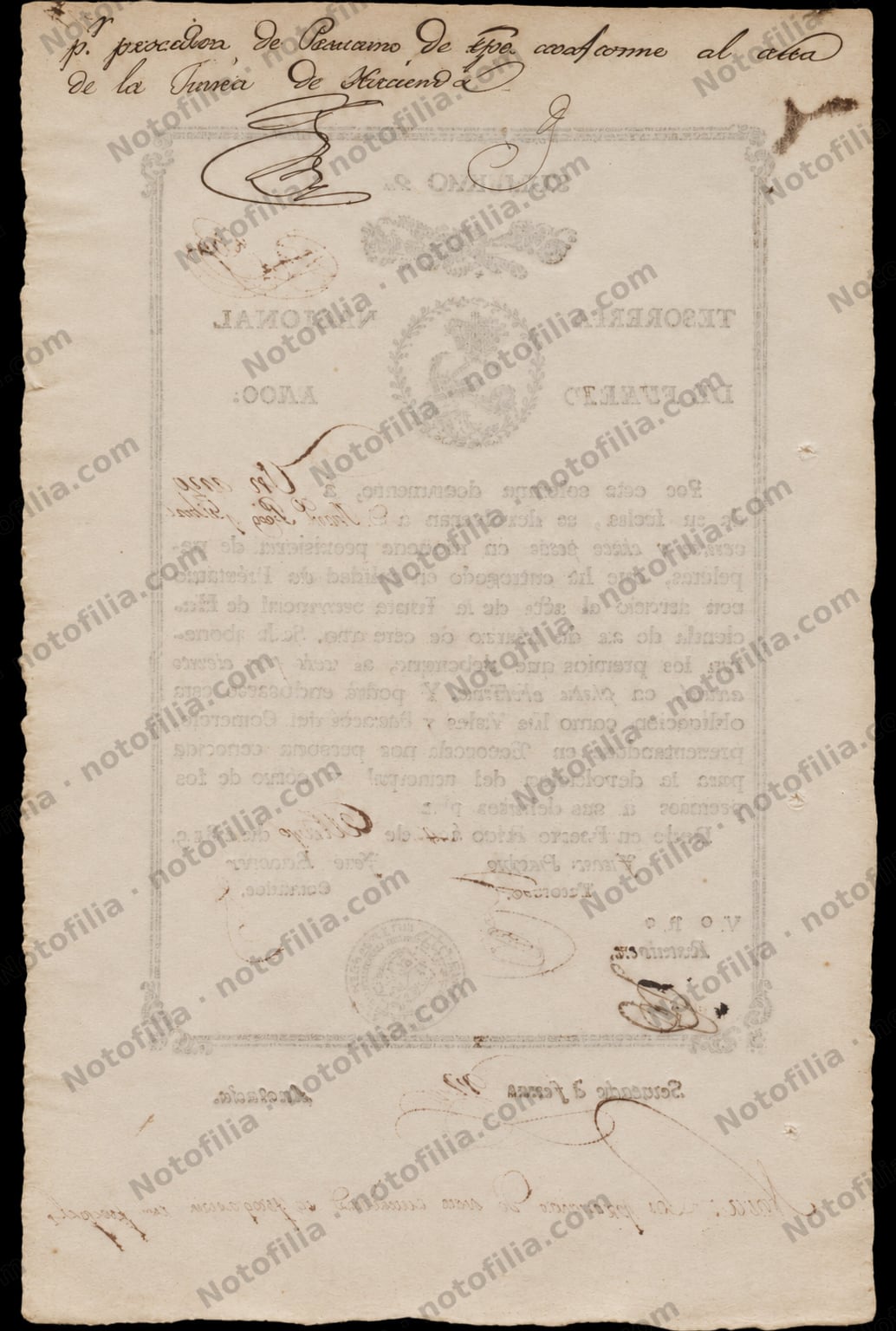
Back
The note
The National Treasury of Puerto Rico issued this obligation on 4 May 1813, during the Mexican situado crisis and the provincial paper issues. It is not the island’s first paper: issues are documented from 1766, and Salvador Meléndez Bruna authorized provincial paper currency on 31 August 1812. The printed text promises to repay, one year from the date, twenty-five pesos in provisional papeleta currency, under the Provincial Finance Board resolution of 22 March that year, and to pay the premios at six percent a year in silver. The term “Un año” is handwritten. The payee reads as Don Francisco Puig y Gibert, the name published on other examples of the type; that does not supply a biography, and it does not make any flourish his signature. A handwritten note at the foot changes the payment term: “Nota: Los premios de esta cantidad se pagarán en papel.” Here premios means the interest. At 6% a year, the nominal interest on 25 pesos is 1.50 pesos; the arithmetic does not show that it was paid. The printed number is 24, a low number. The face has an ornamental border, a crowned anchor and banner within foliage, a seal, and signatures. Beneath “V.º B.º / Ramírez” the approval is attributed to Alejandro Ramírez, intendant of the Treasury, who arrived on 11 February 1813; Juan Patiño signs as treasurer and José Bacener as accountant. The combination matches published examples and names the expected signers; it does not by itself authenticate the hand on this sheet. “Sentada á foxas” and “Anotada” are register entries; the handwritten folio that follows has not been read with certainty. A manuscript note continues on the back, about the payment of interest in paper, with two flourishes attributable to Juan Patiño and José Bacener. The back has no printed design of its own; show-through from the face is not catalogued as a printed back. The original photographs are the evidence for this record. No grade or certification number is in view. Dimensions, watermark, printer, and provenance wait on direct examination. The left margin shows holes; the edges are irregular and some ink is dark.
Scarcity and printage
The type is a National Treasury obligation, transferable by endorsement, not a circulating papeleta. Pick leaves it unlisted (PNL). Edifil 2021 numbers it 4; publisher cross-references also cite it as PR2, Filabo 2PR, and Banknote Book B113a. This record does not reprint price columns. Published examples carry other numbers, including 33 and 34, and they are not this sheet. No. 24 is a low number. No printage is invented.
Population
There is no verified census for No. 24. The photographs show no holder and no certification number. Auction catalogues describe the type as scarce; that does not fix a population or a numerical rarity grade.
Sources
- EnciclopediaPR — History of money in Puerto Rico (opens in a new tab)
Papeletas from 1766, the 1812 authorization, Ramírez’s arrival on 11 February 1813, and the amortization of the paper.
- Documenta & Instrumenta — Fractional paper money in Puerto Rico (19th century) (opens in a new tab)
1813–1814 papeletas authorized by Salvador Meléndez Bruna.
- NumisBids — Sedwick, National Treasury, 25 pesos, 4-5-1813 (opens in a new tab)
Another example, with another number. It names Puig y Gibert, Patiño, Bacener, and Ramírez, and marks the type Pick-unlisted. It is not this sheet, and this record does not adopt the claim that the type was the island’s first currency.
- Ibercoin — 25 pesos, 4 May 1813, Royal Treasury (Edifil 2021: 4) (opens in a new tab)
Cites the 2021 Edifil edition, number 4, for another example of the type.
- Greysheet — The Banknote Book, Tesorería Nacional series (opens in a new tab)
The series is listed in The Banknote Book. The B113a cross-reference is recorded here; this page does not reprint the price guide.
- The E-Sylum — Puerto Rican paper money (opens in a new tab)
The situado crisis, the 1812–1813 papeletas, and Ramírez’s amortization by 1816.
- Bank Note Museum — Puerto Rico (opens in a new tab)
National Treasury context beside the island’s later issues.
Related pieces
Other records from the same issuer or era in this case.