Published
Mylar Yes, Plastic No: Storing Banknotes
PVC destroys banknotes in silence: it yellows paper, lifts inks, and leaves a greasy film. Why archival polyester (Mylar) is the only safe sleeve.
- Reviewed by
- Yezid Acosta
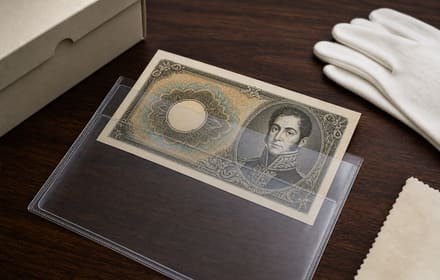
There is a scene that repeats in the collecting world and that hurts to watch. Someone inherits a parent’s or grandparent’s banknote collection, stored with all the love in the world in an album of plastic sleeves bought thirty years ago. They open the album and find the notes yellowed, inks running, stuck to the sleeve like old decals. When they try to peel one off, the paper surface stays glued to the plastic. Decades of history, patience, and investment, ruined not by neglect but precisely by the attempt to protect.
The culprit has a name: PVC, polyvinyl chloride, the most common and cheapest plastic on the market. And the solution also has a name: Mylar, an archival-quality polyester that museums, national libraries, and professional grading services have used for more than half a century. This article explains, without unnecessary jargon but without dodging the chemistry when it matters, why the difference between one material and the other can be the difference between a collection that survives generations and one that destroys itself in silence inside a drawer.
Paper is living (and fragile) matter
To understand why the sleeve material matters so much, it helps to remember what a banknote is. Traditional paper money is made of cotton fibers —sometimes mixed with linen— pressed and interlocked. It is an organic, hygroscopic material (it absorbs and releases humidity from the air) and chemically sensitive. The intaglio inks that give it relief, the optically variable inks, the metallized security threads, and the watermarks live together in an object designed to last a few years in circulation, not decades in a case.
An uncirculated note, with its crisp paper and intact relief, also keeps something almost intangible: the original paper sizing, that stiffness and sheen that collectors and grading firms prize so highly. All of that —fibers, inks, sizing— reacts with what surrounds it. With light, with humidity, with acids in the air and, above all, with the materials that touch it directly for years. The sleeve is not a neutral accessory: it is the note’s immediate chemical environment, twenty-four hours a day, for decades.
And here is the trap: to the eye, all transparent sleeves look the same. A newly bought PVC sleeve looks clean, shiny, flexible, perfect. The damage it causes is not visible on the first day, or even the first year. It is a slow, cumulative, and —important— irreversible process.
What PVC actually is and why it destroys notes
Polyvinyl chloride is, in its pure state, a rigid, brittle plastic. To turn it into those soft, flexible sleeves that bend without breaking, manufacturers add plasticizers: chemical compounds —usually phthalates— that can represent up to a third of the material’s weight. That is the first problem, and it is enormous: the plasticizers are not chemically bound to the plastic. Over time they migrate. They leave the PVC and deposit themselves on whatever is in contact with it.
On a banknote that migration shows up as a greasy film, sometimes visible as an oily sheen on the paper. That film softens the inks, partly dissolves the pigments, and makes the note stick to the sleeve. When the collector finally notices something odd and tries to take the piece out, the ink —or the surface layer of the paper itself— stays glued to the plastic. Veteran collectors talk of notes “burned by PVC”, and the phrase is exact: the damage looks like a chemical burn.
The second problem is still more insidious. PVC is chemically unstable: with heat, light, and the simple passage of time, the polymer degrades and releases hydrochloric acid as a gas. Yes, the same laboratory acid, in tiny but constant concentrations, trapped inside a closed sleeve with the note. That acid attacks the cellulose fibers of the paper, which turn yellow first, then brown, and brittle at the end. It also attacks the inks and corrodes metallic elements such as security threads and metallic inks.
There is a third path of damage almost nobody mentions: the effect accelerates itself. PVC degradation is autocatalytic: the acid it releases speeds the decomposition of the plastic, which in turn releases more acid. That is why a collection can go ten years without visible symptoms and deteriorate dramatically in the next five. When the damage becomes obvious, the process has already been advancing for years and there is no going back: no restorer can return lost sizing to the paper or replace dissolved ink.
For those of us who collect in the tropics there is an aggravating factor. Heat and humidity —the normal climate of Colombia’s hot country, from Barranquilla to Villavicencio by way of Montería and Cali— multiply the speed of all these reactions. A PVC sleeve that on the Bogotá savanna would take twenty years to cause visible damage can do it in five on the coast. The enemy works faster exactly where more collectors live.
How to recognize PVC before it is too late
The most frustrating part is that PVC sleeves are rarely sold labeled as such. They are offered as “protective sleeves”, “banknote sleeves”, “paper-money album”, with no further information. A few practical clues:
- The smell. Plasticized PVC has a characteristic sweet “new plastic” smell, like a cheap shower curtain or the interior of a car just off the lot. That smell is, literally, the plasticizer evaporating. Mylar and polypropylene smell of nothing.
- Excessive flexibility. PVC sleeves are soft, rubbery; they fold and wrinkle easily and spring back. Polyester is stiffer, with a “crisp” feel and a crease that leaves a mark.
- Price and provenance. Cheap albums with integral pockets, especially old and generic unbranded ones, are suspect by default. If the seller cannot say what the sleeve is made of, assume the worst.
- Signs in old sleeves. Yellowing of the plastic itself, a sticky surface, stiffness where there used to be flexibility (a sign the plasticizer has already migrated), or that oily patina inside: all indicate PVC in full degradation. If an album shows any of these, the notes must come out at once, not next week.
It is worth saying clearly: if part of your collection is in sleeves whose material you do not know, the cost of replacing them with archival sleeves is a tiny fraction of the value of almost any collectible note. It is probably the best money spent in the whole hobby.
What Mylar is and why it is different
“Mylar” is a registered trademark —originally DuPont’s, today Mylar Specialty Films— for biaxially oriented polyethylene terephthalate film, a polyester known by its English initials: BoPET. In conservation, when people speak of archival-quality Mylar they usually mean specific grades such as Melinex 516, the film used by the Library of Congress, national archives around the world, and the main banknote grading services to encapsulate pieces.
The difference with PVC is not of degree but of nature:
- It contains no plasticizers. Polyester is flexible by its own molecular structure, with no additives to migrate. There is no greasy film, no softened inks, no notes stuck to the sleeve. What is not in the material cannot leave it.
- It is chemically inert. BoPET does not react with cellulose, inks, or metals under normal storage conditions. It releases neither acids nor gases. A note stored in Mylar is, chemically speaking, surrounded by nothing: the ideal setting for a paper object.
- It is stable over time. While PVC degrades and accelerates its own breakdown, archival polyester keeps its properties for decades. The accelerated-aging tests required by conservation standards —such as the Photographic Activity Test (PAT) and ISO specifications for housing materials— it passes with ease.
- It is a real barrier. Besides not damaging on its own, polyester resists the passage of humidity and atmospheric pollutants well, and its transparency and stiffness protect the note physically: against accidental folds, finger grease, and rubbing.
An honest nuance: Mylar is not magic. It is an inert material, not an active one. It does not neutralize acids the note already carries, nor does it undo previous damage. A note that spent years in PVC and is already contaminated will still have that residue on the paper even if you change the sleeve (in those cases, evaluation by a professional conservator is the only sensible path; never try to “clean” a note yourself). What Mylar guarantees is that, from the day the note enters the sleeve, the housing material stops being a threat.
And the other plastics? The full map
Between the villain (PVC) and the gold standard (archival polyester) there is a middle zone that causes confusion. A quick survey:
- Polypropylene and polyethylene. Both are chemically stable and carry no plasticizers, so they are considered safe for contact with paper. They are used in inexpensive sleeves of acceptable quality. Their disadvantages versus polyester are physical, not chemical: they are softer, scratch easily, protect less against handling, and their transparency is inferior. For low-value notes or trading duplicates, an additive-free polypropylene sleeve is a reasonable option. For the important pieces of the collection, polyester remains the answer.
- “Acetate.” Some old products use cellulose acetate, which over time develops so-called “vinegar syndrome”: it degrades releasing acetic acid (hence the vinegar smell) and damages what it holds. It should be avoided like PVC.
- Glassine paper. The translucent glassine envelopes traditional in philately are not plastic, but they deserve a mention: ordinary glassine is slightly acidic and is not meant for decades of contact. If used, it should be a temporary wrap, never a definitive housing.
- Enemies that are not sleeves. The list of avoidable damage does not end with plastic: rubber bands (vulcanized rubber releases sulfur and leaves permanent dark marks), metal clips (rust), adhesive tape of any kind (the worst individual enemy of a note after PVC), hot lamination (total, irreversible destruction of collectible value), and “magnetic” albums with self-adhesive pages. None of these things should be within a meter of a collection.
In good company: famous documents that live in polyester
If the chemical argument sounds theoretical, the institutional one is overwhelming: the most valuable paper pieces on the planet are stored in exactly the material this article recommends.
The Library of Congress pioneered polyester-film encapsulation in the 1970s and today applies it routinely to its collection of historical maps, nineteenth- century newspapers, and manuscripts: the document is sealed between two sheets of inert polyester that allow it to be consulted without ever being touched. The U.S. National Archives use the same technique for thousands of frequently consulted documents. And for their absolute jewels —the Declaration of Independence and the Constitution— they took the principle to the extreme: sealed chambers filled with argon gas, without a single reactive molecule around the paper. It is the museum version of the same idea a Mylar sleeve applies at home: surround the document with nothing.
The British Library protects manuscripts and historical documents with Melinex, the same archival polyester film mentioned above. And you need not go that far: in Colombia, the Archivo de Bogotá makes its own conservation units — polyester envelopes and rolls, folders and boxes with “archival quality” materials— to hold the city’s documentary heritage, following the conservation guidelines the Archivo General de la Nación sets for the whole country. When you order polyester sleeves for your notes, you will be using the same technology with which Bogotá stores its colonial documents.
The private collecting world tells the same story. Copies of Action Comics #1 —Superman’s first appearance, the most valuable comic in the world, with sales in the millions of dollars— are conserved and traded in Mylar sleeves; no serious comics collector would use anything else. The great dealers of classic stamps ship their rare pieces in polyester protectors. And the sealed holders of banknote graders such as PMG enclose each piece precisely in inert film: when you buy a certified note, it is already living in the correct material.
The pattern is impossible to ignore: national libraries, state archives, auction houses, and graders —institutions that answer for paper valued in fortunes and for irreplaceable historical memory— all converged on the same material. Nobody stores a Magna Carta in PVC.
How to set up a proper housing system
With the diagnosis clear, the treatment is simple and within any budget. A sensible conservation system has three layers:
- First layer: the individual sleeve. Each note in its own archival polyester sleeve (Mylar/Melinex) or, at minimum, additive-free polypropylene, of the right size —the sleeve should overlap the note by a few millimeters on each side, without squeezing it or letting it rattle. Specialized makers of archival material state the material explicitly and the “acid-free” and “PVC-free” condition; that transparency in the spec sheet is itself a quality signal. For high-value pieces there are rigid double-layer polyester portfolios, and of course the professional encapsulation of the graders, which uses precisely this kind of sealed inert film.
- Second layer: organization. Individual sleeves go in acid-free boxes with an alkaline reserve, or in albums whose pages are also archival. Watch the classic error: buying excellent sleeves and putting them in an album of PVC pages. The acid gases of the album still reach the notes. The conservation chain is as strong as its weakest link.
- Third layer: the environment. Not even the best sleeve compensates for a bad setting. The ideal conditions are well known: cool temperature and —more important than the exact figure— stable, moderate relative humidity around 45–55%, without sharp swings, and darkness or minimal light, always without direct sun or nearby fluorescents. In humid climates, silica-gel packets (renewed periodically) inside the storage box help a great deal, as does choosing an interior cupboard rather than an exterior wall, and never a basement or attic. And a final habit that costs nothing: handle notes by the edges, with clean dry hands, on a clear surface.
Not only banknotes: all collectible paper is at stake
Everything said so far applies, almost word for word, to the rest of the paper we usually collect alongside banknotes. Anyone who gathers paper money often also accumulates stamps, old bank documents, checks, stocks and bonds, postcards, photographs, period newspaper clippings, even tickets and lottery slips. Each of those objects is cellulose plus ink, and each suffers in PVC exactly as a banknote does: yellowing, running inks, adhesion to the sleeve.
Some deserve particular warnings. Stamps are especially vulnerable because their original gum —that reverse adhesive that weighs so much in their valuation— reacts to humidity and plasticizers with alarming ease: a mint stamp can weld itself to a PVC sleeve in a few years of humid climate. Old photographs add layers of chemical emulsion that PVC gases attack directly; for them, archival polyester is not a recommendation but a requirement of photographic conservation standards. Nineteenth- and early-twentieth-century documents present the inverse problem: many were printed on wood-pulp paper with its own acidity, so besides an inert sleeve they benefit from housings with an alkaline reserve that buffers their internal deterioration.
Collectors of banking history —checks of vanished banks, bills of exchange, stock certificates with engraved vignettes— handle pieces that are often unique: there is no other example waiting in the next auction. In those cases the economic argument falls short; what is at stake is irrepeatable historical documentation. The good news is that the solution is the same and is bought in the same place: polyester sleeves of the right size, acid-free boxes, a stable environment. A single well-built housing system protects the whole collection, no matter how many kinds of paper live in it.
The economic argument, if the chemistry is not enough
If all of the above sounds abstract, the market translates it into figures with brutality. The price difference between an impeccable uncirculated note and the same note with yellowing, altered tone, or plastic residue can be several times its value —and on scarce pieces, figures that hurt. Grading firms note conservation problems without pity, and terms such as “tone” or “residue” on a certification label scare serious buyers. PVC damage is not an aesthetic imperfection: it is a permanent sentence in the piece’s description, auction after auction.
Do the opposite sum: protecting a hundred notes correctly with archival polyester sleeves costs less than a single Colombian note of middling interest at an international auction. There is no other decision in this hobby where so little money protects so much value.
An action plan for this weekend
If this article left you looking sideways at your albums, this is the sensible order of tasks:
- Audit. Review what your collection is stored in. Smell the sleeves, judge their flexibility, look for yellowing or sticky surfaces. If in doubt about the material, treat the sleeve as suspect.
- Rescue. Take the notes first out of any sleeve with signs of degradation, handling them by the edges. If a note resists coming out, never force it: stop and consult a conservator or a professional dealer before causing greater damage.
- Replacement. Get archival polyester sleeves in the size of your notes and transfer the collection, starting with the pieces of greatest historical or economic value.
- Environment. Move the collection to a cool, dark place of stable humidity, in archival boxes or albums.
- Calendar. Note an annual review. Thirty minutes a year are enough to catch any problem in time.
The sleeve as an act of responsibility
Collecting banknotes is, at bottom, an exercise in custody. The pieces we keep existed before us and —if we do our work well— will exist after. Every nineteenth-century Colombian free-banking note, every provisional issue, every Banco de la República series that survives in collectible grade does so because a chain of people, over generations, decided to care for it.
Choosing Mylar instead of PVC is not a sophistication of the obsessive collector: it is the link that falls to us in that chain. PVC is cheap today and ruinous tomorrow; archival polyester costs a few pesos more today and costs nothing ever again. Rarely does so small a decision separate so clearly conserving from destroying.
Your notes cannot choose their sleeve. You can.
Sources
- Archivo de Bogotá — La conservación del patrimonio documental (opens in a new tab) (polyester conservation units).
- Library of Congress — Care, Handling, and Storage of Works on Paper (opens in a new tab).
- Northeast Document Conservation Center (NEDCC) — Preservation Leaflets (opens in a new tab) (housings and storage materials).
- Paper Money Guaranty (PMG) — resources on conservation and encapsulation of banknotes (opens in a new tab).
Frequently asked questions
Why does PVC damage banknotes?
Polyvinyl chloride is the cheap plastic in many albums: over time it yellows paper, lifts inks, and leaves a greasy film. The damage is easy to mistake for care, because the album was bought to protect the notes.
What is Mylar, and why is it the safe sleeve?
Mylar is archival-quality polyester that museums, libraries, and grading services have used for more than half a century. It does not plasticize the paper or leach plasticizers, so a note can sit for years without sticking to the sleeve.
How should I store banknotes that are not slabbed?
Use inert polyester sleeves, not PVC albums, and handle paper with clean hands or cotton gloves. A PMG or PCGS holder is another layer of protection; it does not replace dry, stable storage.