Published
How to Start a Banknote Collection
A beginner’s guide: how to choose a focus, where to find pieces, and how to care for and classify your first collectible banknotes.
- Reviewed by
- Yezid Acosta
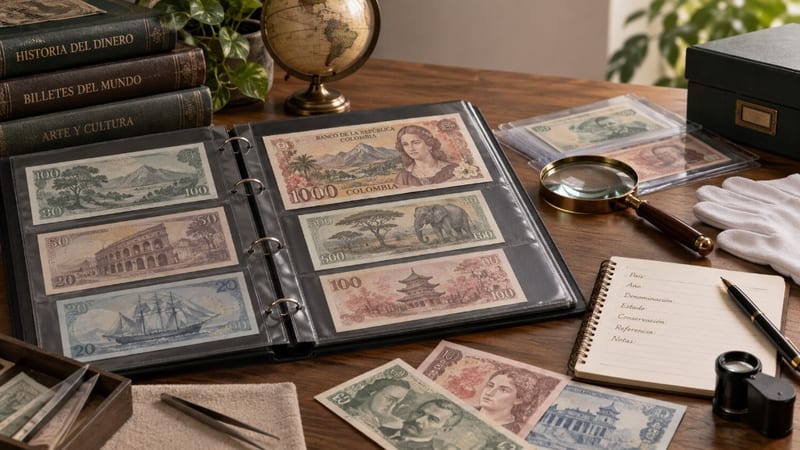
Starting a banknote collection is simpler —and cheaper— than many people think. Notaphily can begin with what you already carry in your wallet and grow at your own pace. These are the keys to taking the first steps well.
1. Choose a focus
Collecting “every banknote in the world” is overwhelming. Collectors enjoy it more when they pick a thread: a country (Colombia, for example), a historical period, a theme (portraits, fauna, trains), an issuing bank, or a type such as polymer notes. A clear focus gives the collection coherence and makes buying decisions easier.
2. Where to find pieces
The first pieces often come from daily change, family albums, or notes that have left circulation. Later, many collectors turn to numismatic fairs, auction houses, and specialist dealers. Always buy from trusted sources and, for expensive pieces, prefer those with clear backing or provenance.
3. Condition is everything
In notaphily, two identical notes can be worth very different amounts according to grade. They are classified on a scale that runs, broadly, from Uncirculated (UNC) to Good, passing through About Uncirculated, Extremely Fine, and Fine. Folds, stains, tears, and worn corners reduce value. At the start, learn to see these details before you buy.
4. Handling and storage
Paper money is fragile. Handle notes with clean, dry hands —or with gloves— hold them by the edges, and store them in acid-free sleeves (no PVC). Avoid direct sunlight, humidity, and heat. Never glue them, mark them, or “restore” them with tape: that destroys their value.
5. Classify and document
Keep a record of each piece: country, issuer, denomination, year, catalog number (banknotes are referenced by Pick number) and grade. A good catalog and an ordered inventory turn a pile of notes into a real collection.
Take the first step
If you are still choosing between coins and banknotes, it helps to read the difference between numismatics and notaphily. And for inspiration, explore our virtual collection and the glossary of terms, written for people who are just starting.
Sources
- Banco de la República of Colombia — educational resources on banknotes and their conservation (banrepcultural.org).
- Standard Catalog of World Paper Money (Albert Pick), the reference work for cataloguing banknotes.
- Conservation good practice from numismatic and notaphilic associations.
Frequently asked questions
How do I start a banknote collection?
Pick a focus — a country, a period, or a theme — and buy pieces you can document: issuer, date, Pick or a local catalog, and condition. A glossary and a type catalog keep you from overpaying for a common note or an inflated grade.
Do I need to grade the first pieces?
No. Grading matters for high-value pieces or when you need an authenticity referee. To start, a polyester sleeve and clear face and back photos are enough to keep an inventory.
Does Notofilia sell banknotes for beginners?
No. Notofilia is a private collection and a bilingual catalogue; nothing shown is for sale. The records and guides are for identifying types, not a shop window.