Published
Cacique Calarcá: a numismatic afterlife
In 1952 the ten centavos left silver for copper-nickel and put Calarcá’s profile into everyday change. The ordinary date was struck in the millions. The piece called Baltasar still has no verdict.
- Reviewed by
- Yezid Acosta
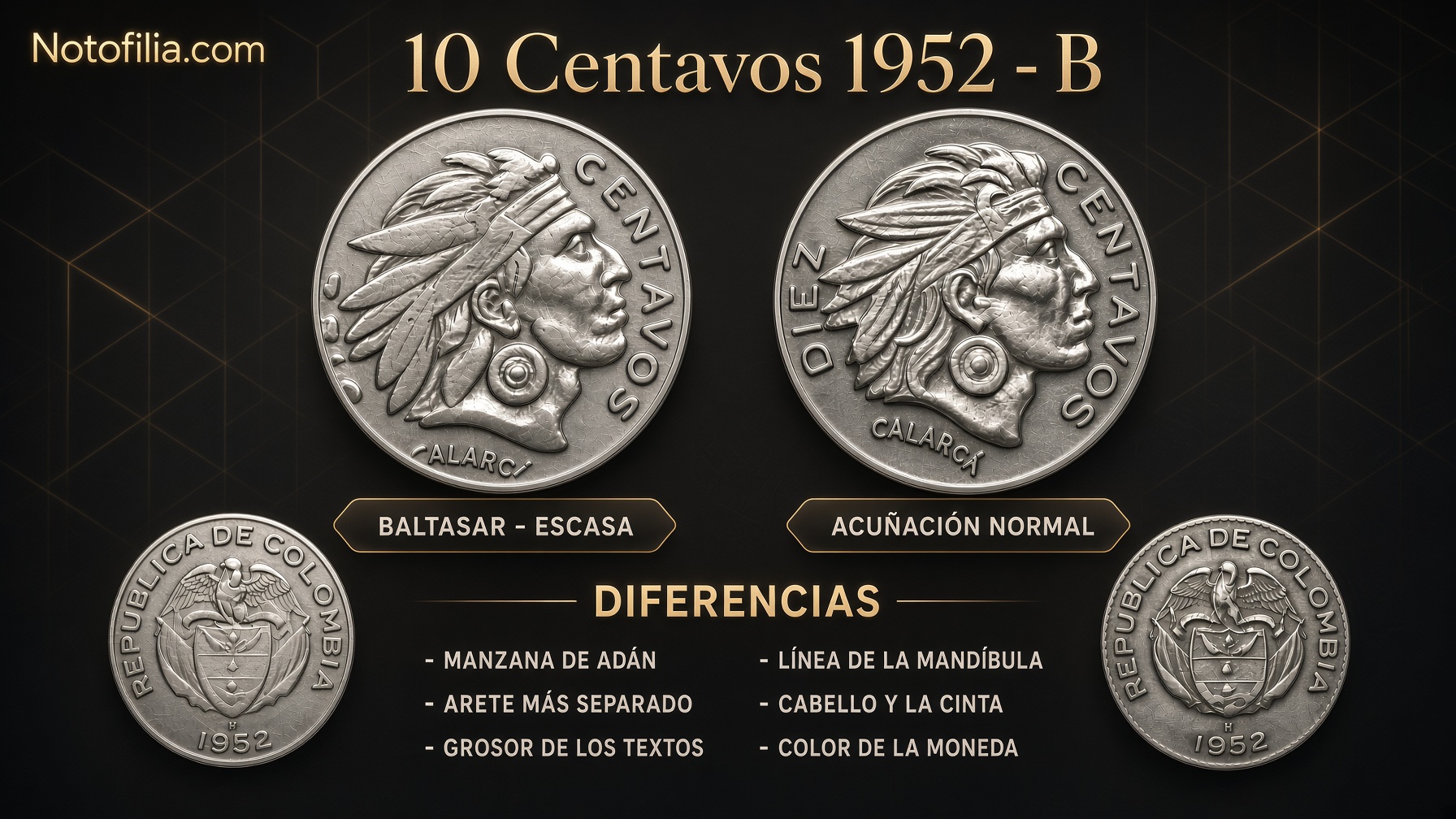
In 1952 the Colombian ten centavos changed metal and changed face. Until then the denomination was .500 silver, with the bust of Francisco de Paula Santander. That same year the Casa de Moneda de Bogotá also struck a copper-nickel piece with the profile of the Pijao leader Calarcá. The ordinary date of the new type was struck in the millions. The one collectors call Baltasar, or the different Indian, still has no verdict on authenticity.
This note is not a collection record. The plate compares two 1952 portraits with the B mint mark. The mintages below are catalogue figures. The Banco de la República annual coin workbook kept in this archive starts in 1987 and does not reach this date.
The name that stayed on the metal
Calarcá enters the chronicles of Pijao resistance in the early seventeenth century, during the campaign of Juan de Borja, president of the Real Audiencia. Two accounts of his death sit side by side, and they do not say the same thing.
The legend is a duel with Baltazar, a baptized Coyaima leader allied with the Spanish, sometimes placed at Peñas Blancas. Jaime Lopera Gutiérrez treats it as legend. Manuel Lucena Salmoral put it shortly in 1962: Calarcá did not die at Baltazar’s hands. The Numista (opens in a new tab) page for the copper-nickel type still summarizes that fight.
El Quindiano (opens in a new tab) (26 June 2024) gives the other version from Lopera and from Fray Pedro Simón, Noticias historiales, volume VI. In the Chaparral valley, Calarcá and the Indian Coyara attack Captain Diego de Ospina’s fort. In the struggle, Ospina shoots him in the chest. Simón writes that he died on the fifth day and that his people kept the death hidden for more than two months. Lopera rests that account on Ospina’s service report of 1650, cited as Archivo Nacional de Colombia, Miscelánea 73, folio 190. This page has not opened that folio. It cites the article and the editions the article names: Simón, Biblioteca Banco Popular, 1981, pages 411 to 414; Lopera, La colonización del Quindío, Banco de la República, 1986; Lucena Salmoral, Boletín Cultural y Bibliográfico, volume V, number 10, 1962.
The same article announces, for a later installment, the thesis that “Calarcá” was a warrior dignity and not a personal name. It is not treated as settled here. The coin, like Simón, presents him as a cacique.
Radio Nacional de Colombia (opens in a new tab) (16 January 2022) recalls that the municipality of Calarcá, in Quindío, was founded in 1886 under that name. The same text places the coin at the end of the 1960s. The catalogue does not. The type begins in 1952 and the last date is 1966.
From silver to copper-nickel
The earlier ten centavos is a different piece. Numista N# 10912 (opens in a new tab) lists it as KM# 207 and Restrepo 379: .500 silver, 2.50 g, 18 mm, reeded edge, years 1945–1952, Santander on the obverse. That silver was still struck in 1952: 1,060,000 pieces, KM# 207.2, which Numista concordances with Restrepo 379.10 and Hernández 416. It does not carry Calarcá.
The new type is Numista N# 5094 (opens in a new tab): KM# 212.1 and 212.2, Schön 31, Restrepo 380, copper-nickel, 1952–1966. Numista attributes both sides to the engraver Luis Alberto Acuña Tapias. The obverse carries the arms, the legend REPUBLICA DE COLOMBIA — without the accent, as the die cuts it — and the date at the foot. The reverse carries DIEZ CENTAVOS and, below the neck truncation, CALARCÁ, in profile to the right, with a feathered headdress.
The B is the Casa de Moneda de Bogotá. Bernardo González White, in a December 2014 note that Cristina Martín San Roque published in El Salón de Cris (opens in a new tab), places it between the base of the shield and the date. He writes that it ceased to be the ordinary mark from 1956. Numista agrees in outline: the large 1956 mintage has no B, and a 1956 B is listed separately with no mintage figure. That 2014 note is not a row in González White’s 2019 banknote catalogue, and no BG# is assigned to it here.
| Feature | 1952 B |
|---|---|
| Metal | Copper-nickel |
| Weight | 2.50 g |
| Diameter | 18.0 mm (KM# 212.1, Restrepo 380.1). From 1954, 18.5 mm (KM# 212.2) |
| Thickness | 1.31 mm on Numista’s type page |
| Edge | Reeded |
| Alignment | Coin (↑↓) |
| Catalogue mintage | 6,035,000 |
Those 6,035,000 are the ordinary date, not the variety. The other small-module year, 1953 B, is listed on Numista at 6,985,000. González White notes that there were no dates 1957 or 1958. Numista’s list does not have them either. The last date of the type is 1966.
In that 2014 note, González White gives other round figures — about 36 million each for 1956 and 1959, and 61.7 million “in 1963” — which do not match Numista’s current table: 1956, 77,705,000; 1959, 36,653,000; and 61,672,000 belongs to 1964, not to 1963. Later dates follow Numista. The 18 mm diameter, the place of the B, and the variety follow the 2014 note.
Baltasar, or the different Indian
The date 1952 became famous for another die. In December 2014 González White wrote that the authenticity of that “variety” still had no clear reading. It might be a pattern that left the mint, or a contemporary counterfeit. He called it Baltasar, or the different Indian. More than seventy years have passed since the coin’s date, and the note does not close the case. This page does not either.
The nickname “la Cotuda,” for the bulge at the neck, circulates in collector speech. It is not in the 2014 note, and it is not the plate’s label. The plate says “Baltasar” on one side and “ordinary strike” on the other.
González White adds a detail the plate does not show. He knows two pieces with the reverse inverted, and they are not the same: one has an open 9 in the date and the other a closed 9, with other small differences in the numerals. He writes that the first remained in the collection of JFK and the second in that of ERM, collectors who have since died. He does not publish their full names. They are not invented here.
What the plate marks
The comparison above is not González White’s text. It is a Notofilia plate of two 1952-B portraits — the “faces,” in everyday speech — with the arms reverses below. It marks six differences. They read as design observations, not as a laboratory finding.
| Detail | Ordinary strike | Portrait called Baltasar |
|---|---|---|
| Neck | A fine larynx, a narrow neck | A marked bulge on the front of the neck |
| Earring | Against the cheek | Set farther out from the outline of the face |
| Legends | Thinner strokes | Heavier letters, in the rim legend and in the date |
| Jaw | A soft curve | A more rigid angle |
| Hair and band | A clearer line; the band follows the skull | Flatter hair; the band does not sit with the feathers in the same way |
| Color | The tone of the ordinary copper-nickel piece | The plate sees it as different. That can suggest another mix. It is not assayed here |
No price on this page
Numista, Foronum, and the price guides publish ranges for the ordinary date. They are not copied. For the Baltasar variety, the sources checked here do not leave a public hammer this page can cite. An asking price in a video is not an auction result. The editorial policy asks for that distinction, and asks that a text which does not show a lot not be turned into an auction lot.
The piece struck in the millions and the disputed portrait are not measured with the same stick. Sharing the year 1952 and the B mint mark does not make them the same die.
The copper-nickel ten centavos put an indigenous leader into everyday small change, in the year that denomination left silver — without the Santander silver vanishing altogether: both metals are dated 1952. The Baltazar of the legend and the collectors’ “Baltasar” share a name. They do not share the same kind of evidence. One is an account of the seventeenth century. The other is a die about which González White would not say whether it came from the mint or from a clandestine workshop.
More Colombian coin, from cobs to the peso, is in the Colombia numismatics case. The study of coin, apart from paper, is in the glossary.
Primary sources
- Numista — 10 centavos, Calarcá, 1952–1966 (N# 5094) (opens in a new tab)
- Numista — silver 10 centavos, Santander, 1945–1952 (N# 10912) (opens in a new tab)
- Bernardo González White, “Baltasar” or “different Indian,” December 2014, in El Salón de Cris (opens in a new tab)
- El Quindiano, 26 June 2024 — Calarcá’s death according to Lopera and Fray Pedro Simón (opens in a new tab)
- Radio Nacional de Colombia, 16 January 2022 — the town’s name (opens in a new tab)