Published
Source: CoinWeek (opens in a new tab)
The 1974-S aluminum cent at US$199,687
CoinWeek (20 November 2026) reports the GreatCollections 1974-S cent. The archive gives US$199,687.50; the headline writes US$199,687.
- Reviewed by
- Yezid Acosta
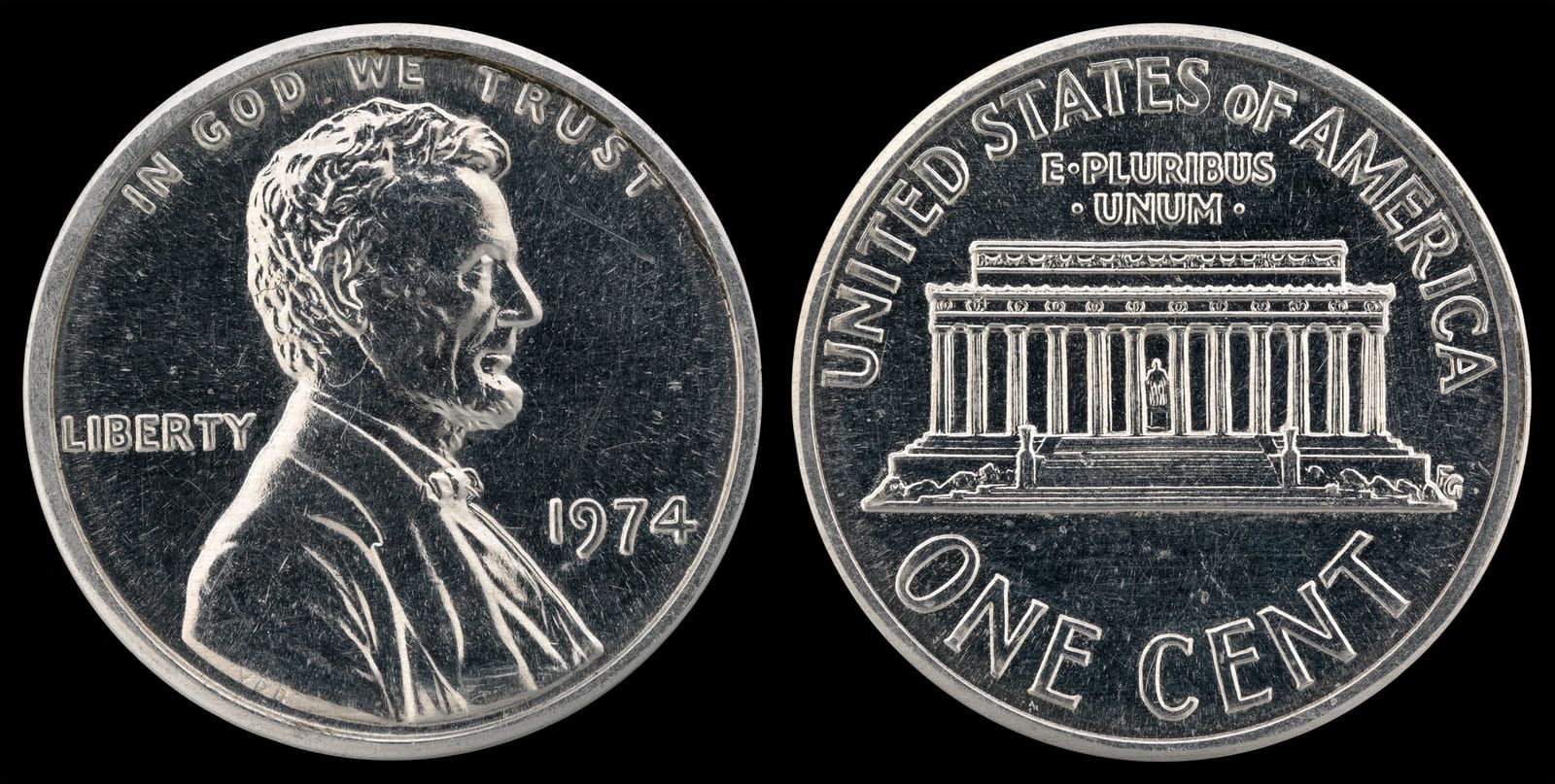
On 20 November 2026, CoinWeek (opens in a new tab) published the 1974-S Lincoln cent struck in aluminum that GreatCollections sold on 22 January 2023. The headline writes US$199,687. The house archive and Ken Potter (opens in a new tab) put the sale at US$199,687.50. The coin is not in Notofilia’s virtual collection. It is not one of the experimental prototypes the United States Mint claims as government property.
The price
Item 1272991 (opens in a new tab) identifies the coin: 1974-S Lincoln Cent Struck in Aluminum, PCGS Proof-68 Cameo, certification 43626249, from Stewart Blay’s Red Copper Collection. It closed on Sunday, 22 January 2023, at 8:11:59 p.m. as printed on the page, with no time zone, after 114 bids. The page we opened does not show the sold amount. It does publish the buyer’s-premium schedule: 12.5 percent (minimum US$5), or 10 percent if payment is by check, eCheck, or wire. The house error archive (opens in a new tab) writes “Sold for $199,687.50.” Potter, on 10 February 2023, gives the same figure for the only striking error in that auction — a 1974-S cent in aluminum on a Nepalese 2-paisa planchet, PF-68 Cameo — and closes by saying that every price in his note includes the buyer’s fee. CoinWeek also says the US$199,687.50 includes the premium. This note takes that figure from the archive and from Potter, and does not rebuild a hammer.
The planchet
The GreatCollections description says the San Francisco proof was struck on a Nepalese coin, that it is believed unique, and that it is likely one of only two 1974 aluminum cents that can lawfully be owned. The other, on that text, would be a reverse with no struck design, on a Philippine planchet. Potter names the 2 paisa. CoinWeek adds that the aluminum 2 paisa carried King Birendra’s name and the Himalayan monal, and it gives about 18.8 mm against 19.05 mm for an ordinary Lincoln cent. It also says the PCGS label identifies the material as a Nepalese aluminum 2 paisa. We did not open that label or a Nepal catalogue, and we did not measure a planchet. The mint mark S sits under the date, on the obverse.
CoinWeek describes the result: Lincoln’s portrait and the Memorial on the reverse, the silvery look of aluminum, and a full proof strike, unlike an off-center error. Proof-68 Cameo is the holder’s grade and the contrast between frosted devices and mirror fields.
The other 1974-S
CoinWeek reports a second coin, ten days earlier. On 12 January 2023, it writes, Heritage sold a 1974-S cent graded PCGS MS61: the obverse struck on an aluminum planchet meant for a Philippine 1-sentimo coin, the reverse with no struck design. It credits the house with the account that the aluminum planchet rested on a bronze cent planchet, so the upper die struck the aluminum and the reverse die struck the bronze beneath it. It gives that Philippine planchet about 15.25 mm and 0.5 g, and says part of LIBERTY fell outside the struck area. This note did not open the Heritage lot page and does not copy a price from that sale.
The prototypes
The summary of case USM 09 0050, in the Treasury Inspector General file published by GovernmentAttic (opens in a new tab), says that in 1974 the Mint proposed aluminum to replace copper and struck approximately 1.57 million aluminum pieces patterned after that year’s cent, as prototypes for the metal and for production. Some of the pieces given to members of Congress for examination were never returned. Daniel P. Shaver’s letter of 26 March 2009, in the same file, speaks of pieces produced in 1973 and not issued, bearing the inscription “1974,” solely as experimental prototypes. This note does not choose between 1973 and 1974.
The letter states the Mint’s position: it never issued those pieces and had no lawful authority to issue them; it regards them as property of the United States; no one may lawfully circulate, sell, buy, or hold them; and, because no one can acquire valid title, they are subject to recovery by the Secret Service. The same policy, the letter says, covers similar experimental prototypes the Mint had no lawful authority to issue. CoinWeek writes “more than 1.4 million.” This note stays with the summary’s 1.57 million. CoinWeek also tells of a 1974-D cent that was to be auctioned in 2014, a federal lawsuit, and a March 2016 settlement in which the Mint announced it had recovered that Denver piece. We did not open the complaint or a 2016 release. Shaver’s letter is about the prototypes. We do not extend it to the San Francisco foreign-planchet error. A GreatCollections sale is not a judgment. CoinWeek says PCGS, GreatCollections, and Heritage have treated these errors as collectible and lawful to own, and it warns that market recognition does not cover every aluminum cent that survived.
The aluminum trial was already in another column, in Seven 1982 cents remain in circulation. There the figure was “more than a million,” taken from Numismatic News. Here the file gives 1.57 million.
The photograph
The picture is not the 1974-S from item 1272991. It is an experimental 1974 aluminum cent (Judd J2151, Pollock P2084) from the National Numismatic Collection, photographed by Jaclyn Nash. It is on Wikimedia Commons (opens in a new tab), in the public domain, with credit to the National Museum of American History. It shows the prototype the file discusses. It is not the San Francisco proof on a Nepalese planchet, not the GreatCollections photograph or CoinWeek’s, and not a piece in the collection.
Primary sources
- CoinWeek — the 1974-S aluminum cent (20 November 2026) (opens in a new tab)
- GreatCollections — item 1272991, 1974-S Lincoln Cent Struck in Aluminum, Proof-68 Cameo (opens in a new tab)
- GreatCollections — error archive, “Sold for $199,687.50” (opens in a new tab)
- Numismatic News — Ken Potter, the 2-paisa error (10 February 2023) (opens in a new tab)
- Treasury Inspector General — case USM 09 0050, aluminum prototypes and Shaver’s letter (26 March 2009) (opens in a new tab)
- Wikimedia Commons — experimental 1974 aluminum cent, National Numismatic Collection (opens in a new tab)
Source: CoinWeek (opens in a new tab)
Editorial policy, sources, and valuation
Comments
Share your view. Comments appear after they are reviewed.
Loading comments…