Design
Watermark
Filigrana
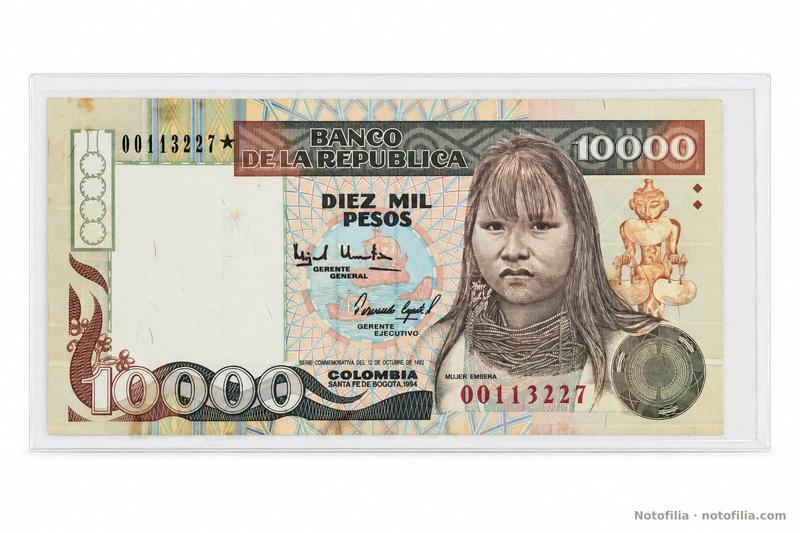
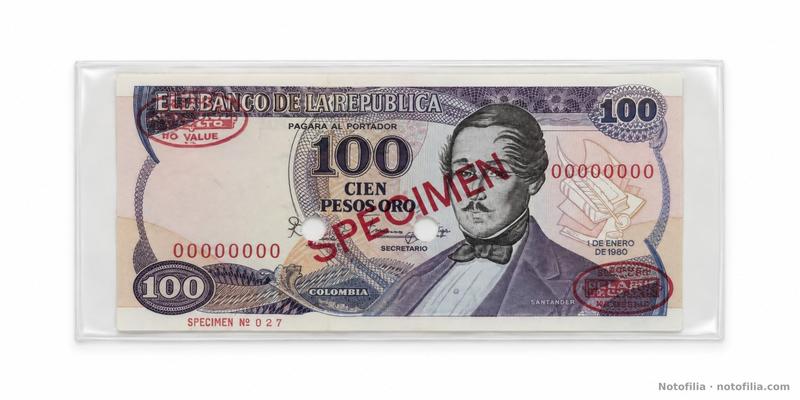
A watermark is a design formed in the paper pulp when the sheet is made, visible when held to light. It is not printed on top: it is different densities of fibre. On banknotes it is often a portrait, an emblem, or a denomination. González White notes, for several rows of the 1977–1980 100 pesos oro, a Liberty-emblem watermark. The 1994 Emberá 10,000-peso note has a watermark area in the margin; the record for 00113227 registers two foxing spots exactly there, and 00249902 shows slight yellowing.
A watermark is not a see-through register, which aligns face and back inks. It is not a polymer window either, which is a cut-out or a translucent zone of the Guardian substrate. On colonial paper and on this collection’s 1779 Continental Currency, the leaf nature print on the back is another anti-counterfeiting device, engraved, not a watermark. Confusing those three phenomena — watermark, register, nature print — leads to a bad description of the piece.
In photography the watermark reads best by transmitted light; Notofilia records do not replace that view with an invented crop. If an example is slabbed, the holder makes backlighting hard: the Victory 20-peso PMG 55 EPQ is described by the volcano and certificate 8083882-032, not by a watermark the capsule does not let one read with certainty. A watermark is not asserted here on a Pick if the cited source does not name it. The term stays anchored to pieces whose records already mention it.
A misread watermark leads one to attribute a Liberty portrait to a type that does not carry it, or to call a polymer window a watermark. This collection’s polymer records describe a window, not a watermark. The 1945 ABNC paper is cited here because it is central-bank cotton, the substrate on which a watermark makes sense.
Examples in the collection
See also: See-through register