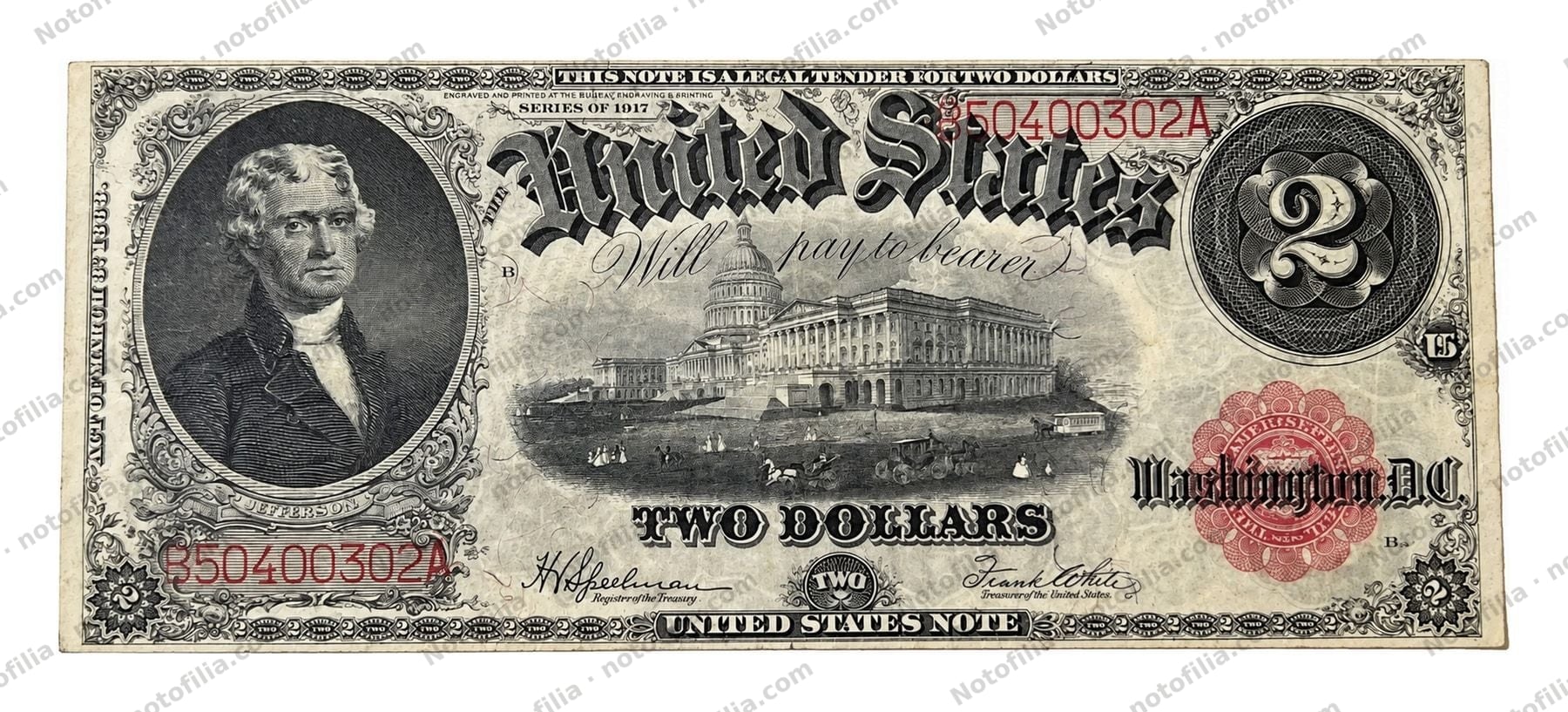
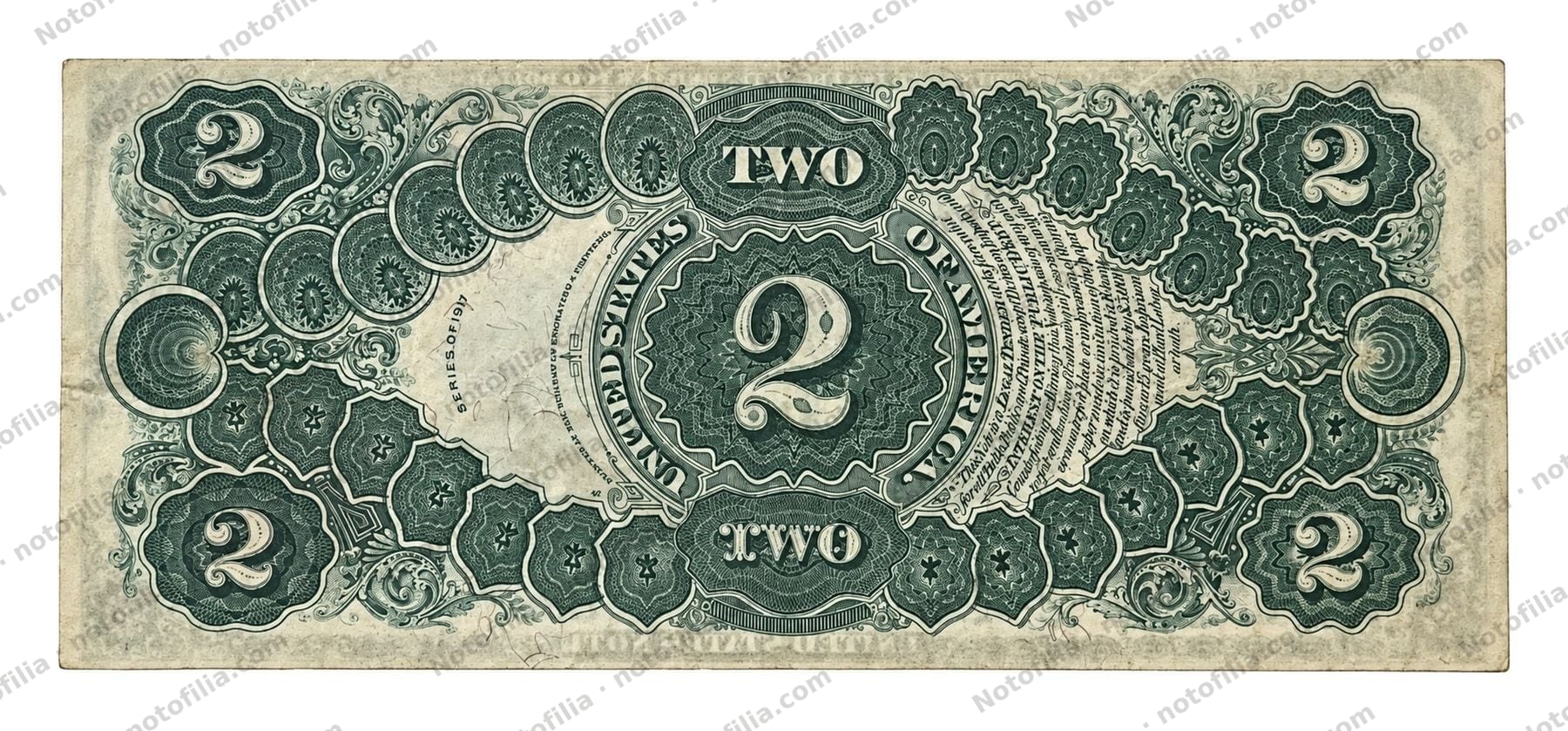
United States · United States Note
$2 note, 1917
$2 · United States Note · Series 1917
Large-size face with Jefferson, the Capitol, and a red Treasury seal; Bracelet reverse. Series 1917, Fr. 60, serial B50400302A, Speelman–White signatures.
Catalog facts
- Pick reference
- P#188(4) · Fr. 60
- Serial number
- B50400302A
- Signatures
- Harley V. Speelman (Register of the Treasury) and Frank White (Treasurer of the United States)
- Condition
- Circulated, unslabbed (private collection)
- Printage
- Bureau of Engraving and Printing. Printed Series 1917, under the act of 3 March 1863. Plate letter B. USPaperMoney.Info places serial B50400302A (BA block) in the mixed Elliott-White / Speelman-White band B44800001A–B56688000A; the Speelman-White-only regular range begins at B56688001A. The printed signatures are Speelman–White (Fr. 60; P#188(4)). This record does not invent a printage for Fr. 60 or for this serial.
Face
Back
The note
The Series 1917 $2 (Pick 188(4), Friedberg 60) is a large-size United States Note — also a Legal Tender Note, or greenback. The black face with a red seal and serials carries Thomas Jefferson’s portrait in an oval at left, lettered JEFFERSON, and an engraving of the Capitol at center. The upper arc reads THIS NOTE IS A LEGAL TENDER FOR TWO DOLLARS; below it, SERIES OF 1917 and the imprint “ENGRAVED AND PRINTED AT THE BUREAU OF ENGRAVING & PRINTING.” The blackletter title United States introduces the promise Will pay to bearer TWO DOLLARS. At right a medallion with the figure 2 and the scalloped red Treasury seal sit over WASHINGTON, D.C. The left border cites the ACT OF MARCH 3RD 1863. The signatures are Harley V. Speelman’s (Register of the Treasury) and Frank White’s (Treasurer of the United States). Red serials B50400302A repeat at lower left and upper right (BA block); plate letter B sits beside the portrait and beside the 2. The lower tablet reads UNITED STATES NOTE. The green back is the type collectors call Bracelet: interlocking circular shields around the central 2, UNITED STATES OF AMERICA, and TWO above and below, with the legal-tender clause and the counterfeiting penalty in the scrollwork. Collectors call these large-format notes horse blankets, the size in use before the 1929 reduction. This collection piece, circulated and unslabbed, is shown on both faces.
The large-size $2
The act of 25 February 1862 authorized United States Notes as legal tender for public and private debts. They replaced the Demand Notes of 1861; the nickname “greenback” was born on those green backs and traveled with this class. A red seal and red serials mark the type. The BEP engraved them from Series 1869. The last delivery to the Treasury was in 1971; none have been placed in circulation since 21 January 1971. Outstanding notes remain redeemable at face. The U.S. Currency Education Program and the BEP FAQs place that line.
The Series 1917 $2 is the large-size Legal Tender with Jefferson and the Capitol: Fr. 57 Teehee–Burke, Fr. 58 Elliott–Burke, Fr. 59 Elliott–White, and Fr. 60 Speelman–White, which Numista numbers P#188(1) through P#188(4). The printed year is the series, not each sheet’s press date: Speelman and White overlapped in office in the 1920s, so Fr. 60 was printed after 1917. The Bracelet reverse names the type. In 1929 the BEP cut the format by about 30 percent — from about 7.375 × 3.125 inches to 6.14 × 2.61; Numista gives 189 × 80 mm for this $2. The small-size United States Note $2 ran through 1966; the FRN $2 with the Trumbull reverse returned in 1976.
Scarcity and printage
The 1917 $2 is an accessible large-size type. Speelman–White (Fr. 60; P#188(4)) is the most common signature pairing: Numista records that 85 percent of members who own type N#212833 have that variety, a measure of presence in collections, not of auction supply. USPaperMoney.Info assigns it the longest regular blocks in the series. As a working denomination, heavily circulated, creased, or stained notes are plentiful; well-centered examples with bright paper, vivid red overprints, and sound margins — in practice, Very Fine or better — are scarcer. Advanced collectors look for Speelman–White mules: mismatched face and back plate sizes, in this series involving plate numbers 59 and 60. This record does not identify serial B50400302A as a mule and does not invent a census or a market premium.
Population
A PMG or PCGS census for serial B50400302A has not been independently verified. The note is shown unslabbed, with no certificate number.
Sources
- USPaperMoney.Info — Series 1917 $2 USN (opens in a new tab)
Jefferson at left, Capitol at center, Bracelet back. Serial ranges by signature, including mixed EW/SW B44800001A–B56688000A and Speelman-White from B56688001A.
- Numista — 2 Dollars, United States Note (N#212833) (opens in a new tab)
Fr. 60 and P#188(4) for Speelman–White; small red seal at right; 189 × 80 mm. Frequency 85 percent among members who own the type. Price columns are not republished.
- Bank Note Museum — P-188, Series 1917 $2 United States Note (opens in a new tab)
Red-seal United States Note; Jefferson and the Capitol; 188(4) Speelman and White signatures.
- U.S. Currency Education Program — $2 note (opens in a new tab)
Jefferson on the $2 face; the FRN with the Trumbull reverse from 1976, after the United States Note.
- Bureau of Engraving and Printing — FAQs (opens in a new tab)
United States Notes: first national paper (1862); last placed in circulation 21 January 1971.
- National Museum of American History — $2 Legal Tender Note, 1917 (opens in a new tab)
Act of 3 March 1863; Series 1917; Jefferson; legal-tender clause and counterfeiting penalty on the back.
- Wikipedia — United States two-dollar bill (opens in a new tab)
United States Note $2 through 1966; FRN from 1976 with the Trumbull reverse.
Related pieces
Other records from the same issuer or era in this case.