United States · United States Note
$1 note, 1928
$1 · United States Note · Series 1928
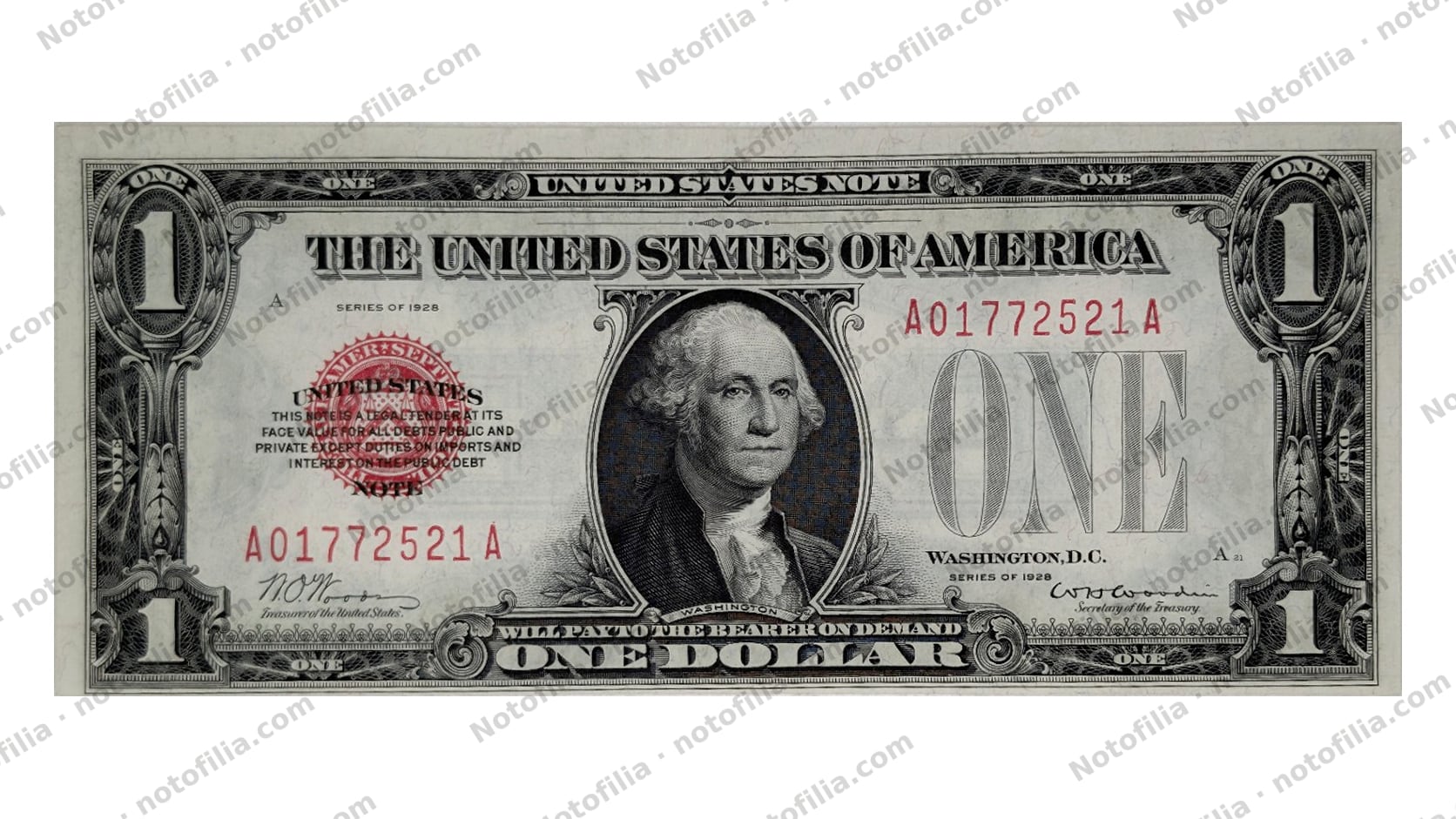
Small-size face with Washington, a red seal, and red serials; Funnyback reverse. Fr. 1500, serial A01772521A, Woods–Woodin.
Catalog facts
- Pick reference
- P#377 · Fr. 1500
- Serial number
- A01772521A
- Signatures
- W. O. Woods (Treasurer of the United States) and W. H. Woodin (Secretary of the Treasury)
- Condition
- Circulated, unslabbed; handling creases and some paper toning; complete margins; no numerical grade from the photographs (private collection)
- Printage
- Bureau of Engraving and Printing, Washington, D.C. Printed Series 1928, as SERIES OF 1928. The series designation does not prove that this specimen was printed in calendar year 1928. Jamie Yakes (Paper Money, January/February 2013, whole no. 283) documents that the BEP suspended face printing on 12 April 1933, serial-numbered 1,872,000 notes, and delivered them to the Treasury between 26 April and 3 May 1933. A final sheet of twelve, serials A01872001A–A01872012A, was numbered in fiscal year 1934. The regular total is 1,872,012, range A00000001A–A01872012A. Serial A01772521A falls in the A–A block, late in that range: 99,491 positions lie between this counter and A01872012A. Plate position A, face plate 21, and back plate 2467. The printed signatures are Woods–Woodin (Fr. 1500; P#377). The serial is ordinary: it is not low (1–100), it is not fancy, and it is not a star. Numista gives the type as 156 × 67 mm. That is not a measurement of this piece.
Face
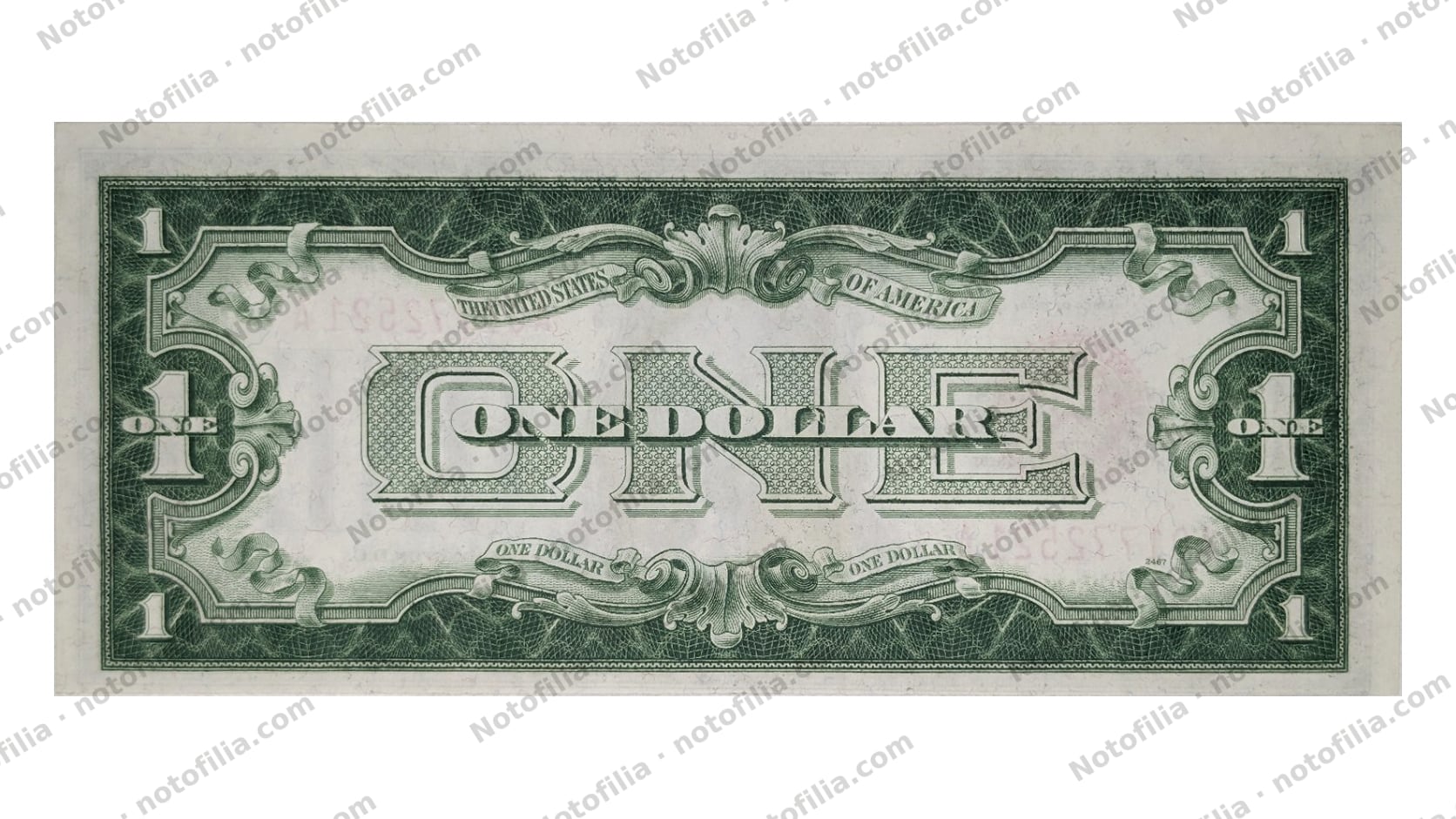
Back
The note
The Series 1928 $1 (Pick 377, Friedberg 1500; Numista N#202363) is a small-size United States Note — also a Legal Tender Note — and the only $1 of that class in the reduced format of 1929. The black face with a red seal and serials carries George Washington in an oval. The upper arc reads UNITED STATES NOTE; below it, THE UNITED STATES OF AMERICA and SERIES OF 1928. At left the red Treasury seal surrounds the clause THIS NOTE IS A LEGAL TENDER AT ITS FACE VALUE FOR ALL DEBTS PUBLIC AND PRIVATE EXCEPT DUTIES ON IMPORTS AND INTEREST ON THE PUBLIC DEBT. Jamie Yakes explains that the BEP engraved UNITED STATES NOTE around that clause because a red seal could fade and, at redemption, be confused with the $1 Silver Certificate. The lower border reads WILL PAY TO THE BEARER ON DEMAND ONE DOLLAR. At right a large engraved ONE sits above WASHINGTON, D.C. The signatures are W. O. Woods, Treasurer of the United States, and W. H. Woodin, Secretary of the Treasury. Red serials A01772521A repeat at upper right and lower left (A–A block). Plate letter A sits left of the portrait, beside SERIES OF 1928; at the right, beside the Woodin signature, the marking is A 21. The green reverse is the type collectors call Funnyback: an ornamental ONE at center, crossed by ONE DOLLAR, with THE UNITED STATES OF AMERICA on the upper ribbon and ONE DOLLAR on the lower ribbons. Back plate 2467 sits in the lower right margin. It does not carry the eagle or the pyramid of the Great Seal. The red seal, the red serials, and the legend UNITED STATES NOTE separate it from this collection’s Series 1928A $1 Silver Certificate (Fr. 1601, serial D00508932B). This piece, circulated and unslabbed, is shown on both faces.
The only small-size Legal Tender $1
The act of 25 February 1862 authorized United States Notes as legal tender. A red seal and red serials mark the type. In 1929 the BEP cut the format by about 30 percent and the printed series became 1928. The legal-tender $1 in that format is this issue alone, Fr. 1500. Yakes, using Bureau of the Public Debt files at the National Archives, places the printing in March and April 1933: $1 Silver Certificate reserves had fallen with Depression withdrawals, and the law then in force capped those certificates. The Treasury turned to the United States Note, which did authorize a $1. The BEP altered a face die to the Woods–Woodin signatures and began finishing steel plates on 24 March 1933. The feared shortage did not arrive. Face printing stopped on 12 April.
The BEP serial-numbered 1,872,000 notes from the stock already printed and delivered them between 26 April and 3 May 1933. A separate order numbered the final sheet A01872001A–A01872012A in fiscal year 1934, and the regular total became 1,872,012. USPaperMoney.Info gives that range as A00000001A–A01872012A. Counter 01772521 sits late in the regular run, 99,491 positions short of A01872012A. The first 8,000 went to the cash room in the Treasury building; Yakes puts at 2,783 the notes cashiers handed to dignitaries and the public before the rest returned to reserves. The BEP also printed 24,000 star replacements. From reported specimens Yakes estimates that about 8,000 were issued; the census he cites runs to 7892. USPaperMoney.Info publishes the star range *00000001A–*00024000A. Numista numbers the replacement Fr. 1500* and lists 8,000 in the printed column. This record does not turn those figures into a survivor census, and serial A01772521A is not a star.
Most of the stock stayed in reserves for about fifteen years. In late 1948 demand for $1 notes again pressed the reserves, and the Treasury decided to circulate the remaining inventory by sending it chiefly to Puerto Rico, so it would not mix on the mainland with Silver Certificates. The table in Yakes, drawn from bimonthly Treasury inventories, records 400,000 on 30 November 1948, 500,000 on 14 January 1949, 400,000 on 15 February, 420,000 on 15 March, and 144,000 on 15 April, until reserves stood at zero. Those deliveries exhausted the inventory that remained. Serial A01772521A sits far above the first 8,000, so it belongs to that stored stock and not to the 1933 cash room. This record does not cite a shipment ledger that names this serial: Puerto Rico circulation is the inference the position in the printage allows, not an individual provenance. William H. Woodin was Secretary of the Treasury for 303 days, from 4 March to 31 December 1933. The Woods–Woodin pairing, according to Yakes, appears on only three early small-size issues: this $1, the Series 1928C $1 Silver Certificate, and the Series 1928D $5 Federal Reserve Note.
Scarcity and printage
Woods–Woodin (Fr. 1500; P#377) is the only signature pairing of the small-size United States Note $1. Counter 01772521 is an ordinary serial, late in the regular range and far from the first 8,000 of the 1933 cash room. Face plate 21 is among the steel plates 1 through 30 that Yakes documents in service on 8 April 1933. Yakes also showed that plate 12, rumored for years to be rare, was on press from 27 March to 12 April 1933 with the others. The regular printage of 1,872,012 is short for small-size paper; storage before 1948–49 explains why high-grade pieces survived. This record invents neither a current census nor a market premium. Star replacements, very low serials, and the final sheet are another matter: this example is none of them.
Population
A PMG or PCGS census for serial A01772521A has not been independently verified. The note is shown unslabbed, with no certificate number.
Sources
- Jamie Yakes — Series of 1928 $1 United States Notes (Paper Money, whole no. 283, 2013) (opens in a new tab)
Printing in March–April 1933; 1,872,000 delivered 26 April–3 May; final sheet in 1934; 2,783 paid out at the cash room; Puerto Rico shipments in 1948–49; 24,000 stars printed and about 8,000 issued; plate 12 in ordinary use; Woods–Woodin on three issues.
- USPaperMoney.Info — Series 1928 $1 USN (opens in a new tab)
Woods–Woodin signatures. Regular range A00000001A–A01872012A. Stars *00000001A–*00024000A. Delivery to the Treasury in April and May 1933.
- Numista — 1 Dollar, United States Note, red seal (N#202363) (opens in a new tab)
Fr. 1500 and P#377; Woods–Woodin; 1,872,012 printed; 156 × 67 mm. The replacement is Fr. 1500*, with 8,000 in the printed column. Frequency 92 percent among members who own the type. Price columns are not republished.
- Bureau of Engraving and Printing — History (opens in a new tab)
Reduction to small size in 1929. This piece sits on the small-size side of that line.
- Bureau of Engraving and Printing — FAQs (opens in a new tab)
United States Notes: last placed in circulation 21 January 1971. Outstanding notes remain redeemable at face.
Related pieces
Other records from the same issuer or era in this case.