Published
Source: DutchNews (opens in a new tab)
A gold half Philipsdaalder of 1580
DutchNews (12 November 2026) reports the 1580 gold half Philipsdaalder. Lot 5574 separates €300,000 and €369,002 with the premium.
- Reviewed by
- Yezid Acosta
On 12 November 2026, DutchNews (opens in a new tab) reports that a Frisian gold half Philipsdaalder, dated 1580, sold on Wednesday at Heritage Auctions Europe in IJsselstein. The page for lot 5574 (opens in a new tab), in the sale Coins, Currency and Medals November 2026, opens the live session on 11 November at 09:00. AD (opens in a new tab) dates its report to that evening, 21:40, and speaks of Wednesday afternoon. The coin is not in Notofilia’s virtual collection.
The price
The lot page lists a starting price of €50,000, a realisation of €300,000, and €369,002 with the buyer’s premium. The house news page (opens in a new tab), DutchNews, NOS (opens in a new tab), and AD write €369,000. AD says the coin “ging onder de hamer” for that figure and, further down, speaks of a “hamerprijs van ruim 3,5 ton.” This note does not turn those sentences into a second hammer. The realisation that leaves the premium aside is the one on the lot page: €300,000. The €369,002 is the total with the premium. The €369,000 is the round figure in the press and on the house news page. This note does not account for the two euros.
NOS writes that bidding opened at €50,000, that the house presents the coin as the most expensive Dutch provincial coin ever auctioned, and that the buyer is not named. DutchNews repeats that provincial record and does not name a buyer either. AD, by contrast, calls it the second Dutch provincial coin: only the eightfold rose noble of Kampen, sold in 2022 for €700,000, would stand above it. This note does not open that Kampen sale and does not choose between the two sentences.
The previous Frisian record is not one line either. NOS gives US$105,000 (almost €95,000) for a Frisian coin, and does not name the type. AD names a gold florin of 1688, hammered in the United States for a little over US$100,000. This note does not open that sale and does not merge the two lines into one lot.
AD quotes Jacco Scheper, of the house: the result sits in a run of rare pieces, and the same thing shows up in Pokémon cards and in old video games. DutchNews picks up that comparison, also by way of AD.
The piece
It is a half Philipsdaalder of 1580, mint of Leeuwarden, with the city’s arms as the mint mark. The lot page calls it an off-metal trial strike in gold, on the weight of four ducats: 13.27 g, and it grades the coin a.UNC. The house news page speaks of a gold proefslag, with the same dies as the silver half, the only gold example known, and 13.27 g “equal to four gold ducats.” AD calls it a gouden afslag. This note does not treat those three words as one grade. There is no third-party certificate. a.UNC is the house’s word, not an NGC or PCGS grade.
The obverse, on the lot page, carries the bust of Philip II to the left and arms that split the date. The printed legend is PHS · D · G: HISPAN · Z · REX · DNS · FRISI. The reverse carries the crowned arms of Philip II, flanked by firesteels and sparks, with the Order of the Golden Fleece below. The legend is ·DOMINVS · MIHI · ADIVTOR ·. The lot page’s references are Vanhoudt/Saunders Gold 1477 (this coin), cf. Vanhoudt 390 (silver), CNM 2.16.1 (silver), and Delmonte 78 (silver). The lot page calls it the first coin of the province of Friesland and the only known regular half Philipsdaalder in gold.
A mint of a few weeks
The lot page dates 1 February 1580 as the occupation of the Kanselarij in Leeuwarden, the last Spanish and Catholic stronghold in the city, and Friesland’s passage under the revolting Estates. They had already signed the Union of Utrecht. Almost at once they asked Lodewijk Alewijn — a mintmaster who had held that post at Vianen and had been assayer at Utrecht — to open the new mint. He rented the “olde cancellerie,” on the Tweebaksmarkt. The first dies were “koningsmunten”: pieces still in the name of Philip II, the king the revolt had renounced. The lot page sees the same thing in Holland, Utrecht, Zeeland, and Overijssel, with dates running to 1580 or 1581. In Friesland that phase was shorter, and very few half Philipsdaalders were struck. Of a full Philipsdaalder, the lot page says a striking has been supposed, and that none has turned up.
In silver, the lot page knows two halves, both from the same pair of dies as the gold. One is in the British Museum, inventory G3,FDSC2.5, from the collection of George III. The other is in the Fries Museum, inventory NY11944; it had belonged to H. Quintus and appeared in the T. Bom sale of December 1882, lot 306. It had been regarded as unique. NOS quotes Scheper in a shorter version: one in the Fries Museum and one in London, and he had not known the gold piece existed. This note does not open the museum’s record.
The weight of four ducats is the house’s comparison, not a sum made here. In this case, the 1761 Utrecht ducat weighs 3.47 g and is .986 gold. It is a later trade coin — on this collection’s record the type enters the mint act on 4 August 1586 — not this strike. This note does not multiply those 3.47 g by four to match them to 13.27. The collection’s history of Netherlands coinage reaches the provincial mints and the ducat, and it does not record this half Philipsdaalder. In the collection’s numismatics this type has no record.
From Rengers to the room
The lot page and the house news page place the coin in the collection of Wilco Julius van Welderen baron Rengers (1835–1916), a Frisian nobleman and mayor of Leeuwarden from 1877 to 1883. The only public appearance the lot page recalls is the Historische Tentoonstelling van Friesland, in the summer of 1877, in the Stadhouderlijk Hof, case 88. The catalogue, the lot page says, noted: “½ Philipsdaalder van 1580, in gouden proefslag, hoogst zeldzaam.” It then went back to the family. Around 1970, Jacques Schulman saw it and took a pencil rubbing; from that, the lot page says, comes the Vanhoudt/Saunders note. The coin was not published in other reference works, and this is the first time it has come to the open market. That is the house’s account.
NOS adds a stretch the lot page does not tell. A few months ago a woman came to the house with a handful of coins. Scheper says: “Die mevrouw wist niet wat ze had” — that lady did not know what she had. NOS writes that the coin had been missing for 150 years. The last public case the lot page dates is the one in 1877. From 1877 to 2026 is 149 years. The 150 is NOS’s figure.
The photograph
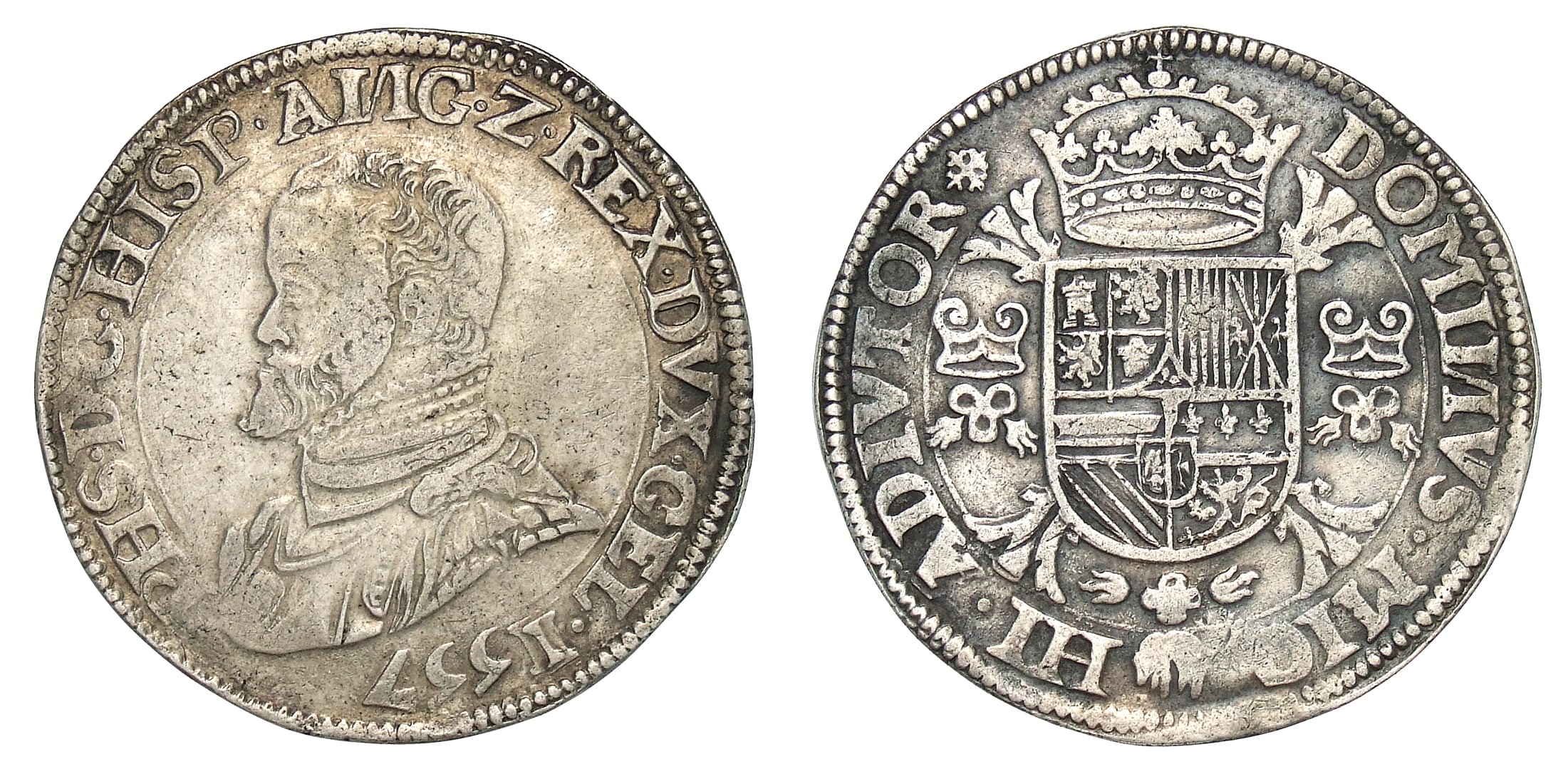
The picture on this note is not the 1580 gold. It is a silver Philipsdaalder of Nijmegen, 1557, from the Berlin Münzkabinett (opens in a new tab), object 18203563. The cabinet’s record calls it a Philippstaler, silver, 34.07 g, 44 mm, and cites it as Delmonte 29a. The obverse reads PHS D G HISP ANG Z REX DVX GEL 1557, with the armored bust to the left. The reverse reads DOMINVS MICHI ADIVTOR, broken on the photograph as MIC-HI, with the crowned shield, the Fleece below, and a cross mint mark at the end of the legend, Nijmegen’s. The photograph is by Reinhard Saczewski and is on Wikimedia Commons (opens in a new tab) under a public-domain mark. It is not Leeuwarden, it does not weigh 13.27 g, the Delmonte number is not the lot page’s 78, and it is not a piece in the collection. We do not publish the auction photograph.
Primary sources
- DutchNews — Frisian gold coin from the 16th century, auction record (12 November 2026) (opens in a new tab)
- Heritage Auctions Europe — lot 5574, 1580 half Philipsdaalder (opens in a new tab)
- Heritage Auctions Europe — house note, 1580 gold half Philipsdaalder (opens in a new tab)
- NOS — Frisian coin auctioned in IJsselstein (12 November 2026) (opens in a new tab)
- AD — gold half Philipsdaalder in IJsselstein (11 November 2026) (opens in a new tab)
- Münzkabinett, Staatliche Museen zu Berlin — Nijmegen Philippstaler, 1557, object 18203563 (opens in a new tab)
Source: DutchNews (opens in a new tab)
Editorial policy, sources, and valuation
Comments
Share your view. Comments appear after they are reviewed.
Loading comments…