Published
Source: CoinWeek (opens in a new tab)
A 1792 half disme realizes US$2.93 million
CoinWeek (13 October 2026) puts the PCGS MS68 hammer at US$2,928,000 in Heritage’s GACC sale. Coins and currency together topped US$19 million.
- Reviewed by
- Yezid Acosta
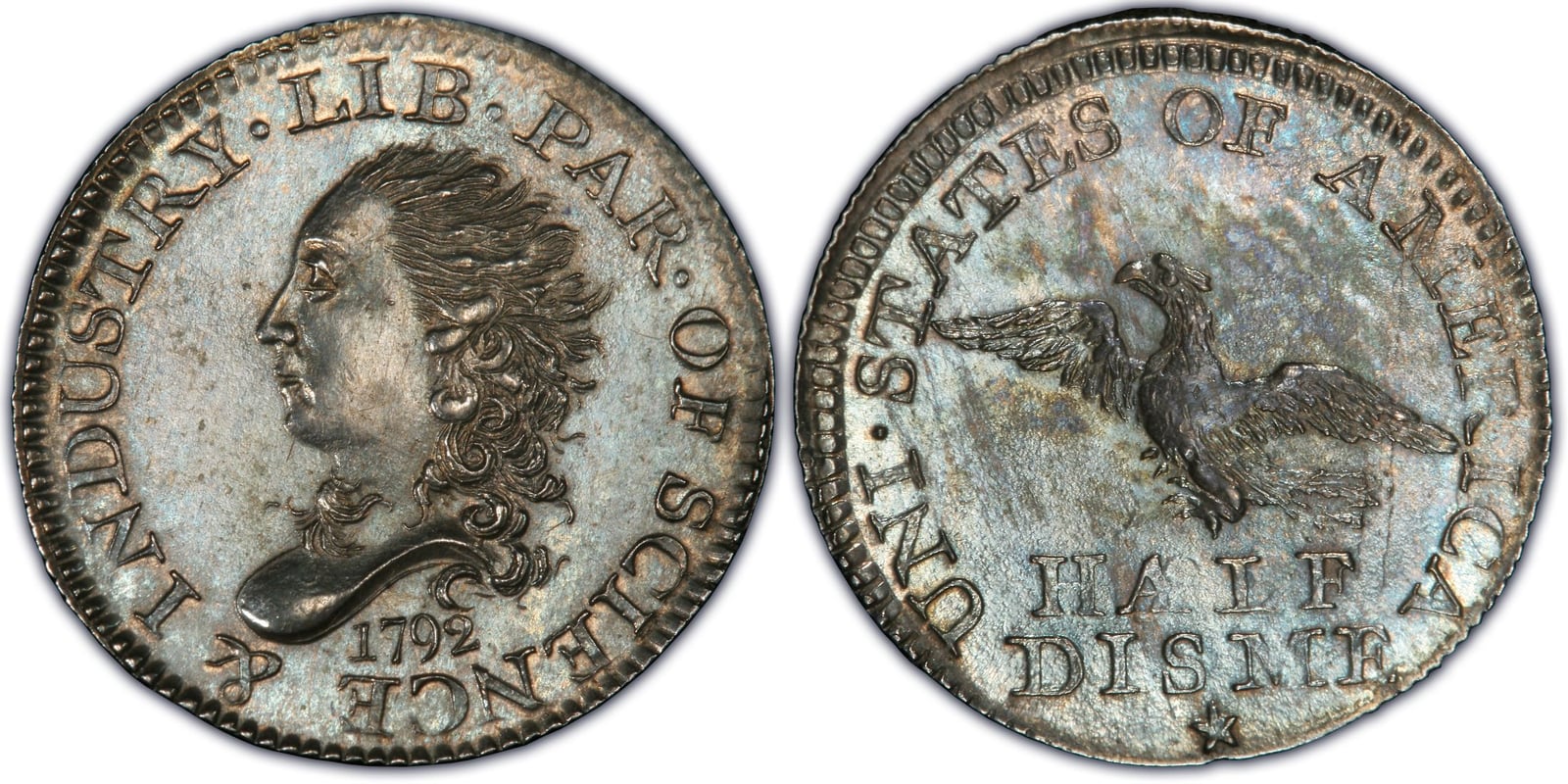
CoinWeek (opens in a new tab) (13 October 2026) reports that a 1792 half disme, encapsulated by PCGS at MS68, closed at US$2,928,000 in Heritage Auctions’ GACC U.S. Coins Signature Auction of 8–9 October. There were 66 bids. CoinWeek presents it as the highest auction price recorded for a half disme and says it more than doubles the previous record of US$1.41 million (Heritage, 2013). The coin is not in Notofilia’s virtual collection.
The 1792 five-cent piece
CoinWeek places the coin as Judd-7, Pollock-7, rarity R-4, and recalls the Coinage Act of 2 April 1792. The Philadelphia Mint was not yet ready: the earliest pieces were struck, it says, in the cellar of sawmaker John Harper. Thomas Jefferson recorded receiving 1,500 on 13 July 1792. Washington, on 6 November, told Congress of a “small beginning” in half dismes. PCGS, per CoinWeek, treats them as regular federal coinage; the Mint identifies the March 1793 copper cents as its first formal circulation delivery.
The auction specimen is from the Ronald Firman Collection: CoinWeek says it is the only regular-strike half disme at MS68 in the PCGS census. It also notes another 1792 half disme at PCGS VG10, which closed at US$85,400. CoinWeek’s 7 October note questions the traditional David Rittenhouse pedigree; that doubt does not change the hammer figure.
Other hammers from the same week
CoinWeek puts the U.S. coins sale at US$10,665,743 and the 6–9 October currency sale at more than US$8.7 million, for a total above US$19 million. Among coins it cites an 1867-S half eagle PCGS MS63 at US$97,600; an 1898 proof double eagle PCGS PR65 Deep Cameo at US$238,577; a 1907 High Relief Flat Rim PCGS MS66 at US$97,600; an 1861-O AU53 CAC at US$91,500; and an 1851 Humbert $50 NGC AU58 at US$76,250.
In currency, the lead lot was a Series 1934 US$10,000 Federal Reserve Note, Fr. 2231-B, PMG Choice Uncirculated 63, at US$244,000 (Binion hoard, serial B00003065A). A 1934 US$5,000 Fr. 2221-H, PMG VF30, closed at US$146,400. A fragment of the D.B. Cooper ransom (Series 1969 $20, serial L32796069A) reached US$134,200. Those figures are CoinWeek’s; they are not Notofilia appraisals.
Primary sources
Source: CoinWeek (opens in a new tab)
Editorial policy, sources, and valuation
Comments
Share your view. Comments appear after they are reviewed.
Loading comments…