United States · Pop art · Rency
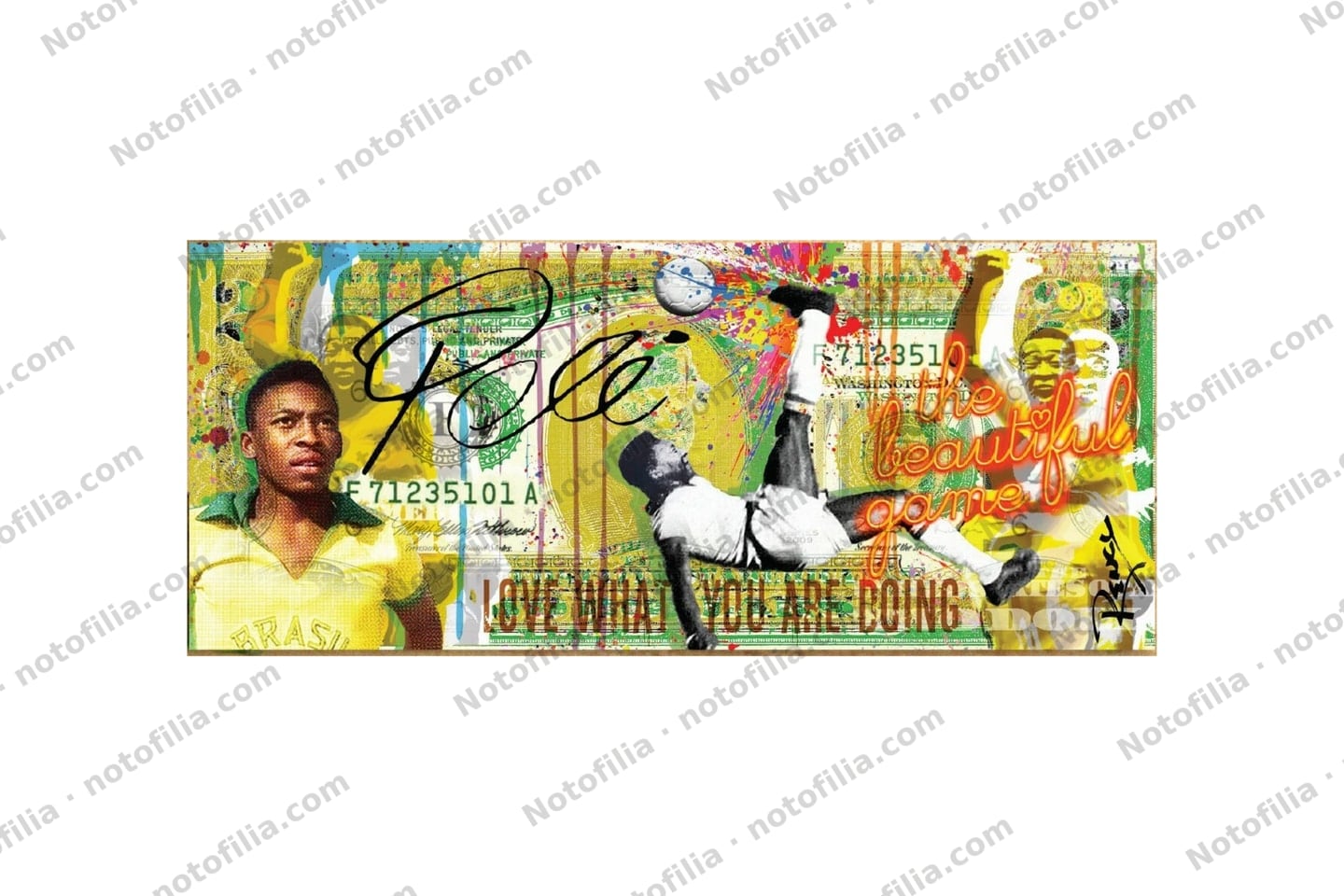
Pelé / The Beautiful Game note, n.d.
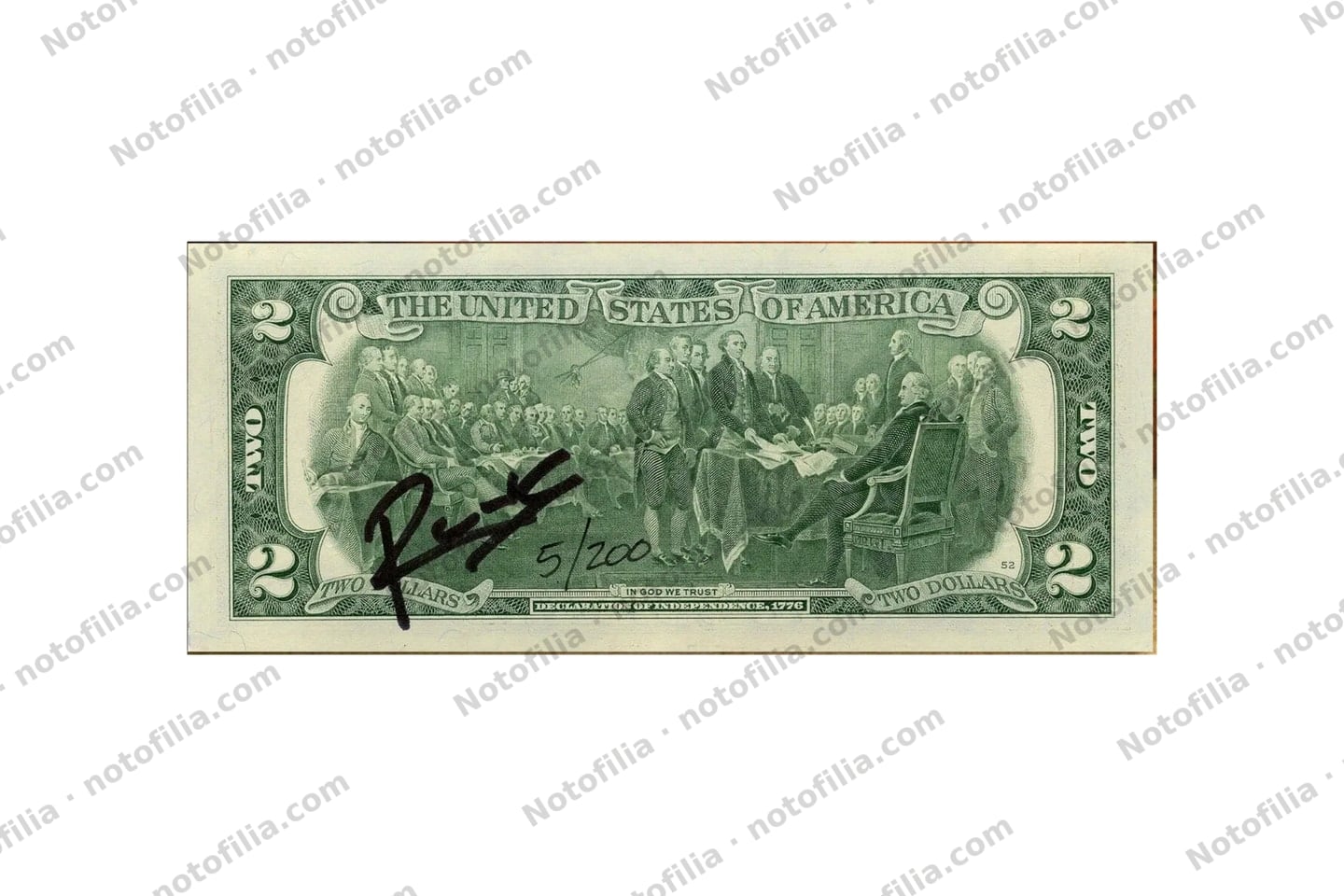
Pelé / The Beautiful Game · 5/200
One object: a pop-art face on a genuine $1, serial F 71235101 A, and the back of a $2 (Declaration of Independence), manuscript edition 5/200.
Catalog facts
- Pick reference
- Rency · 5/200
- Serial number
- F71235101A
- Signatures
- Mary Ellen Withrow (Treasurer, $1 face); manuscript RENCY / Rency 5/200 (artist)
- Condition
- Unslabbed (private collection)
- Printage
- Federal Reserve paper (BEP) with a Rency intervention. Manuscript edition 5/200 on the back. This record does not invent a BEP printage for the type, and it does not treat 5/200 as a population census.
Face
Back
The note
The face starts from a $1 Federal Reserve Note: green serials F 71235101 A, the Treasury seal, and the signature of Mary Ellen Withrow, Treasurer of the United States from 1994 to 2001. Over that engraving Rency overlays portraits of Pelé — young in the Brazil jersey, the bicycle-kick silhouette, the celebrating pose — Pelé’s signature, the legends “the beautiful game” and “LOVE WHAT YOU ARE DOING,” paint splatters, and, vertically at right, RENCY. The back is not the $1 Great Seal: it is the FRN $2 reverse, Trumbull’s Declaration of Independence, plate 52, and, in marker, “Rency” and “5/200.” It is one collectible — face and back of the same object — not two separately catalogued notes, and not a Treasury or BEP issue.
The artist
Rency is the public name of this artist; on the paper the signature is often RENCY in capitals. The artist is an anonymous United States pop and street artist who works on genuine notes. Dealer copy that likens the work to Banksy is a sales line, not an attribution or a verified biography. This is not Rency Punnoose. Pelé (Edson Arantes do Nascimento, 1940–2022) is the subject: “the beautiful game” names football; the bicycle kick and the Brazil jersey are the visual clichés of his career. This record describes the physical object; it does not value the edition or republish auction prices.
Scarcity and printage
The artist numbered this piece 5/200. That fraction is an edition statement on the paper, not a PMG or PCGS census and not a BEP printage. This record does not publish an independent count of surviving examples. The $1 / $2 hybrid with Pelé portraits sets the object apart from Messi / You Have to Fight to Reach Your Dream, edition 2/222, from Life Is Beautiful / LIFE SPRAY, another $1/$2 hybrid also numbered 5/200, and from Warhol & Basquiat / Life Is Beautiful, the $2 intervened on both faces; all four show printed serial F71235101A.
Population
A PMG or PCGS census for serial F71235101A or for edition 5/200 has not been independently verified. The note is shown unslabbed.
Sources
- U.S. Currency Education Program — $1 note (opens in a new tab)
Federal Reserve $1 type: Washington and the Great Seal; this piece keeps that type’s face under the overlay.
- U.S. Currency Education Program — $2 note (opens in a new tab)
The $2 FRN resumed in 1976; Trumbull’s reverse is the back of this piece.
- Wikipedia — Mary Ellen Withrow (opens in a new tab)
Treasurer of the United States, 1994–2001; signature visible on the $1 face.
- Wikipedia — Pelé (opens in a new tab)
Edson Arantes do Nascimento (1940–2022); subject of the overlay.
- Bureau of Engraving and Printing — History (opens in a new tab)
Context for the federal printer; the overlay is not a BEP issue.
Related pieces
Other records from the same issuer or era in this case.