United States · Federal Reserve Note
$10 note, n.d.
$10 · Series 1934A · Cleveland
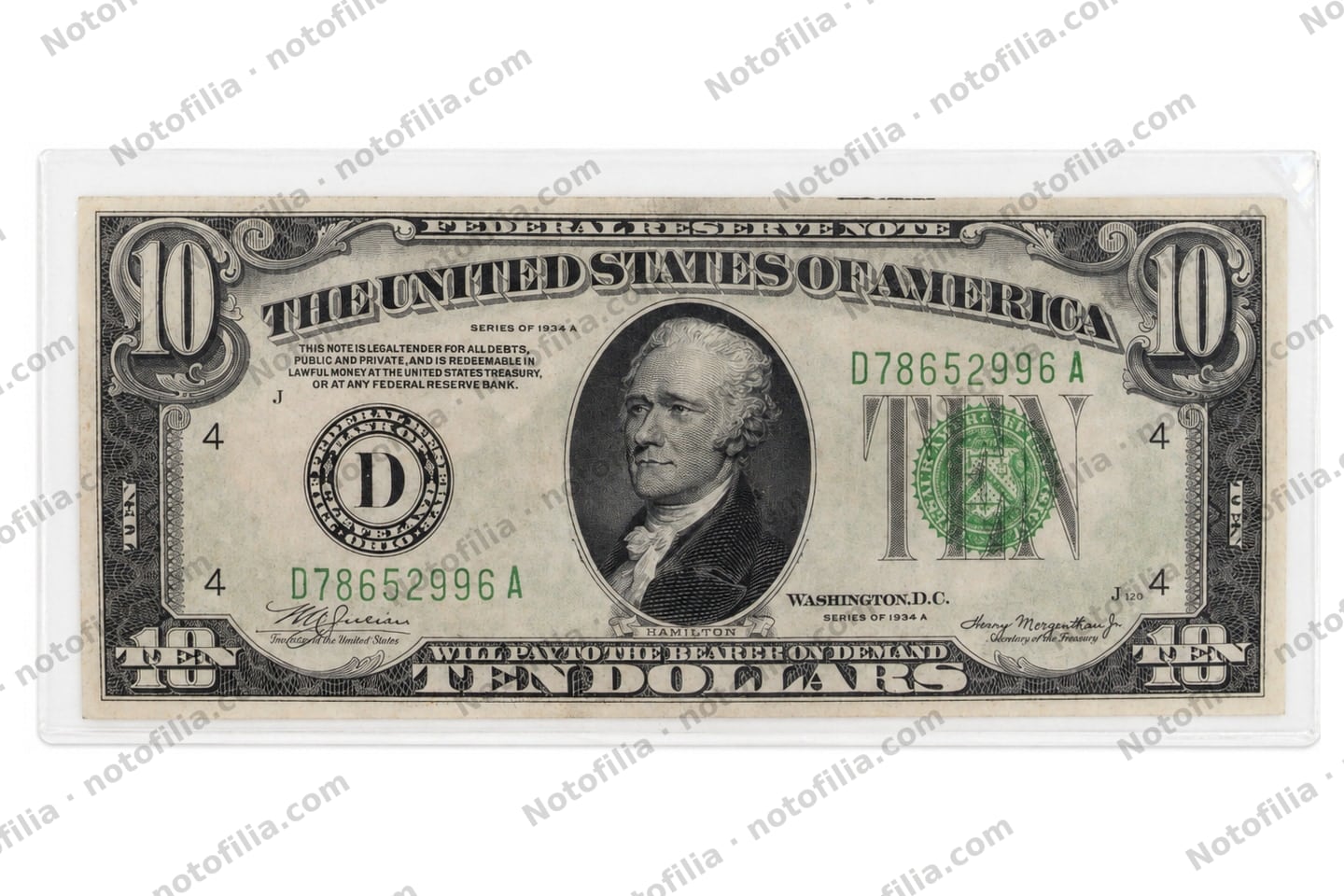
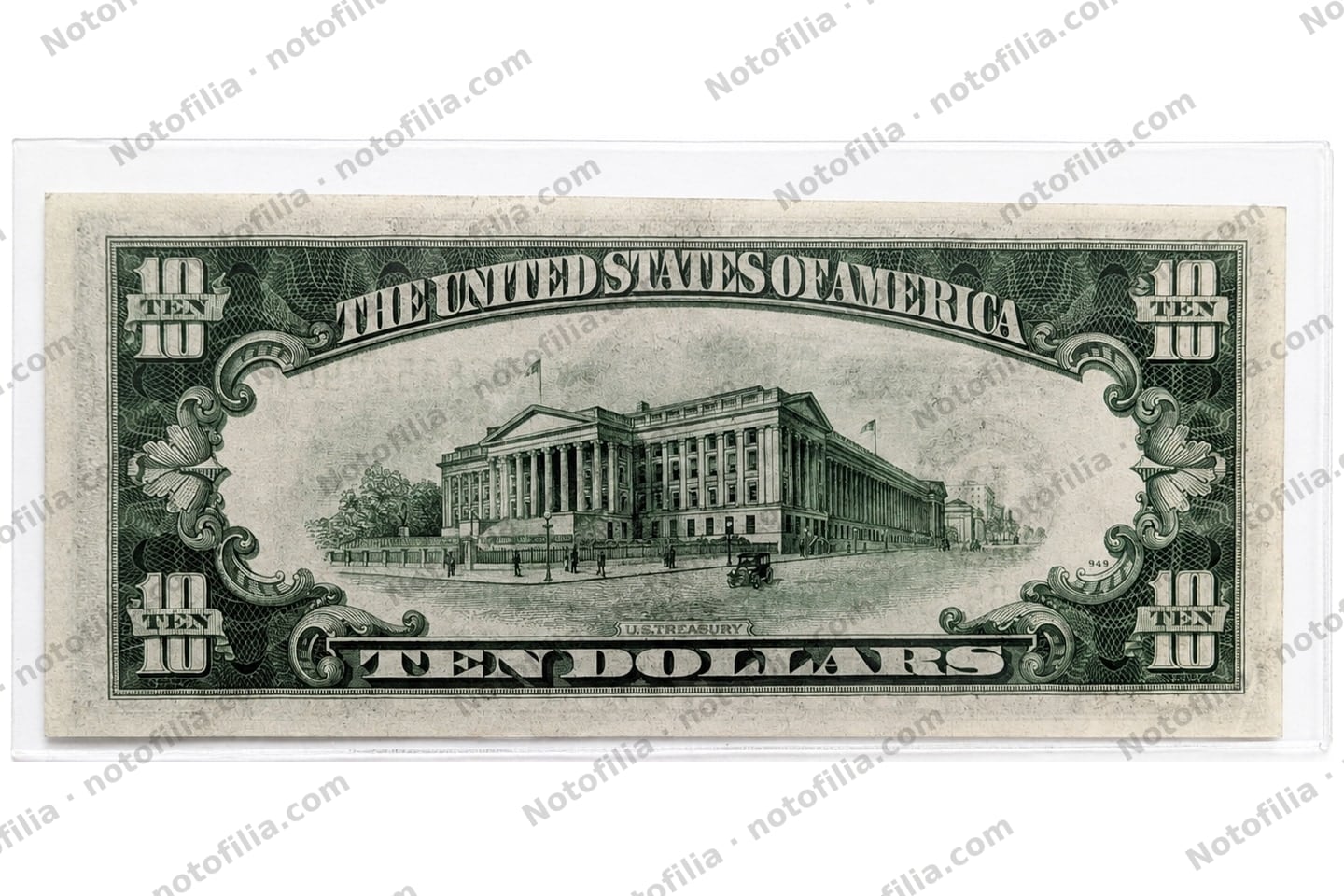
Face with Hamilton and a green Treasury seal; back with the Treasury building. District D / 4. Series 1934A, serial D78652996A.
Catalog facts
- Pick reference
- P#430Da · Fr. 2006-D
- Serial number
- D78652996A
- Signatures
- W. A. Julian (Treasurer) and Henry Morgenthau Jr. (Secretary of the Treasury)
- Condition
- Circulated, unslabbed, in a sleeve (private collection)
- Printage
- A common Cleveland-district type. Series 1934A is the second of the five 1934–1934D issues; this record does not invent a printage by serial block.
Face
Back
The note
The Series 1934A $10 (Pick 430Da, Friedberg 2006-D) is a small-size Federal Reserve Note of the Cleveland district: a circular seal with D, 4s in the four inner corners, and the bank legend “FEDERAL RESERVE BANK OF CLEVELAND OHIO.” The black face with green seal and serials carries Alexander Hamilton in an oval and, at right, the Treasury seal over TEN. The signatures are W. A. Julian and Henry Morgenthau Jr., the same pair as on Series 1934 without a letter. The legal-tender clause still promises redemption “in lawful money” at the Treasury or any Federal Reserve Bank. Face plate J120, in macro size, sits at lower right. The green back shows the Treasury building in Washington, D.C., with an interwar automobile before the façade; plate number 949 sits near the right inner border. This collection piece, circulated and unslabbed, is shown in a sleeve and is serial D78652996A (DA block). It has neither the HAWAII overprint nor the motto “IN GOD WE TRUST.” It is not the Series 1934 (no letter) Chicago $10, serial G30986728A, nor the Series 1934A $10 of that same district, serial G74025286A: serial and district distinguish them (D / 4 Cleveland versus G / 7 Chicago).
Series 1934A
Series 1934A $10 notes keep the Julian–Morgenthau signatures and the same Hamilton engraving. What sets them apart from Series 1934 is typographic: plate numbers grow from micro to macro. The Paper Money Project places that change on 1934A; a mule is a macro face paired with a micro back, or the reverse. Series 1934A notes carry the dark (blue-green) seal, not the yellow-green of the earliest 1934 printings.
1934A production ran through the war years. The Bank Note Museum numbers the type P-430Da in the dark-seal group. Cleveland is district D / 4. This DA-block piece is neither a star replacement nor a HAWAII note. The motto “IN GOD WE TRUST” is not yet on the back.
Scarcity and printage
Series 1934A $10 notes — Julian–Morgenthau signatures, dark-green seal, all twelve districts — were everyday Reserve paper during the war. The Bank Note Museum numbers the type P-430Da. Fr. 2006-D is Cleveland. The type is common in mid grades; the keys are star replacements, plate mules, and the HAWAII $20, which already has a note page: serial L86654132A, Fr. 2305. This record does not invent a printage by block.
Population
A PMG or PCGS census for serial D78652996A has not been independently verified. The note is shown in a sleeve, circulated, unslabbed.
Sources
- Bank Note Museum — P-430D, Series 1934–1934D $10 Federal Reserve Note (opens in a new tab)
430Da: Series 1934A, Julian and Morgenthau signatures; district D = Cleveland; dark-green seal.
- The Paper Money Project — Series 1934 $10 Federal Reserve Notes (opens in a new tab)
Five series (1934–1934D); 1934A introduces macro plates and the dark-green seal; micro/macro mules.
- Greysheet — Fr. 2006D, 1934A $10 Federal Reserve Note, Cleveland (opens in a new tab)
Small-size type, dark-green seal, Cleveland district.
- U.S. Currency Education Program — $10 (opens in a new tab)
Hamilton on the $10 since 1929; the Treasury building on the back of small-size series before the 2006 redesign.
Related pieces
Other records from the same issuer or era in this case.